

The premiere of The Threepenny Opera almost didn’t happen. With the last minute changes to the script—including cutting the original epilogue, the removal of Helene Weigel’s character, and technical effects that were still being rehearsed at 6 a.m. the day of the opening—disaster seemed imminent. That the 1928 production was ultimately a success with audiences and critics alike, a major event in theatre history, was a tribute to Brecht and Weill’s belief in the viability of the enterprise and their artistry in making something fresh by refunctioning a classic 18th Century work, The Beggar’s Opera. They also knew that, despite setting the opera 80 years in the past, it still spoke strongly to the issues of the day, particularly the exploitation of the working class by wealthy industrialists.

Photo by Jared Roberts
Approaching the piece nearly 100 years later, in November of 2023, the production team for The Threepenny Opera at Texas Tech University’s School of Theatre and Dance operated without the pressures of a commercial enterprise and secure in the knowledge that the show had been tried and tested over many decades, with continual revivals throughout the world. What we did discover were the challenges of making the theatre resonate with a modern audience, many of whose members were unfamiliar with Bertolt Brecht, Kurt Weill or the opera—save for perhaps the Moritat or “Ballad of Mac the Knife,” a popular song in America and a hit for Bobby Darin, among many others. Fortunately—or unfortunately, depending on your position in the social hierarchy— the spectators of the 21st Century recognized that the play still reflected the disparity between rich and poor and the means whereby the have-nots attempt to survive.
It wasn’t enough for us to mount the production for the audience’s amusement and understanding; we were intent on digging into Brecht’s means of theatrical creation to be of use to our own time—promoting the audience’s critical thinking, whether sitting in their seats or later, at home, when distance might afford them an opportunity to consider what they had seen and heard.
Brecht had made the path clear: a study of the materials available to us in English, from such sources as Brecht on Theatre and Brecht on Performance, and other translations by the indefatigable Writing Brecht team (engaged in a project that ran from 2013 to 2019), pointed us towards ways of working. David Barnett’s Brecht in Practice was a major resource, a lucid explanation for both theory and practice when it came to Brecht’s objectives for making theatre.
After we chose among the various translations of the script—we decided on Michael Feingold’s version—it was important for the team to agree on an interpretation of the moment-to-moment events that made up the overall work. We used Brecht’s analytical approach of the Fabel for this purpose, first identifying the plot points to be studied and then converting them into gestic incidents. We used the lenses of both the economic state of the period and the dominance of the patriarchy inherent in the society of the time as focuses for the study of the text. That both were still on display as we began to work was a sad commentary on the slow progress—and even reversal—of recent developments.
A few examples from the Fabel, based on Brecht’s model ,will give an idea of what we determined:
From the very beginning, the team drew attention to theatrical artifice as an appropriate means for surviving in economic conditions of the 19th Century British economy. The preshow announcements required by the School of Theatre and Dance were offered by the actor playing Filch, who hijacked his assignment, turning it into a plea for money. He was interrupted by Peachum’s men, who chased him offstage—we later learn—because he was begging without Peachum’s permission. The overture immediately followed, accompanying a parade of beggars. At first, each actor appeared as an upright healthy denizen of the underworld. Under the watchful eye of Mr. Peachum, they became twisted bodies of misery, coughing and groaning as they painfully made their way across the stage in various attitudes of injury or sickness. One beggar walked on, then jumped into a wagon and covered his legs so that he could be wheeled away as a paraplegic. “The Ballad of Mac the Knife” that follows tells us quite clearly that, though Macheath is said to have perpetrated many ghastly crimes, he is able to move easily and freely through the city. We realize that the police are corrupt long before Chief of Police Tiger Brown reassures Mac that all of the illegal activities have been removed from his record.
For the Fabel, the team’s interpretation of the gestic incident reveals that Mr. Peachum runs his syndicate as an artistic enterprise: all beggar clothing and accoutrement are numbered, i.e., the perfect look is chosen from a series of costumes. In Act I.1, Mrs. Celia Peachum tells her husband she has had a complaint about a costume for number 136. That particular item isn’t professional enough because it doesn’t have the proper stains. Mr. Peachum takes pride in the craft: begging is an art, like any other art, with certain aesthetics. Sloppy work won’t do. Ultimately, he uses theatrical means for nefarious ends. The design team clarified this point by putting the beggar clothing on mannikins which Mrs. Peachum wheeled out for display as if they came fresh off the rack.
Meanwhile, Polly is an opportunist who, at the first chance, takes control of Mac’s business. She sees Mac’s various crimes not as a reason to leave him, but as an excuse to get him out of the way. When Tiger Brown is forced by Peachum to put Macheath’s many warrants into effect, she convinces Mac that—because of her love for him—he should save himself by skipping town before he can be arrested. The comedy to be mined from playing loving wife and scheming marketeer—under the watchful eye of her ever suspicious husband—required split second timing. She couldn’t seem too interested in the content of his account books, as he was only forced by necessity to turn his gang over to a woman. While she pretended to be bored with his stern lecture about the details of the business, she deflected her interest by trying to get Mac to make love to her. When the gang arrived and scoffed at her new role, Mac urged her to take charge, placing his hat on her head; she turned on them in an unusual display of ferocity, shocking them into subservience. Her final Haltung of the play was one of deep disappointment, as Mac’s pardon and life peerage had destroyed her plans.
After we had agreed on the initial Fabel, a great aid in establishing the work as a collaborative enterprise, this basic blueprint was applied to design, staging, and dramaturgical materials.
The design team operated on the Brecht’s principle of the Separation of the Elements, the various designs in conversation with each other, offering further perspectives in a semiotic dialogue of light, sound, and setting. Following the example of Caspar Neher, the original designer, the set was made up of selective pieces that gave the impression of various locations. The interiors of a jail cell, a parlor, and a shop, and the underworld environment where it might be performed were framed within a dockside milieu, with ropes snaking across the stage and into the audience.
Songs were separated from the action, as Brecht had suggested, and given their own special emphasis as pieces of entertainment that commented on the world of the play. At the same time, they impressed the audience as stand-alone diversions one might see in a cabaret setting. The performers were not only excellent actors but handled Weill’s music superbly as part of the entertainment for the show. These were “star turns,” full out to the audience with the actors standing at one of two microphones, one on either side of the orchestra pit downstage. The singers did have some freedom of movement: a singer could cross from one mic to another between stanzas, and Polly removed her mic from its stand to sing her “Barbara’s Song” to her disapproving parents. During “The Jealousy Duet,” Lucy and Jenny engaged in a rough tug of war over the one microphone downstage left. For his songs while imprisoned, Mac simply stepped away from his cell to his microphone and back. For “The Ballad of Living in Style,” choreographed as a Cole Porter top hat and tails number, an offstage actor handed him a cane.
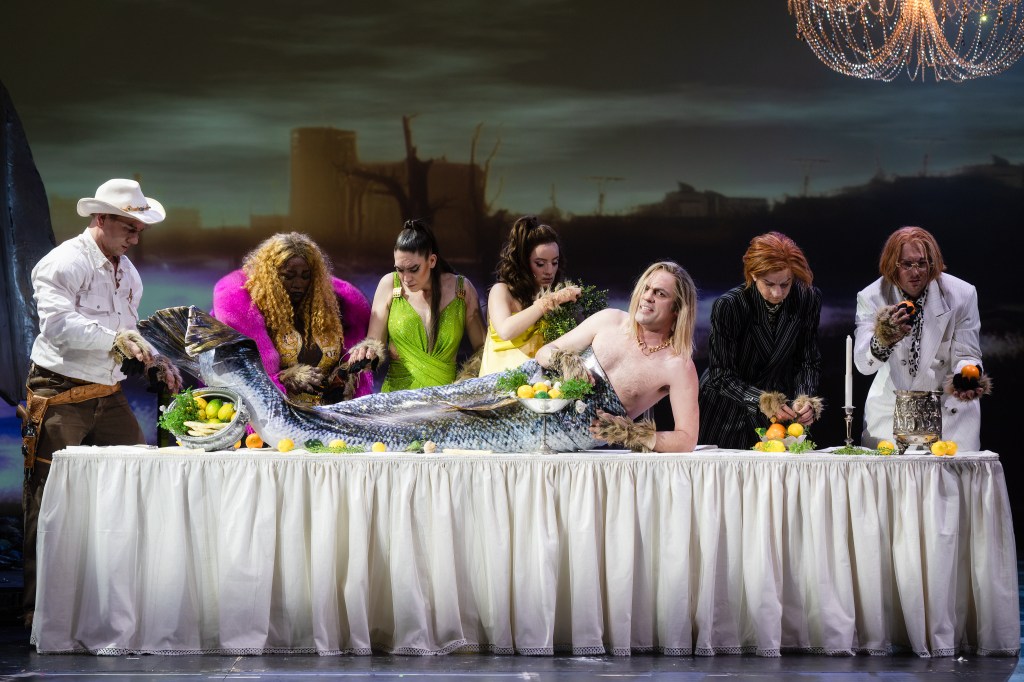
The lighting and sound provided humorous comments: during the second scene, placed in the stable, when Mac referred to the solemnity of the occasion, for a brief moment the group froze in the positions of Jesus and his disciples in Da Vinci’s “The Last Supper”; a “holy light” illuminated them accompanied by a religious musical chord, overplaying the notion of Mac as a spiritual leader, when in fact he treated the symbol of the church, Reverend Kimball, with contempt. The sound designer added a number of inappropriate reactions to the events onstage, disconcerting the audience with such sound cues as someone laughing at the more chauvinistic and off-putting remarks made by the characters and using the ticking of a clock growing in volume as Mac awaited his hanging.
Many such meta moments peppered the play. Mac looked directly at the audience on “Let’s not make an opera out of it”; at Lucy’s referral to spectators in her scene with Polly, the latter glanced out into the house. Mac and Polly’s loving moments before he rushes off to avoid the police were played for the benefit of the spectators in an operatic, i.e., melodramatic style that both characters employed as a replacement for their actual feelings. This is how people in an opera are supposed to behave, they seemed to be saying, no matter how malapropos it seemed under these circumstances.
Within this approach, the team used the technique of literarization, incorporating text and images as commentary. The titles of each scene, written into the libretto by Brecht, appeared as a crawl across the proscenium arch. These disrupted the narrative as they revealed key events before they occurred onstage. Time, date, and location were projected on a screen up left. The audience got the sense of how little time had passed from beginning to end: the events of Threepenny unfolding in less than a week. The sound of a projector cutting off as the slides disappeared signaled the beginning of each scene. For the last scene, a countdown to Mac’s hanging was represented by the projection of a clock which moved inexorably through the morning towards the moment of doom. During “Soldier’s Song,” a slide with the words “Imperialism at Its Worst” reminded the audience that the production team acknowledged the racism of the lyrics and the othering of the subjects under British rule. The patriotism of former officers Mac and Tiger Brown contrasted strongly with the number of wounded from the Burmese campaign who littered the street. Depictions of locations and people mentioned in the libretto were accompanied by further images. For example, the jail cell was a series of bars standing on stage left, while a photograph of the Old Bailey was projected behind it. Subjects mentioned during Jenny’s “Solomon Song,” Solomon, Caesar, and Mac, were projected on either side of the proscenium, Mac’s image being the centerpiece of a wanted poster.
In rehearsals, the Fabel was tested through another element: the actors arranged within the frame of the proscenium arch. The performers themselves were encouraged to present frozen tableaux of each incident to be studied in rehearsal and adjusted for clarity of story and gestus. This gave them ownership over the staging process and an understanding of how all gestures, positioning, movement, postures, and use of props and set pieces were meant to lead the audience in a particular direction. For example, when Mac introduced his gang to Tiger Brown, they appeared out of hiding one by one to Brown’s rising consternation. The last to appear—the smallest and seemingly the most innocuous—caused Brown to smack his forehead, as if his unsuccessful attempt to capture this small Figure had been the bane of his existence. When each gang member kissed Polly as a part of the ceremony, the actors found their own variations for doing so: one kissed her hand, one kissed the hem of her dress, and Matt the Mint—always testing Mac’s authority—dipped her and gave her a long smooch. As Reverend Kimble tried to bless the happy couple, the gang upstaged him, noisily packing up the china and silverware for departure: Kimble was never able to complete his benison.
The actors were also trained to examine their roles for the various Haltungen—the comportment, mien, bearing—that revealed the frame of mind of the Figures themselves. The principle of “Not…but” was useful here, as the characters were constrained to make choices that the audience wasn’t expecting, operating from the principle that each scene was its own play, with the Figures behaving in ways that benefited them in those moments, regardless of what they had done previously or would do in the future. They played complex human beings, who took on different demeanors and stances depending on the circumstances. In this case, the actors were willing to show the worst sides of the people they played, displaying the characteristics of Figures who were forced to act because of the inequity of pay among the social strata. Though in modern terms they would be marked as anti-heroes, they were also the protagonists, who revealed their industry by doing whatever it took to survive in a society that had abandoned them.
When Filch joins Peachum’s organization he is given a new costume. When he asks why he can’t use his own authentic clothes he is told that they won’t be effective. Peachum’s view is that one can’t convince other people of one’s own plight. This is an interesting acting note as well as a comment on society. Filch does not wear his own clothes but will have more success begging with a manufactured example carefully designed to have the greatest effect. Polly’s “Barbara’s Song” is itself an example of “Not…but” as the lyrics describe how she must choose between acquiescence or dismissal; she says “No,” to all the proper men who woo her, but “Yes,” to the one man who isn’t nice and doesn’t really give her a choice.
Mac play-acts throughout Threepenny, taking on various attitudes as the situation demands, but in particular, he attempts to shed his criminal persona, to become a respectable member of the bourgeoisie. Brecht weaves Mac’s overarching aim through the play: marrying Polly as a move towards respectability, putting on airs that contrast strongly with the language and behavior of his gang—such as questioning their taste in stolen goods for the wedding; dressing as a gentleman with white kid gloves and carrying a cane; and maintaining his weekly routine of visiting the whorehouse, even when it leads to his capture—twice—by the police. This accounts for the tightrope he walks trying to keep his feelings in check: Mac always carries with him a hint of danger, but Mac’s display of violence, if rare, is horrifying:, whether he puts his wife in her place, chokes Smith into unconsciousness with his sword cane, or throws Matt the Mint to the floor during the wedding scene. The actor’s ability to move easily from bonhomie to wounded disappointment to gratitude to brutality to upper-class snobbery was a masterful display of Haltung changes.
The actors were trained to consider how Figures would respond to the given circumstances from the viewpoint of people who were transitioning from the Regency to the Victoria era. This meant avoiding the idea of Presentism, as defined by Sam Wineburg as a natural habit of looking at the past from the viewpoint of the present.[1] They were aided by the designers, who created period costumes, props, and suggestions of Regency settings.
Though the gang followed the wedding ritual as they understood it, they unthinkingly abandoned certain proprieties, changing their wedding clothes in full view of the bride and stuffing themselves with food. Polly chose “Pirate Jenny” to entertain the gang, the type of sordid fairground narrative of bloody criminal deeds that Brecht enjoyed in Augsburg as a boy. Even Mac felt that she had gone too far: not because of the content but because of the way she performed it. He complimented her in front of the gang but privately told her in no uncertain terms he didn’t approve of play-acting, which he considered unseemly. This was an irony not lost on the audience as they had come to see a performance rather than a depiction of real life. The anti-theatrical prejudice lived on in the 19th Century if not in the 21st.
We were surprised to discover that the battle between Macheath and Peachum took place by proxy. They didn’t meet until the last scene of the play, when Peachum visited Macheath in prison. They had much in common: neither wanted to get their hands dirty; both in their own way saw themselves as respectable businessmen; and both had questionable views of matrimony. Ultimately, despite their attempts to game the system, they were both dependent on outside forces to judge and finally resolve the disagreement between them. Queen’s Victoria’s pardon of Macheath may or may not have been finessed by Tiger Brown; however, it was not just an operatic device but a further sign that corruption would be rewarded rather than punished and at the highest levels. A happy ending for Mac meant a sorry end for most others.
The Threepenny Opera was an immense undertaking. We were able to test Brecht’s way of working with the resources of the university at our disposal, under conditions conducive to thoughtful and careful work. We also documented our progress, collecting rehearsal photos for comparison to the final product, and gathering notes throughout the rehearsal period concerning our decisions, rejections, and epiphanies.
Finally, the proof of the pudding, as Brecht liked to remind us, was in the eating. The success of the piece can only be judged by the individuals who saw it. Did the audience understand what we were trying to accomplish? If the reactions to each designed moment were any indication, they did. Nor did they find the piece overlong, although it clocked in at just over three hours. We also won a number of awards from the Kennedy Center American College Theatre Festival Region VI, including Excellence in Directing, Costume Design, Scenic Design, Dramaturgy, Vocal Music, and Performance of the Acting Ensemble.
Our greatest success was the learning that took place. The play was primarily done for the students, who were involved in a new process, one they could compare to other ways of working. The practice inculcated in them the theory, even if covertly. It was the realization of the Fabel, on its feet, that they aimed for, using Brecht’s ideas. The performance as research model was embraced, tested, and studied for future possibilities. Ultimately, the team understood that such processes were ongoing, to be continued in future productions. For now, an initial test was complete.
[1] Sam Wineburg, Historical Thinking and Other Unnatural Acts: Charting the Future of Teaching the Past, (Philadelphia: Temple University Press, 2001).



 E-CIBS