
Decisions, decisions. Upon entering the home of Chicago’s Trap Door Theatre on March 8, 2024, the first “performance” of the evening was a vote by the actors on the question of whether to perform Mother Courage and Her Children that night – the heating system for the black box space was not working, and it was a chilly 55 degrees. The vote to proceed was unanimous, and then the ticket holders were given a chance to stay, receive a refund, or attend the next night (the last of an extended sold-out run). All the seats were filled, so that seemed to be unanimous as well.
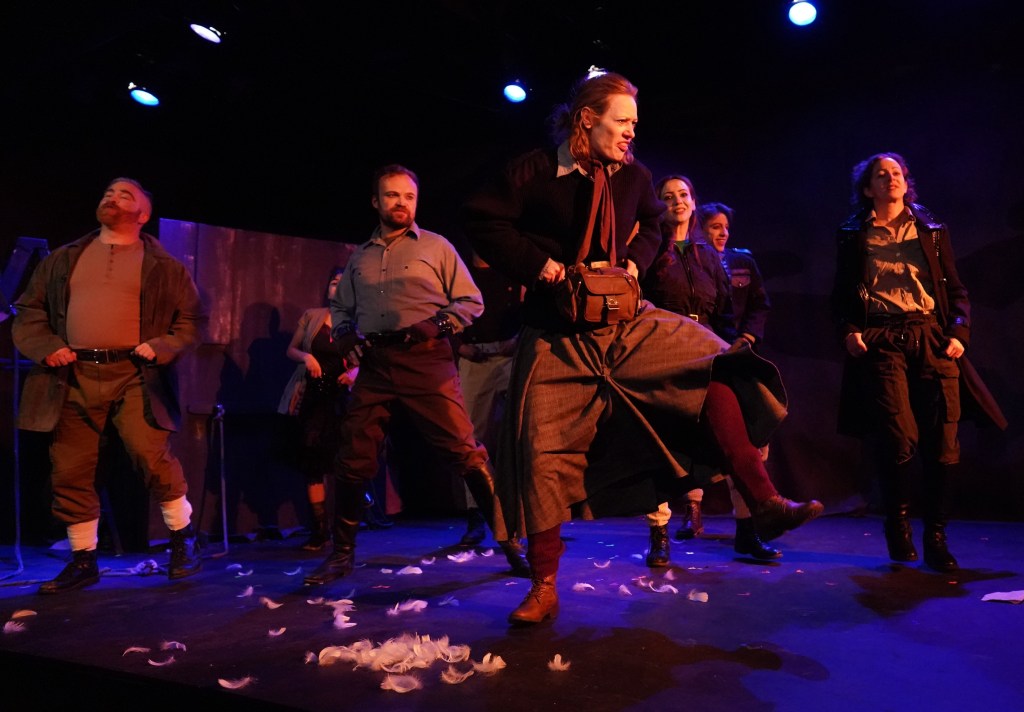
The play of course is all about decisions. We were handsomely rewarded with a fast-paced, energetic show of 110 minutes with no intermission. Using the Bentley translation and a cast of eight actors, director Max Truax, an experienced Brechtian, tackled the demands of the author to present a spectacle of war, profit and loss (mortal as well as pecuniary). Music, choreographed movement, songs in unison, and projections kept the action moving. Props were minimal (more on that in a moment) and the costumes a mix of period and style, eliding any notion of a fixed moment in history.
The actors were in costume and warming up on the largely bare stage as the audience filed in. The space is an elongated shoe box with two rows of seats on two sides – one long, one short. Missing was a wagon, that staple of most Mother Courage productions. Instead, we saw a roughly made wooden cube about six feet on each side, painted flat black, and with harnesses and ropes attached to the side facing the entrance.

Photo by J. Michael Griggs. Joan Nahid & Holly Cerney, with cube.
In speaking the following morning with Truax, I asked about the cube, and he told me that it was his way into the play, and that it only came to him after he had made an initial pitch for a production of the work to the Trap Door artistic leadership. It is something Mother Courage and her three children are bound to – he called it the monolith – and it is both a burden and a source of sustenance (it held a few of the minimal props used in the performance).
Harnesses fitted with ropes, looped through rings on the cube’s side, allow the family members to strain to move it (fruitlessly). Moreover, they are working against each other because one of them can almost reach the end of the stage, but only when the other’s rope is at its shortest at the cube.
Holly Cerney was an excellent and energetic Mother Courage, a mixture of worldly experience, cunning, volatility, and weariness. She made some decisions quickly (to say no to the Cook about opening the tavern), and some were more agonizing – how much to offer to save Swiss Cheese? Joan Nahid was a moving Katrin, and Rashaad Bond and Bill Gordon rounded out the family as Eilif and Swiss Cheese. Nina Martins played a bewitching Yvette and doubled as a soldier. Caleb Lee Jenkins played the Chaplain/Soldier, Kevin Webb the Cook/Officer with Tricia Rogers as a Soldier/Townsperson. A few audience members were recruited near the end to join the fray and stand in place.
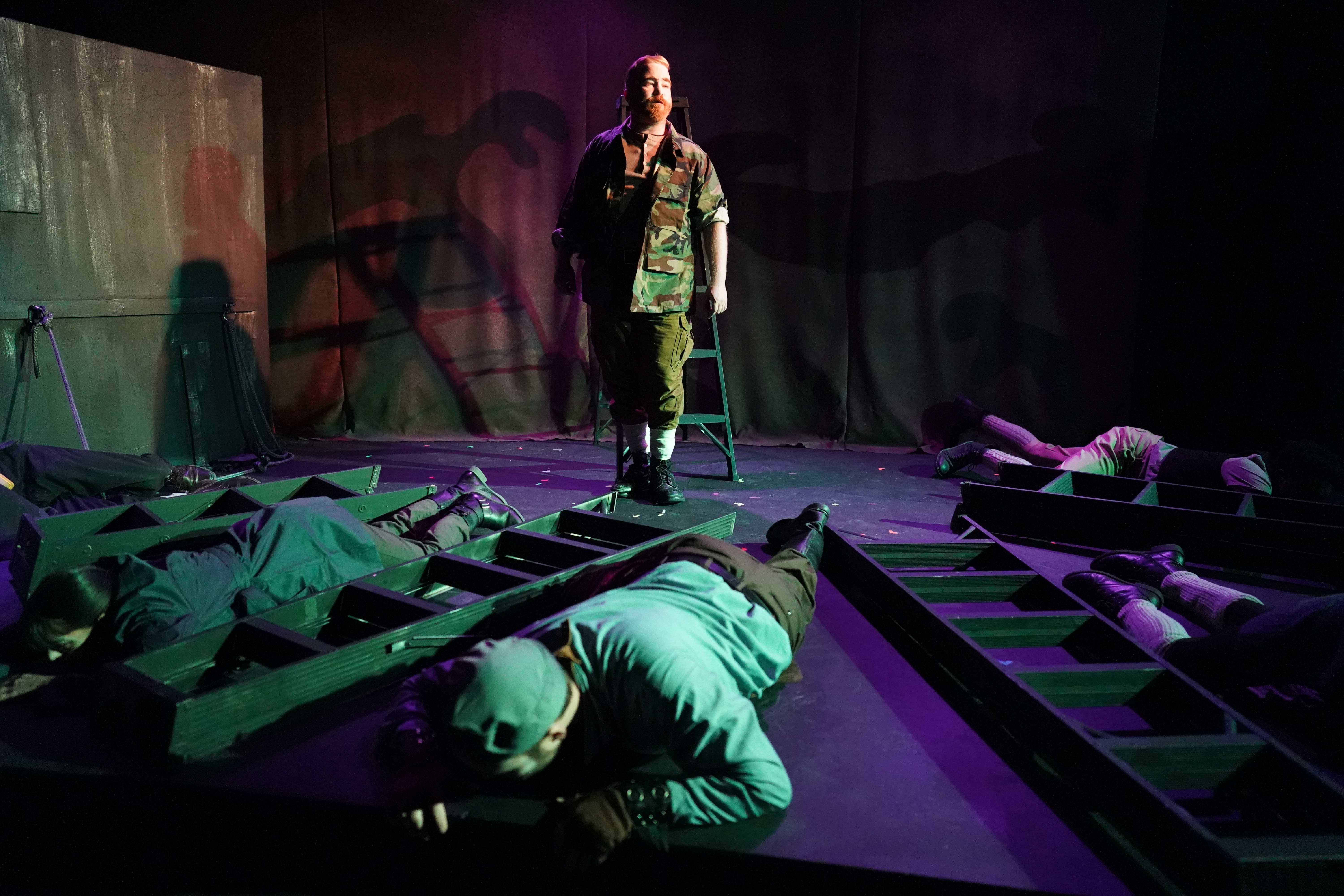
All meshed wonderfully in the choreographed movement and song that characterize Truax’s productions. He told me that he came to theater through painting and dance and that he sees ensemble acting as painting with bodies. The only other set pieces were step ladders of various sizes used to establish both different levels of power and status. Crude wooden guns served multiple functions including as bottles of liquor. I don’t know if Mao’s dictum about power (and all that goes with it) growing from the barrel of a gun was in the director’s mind but it was in mine as I watched. The drawing of lots in the first scene was managed with cardboard (black cross!) and paper (blank) so the crosses could be felt but not seen as they were drawn.



As with any cut performance there are choices/decisions to be made and the full play runs over three hours. So, what to cut? I thought most of the trimming judicious, but it seemed a bit strange to hear the “Song of the Great Capitulation” without the brief scene that goes with it.
Perhaps all serious productions ultimately look back over their shoulder at the Berliner Ensemble’s staging in 1949. How far performances veer from that epic and realistic staging given resources / time / vision might perhaps be measured by a simple criterion – does it work, does Brecht’s vision of war and capitalism make us not only feel but also do the hard work of making us think about this business of war and this war of business. This one worked and both audience and critics praised the performances.
Music was composed by Jonathan Guillen, he did the music for a Truax-directed production of Brecht’s The Mother at Oracle Productions in 2014. Overall, it was a good match, but I thought its strong rhythmic nature was better suited to that early play than it was to Mother Courage. Clips of that staging of The Mother can be found here and here and are worth the watch.
The core concept for the production, Truax told me, was gestating for quite a while, pre-pandemic, before Ukraine, though that war may have helped solidify the decision to stage it. And now we have Israel/Gaza, and Mother Courage productions seem to be everywhere. I saw one other (not in Chicago) I did not care for. This show could hold its own in comparison with those that might be done by bigger (and richer) troupes.
In addition to Mother Courage and The Mother, Truax directed Round Heads and Pointed Heads for Chicago’s Red Tape Theatre in 2018. In 2010 he directed In the Jungle of Cities for Ka-Tet Theatre, also in Chicago. He has been an advocate for the free theater movement – Oracle was a free theater that closed around 2016 (and not primarily for financial reasons), as was Red Tape, which had to close during the pandemic. His vision is for a theater that is a call to action, and he believes companies should produce plays “with a purpose.” That means free, political theater that is accessible to all, regardless of audience members’ means, and theater that is based in diverse communities, outside of the increasingly gentrified neighborhoods in Chicago that house most troupes.
Would that it were so … but congratulations to director, actors and the production and design team at Trap Door (in this their 30th season) for this Mother Courage and Her Children. I would sit through it again at even lower temperatures.


 E-CIBS