
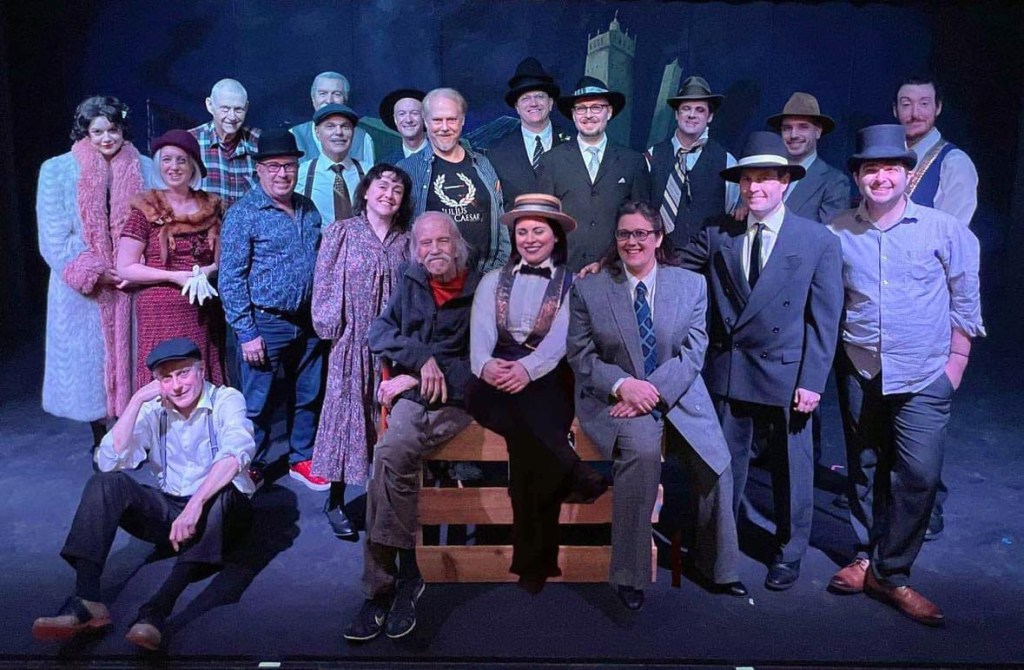
(Entire cast of The Resistible Rise of Arturo Ui at Twilight Theater, Portland, OR. Photo by John Standley.)
Margaret Setje-Eilers: Thank you for agreeing to answer some questions about your wonderful production, Michael. May I call you Michael? I am curious about so many things.
Michael Streeter: Interesting story about that: I went to a Catholic School 1st through 5th grade. The first day of school, the very first day of school in my life, the nun handed each of the students paper and asked us to write our names on our sheet. Presumably to find out who could already write their names. I wrote “Mike” the way I had been writing my name ever since I could write my name. The nun came over, read what I wrote, grabbed me by the hair, lifted me out of the chair, threw me on the floor, and said, “Your name is Michael!” Ever since then, my mother is the only person whom I have allowed to call me Mike. So, yes, you may call me Michael.
MSE: First, a cluster of questions about you and the Twilight Theater. How did you and Tobias Anderson come to co-direct Arturo Ui at this theater? Did you decide together that you wanted to direct this play, then look for a theater, and submit a proposal here? Why did you choose this particular theater?
MS: Tobias and I have worked together on a number of projects. We’ve acted together, I have acted in plays that he has directed, and he’s acted in plays that I’ve directed. I produced a couple of plays that Tobias directed including The Great Tennessee Monkey Trial at Portland Playhouse. And we both acted in Freud’s Last Session by Mark St. Germain, with Tobias playing Sigmund Freud and me playing C.S. Lewis. When we have worked as a producer and director team, we overlapped roles in our collaboration. He mentioned he was planning to submit The Resistible Rise of Arturo Ui to Twilight, while I at the same time was planning to submit my own proposal for a different show. At the time of the proposal deadline, I was in the midst playing Titus in Shakespeare’s Titus Andronicus and dealing with the recent death of my father. Because I had so much going on, I asked Dorinda for an extension. One of Twilight’s proposal questions was something along the lines of “Is there another capacity you’d be willing to work with Twilight Theater?” Before submitting my own proposal, I answered that question. I said that I’d be willing to co-direct with Tobias and that I’d be willing to drive him to and from rehearsals. He’s a neighbor of mine (and he really shouldn’t be driving). Dorinda ran the idea by Tobias, and he loved it. We chatted and went ahead with the co-directing proposal. We chose this theater, quite frankly, because there’s no theater in the town where we live, Gresham, Oregon.
MSE: You and Tobias Anderson have illustrious and extensive backgrounds in theater, as actors and directors, especially in Shakespeare. Was it your first time at the Twilight Theatre? Or your first time together? Have you ever co-directed a show before? If yes, where and when?
MS: Tobias has directed two or three shows at Twilight. This was my first time working there. See my previous response to answer the rest.
MSE: Does the theater have a pool of directors who direct plays there?
MS: Twilight Theater has an open process where they ask for submissions from anyone for each season.
MSE: Did you and Tobias Anderson ever have different opinions on something important?
MS: I think the biggest disagreement was on the use of the projection slides. He wanted to forgo them, and I wanted them in some form, either physical signs carried or presented on the stage, or in a voice-over reading, or in projections, on which we ultimately landed. Having them is very Brechtian IMHO.
MSE: What was the most challenging aspect of the rehearsals, aside from the many calamities you had to overcome?
MS: Casting fifty characters with fourteen actors was tough. But the calamities were enough! (See my director’s notes.) A fitting end to this production: another actor’s parent passed, and for the final two performances, the stage-manager, Ian, had to step in and play the roles!
MSE: What did you hope to achieve with this production?
MS: I hope the audience sees that what is happening now in the United States is nothing new. It has happened in the past and will likely happen again. We need to ‘Resist’ as Brecht implores us in the title. The strategies of a demagogue are the strategies of a demagogue.
MSE: Dorinda Toner, Producing Artistic Director, told me that the nature of the community theater is that anyone can audition. Can you give me an estimate as to how many members of your cast were professional and how many amateurs? Or a rough percentage? When I talked to Sam Halloway after the show, he told me he was a professional actor, but not in a union. I thought he was sensational and very well cast. He had this hardness about him on stage, meanness, such thick skin.
MS: It’s an ongoing debate in the theater world as to what is considered professional. It all depends on how you define it. If by professional you mean dedication to the craft, the project, and disciplined work by the actors, it’s nearly the entire cast. If you mean who gets a living wage from time-to-time, it’s a little more than a third of the cast. If you mean who makes a living as an actor, there are only a handful of those actors in Portland, one of which is Tobias. Only 3% of actors make a living at it, and only 10% make a living wage in any given moment. Only a third are paid anything to act in their career. Capitalism isn’t conducive to art.
MSE: How did the auditions proceed? Did you choose the audition material? How many auditions did you hold? How did you find actors to take over when people had to leave the cast?
There was an open call for auditions. We held two auditions and one callback. The actors did monologues and then read selections from the play that Tobias had picked out. About half the cast I’ve worked with before, including Sam who played Tobias’s son in I Never Sang for My Father, which I directed.
When the need arose for a replacement actor, I asked many friends to step in, but they were all booked. Adrian was in the previous show at Twilight, and it had closed by that time. Fortuitously, he wrote to ask about when he might have the opportunity to work for me. Great timing and he did a fantastic job!
MSE: I understand that Tobias Anderson was an actor in Arturo Ui decades ago. Do you know where, when, and what role he played?
MS: It was in Seattle in 1970. He played Greenwood, the baritone, among other ensemble roles.
MSE: Have you seen other productions of Arturo Ui? How did they influence you?
MS: I watched the Berlin Ensemble version. It was outstanding and intense and everything I expected. I figured they would get rather close to what Brecht was getting at. The only thing I borrowed from it was the small NAZI wave at the shoulder that Ui does in the Berlin production. I had everyone do it whenever they said “Hi” in the play, which turned out to be rather frequent. Otherwise, I purposely did not see other versions to avoid undue influence.
MSE: Can you tell me how you came by the German for the poster that says “Macht Deutschland Wieder Großartig”?[1] That completely stunned me. Perfect! Do you think the audience was able to figure out what it meant?
MS:…Hitler is quoted frequently by wannabe authoritarians. Some keep Mein Kampf at their bedsides. On the flip side of that banner is “Wählt Adolf Hitler”. It was a bit much, so I decided not to use it. I thought about flipping it over during the election scene, but with the loss of the rehearsal time there was never an opportunity to incorporate it. I went to several shows and would listen to audience members try to figure out the German before the show began. If they struggled for too long and it became unbearable, I would translate for them. So, yes. Audience members that wanted to, could figure it out.
MSE: I particularly enjoyed the scenes from Shakespeare’s Julius Caesar, Macbeth, and Richard III. The audience loved Ui’s acting lessons, and Roma’s ghostly appearance was uncanny and striking, while the scene with Ui and Mrs. Dullfeet walking around in circles was quite intimate. How did your discussions with Tobias Anderson go on these scenes? Did you have many different ideas?
MS: Tobias wanted to cut the flower shop scene with all of the rhymed couplets. I almost did, too. But the idea struck me of having them circle the chairs to create the sense of exploring a space while having an intimate conversation. It also sets it apart from the style of rest of the play with the blocking, which matches the unique textual moment in the play, aside from the prologue and epilogue, with rhymed couplets. I put it together with the actors and showed it to Tobias, and he loved it. So we kept it.
MSE: What will you be working on next?
MS: I will be playing Howard in The Designate Mourner by Wallace Shawn. 1984 meets My Dinner with Andre. But mostly I’ll be working toward getting a theater built in Gresham.
MSE: Thank you, Michael. It was a pleasure chatting with you.
Read Margaret Setje-Eilers’ review of The Resistible Rise of Arturo Ui at Twilight Theater here.
[1] I did some research on the phrase, and even though it doesn’t seem that Hitler used these exact words, he said he wanted to “lead this German Reich back to life and to greatness.” (Hitler’s First Speech as Chancellor of Germany, Feb. 10, 1933).

 E-CIBS