

brecht: fragments, an exhibition held this summer, between 15 June and 18 August at Raven Row gallery in Spitalfields, London, combined two elements which highlighted Brecht’s modernist aesthetic of fragmentation and montage. The exhibition brought together journals, albums, notebooks, and manuscripts on loan from the Bertolt Brecht Archive in Berlin and live performances directed by Pheobe von Held. She also curated the exhibition in collaboration with Tom Kuhn, Alex Sainsbury, and the archivist Iliane Thiemann. The sold-out performance element, in Brecht’s words, ‘a live [representation] of reported or invented happenings between human beings … with a view to entertainment’, included fragments of plays Brecht wrote in the late 1920s and early 1930s: Fleischhacker (1924–31), The Flood (1926–27), Fatzer (1926–30)and The Breadshop (1929–30). The exhibition documented Brecht’s exile and chronicled mid-twentieth century political history through the entries from Brecht’s journal and the newspaper and magazine articles he collected during his exile in Scandinavia and the United States. Brecht and his family fled Germany in 1933 and he returned to Europe from the United States in 1947, writing in his journal while in Zurich of his ‘first European Spring for 8 years’.
brecht: fragments reminded the viewer of the importance of fragmentation and montage to the avant-garde and was a revealing insight into Brecht’s approach to the production of art. The incomplete qualities of the archive materials and the performance emphasised the fragmentary and the provisional as the explicit form of Brecht’s modernism. I viewed the press photographs and anchoring captions separately as individual modernist works of art. Brecht espoused a strategy of punctuating representation and he wrote of the necessity to ‘literalize’ theatrical performance because a complex contemporary “reality” couldn’t ever be simply reproduced, although, it is probably easier to conceive a photograph as a straightforward “copy” than a theatrical performance. However, Thiemann writes in the exhibition catalogue, which includes essays by Pheobe von Held, Tom Kuhn, Sarah James, and Georges Didi-Huberman, which are also available on the gallery website, that the sense of ‘work’ was of little use to Brecht because the term implies something completed and organically whole. Brecht preferred ‘suggestions’ or ‘experiments’ instead of ‘work’.
The fragments of image and text, which Thiemann describes as Brecht’s ‘experimental efforts’, offer insight into Brecht’s processes and procedures, the genesis of his oeuvre, and the formulation of his aesthetic. Their exhibition as a whole, the exhibition of these suggestions and experiments, partly because of how they were displayed, reminded me of the often sparse and visually unpleasurable idiom of conceptual art. The collection of press and magazine cuttings was pasted on sheets of unfolded sepia paper and mounted on white card and displayed in glass and aluminium vitrines, designed to protect them from moisture; materials were also hung on the walls of the gallery. Pages, individual images, texts, titles and captions were cut or hacked from newspapers and magazines, such as the American magazine Life. The exhibition included copies of pages from Brecht’s manuscript of his satire The Resistible Rise of Arturo Ui, written in 1941 with the intention ‘to make Hitler’s rise intelligible’.

Viewers circled around the vitrines, perusing and inspecting. I looked for juxtapositions and the sudden flashes of new meaning: a montage can or should reveal hidden relations and connections between supposedly separate things to make such relations and connections glaringly or starkly visible. As Walter Benjamin observes, Brecht’s modernism and the theory of critical realism it involves ‘juxtaposes elements of reality’. Arguably, the political photomontage of contemporaries such as John Heartfield better demonstrates this form of critical realism, but I could see how text and image and the arrangements of the materials, their juxtapositions in the vitrines, suggested or insinuated the political possibilities of montage, those of revealing tensions and contradictions in ideology, of estrangement and making strange.
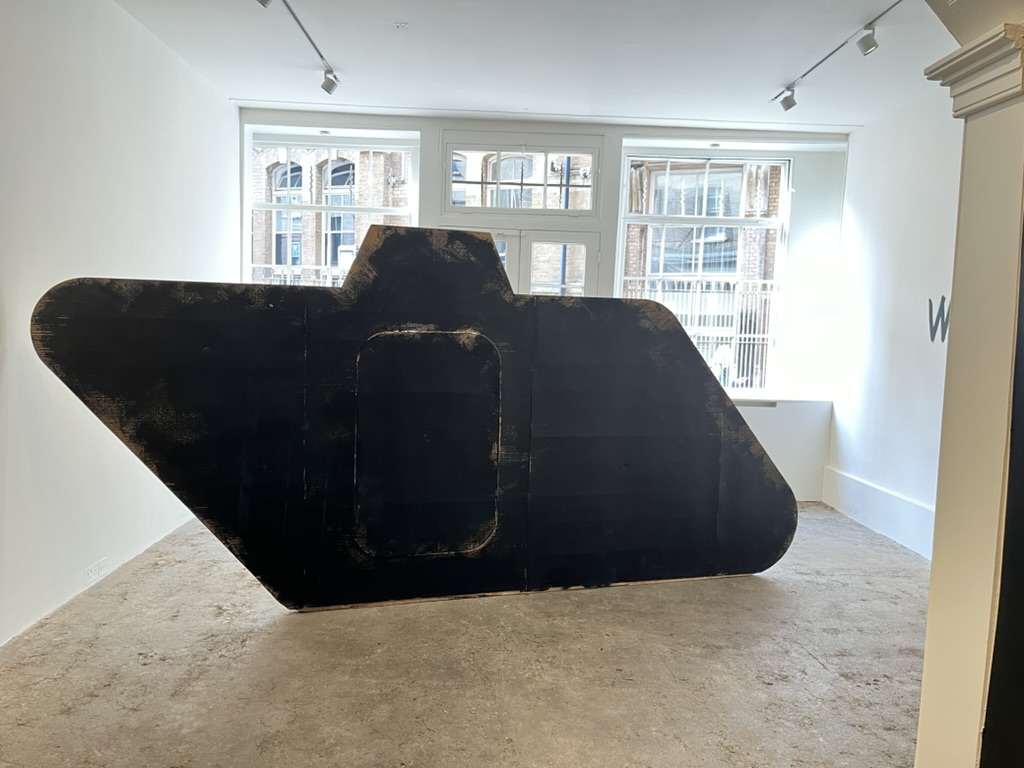
The performance part of the exhibition was acted in and across the gallery spaces, corridors, landings and stairs of Raven Row. Perhaps obviously, there was no sense of a ‘fourth wall’ or an ‘intimate episode’ glimpsed voyeuristically through a keyhole. The audience encircled the actors and props. We stood close against walls, we sat down so others could see better, we glimpsed the performance through open doors; the actors chivvied us along as we climbed up stairs for the next scene – other reviews of the exhibition describe the audience being rushed, jolted, and chucked – and props were also left on display, such as a crude cut-out silhouette of a World War One British tank, dark against the light from the gallery windows. Brecht, in his theoretical essay ‘A Short Organum for the Theatre’, remarks how easily ‘theatre folk’ can move their audience through ‘such slight and wretched stuff as a few pieces of cardboard’.
Brecht wrote that it was difficult finishing Life of Galileo (1938) because he wanted to ensure that an audience would have ‘the necessary detachment’. In that the audience chased after the performance there wasn’t really a strong sense of detachment but instead the ‘strong contact’ with an audience that Brecht also valued. I think everyone felt involved in the performance and our participation isn’t the same thing as the illusionism Brecht challenged. But I did feel self-conscious, of being in the way of the performance and the other spectators in my group, finding the best place to stand and so on. My self-consciousness, an awkwardness, suggests Pierre Bourdieu’s analysis of the love of art as something separating and exclusive, reinforced by the institutions of culture like the museum and arguably the theatre. Brecht did not intend the spectator to feel the kind of exclusion identified by Bourdieu. Brecht writes of the rich, concrete individuality he wanted to create to which capitalism was at best indifferent.
The newspaper and magazine clippings recovered a still recognisable and familiar ‘capitalist image-world’. Brecht’s collection of fragments doesn’t reveal the essence of mid-twentieth century social and political history. Brecht wanted to make the real world not only recognisable but also understandable, even if he couldn’t offer a ‘complete account’ of a given historical situation. I wasn’t sure this was Brecht’s intention for these suggestions and experiments. However, echoing Walter Benjamin’s observation that ‘There is no document of culture which is not at the same time a document of barbarism’, Michael Shane Boyle’s review of the exhibition for New Left Review, describes succinctly the clippings as ‘records of barbarism’. The images that had attracted Brecht’s eye were distant curiosities, maybe because they are, they have been, decontextualised twice. There were photographs of Mussolini and ‘Dr Goebbels’. There was a sequence of pictures from Life magazine taken in June 1940 of Hitler in military uniform, dancing and playing the fool, laughing and joking with his entourage or ‘stooges’. Perhaps the sequence interested Brecht because, like The Resistible Rise of Arturo Ui, it ridicules Hitler, challenging what Brecht believed was the petty bourgeoise’s habitual respect or reverence it felt for ‘great killers’.
There was a photograph of Bonnie and Clyde: ‘Bonnie Good Girl Gone Wrong, Mother Says’ and a ‘snapshot of Bonnie and Clyde having fun with a sawed-off shotgun’. Another reported the treatment of a ‘collaborationist’ in Rennes; the reception of American troops by ‘the people of Normandy’ and the ‘Normans’, and on shortages of rice in China; ‘People Starve in the City Streets’: in 1945 rice production to be ‘down to 34,000 tonnes’. Oil wells in Baku. There was a photograph of a performance of Children’s vaudeville amongst the ruined buildings of London’s East End, the caption describes the performance taking place ‘in a natural theatre’. ‘Italy’s peasants seize the land. Urged on by hunger and the Reds, Calabrian farmers rise against land barons’. Lenin looked dapper in a three-piece suit, wearing a fisherman’s cap, a smart overcoat draped over his shoulders.
As Benjamin observed, memorable gesture is a definitive quality of the anti-illusionism of Brecht’s Epic theatre, and it’s obvious that Brecht was drawn to images that emphasise the physicality and expressivity of gesture and human behaviour. For Phoebe von Held, like montage, gesture fragments or interrupts narrative and as an expressive form is particularly adequate for the representation of the experience of modernity. Thus, illustrating a 1934 German magazine article on the purchase of machinery and the industrialisation of the Soviet economy, a sequence of photographs shows Stalin gesturing towards himself, as if he is giving a ‘thumbs-up’. He points at an interlocuter. He leans back and listens carefully. The sequence allows us to imagine his movements and the drama of the scene. There is a similar emphasis on gesture in the photographs of Hitler. One undated photograph captioned ‘For the suffering population in the Reich’ seems to show Hitler putting money into a collecting tin, again, the focus is as much on his hands as his facial expression. There was an image of a mother holding her daughter. The child looks away, over her mother’s shoulder, seemingly shy. The mother rests her face in the palm of her other hand, the meaning of the gesture was unclear to me.

The exhibition, then, offered an opportunity to consider a perhaps more unfamiliar Brecht, engaged with the pictorial and the techniques of montage. In its emphases, the exhibition at Raven Row illuminated Brecht’s practice as a playwright, theorist, and artist, critically engaged with realism and questions of truth in relation to the mass media in print. More personally, the performance, in its close physical intimacy to its spectators and yet maintaining a feeling of distance through gesture, the makeshift and symbolic props, and carnivalesque costume, was an enjoyable and enlightening experience of Brechtian theatre.
(Feature image: brecht: fragments performance, ‘The Breadshop’ with Osa Audu, Antonia Ganeva and Lucas Albion, Raven Row, 2024
Photograph by Anne Tetzlaff)
Jeremy Spencer is an academic and writer. He studied art history at Leeds and Essex universities and writes on materialist art histories, aesthetic ideology, and political modernism. He teaches on ‘The Other MA’ (TOMA), an artists’ education and exhibition programme based in Southend on Sea and is an associate lecturer at UAL and the Open University.


 E-CIBS
One response to “Review: brecht: fragments, at Raven Row Gallery – by Jeremy Spencer”
[…] For more information on the exhibition check out the documentation on the gallery’s website and see E-CIBS’s review: brecht: fragments, at Raven Row Gallery – by Jeremy Spencer. […]
LikeLike