
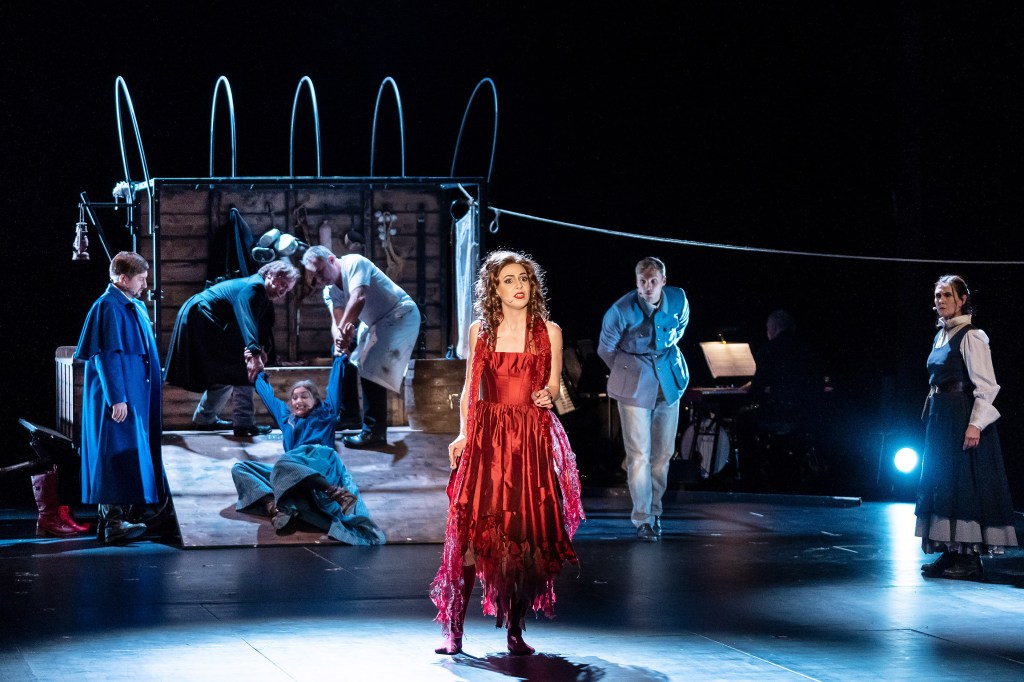
On 16. Nov. 2024 the Landestheater Niederbayern had their Passau premiere of Mutter Courage und ihre Kinder at the Stadttheater Passau. The production was easily the most Brechtian production that I’ve ever seen, in the sense that it was the truest to Brecht’s original. Of course, this means paradoxically it was the least Brechtian production of Brecht I’ve ever seen. Counterintuitively, for this reason, it was also one of the most fascinating productions of Brecht I have ever seen, for unexpected reasons.
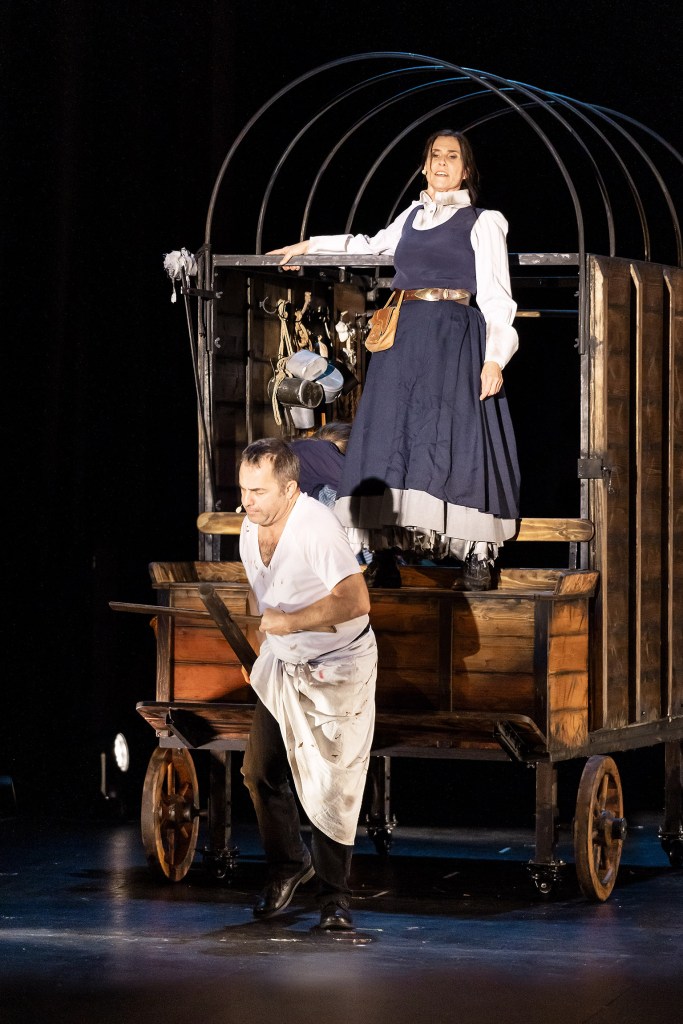
A little cultural background might be necessary for me to explain. Just briefly for those without much knowledge of German theater, the country has a system of independent, state subsidized theaters with a mandate to provide the population with access to the performing arts. These theaters play an important role in cultural preservation. Landestheater are such theaters, and they often perform in multiple communities within the geographical area they serve, bringing professional theater and the performance arts to the people. Given the Landestheater’s role in cultural preservation, it is not at all surprising that the production was performed in a traditional way. That’s sort of the point, and from a purely performative standpoint it really was executed superbly.
The cast, led by Antonia Reidel as Mutter Courage, were all observably well versed in Brechtian acting methods, had great voices, and gave solid performances all around. The music, rendered true to Paul Dessau’s compositions by a four-piece orchestra under the musical direction of Bernd Meyer, was quite pleasurable and impactful. Although, there was a time or two when the music drowned out the vocals. But that was nothing more than a minor distraction and in no way prevented the director, Birgit Simmler, from accomplishing perfectly what the performance was meant do to, i.e. bring the people their cultural heritage in an enjoyable and socially meaningful way.

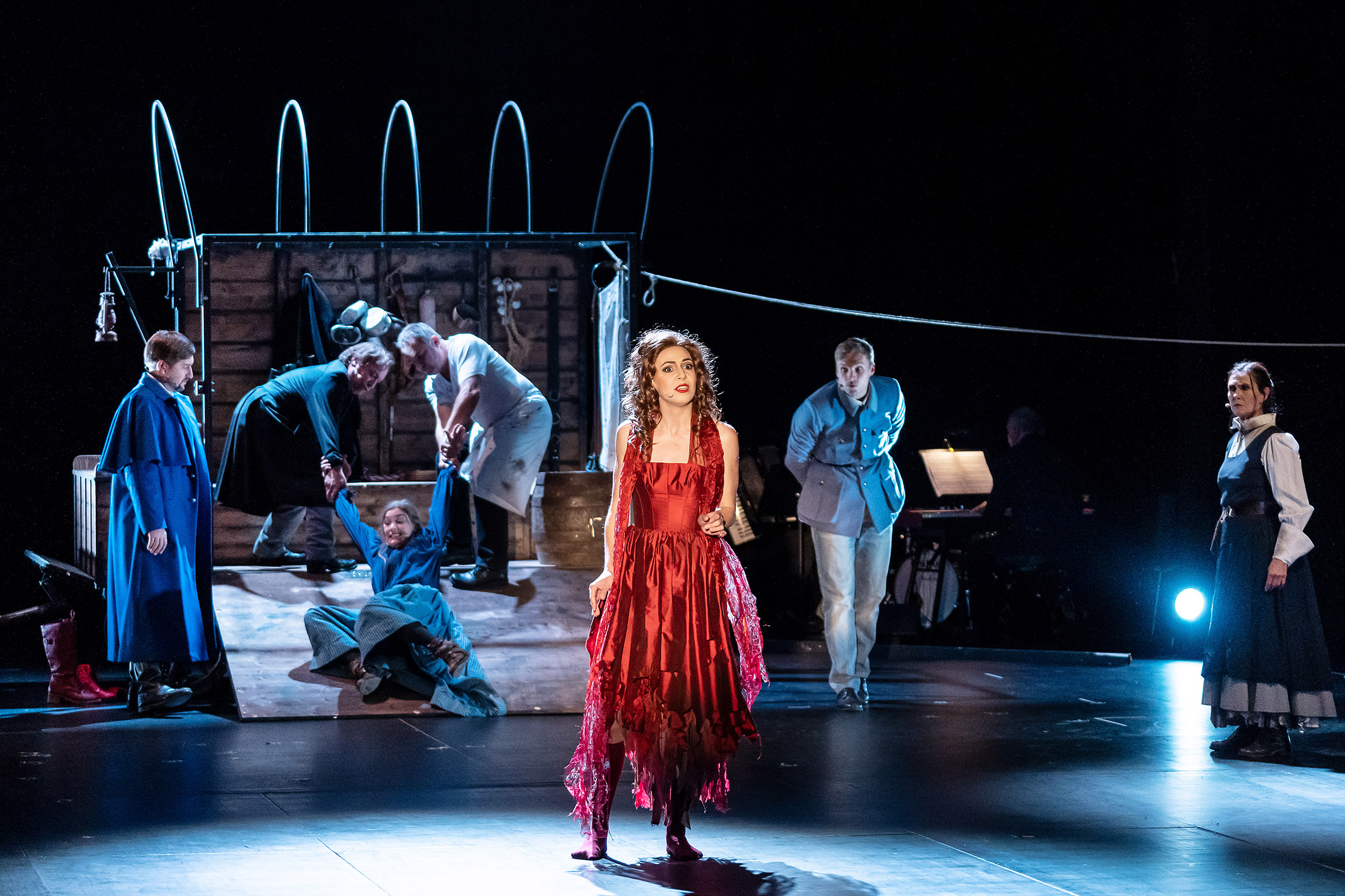

(Click above to scroll through the photos)
From a sociological standpoint this has an important social function. The theater acts as a locus for ritualized activity. There are prescribed actions, normative expectations of decorum, etc. Moreover, the ritualization both by the cast and audience is centered around the piece being performed. In this way, the piece acts as a totemic object, a symbol of German, national, shared cultural history and group connectedness. This idea of theater as a ritual of national unity was indicated by the cross section of the community in attendance. There were pensioners, workers, professionals, intellectuals, students, a cadre of volunteer firefighters in their dress uniforms, a mother with her son, all of whom were brought together by this performance.
That fact that it was performed in a customary way, along with the fact that I, a foreign visitor, was fortunate enough to see it at a regional theater in the heart of Bavaria, Brecht’s home state, really forced me to behold it in a way I normally wouldn’t, as an object within the German cultural heritage. Therefore, to me what was most interesting was not so much the production itself, but rather the entire cultural ethos surrounding it.
To begin with, the Stadttheater Passau is a cozy theater of 334 seats, decorated in a baroque style, and has a history dating back to the 17th century. It’s a super charming and delightful place to see a show.
Additionally, having a drink in the foyer waiting for the theater doors to open provided the social scientist in me the opportunity to take a quick, rough demographic survey of the audience. Given my involvement in the International Brecht Society and having some investment in the promotion and furtherance of Brecht and his work, age was the category which struck me most. Roughly half of the guests of the mostly full theater, I judged to be pensioners, and there were also quite a few middle-aged theatergoers there, as one would expect. But there was also a strong contingent of around perhaps thirty young people between the ages of thirteen to eighteen, most of whom all arrived together as a group. The Brecht scholar part of me was encouraged to see this. It gave me hope for the continued relevance of Brecht in the future. But the Brecht scholar in me was also a little concerned about how seeing Brecht performed in a traditional way might impact those young people’s perceptions of him. As an educator at a performing arts conservatory, students sometimes tell me that their impressions of Brecht are of him being old fashioned and even boring. This is because the only exposure to his works they have had have been done in a museum piece way. My hope is that this experience will entice those younger audience members to learn more about Brecht and discover his socially transformative and experimental aspects and not write him off as a dusty old relic.
Finally, seeing Mutter Courage performed in a customary way, specifically as an object of the German cultural heritage, led me to conclude that while this production represented perhaps a surrender of the experimental Brecht, it also served as a testament to the viability of other aspects of his aesthetic theoretical principles. Take Gestus for example, i.e. the revelations of social relations Brecht wants exposed to the audience. What Brecht puts on display, in this piece – things like how economic necessity forces people to eschew their social, communal instincts for self-preservation; the ease with which people from different religions kill each other; the futility of magical thinking and the importance of actual doing (e.g., others pray for the villagers, while Kattrin [Tabea Günther] beats the drum) – are all still relevant revelations and things we need to see today. This also holds true for the play’s grand revelation that ‚Der Krieg ist nix als die Geschäfte‘—War is nothing but business. If a poor woman who sells trinkets and wares from a shitty old wagon she has to pull around herself like an ox is invested enough in a war to worry about the economic impact of peace, how must the arms dealers who make money hand over fist feel?

According to Simmler, “Theatre is not meant to preserve for preservation’s sake. A theatre is no museum”; and while the performance was traditional, this production proves that, as Simmler puts it, “Mutter Courage has not lost its bite in the last 80 years.”
In sum, while this production was traditional, it was done very well. The audience (I included) loved it, demanding four curtain calls. No doubt this was because it was truly a moment of community, a celebration of the German cultural heritage, and a piece that remains socially salient.

Anthony Squiers, PhD, Habil. is a faculty member at AMDA College of the Performing Arts and co-editor of E-CIBS. He is the author of An Introduction to the Social and Political Philosophy of Bertolt Brecht and Bertolt Brecht’s Adaptations and Anti-capitalist Aesthetics Today.



 E-CIBS