
The 6th iteration of the “Baustelle Brecht / Working with Brecht” series took place on 13 December 2024, as usual at the Literaturforum in the Brecht-Haus in Berlin. The topic of this year’s workshop was “Actualizing Brecht: Current and Historical Practice-Theory Structures” (Brecht vergegenwärtigen: aktuelle und historische Praxis-Theorie-Gefüge), initiated by Anja Klöck, Professor of Acting (including Theory and Theatre History) at the Hochschule für Musik und Theater (HMT) Leipzig. The day’s events were organized in cooperation with the Working Group “Acting Theory” of the German Society for Theatre Research and the International Brecht Society. This year’s activities included paper presentations, an artist’s talk, a round table discussion, the performance of a Brecht-project by acting students, and a book launch. A public call for papers, which, as always at the Baustelle, was primarily aimed at young scholars and theatre practitioners exploring innovative approaches in Brecht research. (See program here.)
The workshop opened with a generous welcome from the host of the well-attended event, Christian Hippe, director of the Literaturforum, who wished those present rich and productive discussions. In her opening remarks, Anja Klöck then emphasized that the workshop’s point of departure assumed every actualization of Brecht’s texts or theories “takes place within particular organizations, with specific media tools, for a certain group of contemporaries in a particular place.” In view of her comments, the call for papers, and the day’s program, this premise can be subdivided into two further-reaching focus areas: First, not only were overlaps between practice and theory not excluded, but rather they became highlighted as inextricable. Second, the presentations reflected the economic and geopolitical localizations of individual artistic or academic endeavors within the wider, global spectrum of Brecht’s reception. The call had explicitly asked for analyses of historical and contemporary applications of Brecht, ranging from the investigation of differences between West and East Germany to the specific characteristics of Brecht’s reception in countries of the Global South. Questions of institutional frameworks, conditions and practical situatedness in a broader sense, as well as material culture and physical routines were also suggested as possible approaches for the workshop.
In the first presentation of the day: “Jenseits un-unterbrochener Gegenwart,” Maximilian Kuhn examined Hannah Arendt’s Brecht essays from 1948/50 and 1969. He identified a collation of the concepts of intervening thinking (“eingreifendes Denken”) in Brecht and reflective intervention (“nach-denkendes Eingreifen”) in Arendt, which also sought to emphasize the difference between the two. In replying to a question from respondent Matthias Rothe as to whether Arendt maintained a bourgeois concept of literature, often with exalted and eternal judgments of taste, which Brecht explicitly rejected, Kuhn was able to sharpen his argument decisively: Arendt’s approach to and use of language exposes a rupture with the idea of actualization through language, which aligns with the poetic distance in Brecht’s works and translates it into a multi-perspectivity of intertwined movements of thought. In this way, she translates the reflexive distance, which Brecht’s “intervening thinking” requires, into the “reflective intervention” of her contemplative portrait in the Brecht essays. Kuhn’s presentation derives from his doctoral dissertation project at the Freie Universität Berlin on questions of representability of theory.
Snehal Anni’s talk (response: Micha Braun) about “The Politics of Translation” dealt with the reception of Brecht in postcolonial Hindi theatre on the level of translation, text analysis, and stagings from the 1960s to the 1990s, including the use of oral history interviews for her work. Indian theatre’s intensive engagement with Brecht raises questions about the challenges of the global circulation of a particular idea of political theatre. With that in mind, Anni traced examples of a uniquely revolutionary theatre (Sohail Hashmi, Rakesh Kumar Sharma, Amal Allana) that reinterpreted Brecht to meet its own unique political, social, and aesthetic needs in a postcolonial setting. She stressed that the actualizations of Brecht in post-independent India, which took place in various contexts ranging from university campuses to socio-political activism and more institutionalized theatres, were not only theatrical performances but also understood as political acts and therefore of interest to the censorship authorities. Specific characteristics of translation, in particular cultural dissonances and foreignness that cannot be transferred into another language, can be understood in terms of a Brechtian aesthetic of alienation, whereby Anni foregrounded the political concepts in Hindi reception. Snehal’s research derives from the dissertation she is completing at the Freie Universität Berlin.
Dwaipayan Chowdhury next focused on Brecht’s reception on Kolkata stages, entitled “Whither ‘Der Nullpunkt’”? Although he centered his talk around Bengali stages, he too was operating in a similar cultural environment as was Anni. As he clarified upon enquiry during a lively discussion, Chowdhury’s reading of the Brechtian “zero point,” can be regarded as radical potentiality and multiplicity, which especially inspired Bengali theatre makers (Uptall Dutt, Ajitesh Bandyopadhyay) in the second half of the twentieth century. By thinking together actualization and counter-actualization of Brechtian aesthetics, Chowdhury described a series of forms and experiments along the lines of a Brechtian “heritage,” a heritage, however, which refuses to recognize any authorial authority. On the one hand, Brecht was cited as a point of reference for the theatre’s literariness and placed in a historical line with Shakespeare; on the other hand, the reference to him justified the estranged situation ensuing from the multiplicity of simultaneous and interruptive events on stage. Marc Silberman’s response sought to clarify the “status” of Brecht’s two notes on the “Nullpunkt” within the context of his ongoing reflections on and adaptations of Stanislavky’s systematized rehearsal and performance techniques. If Stanislavsky positioned the audience as voyeurs and asked them to suspend their disbelief in order to recognize the staged performance as a true reality, then Brecht wanted the audience to change their expectations of how to watch and what to expect from a theatre performance. This approach to Brecht is exactly what Chowdhury laid out in his case studies of Dutt and Ajitesh. His presentation emerged from the doctoral dissertation he submitted in 2023 at the Freie Universität Berlin.
After a luncheon break, Johanna Stapelfeldt and Marten Weise co-presented the final two-part talk titled “Theater als Handwerk.” Noah Willumsen was respondent to the paper which dealt with the actualization of Brecht at the renowned State Acting School of East Berlin, later known as Ernst Busch Schauspielschule. Initially Brecht played no official role in theatre education when the school became state-run in 1951. After his death and rehabilitation in the GDR, however, he gradually became part of the curriculum and had a decisive influence on it. Using archival materials of a studio production by acting school graduates (Mann ist Mann, 1964, directed by Uta Birnbaum) and oral history interviews, the presentation documented the influence of the Brechtian Modelbooks and work methods within the degree program for actor training, suggesting a possible connection to the historical avant-gardes and theatre experiments of the 1920s and 1930s, a topic which has so far been disputed in research about GDR art institutes and schools. The allusion to Brecht, especially regarding documentation, generated discussions about the training of directors as well, which became a degree program at the Institut für Schauspielregie in 1974. The talk showed that protocols of discussions for preparation and concept development, set and costume designs, dramaturgical material, rehearsal plans, role and directors’ books, and their compilation were considered an important part of education and training. In a Brechtian sense, the documentation of the production was considered not only an accompaniment to the process, but disclosed the development, with the aim of exchanging artistic experiences and decisions, showing the processes off stage, and thus making the work at the theatre communicable. The presentation was a first glimpse of the long-term project to archive the theater institute’s legacy holdings going back to its founding in 1905.
A short coffee break was followed by a zoom discussion during which Kym Longhi, founder and artistic director of the Combustible Company, based in Minneapolis (USA), reported on her work experience as director, actor, and teacher, as well as her stage productions with students at the University of Minnesota’s Department of Theatre and Dance. Longhi showed photos from her productions (Threepenny Opera, 2016 and Cabaret, 2024) and outlined her working methods and convictions, which she positioned directly in the Brechtian tradition. She approaches theatre as an inherently political act and aims to organize the rehearsal process and the performance to enable dialectical experiences both for the actors and audience. Kari Margolis’s physically enhanced acting method inspires Longhi’s practice in that decisions on stage – as with Brecht – are exposed rather than concealed: If an actor raises her:his left hand, the possibility that it could have been the right hand is also shown. An intriguing aspect of Longhi’s work came up when she mentioned props. She explained that an unfamiliar use of objects on stage can lead to a disruption of the audience’s familiar assumptions. Along this line of argumentation and as the discussion in conjunction with the shared response by Matthias Rothe and Anja Klöck showed, her approach to theatre intends to open up a greater variety of possibility for both students and the auditorium. Longhi made it clear that, in her opinion, Brecht’s theatre work and its appropriation on contemporary stages can be of great value to American society by provoking a counter reaction to the agitated, consumerist present. She has plans for a new staging of Three Penny Opera in a not-too-distant future.
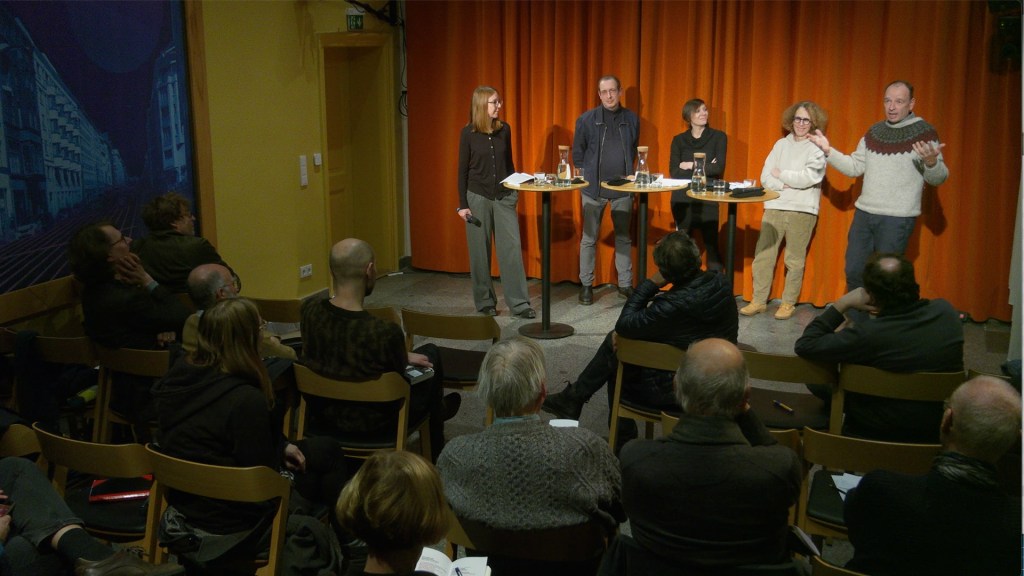
Fittingly, this artist talk was followed by a quick-paced roundtable discussion that raised the question whether today’s dark times are good times for Brecht and his reception. The question sparked short statements by Annette Bühler-Dietrich (professor, University of Stuttgart), Wolf-Dieter Ernst (professor, University of Bayreuth), Dag Kemser (assistant professor, HMT Leipzig), Teresa Kovacs (assistant professor, Indiana University), and Anja Klöck (professor, HMT Leipzig) that ranged from the skeptical and hesitant to the affirmative and even indispensable. They touched on the challenges, indifference, barriers, and curiosity they encounter when introducing Brecht to university students, at theatre training academies, and in adult education venues. The lively discussion that followed included myriad anecdotes by the workshop audience about successes with adaptations of Brechtian Lehrstück methods and applied theatre projects.
The workshop concluded with a performance by acting students from HMT Leipzig comprised of excerpts from their production of Brecht poems, ballads, and songs titled Glut unter der Asche (Embers under the Ashes), which they created for the Düsseldorf Schauspielhaus. In blue jeans and white shirts, a simple costume that oscillated between working-class and American apparel, the student actors (Michael Fünfschilling, Orlando Lenzen, Elias Nagel, Jule Schuck, Charlie Schülke, Sarah Steinbach, Roman Wieland, Luise Zieger) performed under the direction of vocal choirmaster Toni Jessen, singing, speaking and whispering the texts dating from the period between the world wars and underscoring the never-ending crisis of the market economy. In constant unrest and in different constellations, the acting students found new approaches to the poetry’s utopian power. With the musical accompaniment of Boris Leibold (HMT Leipzig) and under conditions that were adverse compared to a real stage, they succeeded in creating a powerful atmosphere. In the subsequent audience discussion, led by the speech expert Martina Haase (University of Halle), it became apparent that this was the result of intensive text work rather than character development. The evening’s dramaturgy was created through an approach to the word as such: from the text into the body into the space.

A book launch as part of the Literaturforum’s regular programming followed in the evening. The deliberate link with the workshop could hardly have been more fortuitous. Matthias Rothe, Associate Professor of German and Philosophy at the University of Minnesota presented his book Tropen des Kollektiven (Theater der Zeit, Recherche Bd. 170, December 2024) and answered questions of his interlocutor Falko Schmieder (Zentrum für Literaturforschung Berlin). The book treats the relationship of artistic production to its circulation under capitalist market conditions. The author’s probing questions and tentative hypotheses hone in on unexplored assumptions especially in the theatre, where the ephemeral and imaginative work of the audience lays bare how cooperative production brings forth formal changes. Rothe focuses on three such theatre groups in interwar Germany that were explicitly committed to epic theatre, a new aesthetic orientation around collective production: Erwin Piscator’s “total theatre,” the agit-prop group “Truppe 31,” and the “Brecht collective.” For all three, a central consideration becomes the role of the audience, that is, each group intended to emancipate the audience from its (internalized) behavior in and (conventional) expectations of the theatre. For Rothe, the “Brecht collective” offers the most fertile ground for his own questions about the nature and limitations of making theatre politically because it recognized the falsity of individual authorship and promoted montage and citation practices to provoke the audience to reflect on its own role in the theatre. At the same time Rothe identifies blind spots of the “Brecht collective,” both in the racialization of jazz (Threepenny Opera, Mahagonny) and in the exoticism of colonial tropes (especially in Mahagonny), in other words, characteristics of the violence on which avant-garde practices relied but could not make visible. The question as to what we can learn today from the contradictions and failure(s) of epic theatre was taken home as a productive suggestion by a room packed with listeners.


 E-CIBS