
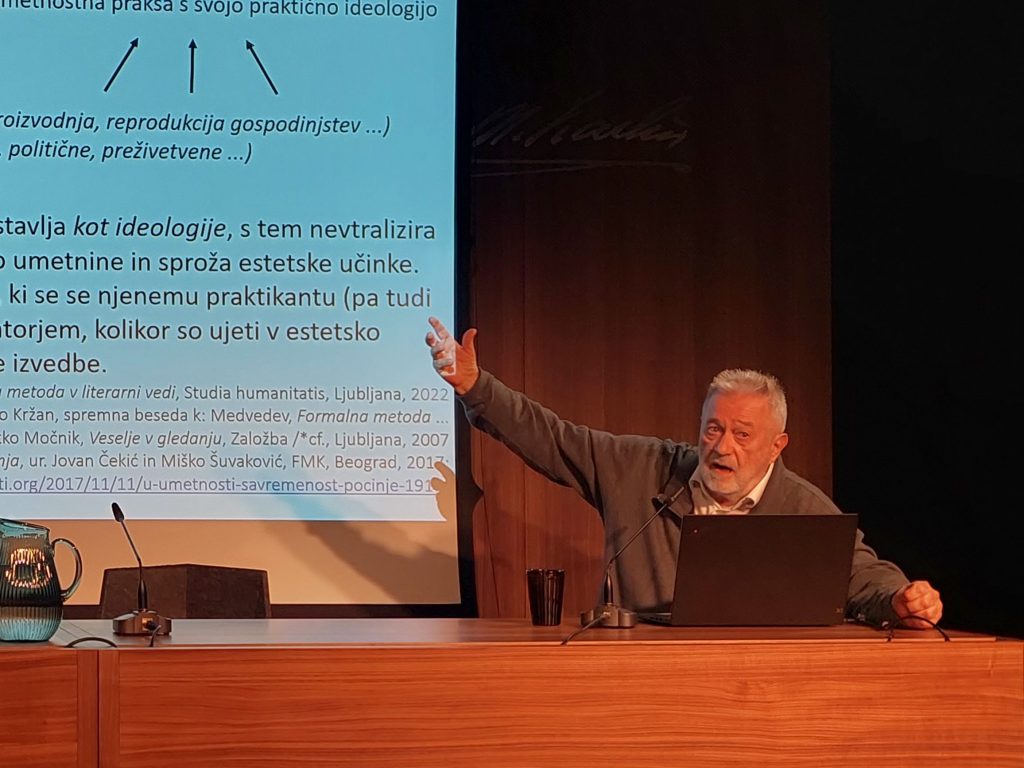
Following the Slovenian premiere of the international co-production of Brecht’s Saint Joan of the Stockyards, a short symposium took place on 11 November 2024 in Ljubljana. The event titled In the Thicket of Capitalism – Saint Joan of the Stockyards Today was organized by the cultural and congress center Cankarjev dom, the Založba /*cf. Press (which published the Slovenian translation of Saint Joan) and the Research Program of the Academy of Theatre, Radio, Film and Television of the University of Ljubljana. The symposium enabled a wide range of insights into Saint Joan from several perspectives: from the literary-aesthetic and literary-theoretical to the theatrical and the performative. It also wanted to encourage sociological reflections on Brecht’s critique of the capitalist system and its dominant ideology.
The event started as a public talk with three actors in the production of Saint Joan (Agata Tomšič as Joan, Danilo Nigrelli as Mauler and Blaž Šef as Slift), the director Davide Sacco and the leader of the music band Laibach (representing the religious sect Black Hats), Ivan Novak. The topics discussed were, among others, possible peculiarities of Brecht’s play from the actor’s point of view and the specific situation of acting in a multilingual performance. Sacco talked about the initial idea for an international coproduction and the play’s relevance for contemporary theatre while Novak explained Laibach’s role in the production of Saint Joan in comparison to other previous theatrical performances by the band.
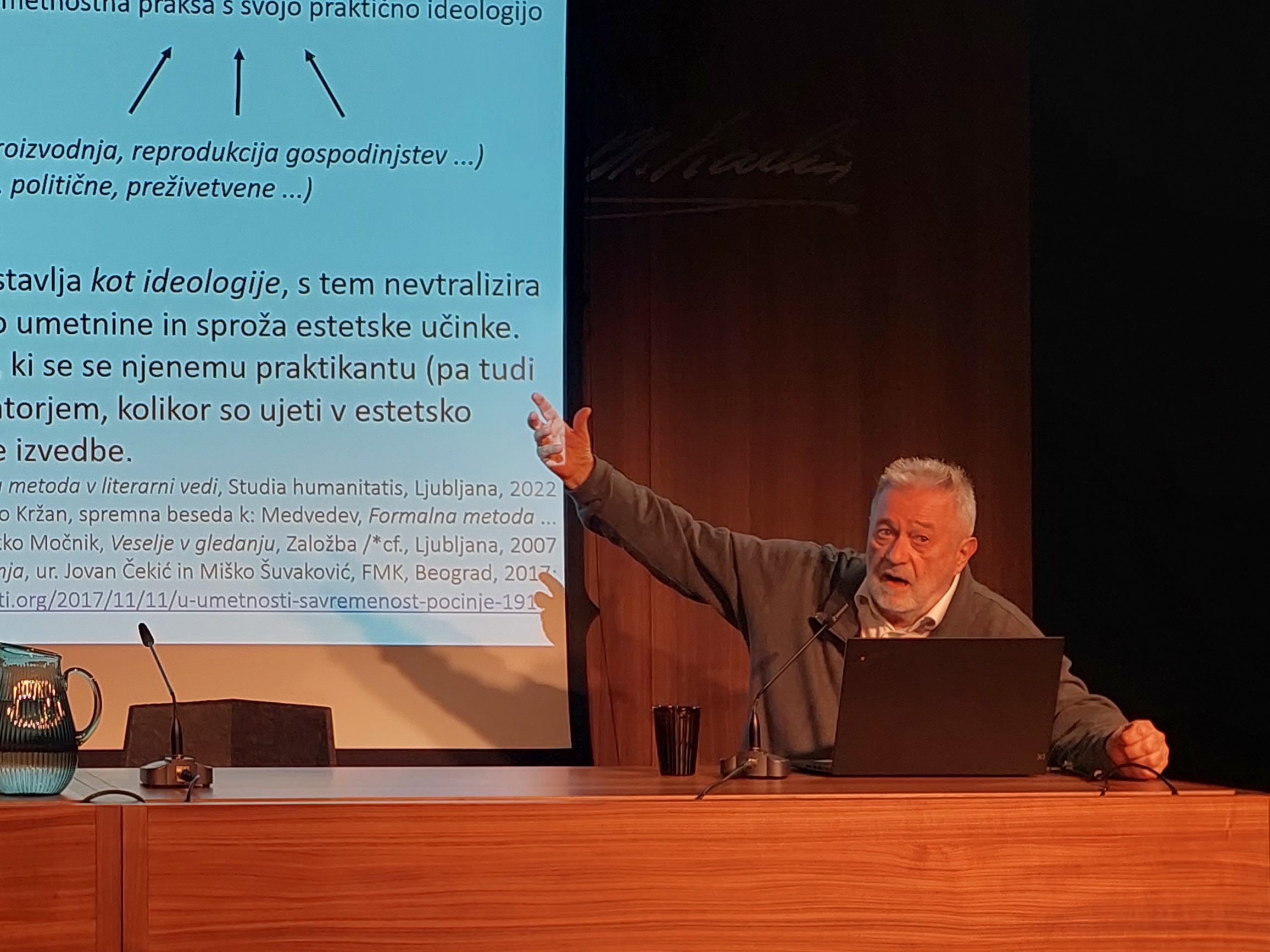
The second part of the symposium, chaired by the Založba /*cf. press editor Amelia Kraigher, was opened by the renowned theoretician Rastko Močnik with an analysis of the contradictory position of Brecht’s play within the realm of the contemporary cultural and art systems. It is characteristic of contemporary art works that they subvert artistic ideology and its apparatuses. On the other hand, paradoxically, they demand that the artistic apparatuses recognize them as works of art. According to Močnik, Brecht implemented a different strategy: he created a new ideology of artistic practice and, at the same time, he theorized it. The problem is that now his works operate in the field of contemporary art and ideally fit into the pattern of contemporary “subversion-with-demand-for-recognition”. They subvert bourgeois aesthetic ideology and its ideological apparatuses (from which they have already gained recognition, since they have been included in the canon) and, at the same time, have been involved in a contradictory reproduction of the capitalist social formation that Brecht sought to eliminate. When the ideological apparatuses of culture-and-art accept practical (subversive) artistic ideology, a radically paradoxical effect occurs – the musealization of the aesthetic revolutionary practice and its ideology.
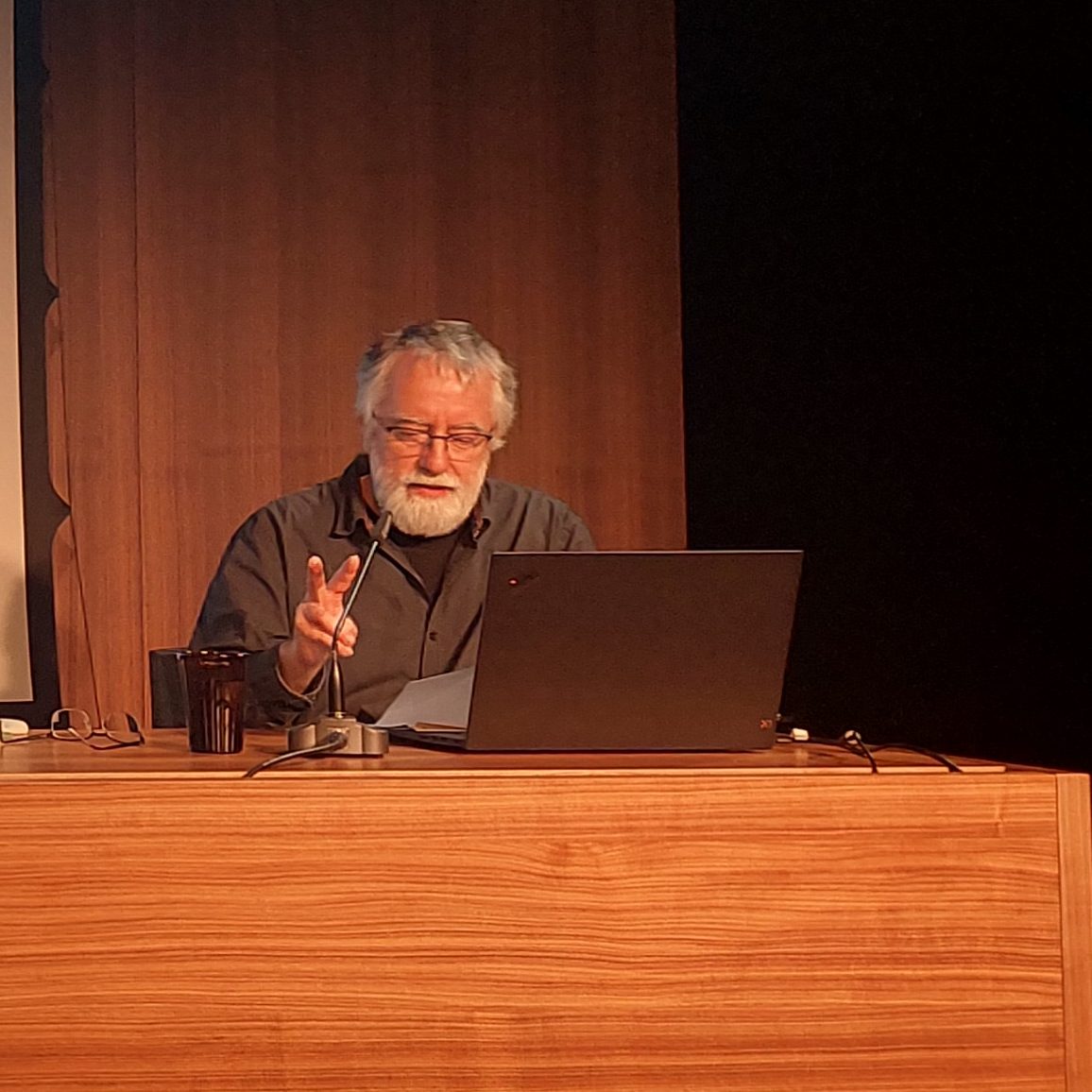
In his paper, Aldo Milohnić spoke about Brecht’s unorthodox and dialogical reading of the classics of Marxism. He recalled Louis Althusser’s important observation that Brecht’s method in materialist theatre is equivalent to Marx’s method in materialist theory: just as the novelty of Marx’s philosophy is not that it is a philosophy of praxis, but that it is a new practice of philosophy, so Brecht’s theatre is not a theatre of praxis, but a new practice of theatre. The creation of Saint Joan is closely connected with his study of the Marxist critique of political economy, which is still relevant and is a possible starting point for a new practice of theatre even today.
Mojca Kranjc, who translated Saint Joan into Slovenian, spoke about the specifics of translating this text, written partly in verse and partly in prose. As a dramaturge with experience of practical work in the theatre, she recognized this mix as a valuable tool (it is often in contrast to the verbal element of lines, situations, scenes, etc., which creates a very welcome dramatic tension and sometimes even irony). Therefore, by selecting vocabulary and idioms, she tried to follow the references contained in the original. The danger of translating verses in a dramatic text is that the verse form can quickly hinder or obscure comprehensibility. However, since, in her view, the content and point of individual lines are of essential importance in Saint Joan, she gave priority to them and, at the same time, followed the rhythm of the Slovenian language.

When Brecht was writing Saint Joan, he was also beginning to write his first series of texts on dialectics, which later became the central concept of his theatre. The aim of the dialectical theatre is to encourage critical thinking through the presentation of contradictions. That is why, in his paper, Jakob Ribič read Saint Joan through the lens of what Jan Knopf calls an “aesthetics of contradictions”. We encounter one such contradiction of the capitalist system at the very beginning of the play: because there is too much meat on the market, the working masses are hungry. Then there are various other contradictions that Ribič points out, such as, for instance, at the level of the dramatic characters and their internal contradictions; the fact that workers cannot be “moral” if they have to survive in an “amoral” system, etc. That is why Brecht’s key point in Saint Joan is that the fundamental driving force of social change is not compassion, but rebellion.
Ula Talija Pollak also took the meaning and effect of contradictions in Brecht as a starting point and explained this using his concept of gestic music as an example. In the performance of Saint Joan, this is particularly interesting due to the special role that Laibach plays as the religious sect, the Black Hats. A good example from the performance is the scene of Joan’s beatification: the actors, who represent the workers, undress Ivana and brutally prepare her like a piece of meat for further “processing”, while Laibach performs a gentle, almost pathetic song. The actors therefore play against the atmosphere created by the music, and this contradiction between the sound and visual elements of the performative situation produces the estrangement effect.
The symposium concluded with theatre director Sebastijan Horvat, who has directed Brecht’s plays several times, most recently Fear and Misery of the Third Reich (Mladinsko Theatre, Ljubljana, 2023). He critically analyzed contemporary Slovenian theatre from a Brechtian perspective and roughly divided it into that which follows Brecht’s principles of political theatre and that which follows the ritualistic and “guru” type of production à la Grotowski. For Horvat, there is no simple relationship between form and content. For example, the avant-garde form of theatre does not necessarily exclude a conservative political position and vice versa: the old-fashioned form of dramatic theatre can be politically progressive if it actualizes the issue of class struggle and radical emancipation. He advocated for a Brechtian approach, which is concerned with comprehensibility and against the ideologies of deliberate artistic mystification.

Aldo Milohnić is a professor of theatre history at the Academy of Theatre, Radio, Film and Television of the University of Ljubljana (Slovenia) and the head of the Theatre and Film Studies Centre. He is author of several books, among others Theories of Contemporary Theatre and Performance, Art in Times of the Rule of Law and Capital, and Theatre of Resistance.



 E-CIBS
One response to “In the Thicket of Capitalism: Saint Joan of the Stockyards Today – by Aldo Milohnić”
[…] In the Thicket of Capitalism: Saint Joan of the Stockyards TodayAldo Milohnić, “E-CIBS”, 20 gennaio 2025 https://e-cibs.org/2025/01/20/in-the-thicket-of-capitalism-saint-joan-of-the-stockyards-today-by-ald… […]
LikeLike