

What a tremendous spectacle it was! The stage was beautifully adorned. It had catchy music and all the pageantry one could hope for. But beyond these aesthetic qualities, this production offered something much more intriguing and profound for the discerning members of the public. For them, it depicted weighty truths about our social world. It held out key facts about the social relations of our day, the social relations under capitalism, presenting them as objects bare and unadorned, ready for examination by anyone who wished to see them.
In this production, the audience was introduced to a very charismatic criminal figure, a protagonist with a finely cultivated public image, one who could easily beguile with his charm. This criminal, a violent thug really, was joined on stage by a host of supporting characters, reprehensible scoundrels themselves, who were eager to ride his coattails to wealth and power.
The supporting cast included other convicts, government officials, and religious leaders who all worked together, plotting, scheming, preying on the weak and vulnerable to line their pockets. Each had their own role in this criminal enterprise of exploitation and harm. Some provided spiritual cover to their misdeeds, shrouding it in a narrative of the eternal good. Others pulled governmental levers to protect the gang and especially its boss from accountability. Still others acted as henchmen, those who could be called upon to carry out grotesque acts of violence in the name of profits for the rich.
The leader of this gang is an especially cunning hoodlum. He always knows what to say and always knows what to do to get his way, and he is willing to go to any length for his self-aggrandizement. He would tell any lie, orchestrate any fraud, and carry out any act of violence. Indeed, there stood a character who will cross any line in his unslakable aspiration for power and conquest.
You can see, then, that this spectacle was not just entertainment, as entertaining as it may have been. The show told an important story about our times. It presented a metaphor for the system of capitalism and its blatant failures. Any system of social organization that produces such vulgar economic inequalities, which can be converted into political inequalities and allow a villain such as that—a felon whose life is a protracted crime spree—to be the one in control, is inherently unjust. Any social system that permits one class to establish rules of the game, to fix them in such a way as to ensure, protect, and protract their domination is an affront to democracy. Any system that protects the abusers, not the victims, is a failed system. It is corrupt in its design.
Nowhere was this clearer than the moment when the public was misled into thinking that there might be a chance of justice in such a system. Specifically, there was a moment when the protagonist actually got caught and dragged into the legal system. Although his money afforded him certain luxuries and privileges that poor people are not privy to, he nevertheless became a defendant. In this instance, a semblance of justice could be gleaned; a shadowy hope tingled for the morally wishful. But, just as suddenly as it appeared, this optimism was shattered. The horrible predator—a misogynist, a rapist, a fraudster, a manipulator, a creep—did not get his comeuppance. Instead, a deus ex machina saves the day, and we are left to watch him stroll away, exhibiting a Gestus all too familiar for the rich: the Gestus of getting off scot-free. There was no accountability for his crimes in this social system, and the ruthless exploitation of anyone within his reach continued.
I sat there in wonder, bearing witness to this spectacle. I was all-consumed in thought. How could this be? What can be done? The whole thing sickened me, so I turned off the TV. Yes, I turned off the TV. I had had enough of The Great Man’s second presidential inauguration ceremony. I’d seen this story before. I saw it, in fact, just two days prior, on Jan. 18th, at the Staatstheater Nürnberg’s premiere of Brecht’s Die Dreigroschenoper. In the span of just three days, I observed the same story twice, both times playing out in exactly the same way.
Even though this piece is almost a century old, its contemporary relevance cannot be overstated. While there were several missed opportunities to bring this out more clearly, under the direction of Jens-Daniel Herzog and the dramaturgy of Hans-Peter Frings and Georg Holzer, the Staatstheater Nürnberg did reveal a good portion of it with a minimal though dynamic visual aesthetic and a keen gestic awareness.

In terms of the visual aesthetic, the set consisted of a giant, rotating wheel mechanism with four different settings attached to it. In addition to providing different backdrops for the various scenes, it had several other narrative, thematic, and practical functions.
From a narrative perspective, it signaled significant changes in the circumstances of the characters, particularly Macheath (Nicolas Frederick Djuren). However, this was not a Rota Fortunæ because the characters had some control over the spinning by using a giant red lever which jutted up, out through the deck, reminding us that humans, not make-believe gods, are responsible for our fortunes.
Thematically, the wheel was used effectively to demonstrate the interconnectedness of society and how the actions of one party affect the entire society. The spinning of the wheel was used as a clever device to represent social destabilization and shared social consequences. The actions of the characters, in this way, were framed in their relation to their social effects. Practically, the wheel was also utilized adeptly to add a vertical dimension and an inverted perspective to the blocking, both of which were used to contradict and thus highlight, through irony, the relative social standings and power dynamics of the scene.
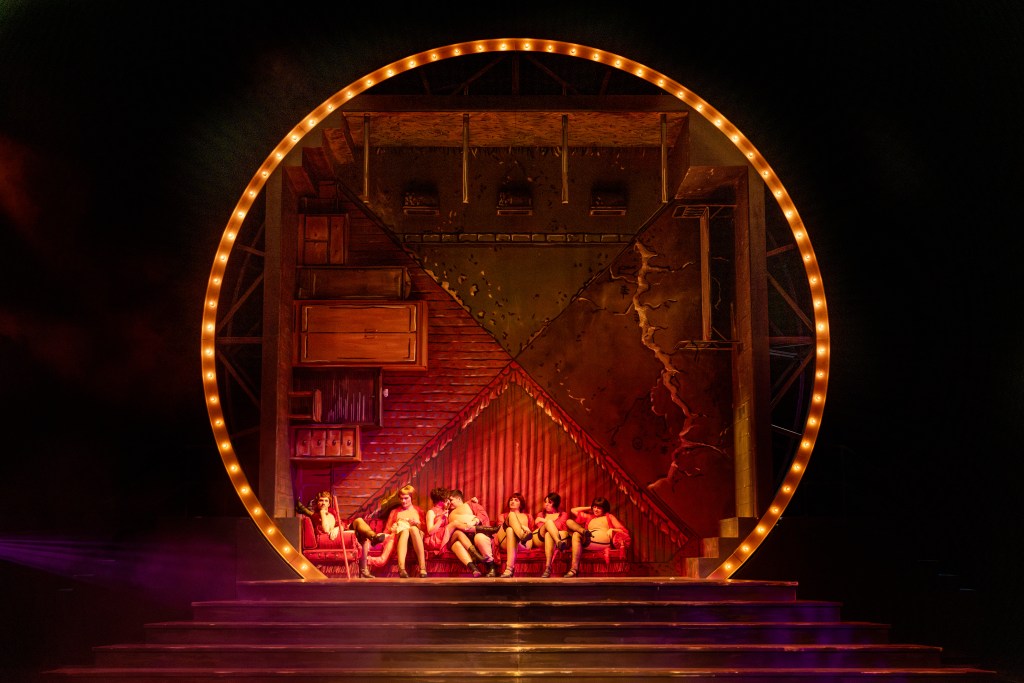
Additionally, the wheel was also used quite interestingly to produce an estrangement effect. After being betrayed by Jenny (Corinna Scheurle), Macheath, sensing his imminent arrest, takes flight. The police, Jenny, and the prostitutes go after him. They all end up inside the mechanism as it spins, turning it into a sort of human hamster wheel. Macheath futilely tries to escape; his pursuers pursue. They fall over, run into each other, trample one another, etc. The slapstick was perhaps a little overdone, but the Gestus could not have been clearer: this is the Gestus of the chase.
Overall, the production had a good gestic sense and used props effectively as a subtle, yet conspicuous means to help bring certain social relations and what’s behind them out. For example, as Macheath sits in his cell awaiting his hanging, Tiger Brown, Chief of Police (Hans Kittelmann), Mac’s old buddy who he as been bribing for years enters. He carries a metal tray with a cloche, a special last meal for Macheath. Macheath, who feels betrayed by Tiger Brown for not keeping him out of jail, initially refuses the food and sits on the far end of his prison cot. Tiger Brown sits on the opposite end, placing the tray of food between them. He subsequently starts sliding it slowly over to Macheath. As the metal tray is pushed across the metal cot, a cacophonous, grating screech is produced. The noise works as a misophonic trigger, and the Gestus of making amends pops out, ready to be observed. So, too, was that which lies behind it. Tiger Brown did what he had to do to get the treats. Eventually, Mac relents and eats the asparagus because he too wants the treats and because he understands Tiger Brown. There is a mutual understanding and acknowledgment that egoistic factors motivate them. That’s how it is.
This is a key revelation which puts emphasis on one of the broader thematic concerns of the piece: To survive in a social order like this, “Zuerst kommt das Fressen, dann kommt die Moral!”—Eating comes first, then morals. In this system, one must worry about themself, their food comes first. Other people in society cannot be a priority. Although Brecht worked on this piece early in his Marxist studies, one can see a clear Marxist influence in this theme, principally derived from Marx’s ideas about the alienation of man from man under capitalism and the bellum omnium contra omnes type of competition capitalist societies are predicated on.
While the production did a nice job in these areas, there were, however, several missed opportunities for making it more socio-politically relevant. To begin, there was a heavy slapstick element to it. I’ve already mentioned the chase on the wheel, but that was just one aspect of it. There was also a tap-dancing horse, and the representation of the police was a rather unimaginative pastiche of the Keystone Cops.
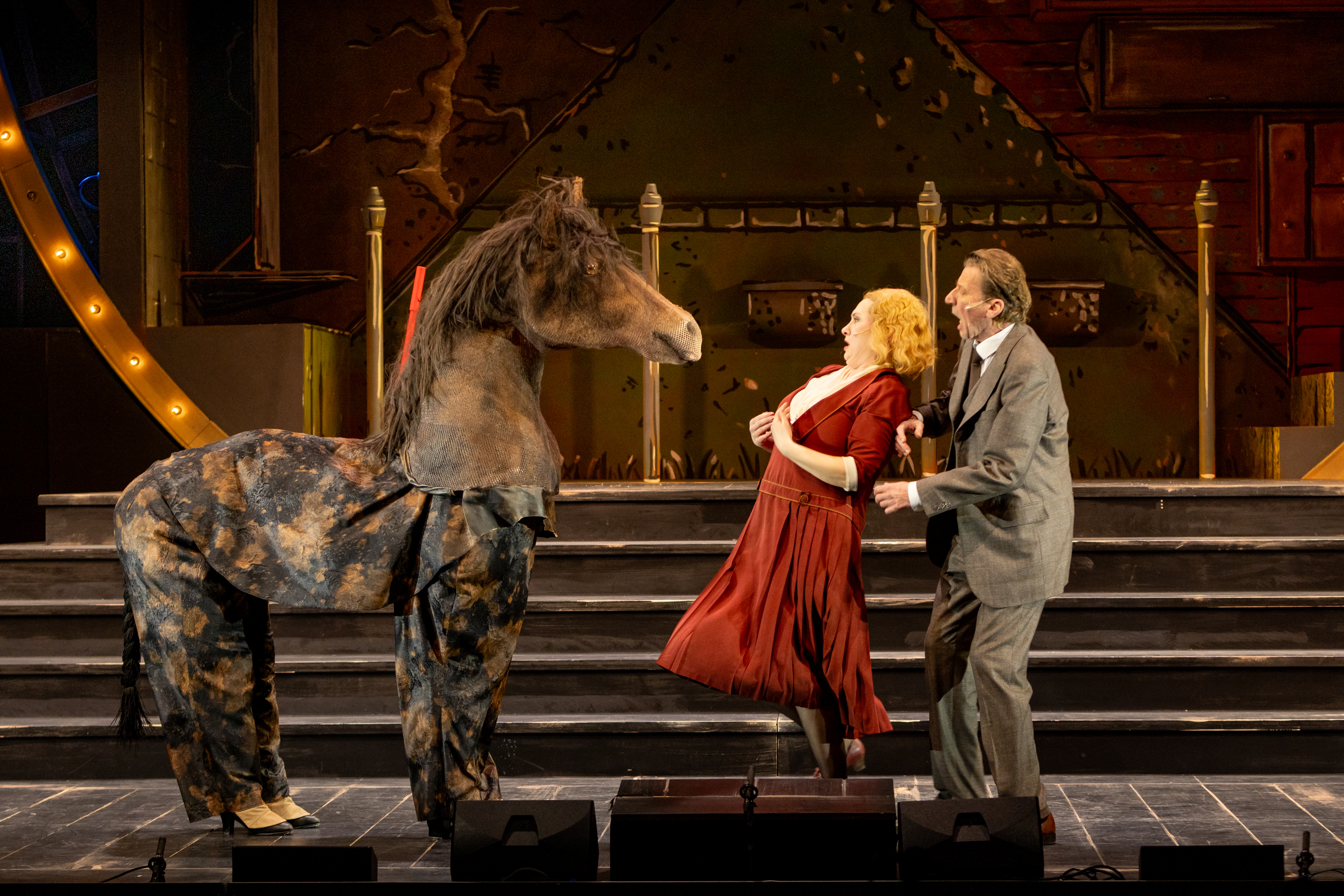
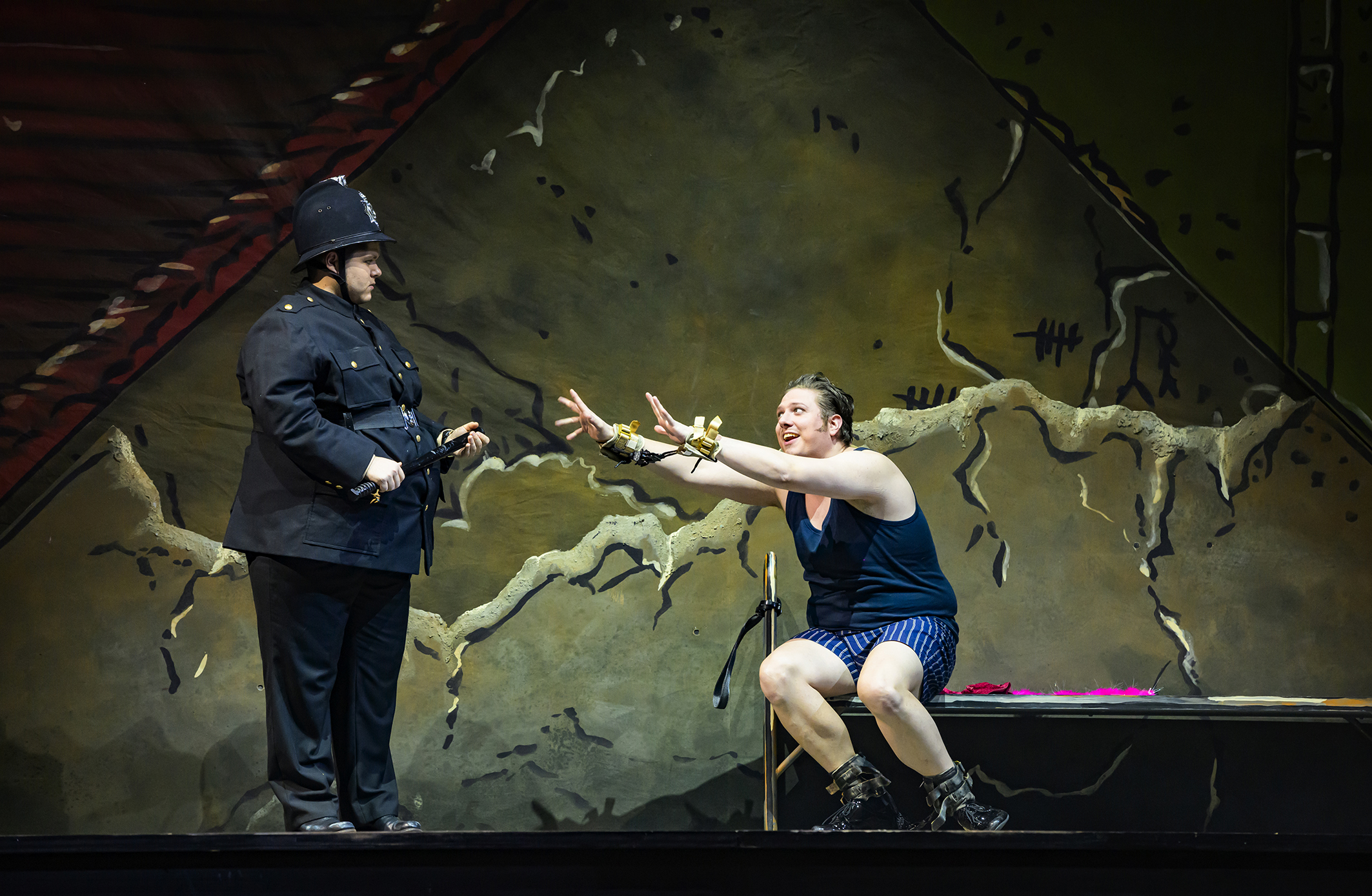
L: Nico Burbes, Nicolas Frederick Djuren, © Bettina Stöß. R: Lisa Mies as Celia Peachum, Michael von Au as Jonathan Jeremiah Peachum , © Pedro Malinowksi.
The latter, I found to be particularly objectionable. By turning the police into jesters, the production totally buried the whole point of having them there, in the first place. The police are the instrument of state violence and social control. This is why both Macheath and Jonathan Jeremiah Peachum (Michael von Au) vie for control over them. Both wish to wield them as a weapon in their struggle for social power and domination.
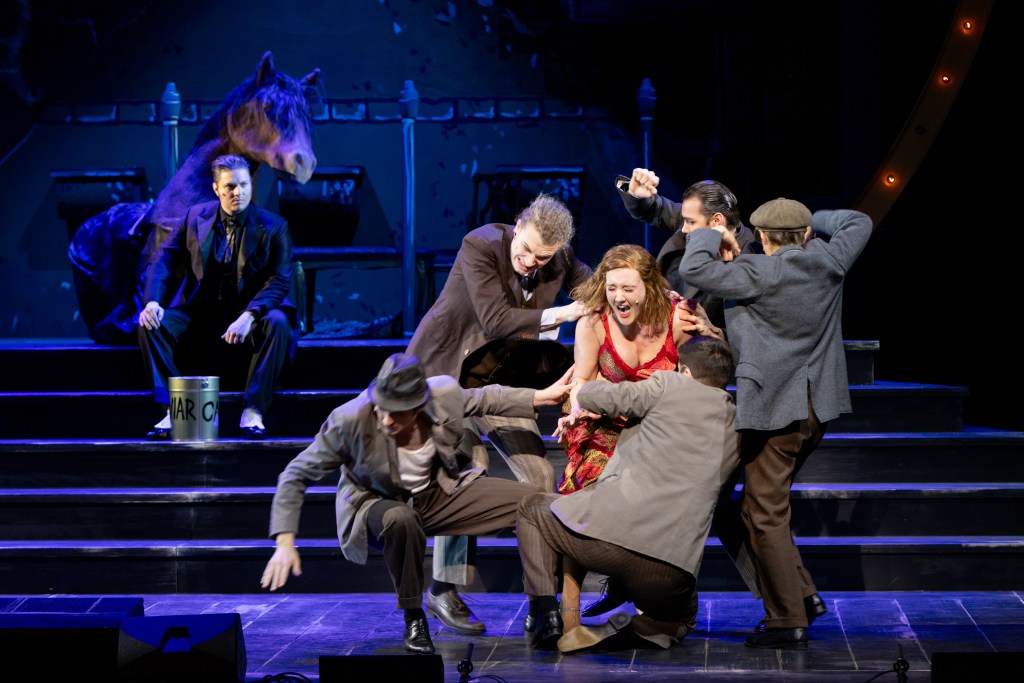
I was also similarly disappointed with a couple of the choices in the wedding scene. The first was the decision to cut Reverend Kimball from the scene entirely. This missed the opportunity to expose religion as a pillar and moral cover of capitalist social control. Given the recent events in the United States, this was an unfortunate omission. The second choice was to have Polly (Inga Krischke) sing “Seeräuberjenny.”
I suppose there was somewhat of a Brechtian spirit in this move, a wink to his Trennung der Elemente—separation of elements. But I’m not sure how well this principle applies to this piece as it does to his later works. The song’s force is generated by emerging from the character’s specific social position, that of an exploited sex worker. In the Dramatis Personae she is called ‘Die Spelunkenjenny’—Dive Bar Jenny, a sobriquet which signals her social station. The song is essentially the revenge fantasy of an abused woman who sits low in both social class and gender hierarchies. By giving the song to Polly, all the subaltern social class connotations disappeared because Polly is bourgeois.
This left just the gender aspect, which was now contextualized in the wedding scene where a bourgeois woman marries a gangster (a bourgeois business-by-other-means-man) to further her own egoist ambitions. The marriage is her playing the social game as it is currently set up. What we see happening is that although there is certainly a patriarchal bias to the whole thing, there are nevertheless openings there for women, especially for a woman of her background. In this respect, coming out of her mouth, the song becomes a declaration of war but also of self-confidence, an anthem announcing her intentions to go to any length to achieve power and self-aggrandize—something that was further exemplified when Mac has to go into hiding and Polly takes over control of the gang, a representation that played heavily off the ‘girl boss’ motif.
All this means that, as a feminist statement, we are left with the idea that some women (i.e., those who are already socially advantaged) are perfectly capable of assuming and carrying out some of the top roles within a still patriarchal, still socially stratified system where manipulation, exploitation, and the commodification of humans is the normal way of life. This type of bourgeois, glass-ceiling feminism is so irrelevant to the vast majority of women in the world as to be devoid of any meaningful liberating potential. Moreover, it is also an andro-normative feminism that is willing to accept Macheath / Trump type toxic masculinity as a social norm.
In sum, this production was somewhat of a mixed bag in terms of allowing its full social impact to emerge. Although there were some choices that I found questionable, that doesn’t imply they were performed poorly. Indeed, everything—from the acting to the singing, music, stage, lighting, sound, etc.—was executed with textbook technical proficiency. Moreover, the production did hit the mark in several key socially significant areas and should be recognized for that, especially for exposing the Capitalist-Criminal Class—Macheath, Trump, and their ilk. That is something we can certainly use.

Anthony Squiers, PhD, Habil. is a faculty member at AMDA College of the Performing Arts and co-editor of E-CIBS. He is the author of An Introduction to the Social and Political Philosophy of Bertolt Brecht and Bertolt Brecht’s Adaptations and Anti-capitalist Aesthetics Today.
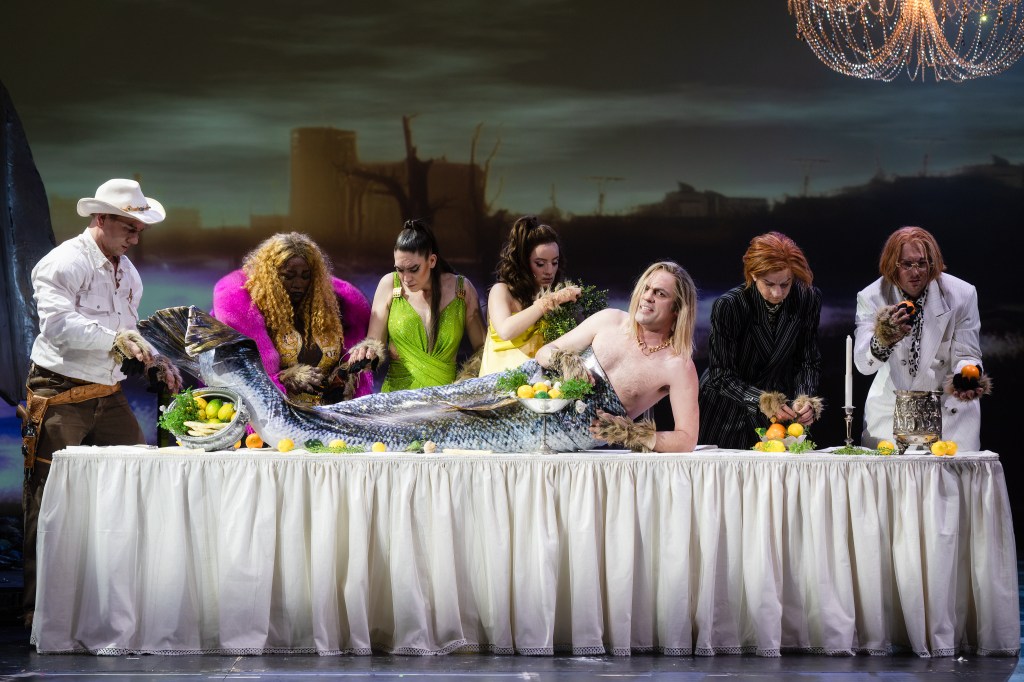
Title photo: Staatstheater Nürnberg „Die Dreigroschenoper.“ Im Bild (v.l.n.r.): Corinna Scheurle, Nicolas Frederick Djuren, Ensemble. Fotografin: Bettina Stöß.


 E-CIBS