
As the echoes of last night’s applause for the National Theatre of Greece’s performance of Brecht’s Mother Courage, directed by Stathis Livathinos, still ring in my ears, I felt inspired to write a brief overview of the staging of Brecht’s plays in Greece during the 2024-2025 season.
Currently, three major productions are captivating audiences. These include adaptations of Brecht’s The Resistible Rise of Arturo Ui (Der aufhaltsame Aufstieg des Arturo Ui), Mother Courage and Her Children (Mutter Courage und ihre Kinder), and The Two Sons (Die zwei Söhne). Each offers distinct interpretations that reflect varying degrees of fidelity to his original ideas. These performances reveal both the challenges and creative liberties involved in staging Brecht in a contemporary Greek context.
The Resistible Rise of Arturo Ui[1], directed by Aris Biniaris with a translation by K. Palaiologos and starring Yiorgos Chrysostomou in the title role, has been running for three years now. I had the chance to see it during the 2023-2024 season, and it still resonates with me. The play strikes me as a powerful piece of political theatre offering sharp and profound insights into how modern society continues to foster the conditions for fascism and Nazism.

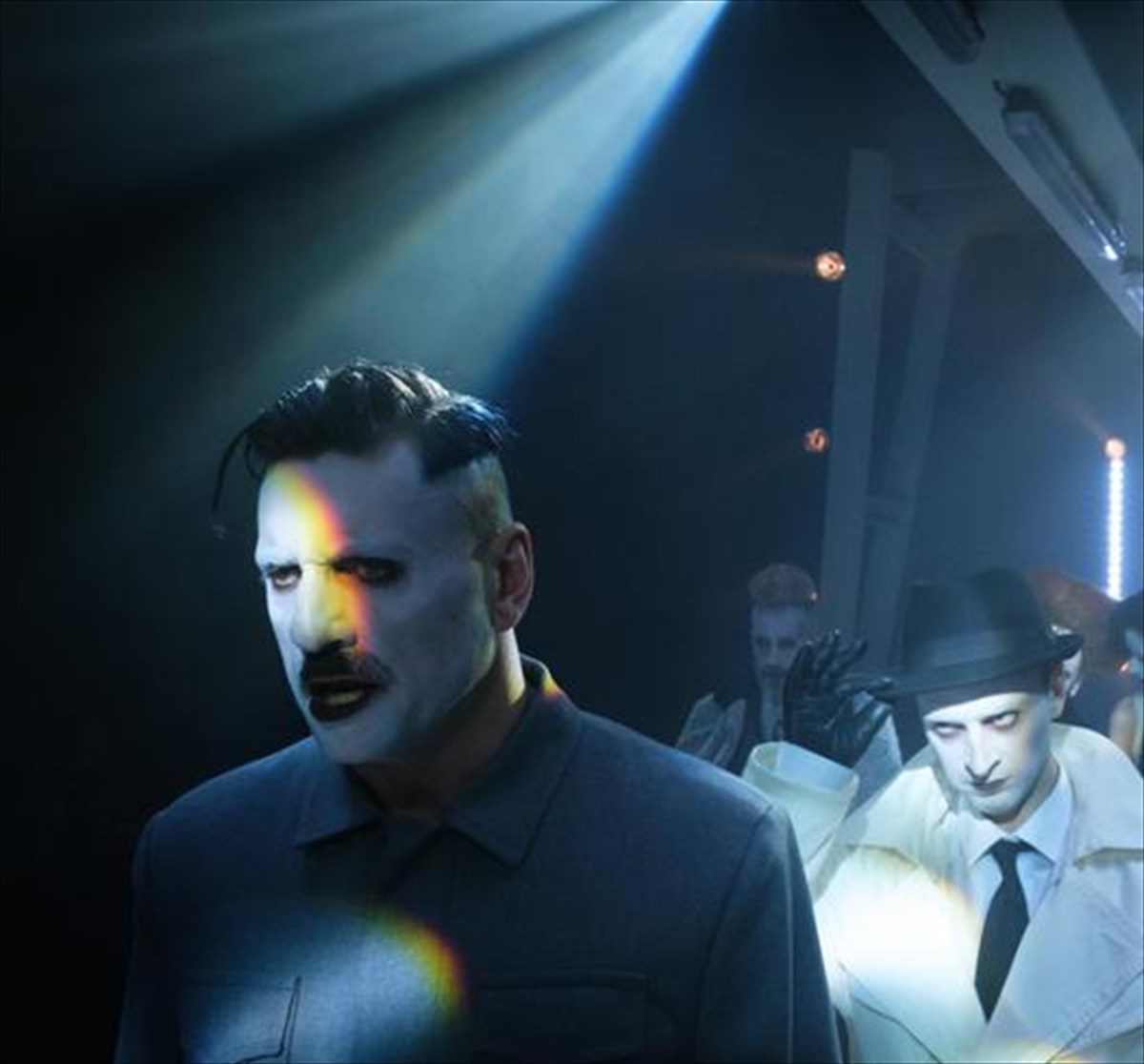


Photos by Patroklos Skafidas
In the shadowy landscape of capitalist social production, the performance vividly portrays the conflicting forces of class struggle. It succeeds in shedding light on the social roots of Nazism and fascism.
One of the most intriguing aspects of the performance lies in its staging. The action unfolds on a runway-like platform, evoking the atmosphere of a dockyard with chains, bridges, cranes, and piles of cauliflowers. The stage is positioned at the center, with the audience seated on opposite sides, facing each other. This choice is not only theatrically compelling but also socially significant, encouraging the audience to witness the unfolding events critically and reflect on their social implications.
The performance employs various techniques, including controlled breathing, repetitive gestures, interruptions in speech and movement, self-referential dialogue, and elements of Verfremdung. The structure of the narrative is transparent, allowing the audience to discern the causal connections behind each episode. In many ways, it feels like a Brechtian masterclass. However, the one drawback is the occasional overacting, which leans toward sensationalism and diverges from Brecht’s intended style.
The second notable example is the National Theatre of Greece’s production of Mother Courage and Her Children[2], directed by Stathis Livathinos—marking the NTG’s first-ever staging of a Brecht play.
The story centers on Anna Fierling, known on the battlefield as Mother Courage, as she navigates the struggle for survival. A shrewd and unprincipled merchant, she profits from selling goods to soldiers while desperately trying—and ultimately failing—to protect her three children from the turmoil of war: her eldest son, Eilif; her younger son, “Swiss Cheese”; and her mute daughter, Kattrin. For this enterprising woman, profit always takes precedence over her family’s well-being, costing her not only her children’s lives but also the values they represent: courage, honesty, and sincerity.


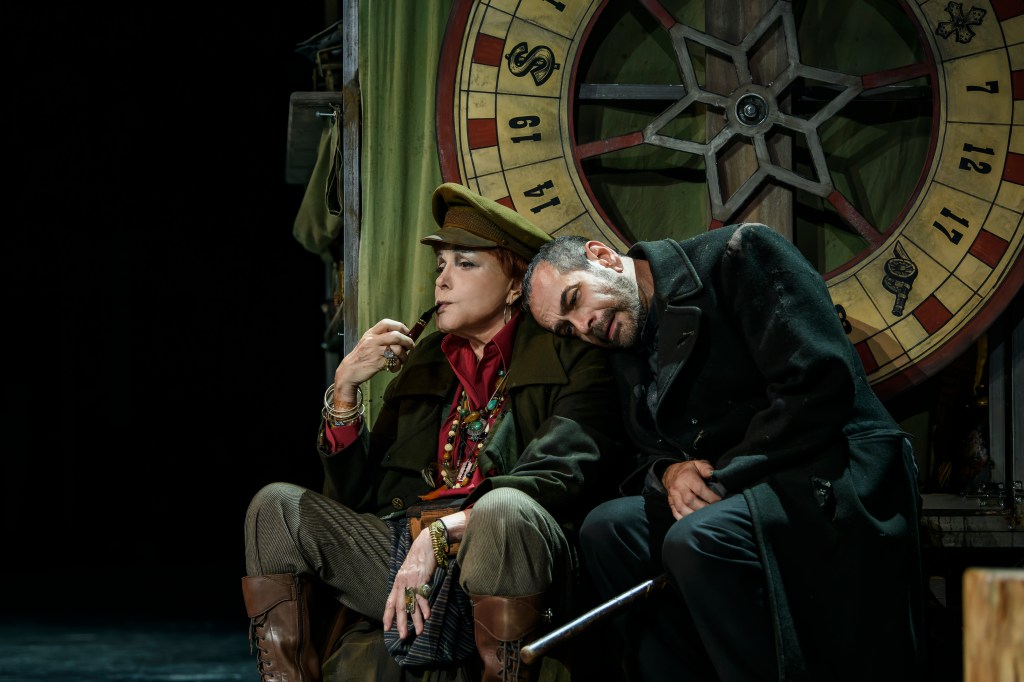
Photos by Elina Giounanli
In times of war, morality and justice seem to crumble. But does this hold true only during war?
Stathis Livathinos’ debut as a director on the Main Stage of the National Theatre of Greece is marked by his first-time engagement with Brecht. In this production of Mother Courage, the music is not Paul Dessau’s original score but new compositions by Livathinos’s frequent collaborator, Thodoris Abazis. The cast features a talented ensemble, primarily composed of younger actors.
In my view, this production exemplifies the high standard of excellence characteristic of the NTG. Livathinos approaches Brecht’s work with great respect, demonstrating meticulous attention to detail in honoring his legacy.
In blending Brechtian and dramatic elements, the NTG’s adaptation of Mother Courage evokes both sympathy and emotion, as the direction emphasizes the devastation and cruelty of war. At the same time, gestural elements, subtle commentary by actors on their roles, and estrangement techniques are evident. Overall, Livathinos leans toward a dramatic interpretation of Brecht’s work. While this does not compromise the play itself, the methodology diverges from Brecht’s core principles, aligning more closely with Stanislavsky’s approach.
Identification is fostered in the portrayal of the main characters, even as the secondary roles adopt a more distanced, opposing style. The character of Mother Courage is explored with a deeper existential focus, with her contradictions gradually converging into a unified portrayal by the play’s end. Her tragic journey resonates with themes of ancient dramaturgy, inviting a natural parallel between NTG’s Mother Courage and Medea.
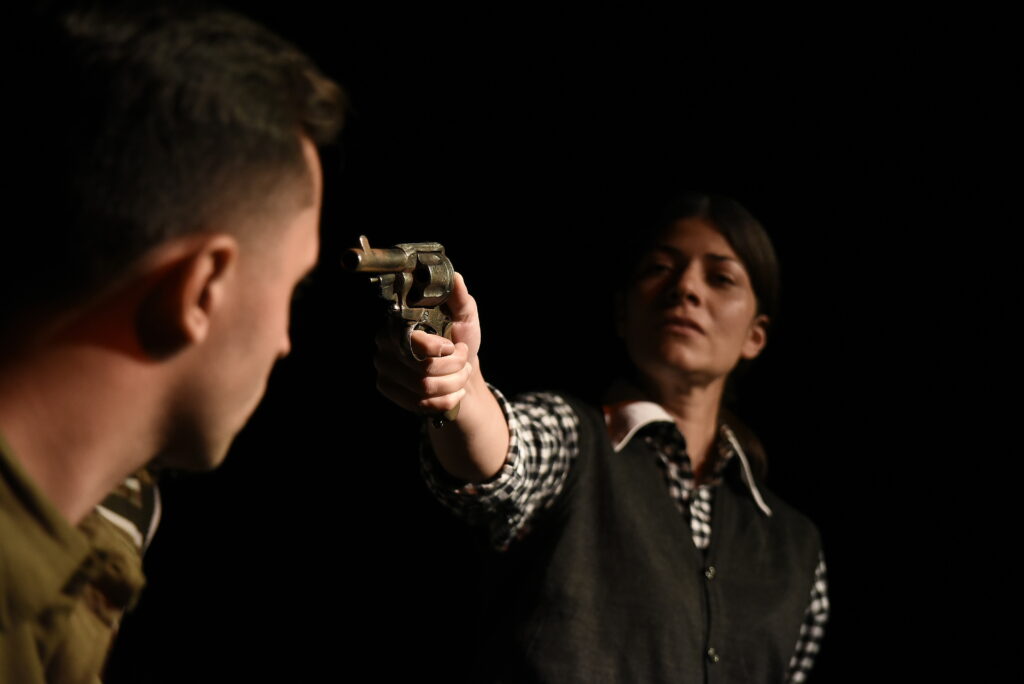
The third production is a Theatrical Ensemble 2510 adaptation of Brecht’s short story, Two Sons[3], directed by Andreas Zafeiris. This powerful anti-fascist production was presented in Greece for the first time, making the performance groundbreaking.
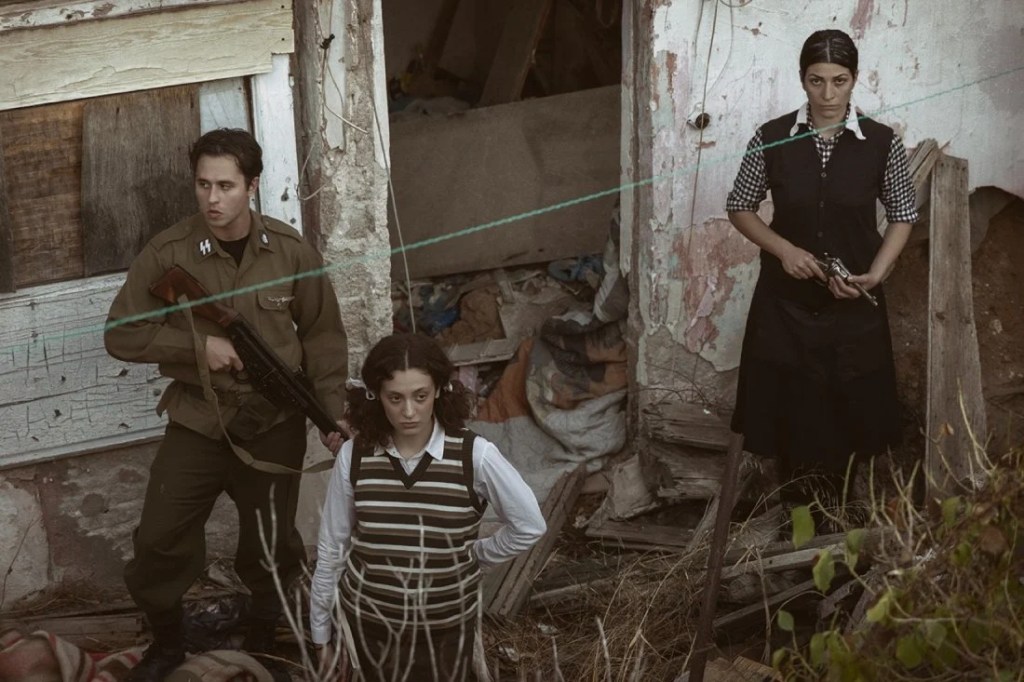

Photos by Panagiotis Loukopoulos
Although the play is short and the storyline straightforward, its analysis is deeply layered and thought-provoking. It incorporates Brechtian techniques, aiming to create a sense of estrangement for the audience throughout the plot. This approach is particularly insightful as it relies heavily on eliciting a critical response from the viewers.
The stage design and costumes are minimalistic, with the direction placing a stronger emphasis on gestures and physical expression.
This production incorporated an after-play discussion with the audience which is pioneering and instructive for the Greek audience.
To draw broader conclusions about how Brecht is interpreted in Greek theater, it is essential to examine how his content is understood and represented in staging practices.
A recurring issue in these adaptations is the lack of a clear understanding of the political underpinnings of Brecht’s work. Misinterpretations of Brecht’s ideas stem from the director’s own perceptions, beliefs, and interpretations, which ultimately shape the adaptation.
For instance, in Biniaris’ adaptation of Arturo Ui, the play fails to explicitly address class struggle and portrays fascism as a deviation from capitalism rather than an organic derivative of capitalism. Additionally, human weakness is depicted in a metaphysical manner, disconnected from social causes—a perspective Brecht would strongly reject. As a result, the play conveys an overwhelming sense of humanity’s defeat, which contradicts Brecht’s intent. He would have sought to inspire change and action, not to present a dystopian, hopeless narrative.
In the case of Livathinos’ adaptation of Courage, despite a well-researched approach, the multiple interpretations of Brecht and his work result in a tone of neutrality and idealism. The play presents war as universally destructive, even for merchants, whereas Brecht’s original highlights the stark divide between humanity and capitalism. In this adaptation, dramatic catharsis becomes the goal, diverging from Brecht’s intent of imparting a lesson to be learned. Furthermore, the play portrays war as a time when classes were unified by devastation, which contradicts Brecht’s perspective.
The emphasis on class struggle is diluted, and any Marxist references are conspicuously absent. This stems from interpreting Brecht not simply as a Marxist but as a broader intellectual of his era. However, this approach not only strips Brecht of his Marxist foundation but also creates issues with the meanings of key concepts generated by his Marxist ideas—such as humanity, capitalism, war, and peace.
Once again, the focus shifts to human weakness: poor decisions, an inability to stand up for one’s rights, indulgence in guilty pleasures, and personal contradictions—elements that overshadow the social and political critique central to Brecht’s work.
Lastly, in the case of The Two Sons, Brecht’s ideas are once again misinterpreted—if not outright misused. His concepts are evaluated through a philosophical lens detached from his historical and ideological beliefs. The play suggests an immutable, inherently flawed human nature. Even the promotional material for the performance describes it as “A timeless work about human nature, the beast within us, and the system that gives rise to Nazism.”
While one might overlook the phrase “the beast within us” as a poor representation of Brecht’s perspective, the inconsistency becomes glaring when the production simultaneously claims to present “the stage as a place of critical thinking and functional reform (Umfunktionierung).” This contradiction undermines the essence of Brecht’s approach and does not align with his intention of fostering critical analysis and social change.[4]
How can a person be both a dynamic beast and a critical thinker? How do we navigate such a stark division between beasts and saints? If the “beast” is within all of us, what went wrong for those who opposed Nazism during World War II? Is it truly Brecht’s view that the beast resides within us all? These questions are ultimately futile. Once again, the interpretation strays far from historical truth, factual context, and the writings of Bertolt Brecht. Had it not been for such deviations from Brecht’s thinking, perhaps this last case could be more essentially related to Brecht rather than addressing his work.
The questions raised by the play reveal an individualistic understanding of human nature—an anarchistic individualism that the direction has imposed on its reading of Brecht. Yet Brecht himself explicitly rejected such ideas, both in his works and in his personal life. This interpretation not only misrepresents Brecht but also undermines the socio-political foundations of his thought.
Dystopia is consistently dominant and unchangeable as an element in the piece. The only thing that can be transformed is the inner self of humans, not the system. There isn’t even a suggestion that humanity has the power to reshape society or history. And when the question of social emancipation arises, the answer becomes ambiguous. For Brecht, however, the answer was clear: socialism.
Ultimately, despite the talented cast, their exceptional professionalism, and the ideological roots of interpreting Brecht, this version presents an alter ego of Brecht—less socialist, less revolutionary, farther from Marx and Lenin, and more aligned with the director’s own perspectives and political stance. This brings to mind David Barnett’s concept of the unity and mutual processing of theory and performance in Brecht’s political theatre.[5] His political beliefs determined his theatrical and performance characteristics.
In Greece, performance practices arise from a lack of deep understanding of Brecht, and, to some extent, research-based approaches to his work. Apart from accidental misjudgments based on this inadequacy, a political reification of Brecht is unfortunately noticed. Violating the relations between the text, its time and the author, downgrading the importance of theoretical works, such as the Short Organon and Buying Brass, the schemes of political reification can portray Brecht as an anarchist, a liberal, or even a reformative political thinker and undermine his ideas on fascism, war, human nature.
The staging of Brecht’s work is often formalist, and his techniques are frequently reproduced without regard for his underlying ideas about theatre, the actor’s role, drama, or epic theatre. This lack of insightful staging leads to misinterpretations and misquotations that dilute Brecht’s intentions, doing more harm than good to his legacy.
As a result, audiences often approach Brechtian plays as if they are museum exhibits—old, dusty relics of theatre history—or something “classic” and detached from their original purpose. These limitations are evident in Greek stagings, where Brecht’s method—a dynamic, modern approach to theatre aimed at fostering social awareness and political action—is often diminished. The emphasis tends to shift toward creating spectacle rather than highlighting the political essence of Brecht’s ideas and plays.
My advice? Read Brecht, appreciate his texts in regard to his political ideas, and prepare to be amazed. Then, keeping Brecht’s own guidelines in mind, make art a useful weapon for those in need.
George Sarantopoulos is Doctor in Philosophy at the National Kapodistrian University of Athens and a philologist. He also serves on the Administrative Board of the Panhellenic Union of Philologists.
[1] The Resistible Rise of Artutro Ui (Greek: Η άνοδος του Αρτούρο Ουί). Duration: 90′. Text by Bertolt Brecht. K. Paleologos (Translation), Aris Biniaris (Director), Elena Triantafyllopoulou (Director Assistant), Paris Mexis (Associate in dramaturgy, production, dramaturg), Paris Mexis (Costume Design), Stella Kaltsou (Music coach), Alexandros Ktistakis (Music composer), Hara Kotsali (Movement), Hara Kotsali (Movement).
Cast: Michalis Valasoglou, Thanasis Isidorou, Aris Kasapidis, Tasos Korkos, Kostas Koronaios, David Malteze, Errikos Miliaris, Marios Panagiotou, Maria Parasiri, Alexia Sapranidou, Foivos Symeonidis and Yiorgos Chrysostomou (as Artutro Ui). Since February 2024, Kimon Kouris and Sotiris Tsakimidis have been replacing Michalis Valasoglou and Kostas Koronaios.
[2] Mother Courage and her children (Greek: Μάνα Κουράγιο και τα παιδιά της). Duration: 165’ (with intermission). Text by Bertolt Brecht. Giorgos P. Depastas (Translation, lyrics), Stathis Livathinos (Director), Theodore Abazis (Music), Eleni Manolopoulou (Set and costume design), Andi Xhuma (Movement), Alexandros Avranas (Video design), Alekos Anastasiou (Lighting Design), Erie Kyrgia (Associate in dramaturgy, production dramaturg), Melina Peonidou (Music coach), Elena Bernte (Directing assistant), Yorgos Karoumpalos (Music assistant), Emily Koukoutsaki (Set and costume design assistant), Elina Aloupogianni (Second set design assistant), Marialena Triglida (Third set design assistant), Olga Faleichyk (Makeup design), Konstantinos Koliousis (Hair design).
Cast: Nikos Alexiou (Chaplain), Bety Arvaniti (Mother Courage), Antonis Giannakos (Swiss Cheese), Giannis Dendrinos (Sergeant, Soldier, Ensign, Older soldier), Panagiotis Kammenos (Cook, tenor saxophone, bass), Fotis Koutrouvidis (Soldier, Narrator), Paris Leontios (Clerk, Soldier, Narrator), Anna Magou (Kattrin), Vasilis Darmas (Sergeant, Soldier, Narrator, bass), Vasilis Papadimitriou (Peasant, Soldier, Narrator, clarinet, bass clarinet), Angelos Pappas (Man with the bandaged eye, Soldier, electric guitar), Antonis Parharidis (Colonel, Soldier), Theodosia Savvaki (Peasant woman, saxophone), Eva Simatou (Yvette), Ioannis Syrios (Eilif), Christos Sonakis (Recruiting officer, Soldier), Vasilis Tsalikis (Soldier, Young peasant, Narrator, Soldier, keyboard), Stamatis Fakorellis (Quartermaster, Soldier, on-stage musician), Iakovos Pavlopoulos (percussion)
[3] Two sons (Greek: Δύο γοι). Duration: 75’. Text by Bertolt Brecht. Andreas Zafeiris (Staging, adaptation, performing, Director), Maria Makridima (Assistant Director), Team 2510 (Costumes, settings), Panagiotis Loukopoulos (Photography), Elefteria Sakareli (Communication – PR). Cast: Panos Konstantelis, Viky Ediaroglou, Eri Marioglou.
[4] David Hume and the philosophers of early capitalism sought to define the stable essence of human nature and the human condition, viewing them as fixed either by nature or by law.
[5] David Barnett. Brecht in Practice. Theatre, Theory and Performance. Bloomsbury, 2015.


 E-CIBS