

Brecht’s The Mother, an adaptation of Maxim Gorky’s novel about a widowed housewife turned socialist revolutionary leader, originally premiered in 1932, in Berlin. Three years later, Brecht would have his North American premiere with a run of the play in New York City. This production was a notorious failure. Cultural barriers and differences in aesthetic philosophies were to blame. The play and the music had been created for Brecht and composer Hanns Eisler’s newly developed epic style of performance. However, despite their attempts to convince the director and musical director to embrace the style the play was written for, the directors refused. At one point during rehearsals, a heated argument arose, and Brecht and Eisler were thrown out of the theater. Tempers were so heated that they had to ask scenic designer Max Gorelik to retrieve their hats for them. It seems that New York and America were not yet ready for Brechtian theater.
Ninety years later, running from March 29–April 13 (review date April 4), A Mother, a loose adaptation of The Mother, had its world premiere in New York at the Jerome Robbins Theater in the Baryshnikov Arts Center.
The play was written by the Emmy-nominated and Lilly Award-winning Neena Beber, who co-conceived it with the show’s lead, the Tony Award-nominated Jessica Hecht. The rest of the troupe, under the direction of Maria Mileaf, was composed of Delilah Napier, Zane Pais, Fergie Philippe, and Portia, who all doubled, tripled, and even swapped roles.

The interchanging of roles had a dual function. It provided needed moments of levity, which helped balance out the weightier moments, and it helped create critical detachment by pointing out to the audience the contrived nature of the performance, as if to say, ‘We are trying to show you something here—we’re doing this for a reason, so pay attention!’
This critical detachment was furthered by the choice to have a virtually non-existent set, merely a phantom hint of locations bounded by the black box of the theater. This also allowed the actors to emerge and showcase their talents.
Inspired by an ostensive chance encounter with an old paperback copy of Brecht’s The Mother, the play masterfully interweaves scenes from The Mother with several narrative threads that recount formative moments of Hecht’s adolescence.
The first primary thread was her experiences at a Jewish summer theater camp, where she was first exposed to Brecht vis-à-vis his The Mother by a radical and idealistic camp counselor, Michele (Delilah Napier), who had just returned from Berlin. Enamored by the liberating social potential of Brecht, Michele sets out to teach the youths Brecht’s politically motivated approach to theater while directing the camp’s production of Paint Your Wagon.
The second was her first romance, which was with an African American boy, Daryll (Fergie Philippe), in Miami’s disco scene in December of 1979—a period and place marked by racial tension, something that would lead to massive riots in 1980 after the police killing of Arthur Lee McDuffie, a Black insurance salesman and former Marine who died as a result of a brutal police beating.


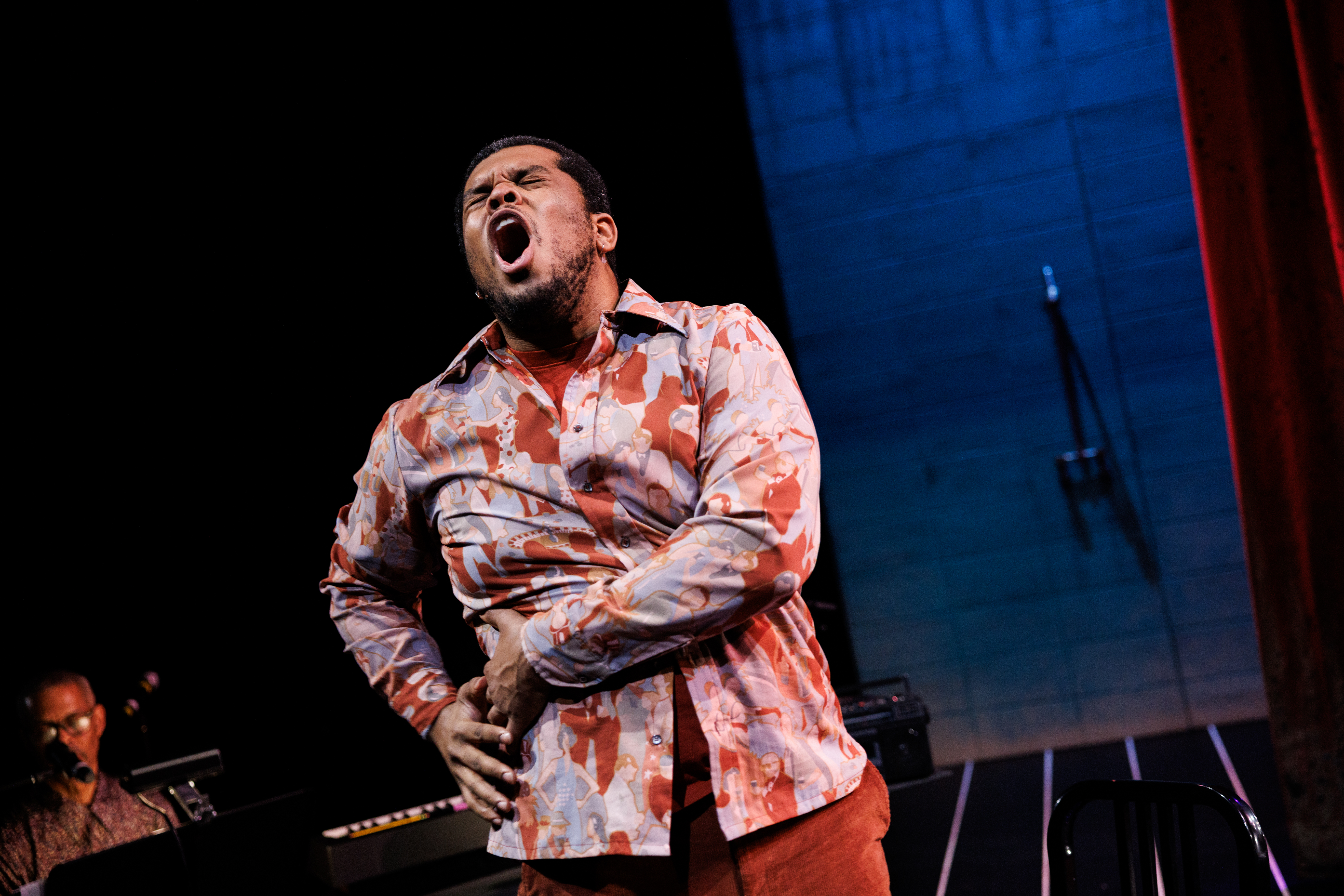
Photo by Maria Baranova.
With these two primary narrative threads, the play sets up a dialectic of justice/injustice. Through her romance with Daryll, Jessica is exposed to racial injustice and issues of systemic racism, and through her interactions with Michele, Jessica is introduced to the possibility of helping to achieve justice through Brecht and theater.
The various narrative threads of Hecht’s life maintained a degree of conceptual separation from each other and obviously from the scenes from Brecht’s play, but they were all skillfully connected by an internally consistent logic through the device of a meta-aware Hecht. This meta-aware Hecht (a quasi-fictional, quasi-self-portrayal, with a deliberate blurring of the two) guided the overarching narrative using a great range of her acting talent, oscillating from laugh-out-loud quips to gripping social drama.
In the end, the aforementioned dialectic is left open, and the audience isn’t left with any resolution to the social issues of the dawning 1980s Miami. Nor are they given one to those of our time, for that matter. What they are left with, however, is the idea that each of us is a potential catalyst of social change, a potential revolutionary, a bearer of the banner of social justice. In this way, A Mother employs Brecht’s The Mother as a device to address the social issues of our time, just as it did the social issues of his time.
The brillance of the piece was further heightened by the music. The songs were composed by the multi-talented Mustapha Khan, a two-time Emmy Award-winning filmmaker, with help from Beber, the cast, and the musicians William Kenneth Vaughan and Norman “Skip” Burns. Aesthetically, the music displayed great variety and range, moving from disco to Latin beat, to Black liberation undertones, to honky-tonk campfire. The latter was clearly one of the crowd favorites. In this song, a guitar is hurriedly shoved into the hands of Zane Pais (who, as a running gag, has trouble keeping up with who he’s supposed to be playing). He’s then told he’s now somehow supposed to be playing Brecht himself. After a brief moment of panic, he’s ready to start strumming as soon as the first ray of the spotlight hits him. Besides just being great fun, the song, “Let’s Make Strange,” also served as a pithy little lesson on Brecht’s aesthetics.

Brecht’s The Mother was a fitting work to adapt because our present time demands the type of militant response the work offers. While I do wish the production would have leaned more heavily into the militant aspect of the piece and let Brecht’s militantism seep more into the other narrative threads, it was by no means buried. So, I’m happy to take what I can get.
This show’s run came at a very serendipitous time for me—i.e., while I was at the end of a six-week, eleven-event lecture and workshop tour promoting a new book on Brecht and adaptation. Therefore, I feel like I can say with some authority that the work really has a Brechtian spirit of adaptation because it takes that which of Brecht is useful for right now, in this historical moment, under these material conditions, for these creators’ socio-political intentions, and wields it as a weapon in social struggle.
This was a point I made sure to raise during a special Brecht Talkback panel after the show, moderated by the production’s dramaturg, Fareeda Pasha, which featured my E-CIBS co-editor Joerg Esleben, Foster Hirsch, and myself. The talkback generated a lively discussion ranging from Brecht’s aesthetics, political theater, current events, and translations and even garnered comments out of the audience from Academy Award-winning actress Estelle Parsons.

In sum, this show was a great success on all fronts. Clearly, everyone (the musicians, director, cast, crew, and audience) was more prepared for Brechtian theater than they were ninety years ago. But it’s uncertain how much of Trump’s Amerikkka is ready for the message of A Mother. Nevertheless, it is ‘ganz klar’ that this show is needed now, ready or not. It embodies the Brechtian spirit of adaptation, which simultaneously points out the grim realities of our dark times while keeping open the possibility of altering the social mire that fails and injures so many.

Anthony Squiers, PhD, Habil. is a faculty member at AMDA College of the Performing Arts and co-editor of E-CIBS. He is the author of An Introduction to the Social and Political Philosophy of Bertolt Brecht and Bertolt Brecht’s Adaptations and Anti-capitalist Aesthetics Today.
Cover photo by Maria Baranova.


 E-CIBS