
In the shadow of the minster where the Council of Konstanz convened in the fifteenth century, the city’s theatre once again erected its open-air venue, this year for a production of The Threepenny Opera, directed by Christina Rast. While performing this play outdoors is a challenging endeavour, Theater Konstanz offered a rewarding evening with its stage adaptation that was particularly notable for its distinctively Brechtian acting style and its striking use of costumes.
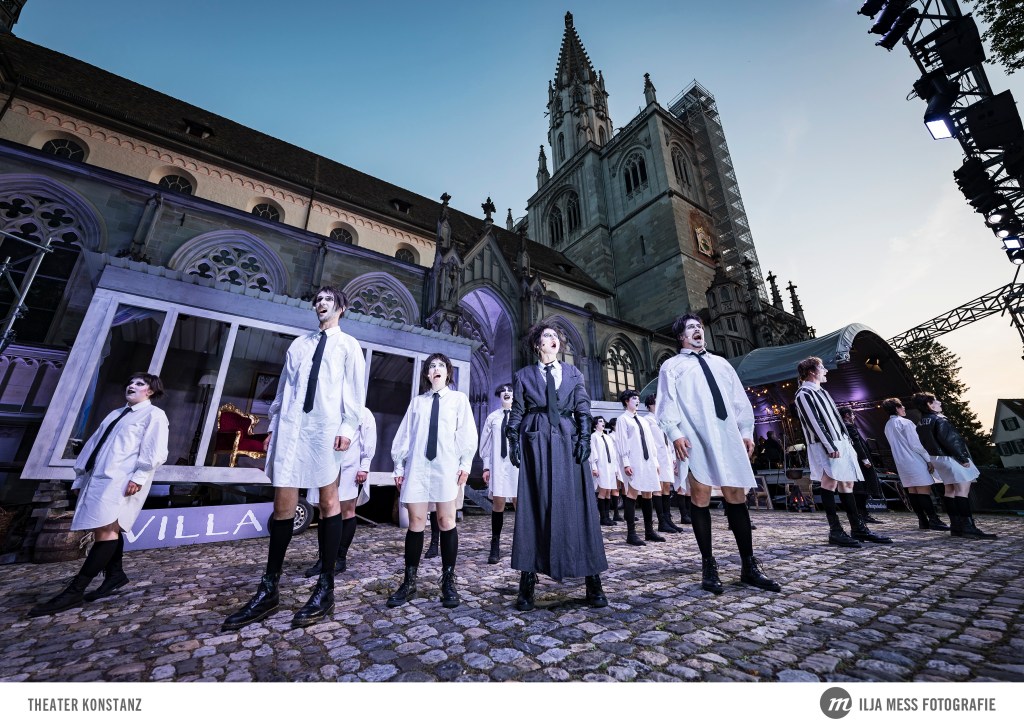
Reflecting the extent to which the show is embedded in and in dialogue with its architectural surroundings, the performance began on the dot, accompanied by the ringing of the church bells. Indeed, the minster was very much part of the stage set (Franziska Rast) – there were no curtains separating the stage from the architecture behind, for example. Protected by trees that casted much-needed shade on the hot summer evening,[1] the audience sat facing the windows of the church. The stage was built horizontally, running alongside the nave. This large, stretched-out stage was challenging to play on, in particular in daylight, when it is noticeably difficult to catch the audience’s attention and when spectators may get the feeling of missing out on some of the action happening at the far end of the stage. Light and sound technology aside, the stage machinery was minimal as the set remained the same throughout and actors played in the middle of the cobblestones of the square itself. Behind them, however, there were four different ‘mini’-stages that represented stages-on-the-stage: stage-right, a prison with a balcony on top; in the middle, two wagons, one of which serving as the stable in which Polly and Macheath get married, later transformed into a villa, and the other one functioning as Peachum’s outfitting shop; and finally, stage-left, a more conventional stage with a roof for the orchestra (Bodensee Philharmonie under the direction of Gabriel Venzago and conducted by Manuel Lauerer). The wagons were not only somewhat reminiscent of Mother Courage’s cart but the arrangement also echoed the medieval tradition of pageant theatre in a nod to the historical context of the minster square.
Jasper Diedrichsen.
The most characteristic feature of this production was certainly its approach to acting, which was very much Brechtian in style – not only because actors repeatedly fell out of their roles to read out stage directions or to address the audience. In the Konstanz production, bodily movement took centre stage, foregrounding the physical dimension of acting. Gestic elements played a central part as the repeated use of specific exaggerated gestures, such as a hand-shake to mark business deals, structured the performance. The acting style was also heavily inspired by pantomime, for example during the Ballad of Mack the Knife, when the cast moved in unison as if trying to start the ‘motor’ of the accordion player, a member of the orchestra, who accompanied them. Because the ‘engine’ of the instrument stuttered again and again, Weill’s and Brecht’s uber-famous song was repeatedly interrupted in the spirit of Verfremdung, thereby making it difficult for the audience to swing and sing along, as they might otherwise have been tempted to do. Such appearances of the cast as a chorus were an important element in this production and underscored the importance of choreography (Vivian Kremer), which created strong images and powerful examples of gestic acting.
This emphasis on the collective was enhanced through the costumes (Sarah Borchardt) as the actors all looked the same, wearing a long white shirt with a black tie, black socks and shoes, slightly dishevelled hair and faces coloured in white. Some wore additional items to clarify their role – for example, a black leather jacket with ‘POLICE’ printed on it for Tiger Brown (Jana Alexia Rödiger), or a striped jacket for Macheath (Jasper Diedrichsen), foreshadowing his repeated imprisonments. This choice of costume design reinforced the collective significance of the story, suggesting that it is universally applicable rather than based on individual fate. It also served to prevent identification with the character – both for the actors themselves and for the audience, who was required to concentrate on figuring out who plays whom. And finally, it sought to blur gender distinctions (even though the general approach to casting was not gender-blind).
The characters that stood out most from this collective were Jonathan Jeremiah Peachum (Patrick O. Beck) and, even more so, his wife Celia (Michaela Allendorf). In the Konstanz production, they performed central roles – it was their actions that fuelled the plot and it was they that were in control over the events. For example, when Macheath was betrayed by the sex workers, the Peachums were sitting in armchairs in their villa, cunningly observing the intrigue unfold. Their dominant role was also underscored through their costumes, which, while resembling those of the rest of the cast, had Gothic elements.

The Peachums also stood out for their vocal performance. Michaela Allendorf, in particular, delivered a striking and remarkable portrayal of Celia Peachum that emphasised the central significance of this character, with Allendorf commanding the stage with both her powerful voice and her compelling physical presence, often, as a result, outshining the other characters. Indeed, while Brechtian theatre is amateur in style, there was a considerable discrepancy in actors’ renditions of the songs. Some actors had comparatively weak voices and Macheath was rendered as a whiny, cowardly figure that lacked the charisma and appeal often associated with the figure.

HINTERGRUND: Thomas Fritz Jung, Kristina Lotta Kahlert, Michaela Allendorf, Anne Rohde,
Jana Alexia Rödiger.
Despite this discrepancy, however, the show finished on a strong note as the deus-ex-machina that saves Macheath from the gallows was initiated by the re-appearance of the chorus, with the actors now all dressed up as Bertolt Brecht, wearing leather coats, hats, and glasses, deciding – much like in John Gay’s The Beggar’s Opera – to intervene and change the ending.

Kahlert, Michaela Allendorf.
This explicitly metatheatrical device not only strengthened the V-effect that underpinned the entire production, but also drew attention, as dramaturgical assistant Annika Hilger writes in the programme note, to the predominance in public perception of Bertolt Brecht as sole author of The Threepenny Opera, rendering invisible the work of his associates, most notably that of Elisabeth Hauptmann, whose work as collaborator is acknowledged by Theater Konstanz. It is this attempt to bring The Threepenny Opera and, with it, the work of Kurt Weill and Elisabeth Hauptmann to greater public attention through a performance on the popular outdoor stage on Minster Square that make the Konstanz open-air production both a worthwhile theatrical undertaking and a pleasurable evening – in the best Brechtian sense – for the audience.

Anja Hartl is an Assistant Professor in the Department of English at the University of Innsbruck, Austria. She is the author of Brecht and Post-1990s British Drama: Dialectical Theatre Today (Bloomsbury, 2021) and has edited the Methuen Drama Student Edition of The Threepenny Opera. In her postdoctoral project, she explores shame in the Victorian novel. She has published on contemporary British theatre, Bertolt Brecht, the Victorian novel, Shakespeare, adaptation, and border studies, and is co-editor of the Bloomsbury Methuen Drama Agitations series.
[1] The reviewer saw the production on 21 June 2025.


 E-CIBS