
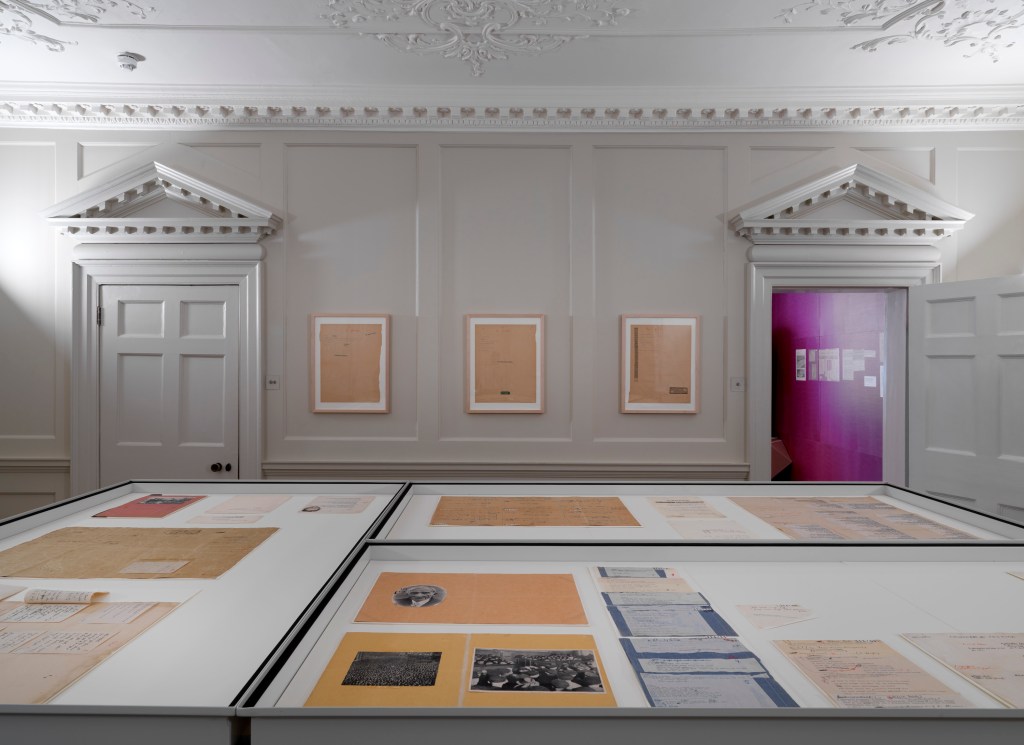
brecht: fragments took place at Raven Row, London, from 15 June to 18 August 2024. It was the first exhibition to address Bertolt Brecht’s image- and text-based collagist methods, featuring original visual materials from the Bertolt Brecht Archive, Berlin, alongside a performance montage assembled from his dramatic fragments. It was curated by Phoebe von Held, in collaboration with Tom Kuhn, Alex Sainsbury, and Iliane Thiemann from the Bertolt Brecht Archive at the Akademie der Künste, Berlin.
In this interview, Beny Wagner, an artist, filmmaker, and writer discusses the conception of brecht: fragments with its curator, the talented theatre-maker and scholar, Phoebe von Held. Their conversation explores how archival materials were transformed into performance, how the architecture of Raven Row shaped the dramaturgy, and why Brecht’s methods of montage and fragmentation remain urgent today.
Beny Wagner: My visit to your exhibition and performance brecht: fragments at Raven Row in June 2024 felt like a revelation about the relationship between art, politics and form. I was intrigued how and why someone would inject Brecht into the present cultural and political landscape. What I experienced was a surprise, a sort of collision of the past and the present in ways that don’t exactly fit neatly. It was this effort to bring different orders together — the theatre into the art space, the politics of another time and place into our context — and working within the gap between these orders, that produced an incredibly productive rupture for me, a space where I suddenly felt my own agency to imagine new kinds of relation.
Phoebe von Held: I wanted to share some of the more experimental and less well-known aspects of Brecht’s creative processes — his visual production and methods of fragmentation, which generated materials that might not even have been intended for the public. A contemporary arts context seemed the most apposite context for this, especially as it recognises the transdisciplinary legacy Brecht had on avantgarde thinking across the arts to this day. Of course the materials that we showed were ‘historical’ but the starting point for this project consisted in a recognition that some of Brecht’s social analysis of the struggles imposed by capitalism —treated so poignantly in some of his dramatic fragments — still speak to us with shocking accuracy a hundred years on. In the very early explorations, trying to decide which materials should enter the exhibition, I was indeed worried that some of the visual material that Brecht produced, which grows richer and more differentiated during his exile years in the 1930s and 40s — that this material might be received with a historical distance not productive for being put into a dialogue with current politics. But when the material finally went on display in 2024, it became patently clear that Brecht’s photographic montages with their exposition of the gestures of dictatorship, fascism, totalitarianism, and imperialism created a frighteningly powerful resonance with the rise of the ultraright, the resurgence of populist, dictatorial leaders and the return of the threat of global war we have been experiencing in the past decade.

BW: What I found so compelling about the project was often located in the meticulous formal decisions and strategies that structured every part of the exhibition, but particularly the performance. Whether it was the costumes, or formal flourishes in the acting, the sets, or the many ways in which the space itself was activated in the course of the performance, it felt to me like the smallest details reverberated through the whole production. There is great strength in the plays’ messages about inequality and greed, alienation and suffering. But beyond the messages, what I found most evocative were the many ways that specific formal decisions, large and small, come together to produce an experience that is latent with creative and political expansiveness. Can you talk about how this exhibition came to be? How did you arrive at the idea of bringing Brecht’s collages together with his dramatic fragments? How were these reimagined for the specific parameters of Raven Row?
PvH: The first impulse towards this exhibition arose from a translation project of one of the dramatic fragments in the exhibition, Fleischhacker (1924-31), in which Brecht’s anti-narrative, fragmentary style is radicalised to a point that the disparate scenes can no longer be arranged within a chronological arc. My co-translator Matthias Rothe and I kept discussing the astonishing unperformability of this highly fragmented text and that in a way, the most adequate way of showing it would be in the form of an installation. This already was a key moment in reorienting my dramaturgical thinking towards imagining the piece within an exhibition context rather than a theatre. Reviewing the original manuscript folder at the Bertolt Brecht Archive in Berlin, I was also struck by the fact that Brecht and his collaborator Elisabeth Hauptmann had collected in it a substantial number of visual documents. I came to see another project folder, Die Heilige Johanna der Schlachthöfe (1931)[Saint Joan of the Stockyards], in which Brecht and Hauptmann pasted photographic images and illustrations, cut out from newspapers, onto several manuscript folders. The entire manuscript consisted of a collage of strips of typescript mounted onto coloured card. I was deeply impressed by the visual impact and dexterity characterising these pages. A continuum between the radicalisation of fragmentation in Brecht’s writing, the overarching use of montage across media, and the exploration of images became apparent. So these insights congealed to an idea of performing Fleischhacker as a play in image-like fragments as part of a larger exhibition dedicated to Brecht’s visual project.
BW: I love how the whole project begins from a sense that the work is unperformable. The catalyst of its abundance of creative expression is a seeming dead end. You mention Fleischhacker, but the performances included several other plays. How did you select them, and what led you to weave them together?
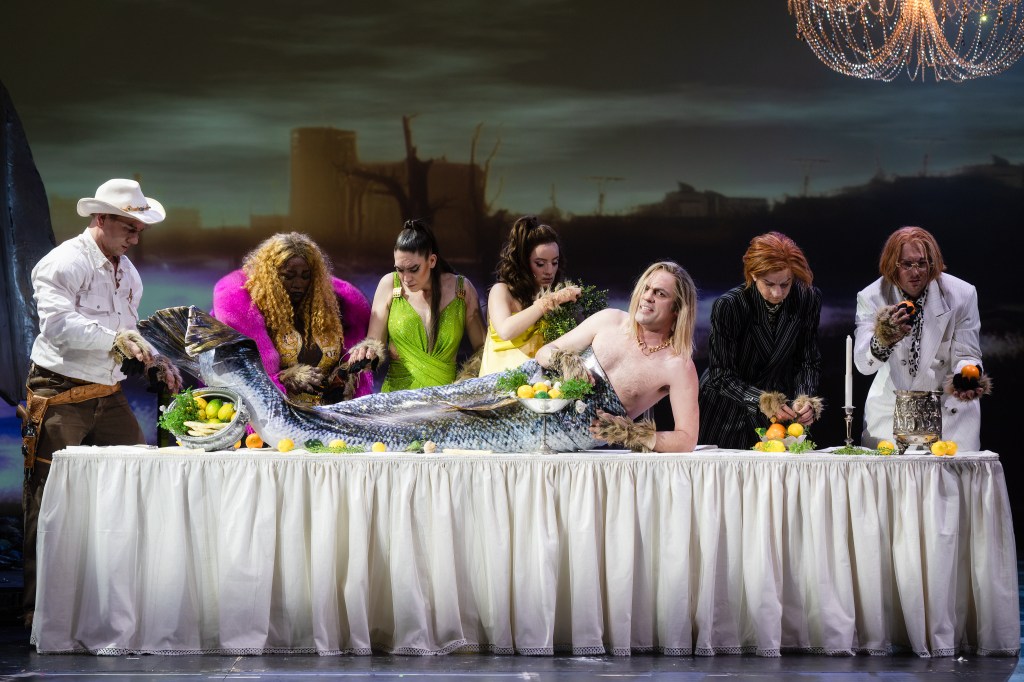
PvH: The idea of creating a performative montage consisting of not just one but several dramatic fragments emerged in early-stage conversations with Alex Sainsbury, director of Raven Row and one of my co-curators. Alex suggested to stage fragments of scenes from different plays alongside fragments of archival image materials, all scattered across the different spaces of Raven Row. At first, I was concerned that such de-contextualisation would come across as eclectic and compromise the political meaning elaborated in the work. But then I realised that by choosing very specific projects, we could explore the extraordinary thematic and formal inter-connections that unfold across Brecht’s writing at large. This corresponded to an idea that interested me very much, namely Brecht’s attempt to address larger systemic questions as part of his conception of the ‘epic’, which is not just about disruption, but also about establishing inter-relations on a macroscopic level. To complement Fleischhacker, I made a selection of three further dramatic fragments, chosen from the fifty unfinished plays published in German. All four projects were written during the second half of the 1920s, speaking to Brecht’s unrelenting quest to dramatise globalised modernity, with the topic of capitalist economy at the centre. These texts also resonated strongly with current issues: Fleischhacker and Breadshop (1929-30) respectively explore the dysfunctionality of deregulated financial markets and their devastating effects on the everyday economic reality of people on the street. Fatzer (1926-30) is a reflection on the experience of global war and the financial interests behind it. The Flood (1926-27) takes issue with humanity’s unchecked self-elevation through technological progress, and an ensuing self-inflicted apocalypse, which now reads as climate disaster.

Photograph by Anne Tetzlaff.
BW: Brecht understood the focus on the individual and their personal story as marks of bourgeois culture confined by individualism. He devised non-naturalistic techniques of acting to shift the focus from the individual towards social relations, the relations between the actors on stage and between the actors and their environment. To foreground this space of relations, how the different parts simultaneously influence and are influenced by the others; to focus on this was to focus on how social and political relations are open to perpetual change. Can you describe how you worked with the actors towards Brecht’s relational style of acting in the rehearsals?
PvH: The non-linearity inherent in this montage of unfinished text fragments and its rehearsal process, constantly moving between scenes and even plays, and across a set of separate spaces, I think, pushed the actors to work more closely together to forge that ‘relational style’ that you perceived. The focus was always on the single scene — on an isolated situation or social configuration — so the actors needed to bring all their attention to finding solutions to that specific interaction without much of a lead-in or narrative context. They had mainly each other to rely on and the reciprocity of their textual interpretations. So I would say it was partly due to the amplification of fragmentation that marked this project — the actors simply couldn’t draw on their own narrative ‘journey’ as they would do in a conventional play. But perhaps even more profoundly, it was anchored in Brecht’s immense poetic and dramaturgical skill to tease out the dialectical power dynamics inherent in social relations by means of collective gesti and to do so with such analytical sharpness and with that these become highly inspiring and to actors and to me as a director who enjoys working with movement and gesture.
BW: By transporting this relational sensibility from the theatre to the exhibition space, where the actors and viewers shared the space in somewhat open-ended ways, I felt every part of the performance was cast in a new field of relations: the relation between theatre and installation, between performance and movement, between the actors and the audience, between the inside of the gallery and the world passing by outside. The unusual spatial configuration of the exhibition space in a way multiplied relational reference points. How did you initially decide how you were going to embed the performance into the complex architecture of Raven Row?
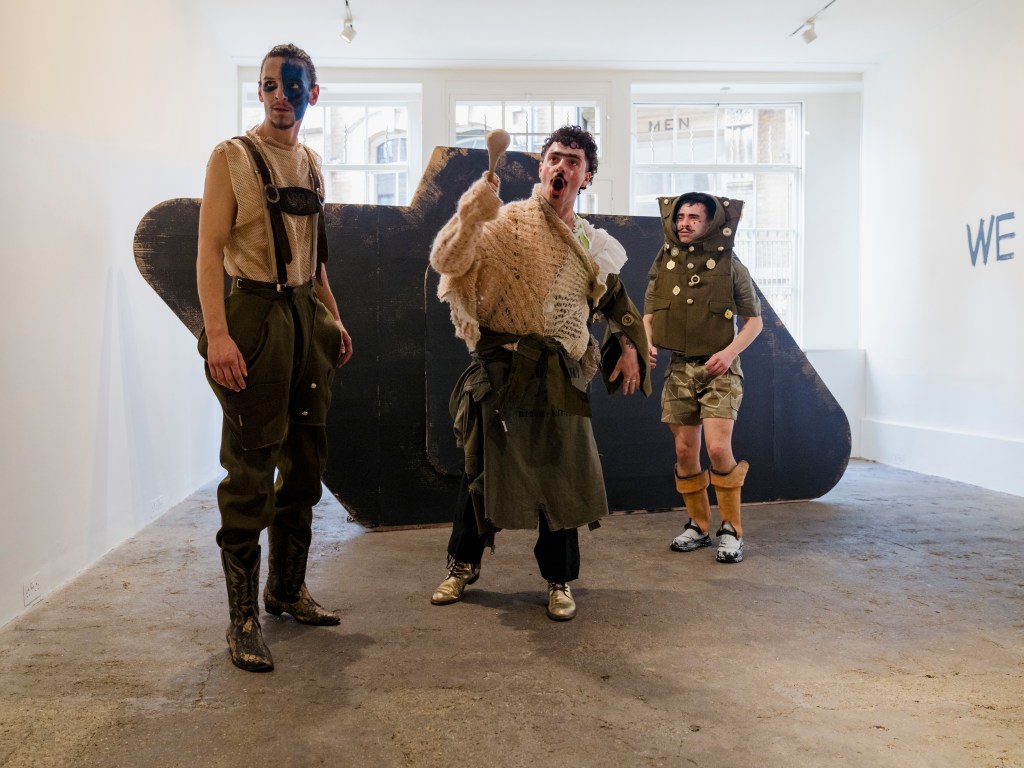
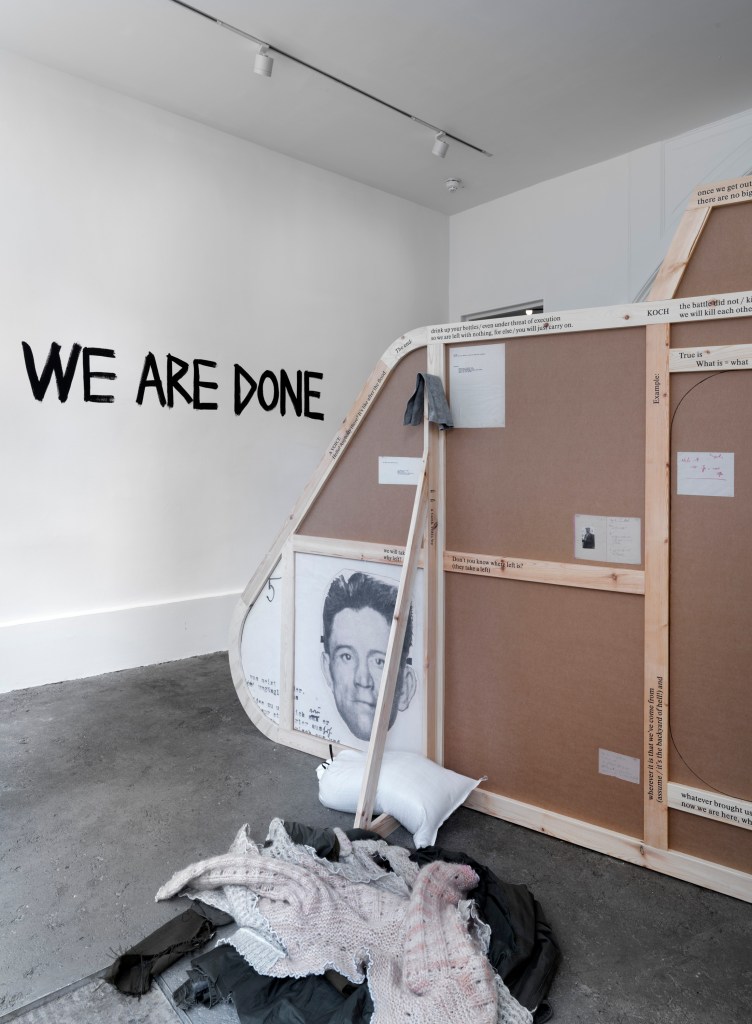
PvH: The main decisions around the use of space were taken in tandem with the development of the performance script in 2022 as part of a site-specific RnD with actors at Raven Row. In collaboration with a dramaturg, Henrik Adler, we had worked out a greatly reduced scene selection, paying attention to thematic and poetic correspondences as well as to the relationship to the space. Although it would have been much simpler to confine ourselves to a single space, we couldn’t resist working with the full range of Raven Row’s highly evocative architectural and geographic features — the eighteenth-century elements of the historical building, its white cube modernism, its openness to the street, situated in a part of the historical East End that now neighbours directly on the financial district of the Square Mile. Moreover, distributing the scenes across the entire building promised to give us a highly nuanced framework of modulating the different registers of Brecht’s aesthetics of fragmentation. It invited us to use the divisions, gaps and connections inherent in the architecture for structuring our montaged dramaturgy. Doors and walls perfectly manifest the twofold separation yet connectedness between scenes. Staircases could serve as extended conduits between play fragments that seem at first sight separated but then come to form a nexus sociologically or poetically. A room could emphasise the isolation of a dramatic fragment when a door would shut. A door opening unexpectedly, with an actor breaking into an ongoing scene, could serve as a moment of disruption. So we then developed the idea for a site-specific promenade piece, mapping the longest, most coherent scene of Breadshop onto the largest space in the modernised basement, which also features a panoramic window at street level, perfectly designed for the recurrent entrances from the street that are written into the play. The much more fragmented scenes of Fleischhacker, Flood and Fatzer were located across a number of smaller rooms, corridors, staircases and halls on three levels of the historical building. The spatial symbolism and subjective experience of the architecture became key. The gravitational pulls between ‘the high’ and ‘the low’, between rising and falling, elevation and depth, not only as socio-economic markers, but as a deep anthropological experience of being-in-the world, are fundamental allegorical polarities in Brecht’s writing. So we used the spatial conditions of the building as inspiration for the way we sequenced the scene fragments along the promenade, and of course as a way of amplifying the sociological/spatial symbolism expressed in the text.

Photograph by Anne Tetzlaff.
BW: I booked a slot for the performance in advance and when I arrived, I was given a coloured sticker that indicated I would be in one of two groups. I didn’t know what this meant but went to my designated area in the large gallery in the basement on the ground floor. The other group of visitors disappeared. The performance started and was so immersive that I kind of forgot about a second group. It wasn’t until we started moving, and then later intersecting with the second group, that I felt this quite powerful destabilisation of my own experience. I understood there was another performance going on that I wasn’t able to see. I understood it contained components of what I was seeing, and even assumed they were the same components. But I also understood the order would inevitably be scrambled, that the chronology was broken, and that their experience was fundamentally different from mine. Despite the immersiveness of my experience, much like my perception of the world in general, it made me aware of how profoundly incomplete my perspective is. This destabilising gap opened up a whole field of ideas for me. This is one of the formal frameworks that I think of when I’m trying to articulate the relationship between art, politics, and form. Can you talk about your decision to break the audience into two groups?
PvH: When determining the journey through the historical building, we immediately understood that we faced a major technical problem, which was that the smaller rooms and staircases severely restricted audience numbers. But this problem turned out to be a blessing because the solution consisted in splitting the audience into two groups who would follow two parallel, simultaneous performances. This doubled our capacity, but it also opened up a whole other aesthetic dimension. The audience would start out together as one group to witness a prologue from Breadshop in the basement. They then were split, and whilst one group followed the ‘promenade’ through Fleischhacker, Flood, and Fatzer up and down the historical building, the other group remained with the longer Breadshop scene in the basement. At the end of the first round, both groups briefly crossed paths in the entrance hall, and then the two parts were repeated with reversed audiences.
When we workshopped this parallel performance structure in 2022, we could see that whilst one group would become absorbed into the performances on one track, there would be a forgetting of the other group on the other track. There was a eureka moment, when we ran the whole piece with its repetition for the first time, because the two groups collided perfectly at its midpoint in the entrance hall when the transition occurred. It was a strangely riveting experience for everyone to suddenly remember that there had been a whole other performance going on outside one’s field of vision. With Uri Agnon, our composer, we then quite consciously deployed music and sound as a means of guiding the attention to places which were out of sight. An instrument would be heard from the distance with the musician/actor only approaching gradually, a long time before they would step into view. The audience could never access the full picture of all the actions and events inhabiting the building. This dazzling sense of a highly dispersed and partly obscured field of vision was enhanced by the fact that the two casts enacting the parallel performances weren’t clearly separated, but that actors would suddenly cross over into the other group, seemingly appearing out of nowhere. It allowed us to play with the dispersive element in montage, which is often forgotten over its juxtapositional qualities.
Photograph by Anne Tetzlaff.
BW: What I found fascinating was that beyond that heightened experience of my world becoming fractured and provisional, there was also some kind of continuum. At one moment I was completely immersed in my performance stream, and the next moment I understand that I am sharing this reality with these strangers. In this encounter with the other audience group, I realised the need for a community, this need for a reality that we can grasp and communicate together, and that it is necessary for any kind of political action.
That experience brought an essay to my mind, I had recently been thinking about a lot, an essay by film scholar Erika Balcom, called Reality Based Community. She’s writing in 2017 in the wake of Trump and Brexit and is grappling with the tradition of deconstruction in artist film and documentary film. I understand her central argument to be that at a time where reality is already so fractured, and where political influence operates within that fracturing and splintering, the gesture of deconstruction does not have the same claim to political action as it once did, and as we still expect of it. Instead there is political urgency in actually establishing and nurturing a different reality structure as a means of producing a commons, or a community that builds on a common reality.
I am very much translating this in my own terms. But I felt that the decisions that came to structure the performance, the way it engaged the space, and the effect these relations had on my experience as a viewer/participant managed to build collective experience and simultaneously activate its outer limits. This oscillation felt full of social and political ramifications.
PvH: This opposition between a deconstructive turn and the need for establishing a reality-based community reminds me a little of the Marxist Brecht / Lukàcs debate of the 1930s, a dispute between Brecht’s abstracted approach to realism, using forms of estrangement to break through to the ground of reality, and Lukàcs’ figurative realism, which claimed that within a reality that is already obscured through social alienation, only a figurative realism can effectively form the foundation for political critique and action. I would be very cautious about relinquishing the project of deconstruction for the sake of a shared community. What is our alternative? An unbroken kind of narrative realism? It is always going to be didactic. So, I don’t think the problem is deconstruction. Or that deconstruction doesn’t work within realities that are alienated or fractured. Whenever deconstructive analysis is undertaken successfully, uncovering a blindspot at the foundation of how we perceive or rather mis-perceive social and political realities, it cannot but deepen our understanding about the collective conditions of our experience. It is concrete and therefore builds community, even in our highly fractured, distracted and conflicted world.
Having said this, it is true that it was a crucial question in our dramaturgical process as to how to curate those moments of bringing the two audience groups together, and whether to bring them back together at all, or let the fracturedness of the whole experience take over. In the end we decided that it was important to find a way of reliably engineering an encounter between the two groups in the middle and at the end of the piece. So we did indeed opt for making this experience of being part of a community of strangers transparent. But I think the point is that this was not done on the basis of a realist narrative that reflects a specific communal experience or identity; the focus was more on the communal experience as such, a dipping in and out of a sense of belonging to a collective, and the question of a shared responsibility this may conjure up.
BW: I felt that the moment in the middle of the piece when the two groups meet in the entrance hall perfectly embodies the complex nuances you are describing here. Can you talk about how you constructed that moment?

PvH: So in order to create that encounter, we needed to find a way of synchronising the two streams. Towards the end of the first round, the audience group, who had just finished Breadshop, was led into the entrance hall to witness the ‘Savannah Song’ from Fleischhacker, the first scene in the promenade through the historical building. At the same time, the other group had just arrived at the final scene of Fatzer in the gallery adjacent to the entrance hall. So the two groups were only separated by a wall. The plan was that at the end of Fatzer, that particular cast would lead their audience out of the door into the entrance hall so the two groups could come face to face and then pass by each other. But when we tried to run the two scenes in parallel, the loud, boisterous Savannah song always upstaged the subtle, reflective monologues of Fatzer. In the end we decided that the actor who played Fatzer, Louis Goodwin, would interrupt his monologue, open the door and step into the ‘Savannah’ scene to summon his fellow actors to stop and wait until he had completed his scene: ‘hey guys, can you hang on for a moment, this is my best scene.’
The Fatzer actors then finished their scene, while the Savannah cast together with their audiences were challenged with a longer wait. The actors addressed the situation directly, produced snippets of improvisation around an ‘intermission’, but overall, I think the spectators very much felt a breakdown in the performance mode as they had experienced it so far. They were thrown back onto themselves, confronted with their own agency and the question over the status of the performance. One of the actors at the time commented that after all we were doing Brecht and that this was one of those classical Brechtian moments, when the technical apparatus behind the production breaks down, and a barer connection and reciprocity between actors and audiences materialises.
BW: This resonates with how I understand Brecht’s Verfremdungseffekt, as the production of an experience in limbo. The techniques of rupture and destabilisation are used to reintegrate experience directly, but with expanding possibilities for understanding the world and acting within it. It’s about softening the boundary between where the performance is happening and where the larger reality of a shared event is situated.
PvH: Yes, in a way performing Brecht in an immersive environment helped with creating this experience, but the question is, if it is really so classically Brechtian. It’s one of the central tenets of Brecht’s theory of Verfremdung that the technological feats of production are always on display, so the audience never becomes too absorbed into the illusion of the play. The theatrical artifice is always in your face. In my opinion, this over-asserted separation between a site of theatrical production and a site of the ‘real’ reserved for the audience is not necessarily helpful. I think the immersive context at Raven Row and its ambulatory element helped with constituting a different type of aesthetic alienation in which these boundaries were, as you said, constantly in limbo. The spectators’ position constantly shifted between outside and inside. This is fundamentally different from the kind of ‘distanciation’ that is usually associated with the classical Verfremdungseffekt. In the promenade part of our performances, the audiences were in fact deeply implicated in an actual relation with the actors who guided them through the building. The delivery of the Brecht texts was consistently punctuated by direct addresses to the audiences. Especially one of the actors, Seth Kruger, excelled in creating extremely pertinent improvisations around their scripted monologues, which meant that the boundary between scripted text and improvisation became blurred. Their ability to spin the audiences into a dialogical relation was so strong that the audiences regularly spoke back. During the making of the piece, we also discussed whether to intensify the participatory element, but in the end, we stuck to this form of sharpening attention rather than breaking down the division between actors and audience completely.
BW: The spaces of potential exchange were powerful because they contained a latency. I think if I had been asked to participate in a more direct way, I would have probably thought at that moment — ah, it’s that kind of thing. I think the problem with a lot of participatory work is that people will participate, but the question is on what terms. There is little traction you can get from this because you are triggering an autonomic nervous system response of shame and fear. It disrupts the possibility of any true kind of participation.
In brecht: fragments, I felt that in the moment when the actors addressed the audience, there was always this kind of charged potency that the performance could turn into something more participatory but it always stopped short of that and that disrupted and delayed my ability to contain or place it elsewhere. In that delay, or latency, something really interesting could happen — it activated my thinking and sense of agency.
These moments in the acting created so many interesting connections between inside and outside. And this framework for the relationship between the actors and the text, and the actors and the audience was amplified by the space. I think this was particularly felt in the decision to open the giant window in the basement gallery directly onto the street. As an audience member, I was slightly on edge the whole time – what would the passers-by think? Would they understand it’s art? Could they enter through the window, walk down the ramp and disrupt the scene? It produced this latent tension, a confrontation with the real world, not just as an abstraction to negotiate once the play is over, but as a material reality that is always there, always unpredictable.

PvH: Yes, the window to the street offered enormous vibrancy as it confronted the dramatic and historical material with an ongoing reality check, opening up the exhibition to the indeterminacy of real life and our political moment now. Not only did the audience look out onto the street, passers-by looked back in onto them, and sometimes indeed attempted to walk in. In the evenings, audiences would often see Deliveroo cyclists passing by, creating an immediate concrete connection to the economically disenfranchised ‘Unemployed People’ as key protagonists of The Breadshop, who we had already equipped with cardboard delivery backpacks in order to situate them in the context of today’s gig economy. Of course, that analogy of unemployment during the Great Depression to working conditions in today’s economy is no more than an approximation, but in terms of the social relations and indeed the gestures produced by both historical contexts, it made absolute sense. It would be left up to the viewer to examine both the historical resonances as well as dissonances conjured up by this comparison.

Photograph by Anne Tetzlaff.
I think, in general, the great luxury offered by this project consisted in an invitation to look into the archival via the lens of life performance and, vice versa, at the performances against the backdrop of the archive, opening up wide-ranging connections between different historical layers and the present, between different practices and different media. The porous largesse of Raven Row’s architecture served as an invaluable container, permitting us to construct an extensive multi-media palimpsest, which I hope, rather than monumentalising Brecht, provided a rare glimpse into his hidden working methods and unceasing inquiry into how to grasp and represent the sociological laws behind political reality.
For video-documentation of excerpts from the performances.
A selection of reviews on the exhibition:
- Victoria Baena, The New York Review of Books, August 2024
- Sascha Behrendt, Curator Guide, August 2024
- Claire Bishop, Top Ten 2024, artforum, December 2024
- Shane Boyle, Side Car, New Left Review, 25 July 2024
- Frieze New Writers Pick the 8 Best Shows in the UK and Ireland, Frieze, 1 Aug 2024
- Isabel Jacobs, e-flux notes, 12 July 2024
- Juliet Jacques, ArtReview, 5 July 2024
- Isobel Harbison, e-flux Criticism, 13 September 2024
- Deborah Nash, The New Word, 17 July 2024
- Philip Oltermann, The Guardian, 12 June 2024
- Georg Schöllhammer, Springerin, Issue Nr. 03, 2024
- Jeremy Spencer, E-CIBS, November 4, 2024

Beny Wagner is an artist, filmmaker and writer. His films have been shown globally in festivals and museums such as: Berlinale, International Film Festival Rotterdam, Tate Modern, CPH:DOX, Seoul Mediacity Biennale, Museum of Moving Image New York. His writing has been published in e-flux, Diaphanes, Valiz, Spector Books and Sonic Acts Press. He is a lecturer at Goldsmiths University of London.

Phoebe von Held is a London-based theatre-maker with an expanded practice of research, writing, translation, scenography and curating. Her work has been shown in theatre and exhibition contexts. She is the author of Alienation and Theatricality: Diderot after Brecht and together with Mathias Rothe, the translator of Brecht’s Fleischhacker, published in Brecht and the Writer’s Workshop.
 E-CIBS