
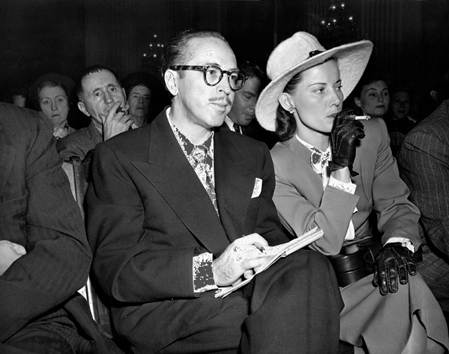
On October 30, 1947, seventy-eight years ago today, Bertolt Brecht appeared before the House Un-American Activities Committee (HUAC), an event that still resonates in today’s struggles over intellectual freedom.
The HUAC was a U.S. House of Representatives committee that investigated alleged communist influence and so-called subversive activities. It became infamous during the ‘Red Scare’ for its highly publicized hearings, which, to create spectacles, repeatedly targeted artists, writers, and entertainers to create a climate of fear and intimidation aimed at ideological conformity. Brecht was dragged in front of the committee by subpoena just weeks after his close friend and frequent collaborator, Hanns Eisler’s testimony. Although Brecht found himself at the centre of a political circus, he managed to turn his testimony into political theatre as great as any work the Western canon has to offer. At one point, in an overly exaggerated, strained English and feigned heavy accent, Brecht squabbled with one of the members of Congress over the translation of one of his poems. Adding to the carnival atmosphere, Brecht brought along a translator who spoke English even worse.
The hearing played out as a clash of characters that exposed a profound contradiction. On one hand, the United States celebrates itself as the bastion of democracy, free expression, etc. But, on the other hand, the governmental committee’s inquisitorial style, its demand for ideological conformity, and the spectre of sanctions and punishment against its targets revealed the fragility of those very freedoms. Ostensibly about fact finding, the committee functioned more to publicly highlight things that fed into their anti-socialist narrative. After the HUAC hearings, many witnesses and those who refused to testify faced severe repercussions. Some, like Eisler, were deported. Others, especially in Hollywood, were blacklisted, preventing them from securing work in film, television, or theatre. The committee’s effect was to silence the artists and intellectuals that got caught up in its tentacles.
The committee had targeted Brecht for the same reason that it targeted its other victims; he was publicly opposed to capitalism. Capitalism is an economic system that is characterized by the private ownership of the means of production. Simply understood, the means of production are the things needed to produce goods and services such as land, resources, machines, tools, or factories. According to the Marxist view, there is an inherent tension between the class of people who own the means of production (the bourgeoisie) and the class of people who sell their labour working with the resources, tools, machines, etc. to produce things (the proletariat). This system results in great economic, political, and social inequalities where “the proletariat,” in Brecht’s words, “is held in bestial subjugation by the bourgeoisie”[1] through the “abuse of property for the purposes of exploitation.”[2] “[T]here [are] painful discrepancies in the world around us,” Brecht explains, “conditions that [are] hard to bear…Hunger, cold and hardship…”[3] The goal of most of Brecht’s theatrical and literary works was to assist the working class struggle with removing themselves from the oppressive thumb of the bourgeoisie so they could begin enjoying all the fruits of their labour, most of which is presently siphoned off by the bourgeoisie. This type of exploitation at the foundation of capitalism is an occurrence that is legitimatised, maintained and enforced through an intertwining system of economic, political, legal, and ideological strongholds which the bourgeoisie has set up ensuring their social advantage. In essence, the idea is that the bourgeoisie enriches themselves on proletarian labour, then converts that economic wealth into legal and ideological control over the workers. This idea goes to the root of what Brecht hoped to reveal through his testimony.
On the stage that was Brecht’s HUAC hearing, the committee, representatives of the state acting as loyal agents of the ruling class, played the role of an accuser, determined to paint Brecht as a malevolent foreign radical, a man with ideas so dangerous they threaten the stability of The United States of America and could poison the minds of the American People. For his part, Brecht played the role of a resolute anti-fascist, taking several opportunities to point out that his works were meant to fight against the authoritarianist threat of fascism, just as the U. S. had supposedly done in the Second World War, which had ended just three years prior.

Because of Brecht’s star performance, the hearing dramatized where the ruling class draws its line. It revealed that what is ultimately sacred in America is not democratic norms like the freedom of expression, but capitalism and that is precisely what made Brecht’s art so frightening to the committee. The committee and its associated sanctions were examples of the lengths to which a capitalist state apparatus will go to defend the privileges of the ruling class. Brecht, however, turned the dialogue on its head, revealing that it was not his work but rather capitalism that was subversive to democracy. In short, by revealing this contradiction, Brecht showed that the disruption of capitalism, not its preservation, was the true condition for democratic freedom.
Brecht’s testimony drew significant media attention in the U.S. and abroad, with newspapers noting both the irony in his performance and his departure for Europe the next day. In 1980, it even inspired an award-winning short film dramatization called, A GOOD EXAMPLE: Bertolt Brecht and HUAC which can be viewed below. Today it serves as a lesson in resistance. By exposing the contradiction between America’s democratic ideals and its capitalist imperatives, he dramatized the way power protects itself by silencing those who challenge it.
Today, in an age when Arturo Ui-esque authoritarian thugs ban books, muzzle academics, suppress climate science, sack educators, rewrite history curricula to erase uncomfortable truths, deport intellectuals on ideological grounds, censor art and performance, purge libraries, politicize judicial and legal systems against critics, target journalists, and weaponize government against critical thought, Brecht’s defiance remains a call to action. His testimony reminds us that art and intellect are not luxuries, but essential tools in defending ourselves against those who want to silence us.
A GOOD EXAMPLE: Bertolt Brecht and HUAC
This is a dramatic reconstruction of Brecht’s testimony before HUAC. It was the winner of a Blue Ribbon at the American Film Festival in NYC and received honors at the London, Sydney and Edinburgh Film Festivals.

Anthony Squiers, PhD, Habil. is a faculty member at AMDA College of the Performing Arts and co-editor of E-CIBS. He is the author of An Introduction to the Social and Political Philosophy of Bertolt Brecht and Bertolt Brecht’s Adaptations and Anti-capitalist Aesthetics Today.
[1] Brecht, Bertolt, Tom Kuhn, Steve Giles, and Laura J. R. Bradley. Brecht on Art and Politics, Methuen, 2003. p. 341.
[2] Ibid., p. 134.
[3] Brecht, Bertolt. “Theater for Learning.” Brecht Sourcebook, edited by C. Martin and H. Bial, Routledge, 2000, p. 27.



 E-CIBS