
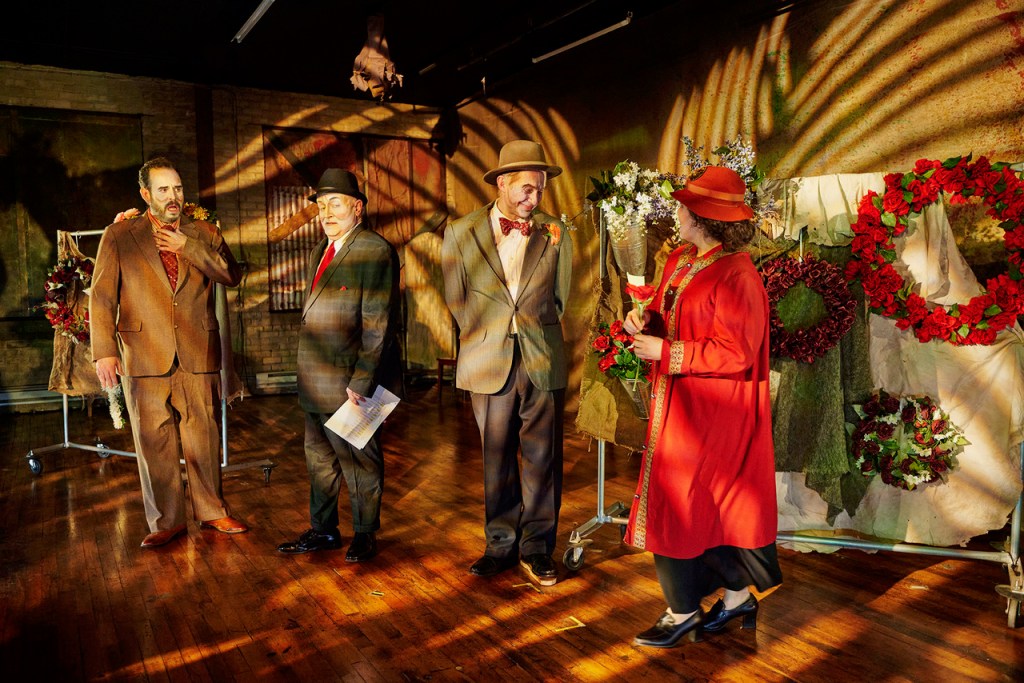
St. Paul, MN—October 31, 2025
After a “mistrial” in September 2024, when Frank Theatre could not begin their rehearsal in an empty factory, because the Actors’ Equity Union had safety concerns (on the level of missing showers and peeling paint), they have now found a new stage—a former yoga studio. The path to the performance space is labyrinthine. As if you are invited to a secret society, or as if you are let in on a secret. And this is exactly what is going to happen, only that this secret has been there for a long time and everybody who wanted could have seen it: the mechanics of power abuse.
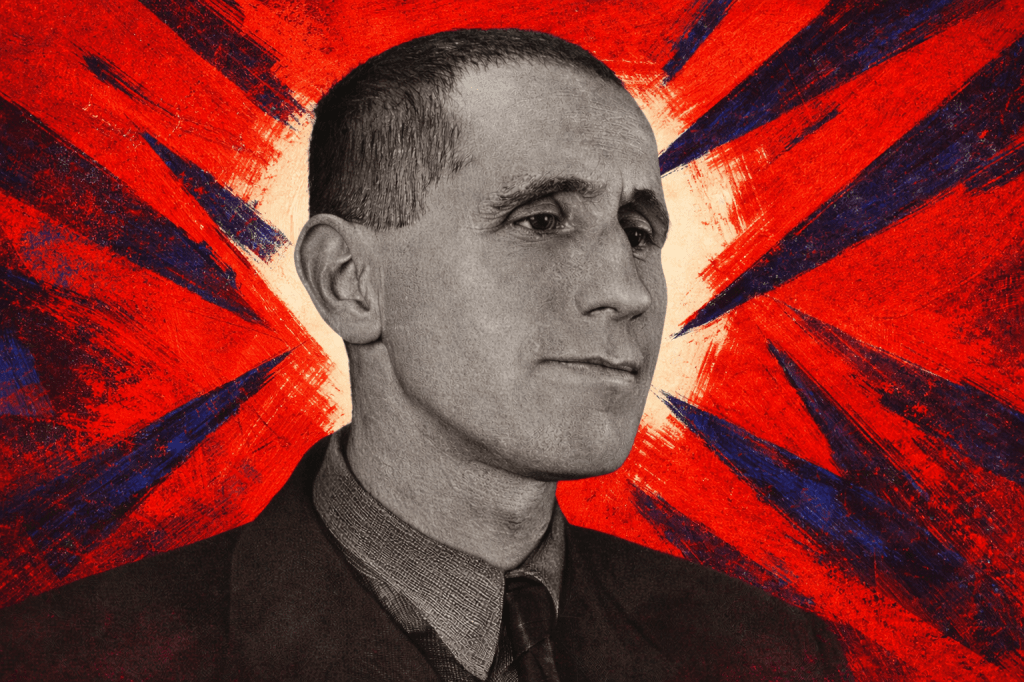
Arturo Ui, written in 1941 and set in a fictitious 1930s Chicago, makes the rise of a gangster boss a parable of Adolf Hitler’s rise to power. Brecht and the artists collaborating with him—Hanns Eisler, Margarete Steffin and others—did extensive research on the gang activities in Chicago and New York. Brecht watched almost obsessively gangster movies — a genre naturally coming into fashion with the growing importance of gangs. He collected newspaper articles on spectacular gang violence when visiting the US for the first time in 1935 and most likely, read Fred D. Pasley’s Al Capone biography. Brecht was interested in the moment, when being a gangster became a real business, mainly through racketeering, a practice that expanded in the 1930s, for example, to the food sector (see the Cauliflower Trust in the play). And part of this professionalization of crime was alliances between city politics and the new ‘gangster entrepreneurs’. Almost simultaneously with the research on what became Arturo Ui, the Frankfurt School of Social Research advanced, inspired by the same development, their little-known “racket theory of fascism”. The analogy between gangsters and Nazis was in the air, and it perhaps suggested itself to turn this alliance between business, crime and politics into a parable of Hitler’s path to power. The correspondences between Germany and Chicago are far from hidden in Brecht’s play. The characters’ names already display them: Roma, Röhm; Giri, Göring; Givola, Goebbels; Dogsborough, Hindenburg. The corruption scandal surrounding the purchase of a shipyard at the heart of the story ‘represents’ the East Aid scandal. Money dedicated to supporting the agrarian economy in Eastern Prussia was used to subsidize President Hindenburg’s family and friends, we find an equivalent for the Reichstag fire, etc. And Brecht doubled down, making the references even more explicit by proposing that at the end of each scene a statement of the facts in question should be projected.
However, when the play was completed in 1941, reality had overtaken fiction. “We are given a trivial gangster organization, the cabbage trust. The true horror of fascism is conjured away; it is no longer a slow end-product of the concentration of social power, but mere hazard, like an accident or crime”, Theodor W. Adorno remarked. What do we do today with this ‘mess of a play’, that is a play, at the same time too removed from the facts and too precise in its didacticism, incapable of capturing the “true horror” that existed and perhaps awaits us?
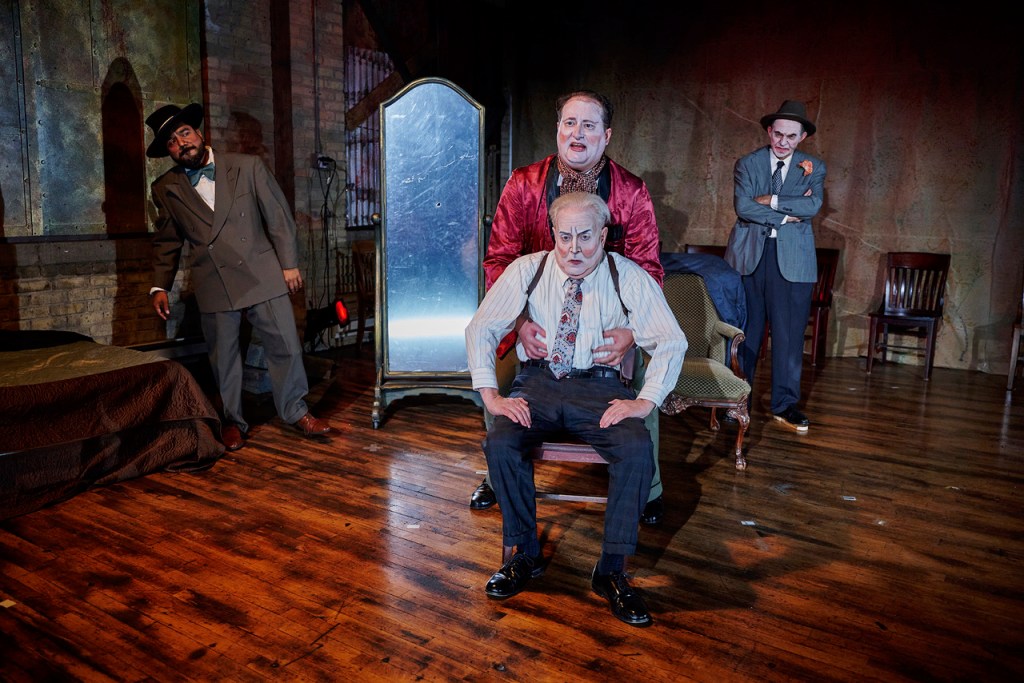
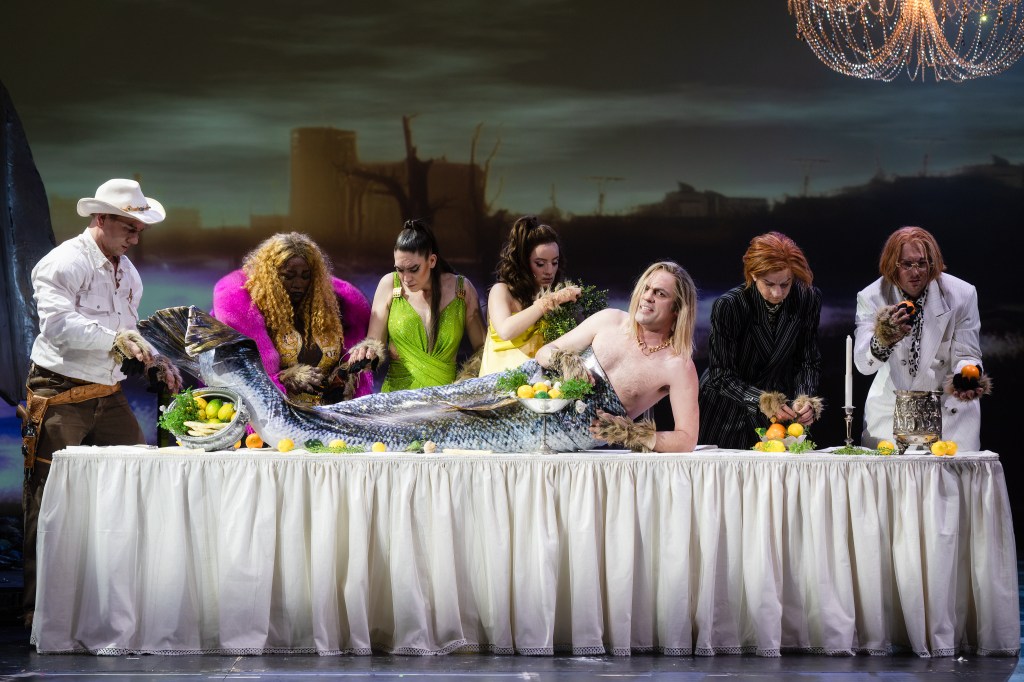
Luckily, Frank Theatre, under the direction of its founder Wendy Knox and with Bruce Norris’ adapted version, does not try to make the play fit neatly with historical or present events (the similarities between the character names and the real people will be largely lost today). References to Hitler or the politics of the current administration are interspersed, but not in your face, and you almost miss them. Arturo Ui (Gary Briggle) is neither Hitler, nor Trump, he is at the same time both and none of them. The costumes (Andrea Gross), the partially overdone make-up, do a fantastic job of keeping the references suspended. And Arturo Ui is, first of all, a charmer, a real used-car salesman (not the deplorable caricature, we now experience daily), someone who makes the audience hope that he can’t be that evil. There are many moments when not only the characters on stage succumb to Arturo’s seduction, but we, the spectators, as well. These moments are very subtle, Dogsborough’s vanity (Jim Ramlet), when Arturo manages to compliment him, is never over the top. Certainly, the play’s style is Brechtian in its framing —actors/characters sitting on chairs around the scene waiting for their entrance, a host addressing the audience directly, offering recaps and telling us about the events to come —but almost realist in its unfolding of the plot. This opens a space for nuances easily lost in satire, a space, which all the actors take great advantage of, and it ultimately makes the play’s message (of course, with Brecht there must be one!) even scarier —I will come to that. Back to Arturo: his charm is backed up at every moment by pure violence, and so in retrospect, after we have had our second of weakness — it’s not more than that — we need to ask ourselves, how could we not have seen or felt that?
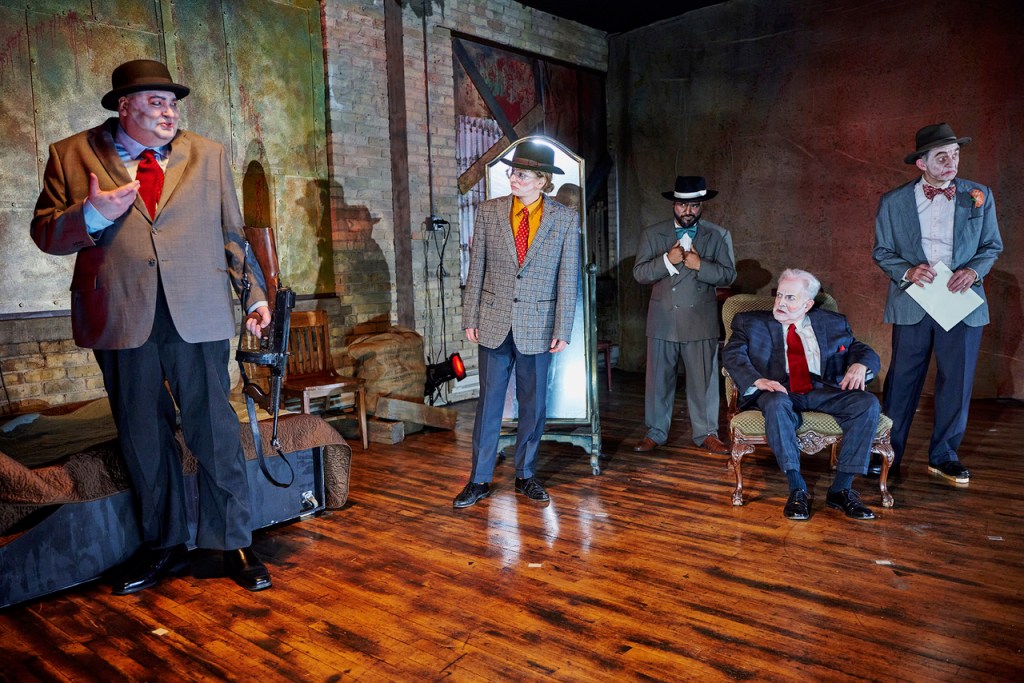
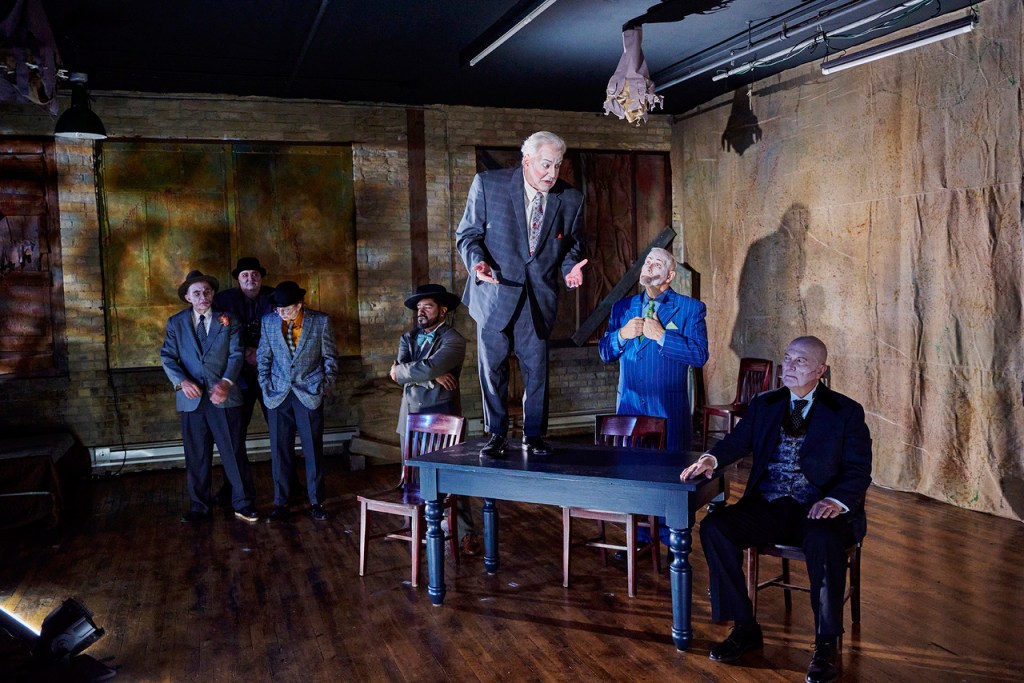
If Arturo Ui — the character and the play— were a contemporary allegory, it would be that of a democracy that exists only in appearance, and we see such a thing taking center stage in the final scene, when Arturo organizes the election that confirms his power. So here is my question: at what time, then, was his rise still resistible — as the title suggests? Arturo and others with authoritarian ambitions don’t come out of a void, democracy must have already been hollowed out for this to happen. Arturo’s rise is a symptom not a cause. But these are reflections from a safe distance, a distance, implemented through a double removal, removal from the present US, removal from a theater that requires the suspension of disbelief. Frank’s company leaves the story in the Chicago of the 1930s without enforcing ‘presentness’, and theater shows itself here as theater, not only because a host moderates the story, the host, after all, is themself a character, but on a more fundamental level, when we see the actors changing the scenes or when they sit around the scene, not yet characters, not actors anymore, or, when a visible piano sets the tone.
But the safety of this distance is deceptive. We should know better. Each scene is signposted, and different from Brecht’s suggestion to make the references to real events explicit, what the signs offer is something like a takeaway or essence of the portrayed events: collusion of business and politics, corruption of the courts, and so on — steps towards authoritarian power and a suddenly familiar scenario. The story thus becomes contemporary not through concretization, but through abstraction. We are reminded of a lesson we should have learned already. The real shock, then, made possible by the impression of safety, is the ending. Suddenly, the play, as they say in German, “rückt dem Publikum auf den Leib”—or hits close to home. This was when I realized that the former yoga studio has boarded-up windows and walls sprinkled with something red, and the theater becomes much too small, the scene much too intimate. I can’t say more. See it for yourself, running from October 31 to November 23, 2025, in the Ivy Building for the Arts in Minneapolis (Minnesota).

Matthias Rothe is a Professor of German Studies and Philosophy at the University of Minnesota (selected publications include: Tropen des Kollektiven. Horizonte der Emanzipation im epischen Theater (Theater der Zeit, 2024); „Michel Foucault und/oder die Aufklärung?“ Merkur 12/24, “Economic Psychos. Volker Brauns Das ungezwungene Leben Kasts nach Bret Easton Ellis”, Text und Kritik 55 2023).
Cover photo by Tony Nelson: Pictured (L to R): Laila Sahir (Betty DUllfeet), Patrick Bailey (Givola), Gary Briggle (Arturo Ui), Leif Jurgensen (Dullfeet).


 E-CIBS