
Ira Avneri, a key player in the Tel Aviv independent arts scene, titled his production Antigone [Brecht]. This unconventional formulation does not only highlight the production’s derivation from Brecht’s work but also immediately engages with Brechtian poetics, using its very form to estrange traditional norms. The inclusion of Brecht’s name in the title signifies his role beyond that of the dramatic text’s author, establishing him as an internal voice within the staging itself.
Brecht completed his Antigone adaptation, as noted in his journal entries, between November and December 1947. Its premiere took place in Chur, Switzerland in 1948. Subsequently, the production was documented in the Antigone Modell 1948, published in 1949, comprising notes and staging records. Brecht conceived his version in the wake of World War II, actualizing the ancient tragedy and its core themes of conflicting wills. The play served as an experience of liberation from despair, a return to the human being, a reflection on power and violence, and a form of historical education.[1] Given this context, the title of Avneri’s production could have been further enhanced by adding the words “Model 2023/2024”. The addition would effectively mirror how Brecht’s own dating signified historical meaning, while simultaneously highlighting the contemporary historical forces now engaging with this canonical text.
Avneri’s play, which addresses the theme of war, had two premieres. The first occurred in May 2023 during the heated public debate surrounding the Israeli government’s proposed judicial reforms – a move many perceived as the dawn of a “dark era”. In that context, Brecht’s sharp irony regarding authorities who manipulate public thought resonated as a stark voice of reason. Following the brutal Hamas attack of October 7, 2023, which involved acts of extreme violence and was met with widespread national mourning, theatrical activities were temporarily halted. The play resumed performances in 2024, set against the backdrop of the renewed war between Israel and Hamas and the re-emergence of the ethical dilemma of whether the ends justify the means. Amidst this, outside Israel, many have voiced their perspectives on the conflict, and protests calling for retaliation by both sides have erupted in European and American cities. Against this background, Bertolt Brecht’s voice found a renewed resonance.
Brecht was a vocal proponent of critical thinking, employing his theatrical system as a powerful form of resistance against the mass psychosis of Nazi Germany. Yet, he may seem optimistic in comparison to Avneri’s production of Antigone, whose staggering catastrophism brings us back to ancient Greek tragedy. The “Model 2023/2024” of Antigone has a subtle and intricate relationship with Brecht, simultaneously drawing near to and estranging from his work. At the same time, the play creates a powerful dialogue with the current catastrophic reality and, at moments, breaks with the rational principles of epic theater, capturing a sense of despair comparable to that of a classical tragedy.
Avneri is a director and thinker who primarily works with classical texts and is well-versed in ancient culture. His directorial activity parallels his academic pursuits as a researcher of ancient Greek philosophy. His doctoral dissertation, “Philosophy at Home: Space and Performance in Plato’s ‘Domestic Dialogues’ “, delves into the performative elements of ancient Greek philosophy. Avneri the researcher reveals the theatricality inherent in Socrates’ intellectual strategy and provocative conduct. Avneri the director transforms the theater into a space for experimental, provocative thought, stimulating actors and spectators alike.
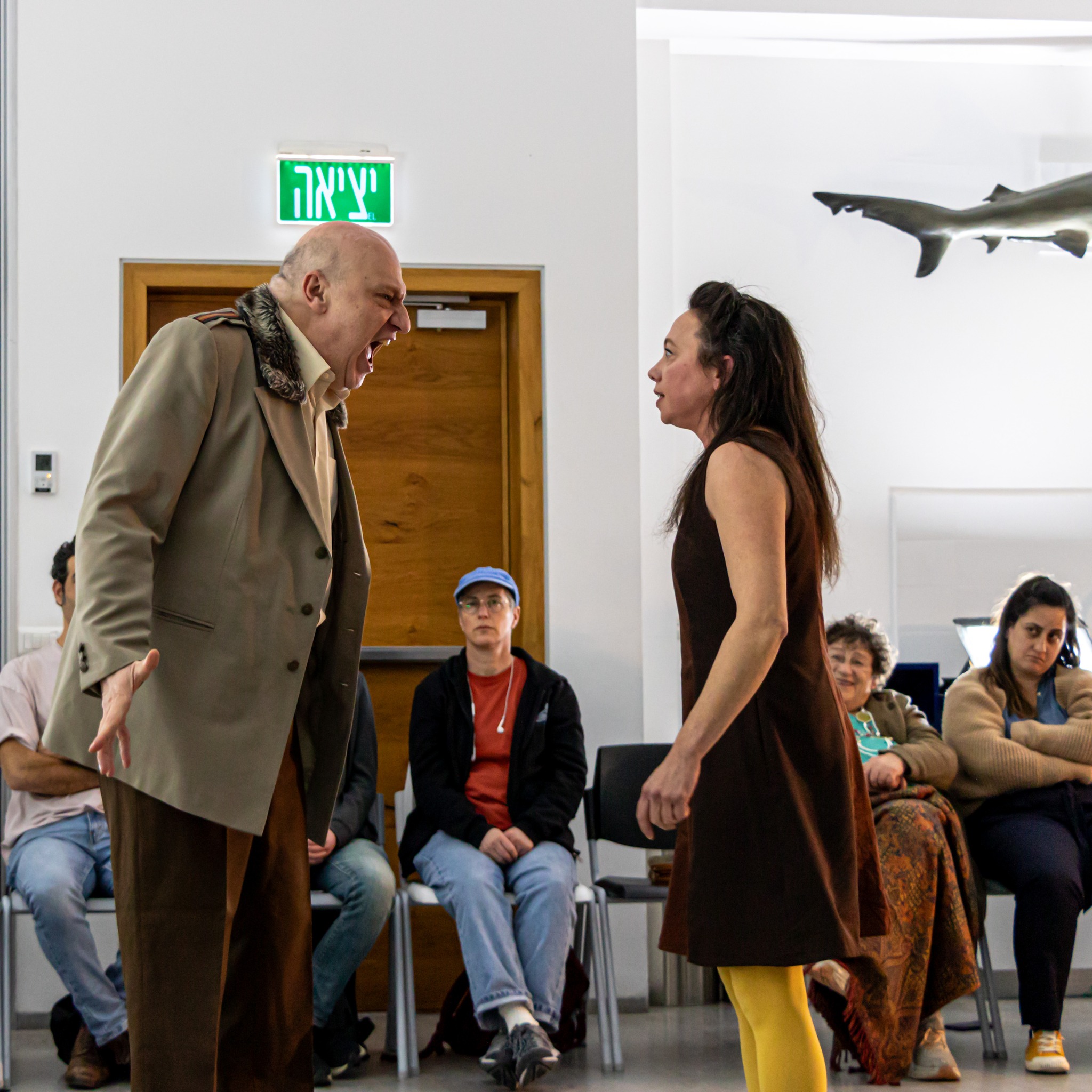
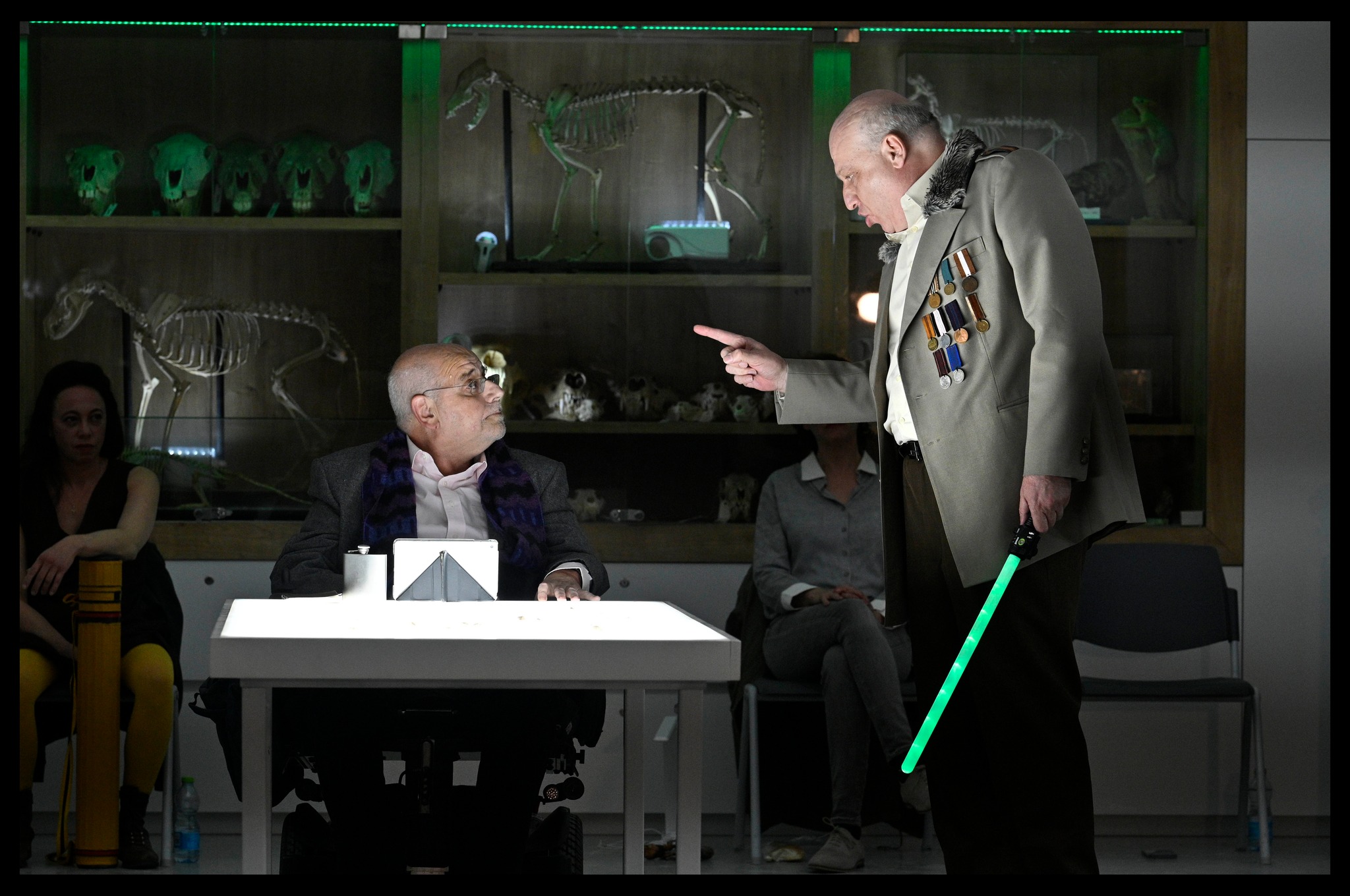
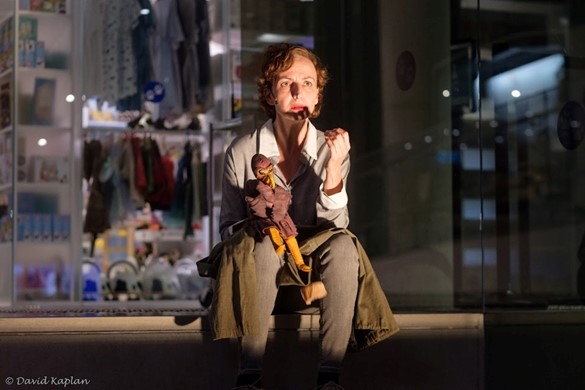
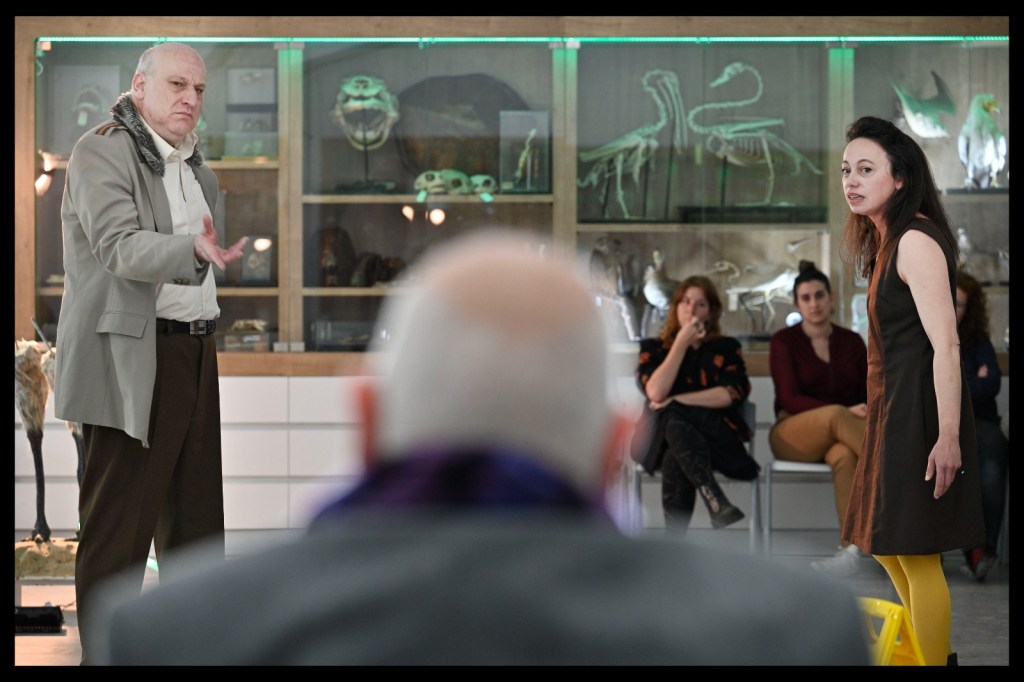
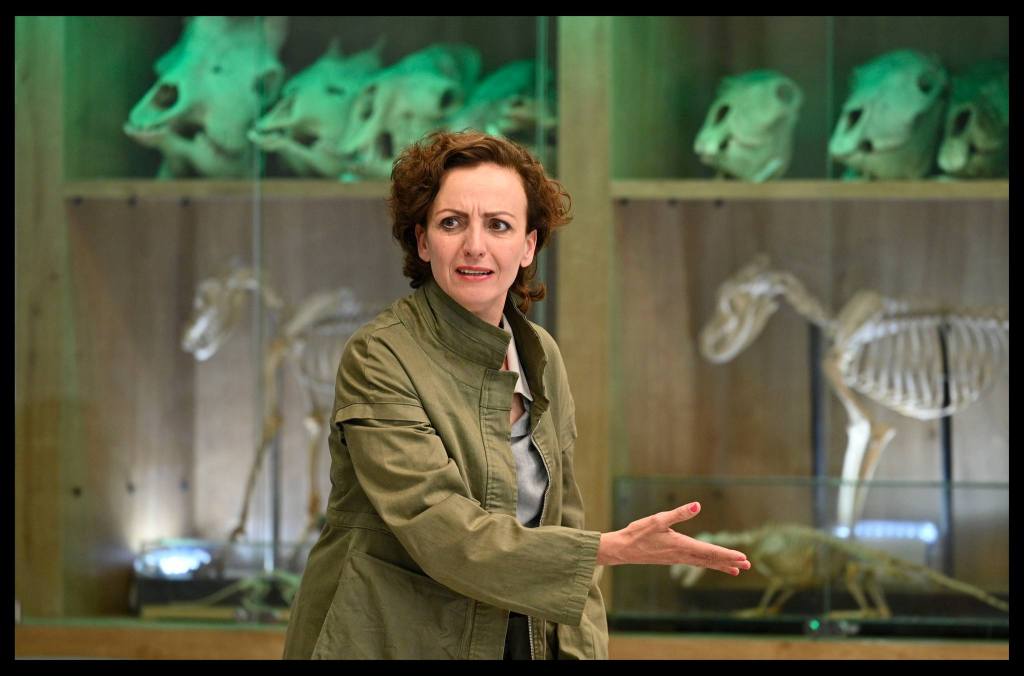
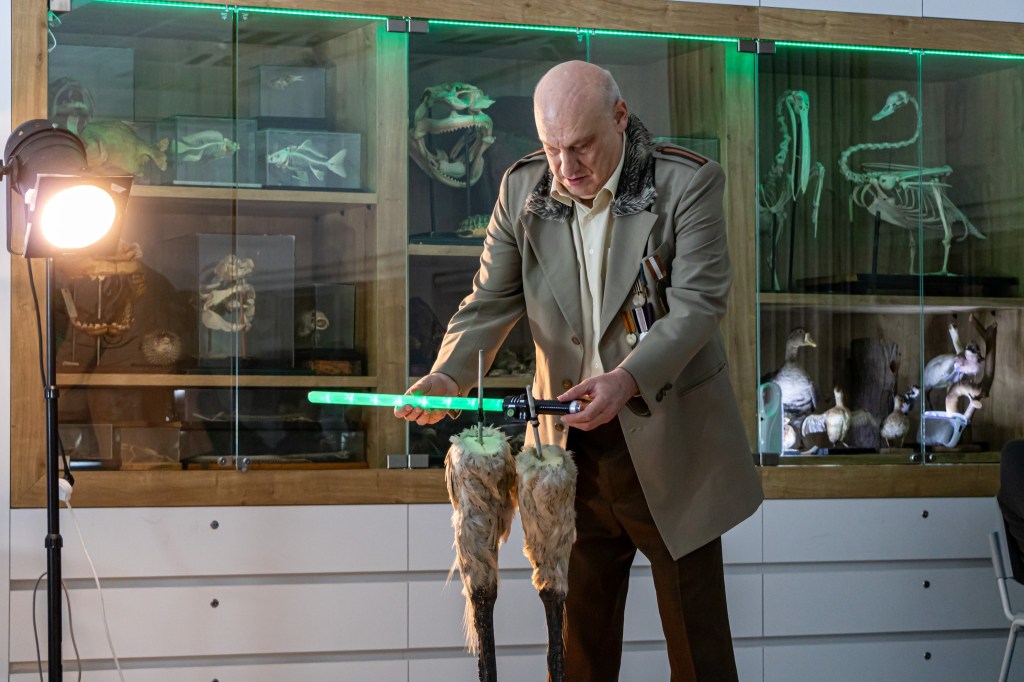
L: Creon and Antigone. Proto by Gal Rosenman; Upper R. Creon and the Chorus Leader. Photo by Yossi Zwecker; Bottom R.: Prologue. Photo by David Kaplan.
Antigone [Brecht], created by Avneri in collaboration with stage designer Dina Konson, was performed in Tel Aviv University’s Steinhardt Museum of Natural History. The museum’s rooms become the play’s stage, with performative events taking place in the lower lobby, exhibition hall, and seminar classroom. Each location presents a distinct genre of performance, collectively creating a poly-spatial effect and multi-layered estrangement. The museum spaces themselves serve as a profound statement: the unfolding events in this Antigone – the discussions of war, death, and tyranny, the whispers and screams – are destined for preservation. Functioning as an underlying subtext, this statement is a constant that significantly shapes the perception of the play.
The museum’s lobby and stairs – where the famous Brechtian prologue, interwoven with the ancient plot of Antigone – is performed, are shaped into a theatrical space born before our very eyes. Here the standard division between stage and audience is respected, yet the play’s site-specific design is apparent. The museum’s lobby and its initial exhibition, featuring stuffed birds of various species soaring high, function as both the backstage and set. The prologue shifts Brecht’s scene from a 1945 Berlin bomb shelter to a new, evocative setting. Rather than two sisters having an apocalyptic conversation, we witness a young woman engaging in a dialogue with a slightly charred, humanoid bird puppet. This puppet, myna – the talking starling, echoes the stuffed birds suspended above, bringing a totemic magical quality to the play. The young woman and the bird puppet represent Brecht’s sisters and resemble each other. Michal Weinberg, as the First Sister who later transforms into Ismene, speaks for both characters, maintaining a delicate balance. She neither exaggerates the bird’s presence nor allows her own performance to become excessive. Both appear as messengers of death. In the museum’s depths, the taxidermied birds in flight further reinforce this impression. The prologue is imbued with a profoundly restrained gloom.
The transformation of the Second Sister into a myna is evocative of several mythological female figures (Procne, Philomena, and Aedon, among others) who, in their grief, were turned into birds. As Avneri explained, the bird is actually an image introduced in both Sophocles’ and Brecht’s versions of the play, where the guard compares Antigone herself to a bird, and it is this literary allusion that inspired the production’s imagery.
Freddie Rokem notes that in both Sophocles’ and Brecht’s plays, Antigone compares herself to Niobe, another model for total grief rooted in ancient myth. Considering the iconic nature of Brechtian dramaturgy, Rokem discusses the hidden role of Niobe in Brecht’s plays, thereby unveiling the symbolic tragic quality that accompanies every mention of her. In his analysis, being “like Niobe” is the core performative task of stage action.[2] What is particularly interesting is that the creators of Antigone [Brecht], who are well acquainted with Rokem’s ideas, reveal these hidden meanings as if continuing his line of thought and strengthening it. They achieved a ‘double effect’ of universal sorrow by merging Antigone-Niobe with the bird-puppet, which brings to light the irrational dimensions of the catastrophic – truths that simply cannot be put into words. While Brecht’s prologue sounds like a bitter warning that brings ancient terror into our time, the current prologue returns the terrible to the realm of ancient myth. Myth becomes a tool that allows us to imagine the doom of the world. And in a stark departure from Brecht’s play, where the sisters survived the bombing, in Avneri’s version, only one sister, who has become Ismene, remains in the world of the living. With a firm and calm voice, she explains to the bird that everything is subject to destruction.
Remaining faithful to the Brechtian belief in the power of stage art, the creators of the production present their somber prologue as a play-within-a-play. This meta-presentation is performed, perhaps most surprisingly, as a “private performance” for Antigone herself, who is watching the conversation attentively from the steps of the improvised stage in the lower lobby. By revealing the presence of a meta-spectator, the production signals to the audience that they are not merely observing the world’s end, a strong initial impression left by the conversation between the woman and the bird. Instead, the audience, alongside Antigone, is invited to analyze the conversation’s meaningful parts and agree or disagree with them, thereby coming to anticipate the continuation of events, new confrontations, and fresh opportunities. This shift creates a sense of optimism.
Indeed, everything suddenly goes into motion. The audience is invited to follow Antigone into the museum’s exhibition halls, looking at the exhibits as they listen to the museum’s audio tour on headphones which they received upon entering the space. The calm measured narration of the guide – a stylized introduction to the exhibition that tells the story of nature – is periodically interrupted by the nervous, panting sounds of Antigone, recounting the horrors of war. This creates two parallel and colliding soundtracks: one of natural history and one of personal catastrophe. Avneri clarifies that “the play’s soundtrack juxtaposes the institutional-patriotic narrative of the museum with the narrative of Antigone. The museum’s audio tour stresses that the corpses of dead animals are ‘state property’ that individuals may not collect without permission. In contrast, Antigone’s narrative stresses that corpses are not ‘state property’ and that an individual must act on their own accord when authorities are tyrannical”. It’s also worth noting a hidden detail. The audio guide’s voice, narrating the natural history, belongs to the highly respected retired theater critic Michael Handelzalts, who will later perform as one of the actors in this performance. Only a small part of the audience can identify it, but the actors’ awareness of the voice creates an inner energy that resonates throughout the entire play.

With the beginning of the movement, the play’s format changes, transforming into an immersive performance tour. On the surface, the exhibition halls and galleries, with their masterfully made stuffed animals, seem to have nothing to do with the tragic events of Antigone. Yet, the museum is drawn into the tragedy, immersing both characters and spectators in the world of animal species. In this world an equalization process takes place: those who present the tragedy are made equal to those who watch it. Together, they become part of the exposition, as if all were species put on display. The performative space becomes an instrument of irony and critical reflection on the human race. This creates a sophisticated immersive theatre experience that does away with forced, playful participation. Instead, the audience is immersed in an unhurried, meditative contemplation, which ultimately confronts them with the irreversible truth of their own place in the gallery of stuffed animals. This is, in fact, a second prologue to Antigone, added by the creators as a continuation of Brecht’s original. Like Brecht’s, its nature is also meta-theatrical.
The third format used in Antigone [Brecht] is defined by a third type of performing space, to which the audience is led after an educational, and somewhat mocking, excursion through the museum’s exhibits. Thus, the spectators find themselves inside a long, rectangular room that functions as both a classroom and a lab. A laboratory atmosphere permeates the space, from the dazzling white cupboards along the lower walls and the animal skeletons in display windows above them, to the sinks with running water for emergency handwashing. The audience, numbering no more than fifty people, is seated around the perimeter of the classroom. The bright fluorescent lights (designed by Yaron Abulafia) are hardly ever dimmed; the main events of the play are presented in the center, and everyone is in full view. The director and stage designer are also in full view, sitting in the same row as the spectators. They observe the laboratory action they have created and its reception. Unlike the actors and spectators, their faces betray no emotions, which strengthens the tension, arouses curiosity, and makes their presence part of the overall, provocative performance.
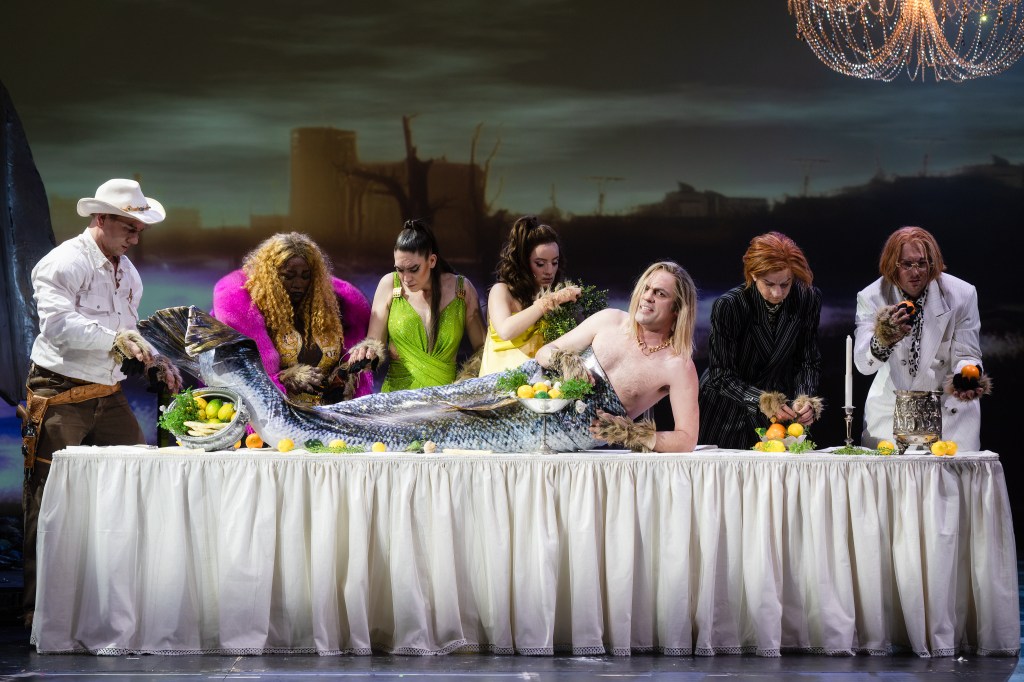
Antigone [Brecht] is a play about rebellion, with every character rebelling against the war. For Antigone, her revolt is an explosive outburst, driven by hatred for the system and the king who justifies war as a state necessity and as part of the world order. At certain moments, Keren Tzur as Antigone seems to perform at the limit of what is possible, her body shaking with anger and her monologue devolving into a shriek. Antigone’s rebellion is not a mere criticism of war, but a bodily rejection of it and the ideology that whitewashes it. Ismene’s rebellion, in contrast, is not a scream, but a quiet and resolute confrontation with the world of war and its leader. Antigone is driven by impulse and spontaneous reaction. Ismene, on the contrary, is defined by her restraint; she carefully considers her options and comes to the quiet but firm conclusion that war is unacceptable. In the roles of the Guard, the Messenger, and Haemon – all performed by a single actor, Benny Elder – rebellion is expressed through a series of testimonies, accumulating in the realization of the truth that war brings nothing but death to people. The actors’ work is a filigree of thoughtful precision. It is clear that for them, acting is not just a performance but an intellectual process—a constant act of grappling with a world where reason has disappeared. At one point, the actors intentionally blur the line between their roles and their own lives, gathering at a table to discuss their reality’s descent into a kind of Gehinnom, the Hebrew word for hell. This act of estrangement is not just a theatrical device; it’s a form of public analysis and civil resistance that perfectly embodies the core of Brecht’s philosophy.
The production makes no direct analogies or literal references to the current war between Israel and Hamas. Instead, it serves as a true Brechtian parable, forcing the audience to constantly reflect on war. Its message is universal: war can never be the final argument for human life.
The play features some of the most sought-after actors in Israeli repertory theater, a notable feat for an independent production. Their presence is a testament to their long-standing collaboration with Ira Avneri, who has worked with several of them on a number of world classics, including Schiller’s Mary Stuart, Chekhov’s The Seagull, and Lorca’s Blood Wedding. They are likely drawn to Avneri’s rehearsal method, which is a meticulous process of analysis and intellectual engagement. Rather than using directorial demonstrations, he offers analytical cues, guiding the actors to sharpen the meanings of their roles and create their own images, all within an environment that provides them with creative freedom.
Avneri also invited legendary theater critic Handelzalts to play the unique role of Chorus Leader. Handelzalts retired from the Haaretz newspaper in 2017 and has been involved in various cultural projects, but Antigone marks his first time appearing on stage as an actor. By reducing the number of elders to one – the wheelchair-bound Handelzalts (who does in fact have a disability and he can customarily be seen arriving to all theatre premieres in his wheelchair) – the director took into account that his non-actor is a man of rare authority, who left his mark on the Israeli theater landscape for decades. Unsurprisingly, he alone represents all elders. The paradox of this assignment is logical and even allows for some missteps in his performance. Rather than making the veteran critic memorize the long passages of the chorus of elders’ speeches, the director provides him with a tablet from which reads his lines and scrutinizes those of the other actors in real time. This choice does not only add a note of humor but also preserves Handelzalts’ authenticity, as the critic effectively becomes a character in the play. The helplessness of the sensible elder’s arguments against King Creon (Eran Sarel), who is possessed by a war demon, leaves the audience with a profound bitterness that is difficult to process.
The production’s creators embody Brecht’s ironic thought, contrasting the actors’ explosive passion with a continuous undercurrent of mockery. This theatrical slyness is woven into every detail: the masterful casting, the unique way the actors inhabit their roles, the use of space, and the symbolic signs provided by production designer Konson.
It’s worth examining the details of Konson’s work in devising a site-specific piece that develops an innovative scenographic language. The visual minimalism of Antigone [Brecht], performed in the spaces of the Museum of Natural History, creates a series of semantic echoes, imbuing each sign and color with symbolic meaning. Ismene’s white turn-down collar, emphasizing her natural orderliness, echoes both the white wall cabinets of the classroom-laboratory and the dazzling white light-table – reminiscent of an operating table – around which all the characters gather at the play’s climax. The same series of semantic echoes includes a white table, where the elderly chorus leader, critic Handelzalts, is positioned for most of the play. Another visual series emerges from the nuances of yellow, a color that, according to Konson, originates with the myna bird held by Ismene in the prologue. The myna bird is easily recognizable by its brown body and yellow legs. This same yellow color is seen in Antigone’s stockings, the costume of the watchman-messenger and the modern caution sign he places on the wet floor. This yellow hue, which appears in darker and lighter shades, is a powerful symbol of the desert, sand, and earth that Antigone collects in her yellow tube. A huge yellow lion mask worn by Creon (a symbolic reference to Dionysus) also belongs to this series. It is made in the ancient tradition as a headpiece, with one key difference: instead of a fearsome beast, it’s the head of a plush toy lion.
The play’s main sign is a figure of two immense, stripped bird legs with splayed claws and an absent body. Erected in the laboratory classroom to mark the beginning of the theatrical events, this sign brings white and yellow into direct contact, presenting a tableau that is at once sarcastically surreal and an ominous warning. The crippled bird-legs stand on a yellow sandy mound atop a small white platform, serving as a memento mori created by the performance’s designers. The figure bears no direct relation to the events of Antigone; rather, these bird legs’ frightening presence establishes an independent, parallel narrative to the main action, resembling the famous horse skulls in Brecht and Kaspar Neher’s staging of Antigone in Switzerland in 1948.
Olga Levitan, formerly of the Departments of Theatre Studies at The Hebrew University of Jerusalem and Theatre Arts at Tel Aviv University, specializes in the history and historiography of Jewish modernist and Israeli theatre, in addition to performance analysis. Her professional career began as a theatre critic in St. Petersburg and Moscow, preceding her move into academic research in Israel. Her last publications include: “An Archival Novelty. The Theatre’s Habima Telegram to Joseph Goebbesl”; “Time Commented by the Theatre”, Art and Culture Studies; “‘Di Yidn Kumen!’: Israeli and Multicultural Identities in Israeli Yiddish Light Entertainment Shows“, In geveb: A Journal of Yiddish Studies.
[1] See: “The Antigone of Sophocles. Texts By Brecht”. In: Tom Kuhn and David Constatine (eds). Brecht Collected Plays: Eight. London: Methuen Drama. 2003, 197-218.
[2] Rokem F. Bertold Brecht’s ‘Niobes’: Example, Interruption and Model // Modern Drama. 2024, 67 (№ 1). P. 25-49.
Cover photo by Yossi Zwecker.

 E-CIBS