
What’s the point of staging Brecht in 2026 when, less than a year from now, the author’s copyright will expire, which will allow for much greater artistic freedom? Why do a major new production of The Threepenny Opera in 2026 when, in two years’ time, we will celebrate the centenary of Brecht’s arguably most popular piece? And why choose to put on The Threepenny Opera in Augsburg’s interim theatre space in a former industrial park now, rather than wait for the re-opening of the much bigger main stage (planned, at the time of writing, for 2029)? Despite these more or less rigid constraints, director Sapir Heller’s version of The Threepenny Opera at the Staatstheater Augsburg is a remarkable example of experimentation with and interrogation of Brecht’s and Weill’s play that provided a lively and engaging evening. The show premiered on the opening night of Augsburg’s annual “Brechtfestival,” curated by Sahar Rahimi and Mark Schröppel under the motto of “Alle” (“Everyone”), and offered a powerful kick-off to the 10-day-long series of events across the city.
The stage design (Anna van Leen) exemplified the overall approach to Brecht’s and Weill’s opera in this production. Even though the musicians (Augsburger Philharmoniker and Orchesterakademie Paul Ben-Haim under the direction of Ivan Demidov) were somewhat hidden, the orchestra pit was fully integrated into the set; it separated the stage into a main part, initially closed off by a luscious red curtain, and a catwalk at the front, where characters performed songs and interacted with the musicians and the audience. This arrangement also underscored the importance of on-stage spectatorship: mirroring the auditorium, the characters sometimes turned into spectators themselves as they watched others perform, heightening audience members’ awareness of the artificiality of the situation and creating comic effects. While the original setting – London – was not changed in the dialogue, the stage design and props suggested an altogether different setting: a screen at the back showed a desert and, at the same time, the show seemed to be set by the sea-side as a lorry transporting fish crashed at the beginning of the show. After the Ballad of Mack the Knife, performed by the cast at the front of the stage, the curtain rose to a loud bang and flashing lights to reveal the accident, with the vehicle cut in two. The driver’s cab lay around stage-left and the cargo area, out of which a heap of fish had spilled, was to the right. This latter part functioned as a versatile mini-stage that was transformed into Macheath’s prison cell or the brothel, for example.
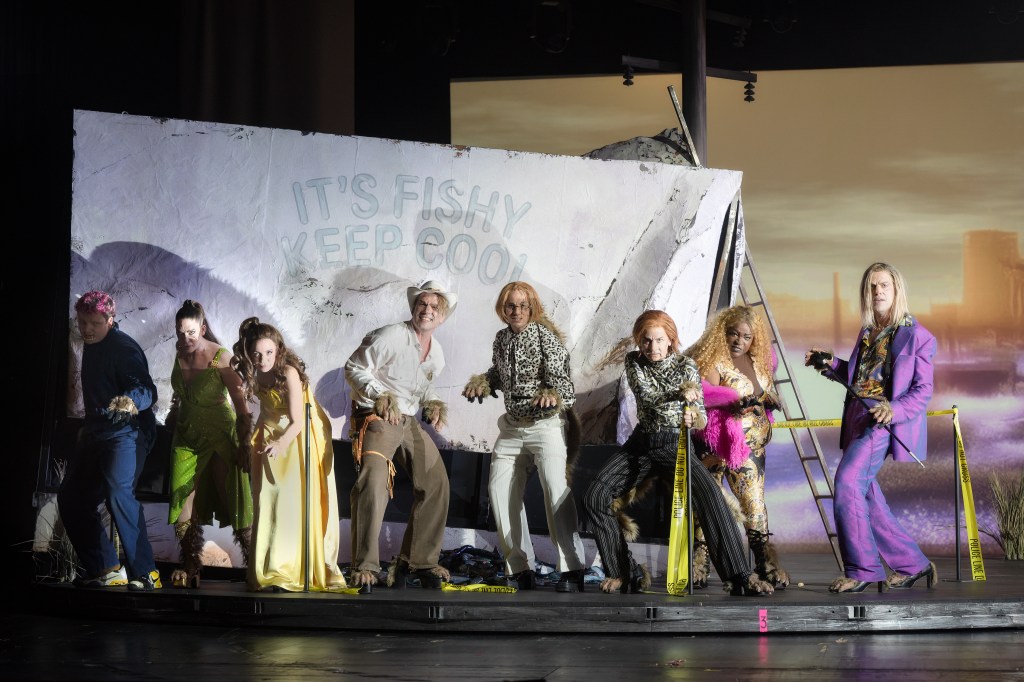
While this was a compelling and playful creative device, the tension between the different overlaid settings did not feel entirely thought through and was not reconciled at the end.
Regardless of this, however, the choice of imagery linked to this juxtaposition of settings was innovative and enriched Heller’s reinterpretation, which was in many ways inspired by the animal kingdom. As a key prop, fish were an omnipresent and highly evocative element in the production. They were used as currency, for example to pay the prostitutes, but also connoted a more suspicious and negative dimension: the tarpaulin on the lorry accordingly read “It’s fishy, keep cool”, emphasising the dubious nature of Peachum’s and Macheath’s undertakings. The characters also used fishing rods, which highlighted the interdependencies between them and underscored their seductiveness.
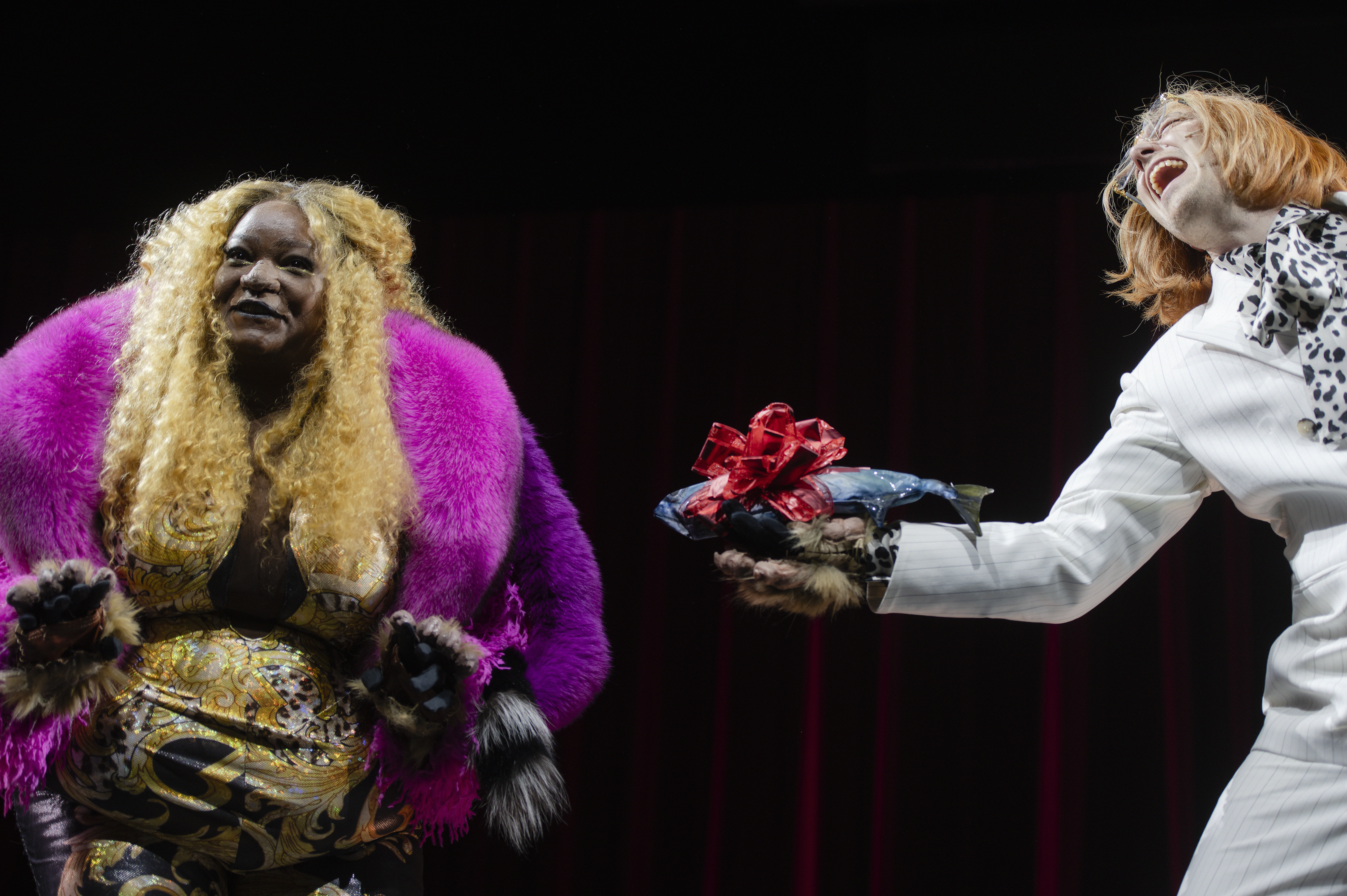
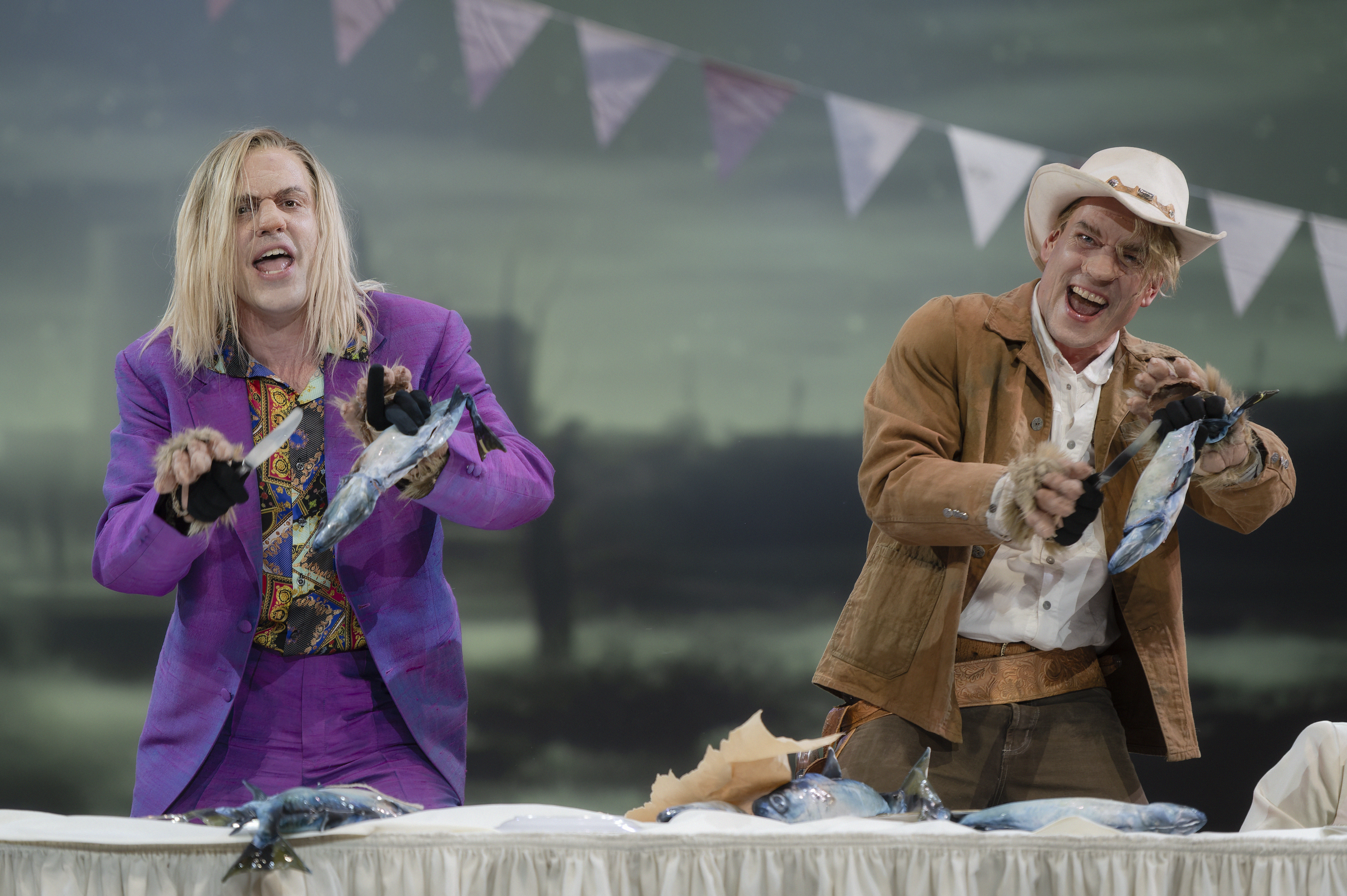
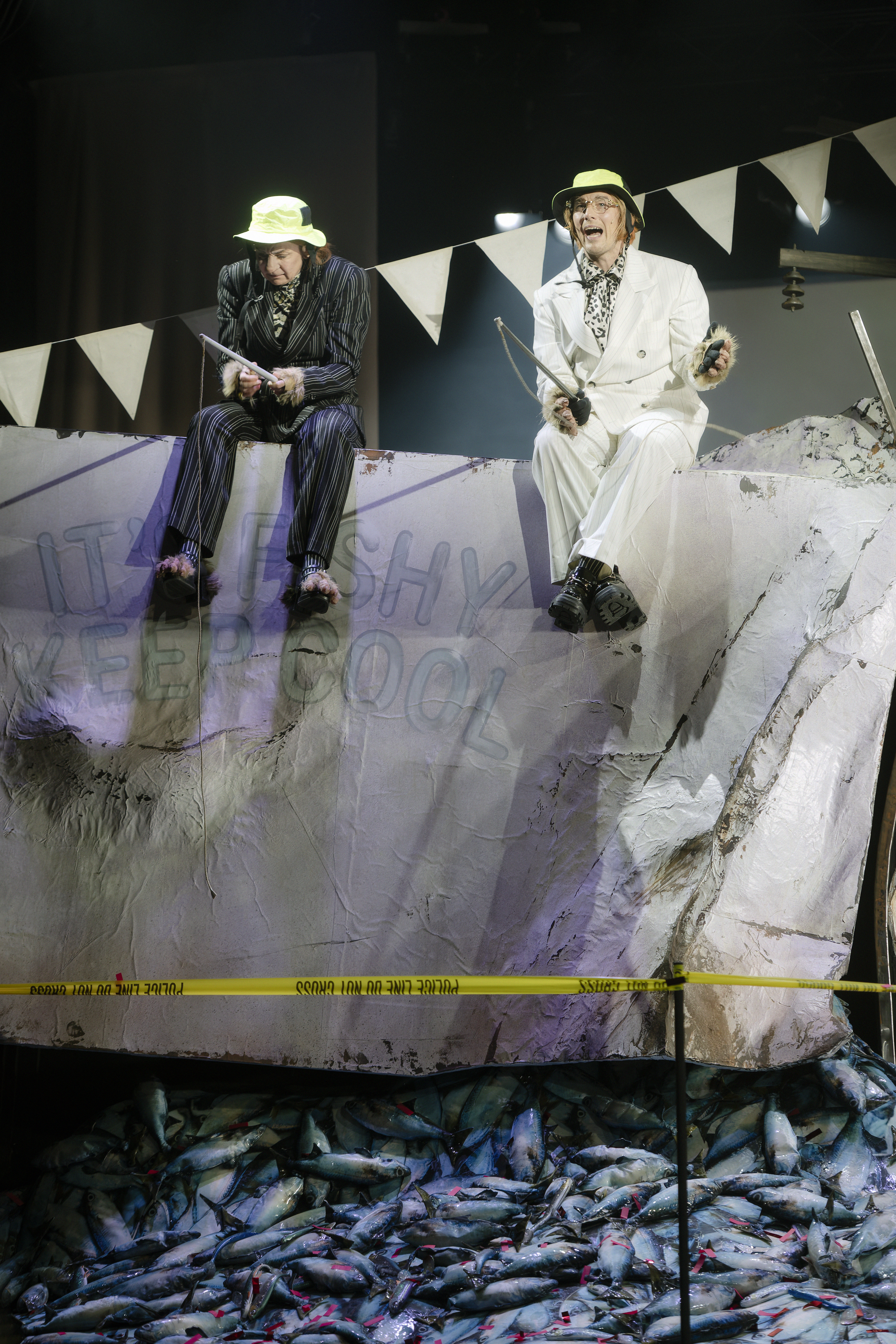
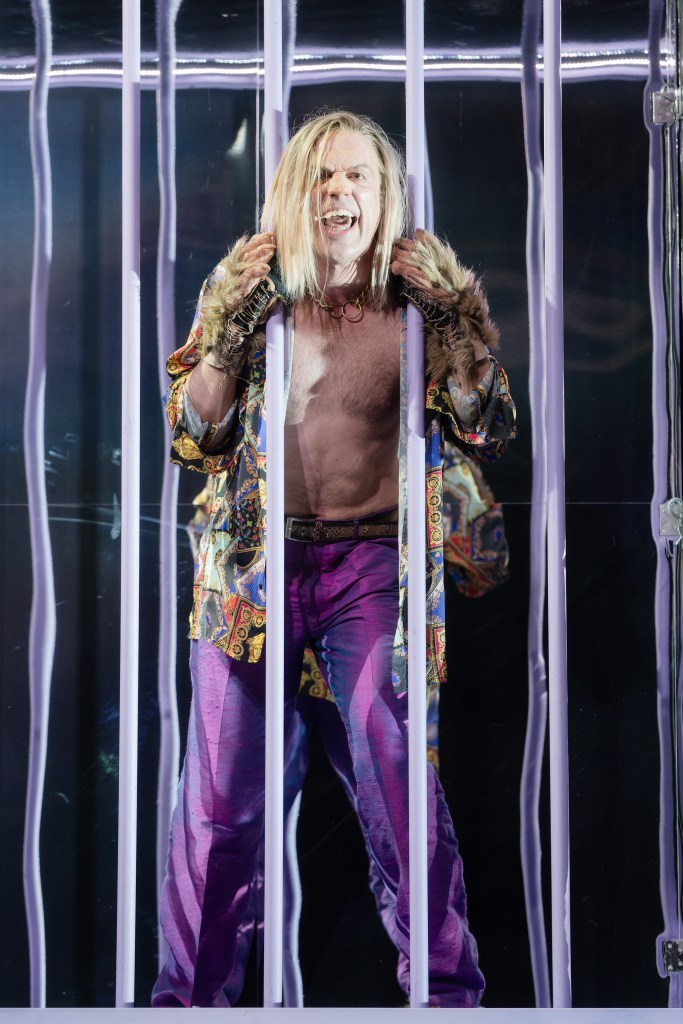
Upper Left: Jenny (Samantha Ritzinger) is paid by Mrs Peachum (Patrick Rupar). Lower Left: Macheath (Thomas Prazak) and Tiger Brown (Sebastian Müller-Stahl). Right: The Peachums and their fishing rods (Natalie Hünig, Patrick Rupar). Copyright: Jan-Pieter Fuhr.
The eclectic and colourful costumes (Slavna Martinovic) not only imitated a 1960s/70s style but were also of an animalesque quality. While the prostitute Jenny (Samantha Ritzinger) wore a snake-like suit, the other characters were equipped with hooves, paws, and fur. They barked, yelled, and groaned, sniffing each other and jumping wildly around the stage (choreography: Angelica Di Sannio). In the programme note, dramaturg Sabeth Braun writes that hyenas – opportunist and predatory animals – served as a source of inspiration for the creative team, offering an apt parallel for the characters in The Threepenny Opera. Indeed, while this element may have been alienating, disturbing and, at times, almost distracting, it worked well within the wider metaphorical context of the production, enhancing the portrayal of the hierarchy and dynamics between the characters in their struggle for the ‘survival of the fittest.’
The acting and singing performances of the entire cast were powerful and exuberant. Macheath (Thomas Prazak) was flirtatious – although he may have lacked some of the charisma associated with the character. His interactions with cowboy Tiger Brown (Sebastian Müller-Stahl), most notably in the Cannon-Song, were particularly strong. What stood out most in this production, however, was its emphasis on the female characters, who were portrayed as emancipated and fierce women. Polly (Olivia Lourdes Osburg) was above all a businesswoman pursuing her own interests in her liaison with Macheath. The Jealousy Duet with Lucy (Mirjana Milosavljević) was reinterpreted to foreground female solidarity against oppressive and exploitative males over competition and envy. Natalie Hünig dominated the stage as Jonathan Jeremiah Peachum, alongside his wife Celia (Patrick Rupar). The gender reversal proved an effective element in the production’s interrogation of gender roles, and Hünig’s charismatic, bossy, and larger-than-life Peachum was delightful to watch.
While the orchestra was obviously a central element of the production, the musicians’ active involvement in the onstage action came to the fore at the end of the show. As is well known, Brecht’s deus-ex-machina ending, in which a royal messenger on horseback announces Macheath’s pardon, requires a creative solution when put on stage. In Augsburg, this resulted in a critical interrogation of Brecht’s and Weill’s opera: just as the characters were about to feast on the highwayman, who, rather than ending up on the gallows, was turned into a grotesque mermaid figure and served as the evening’s main fish course, Macheath interrupted them and protested that, in Brecht’s version, he is saved.
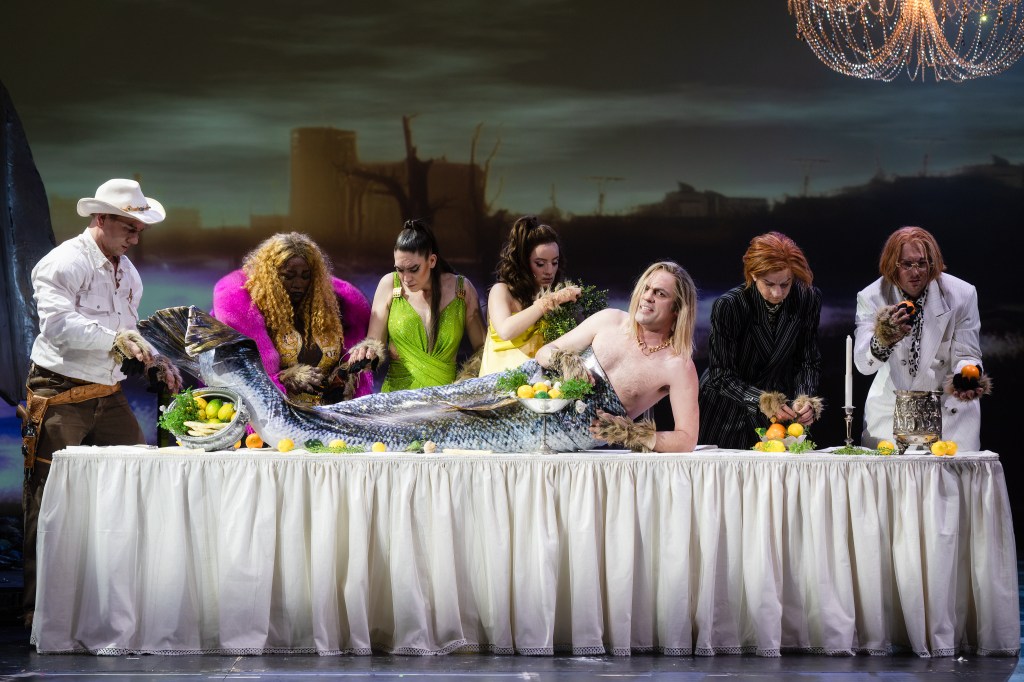
The characters then discussed different options before conductor Ivan Demidov impatiently interrupted to initiate another round of rehearsal of “The Third Threepenny Finale.” This self-reflexive ending was powerful not only in underscoring the production’s timely exploration of the pressures of life under capitalism, but also in articulating its critical approach to The Threepenny Opera in a humorous, sharp, playful, and – most crucially – highly engaging way.

Anja Hartl is an Assistant Professor in the Department of English at the University of Innsbruck, Austria. She is the author of Brecht and Post-1990s British Drama: Dialectical Theatre Today (Bloomsbury, 2021) and has edited the Methuen Drama Student Edition of The Threepenny Opera. In her postdoctoral project, she explores shame in the Victorian novel. She has published on contemporary British theatre, Bertolt Brecht, the Victorian novel, Shakespeare, adaptation, and border studies, and is co-editor of the Bloomsbury Methuen Drama Agitations series.

 E-CIBS