

IN THIS ISSUE
Statement from the IBS Steering Committee on the Arrest of Members of the Freedom Theatre Jenin
REFLECTIONS FROM OUTGOING IBS OFFICERS
The International Brecht Society—Reflections on a Turbulent Decade (Stephen Brockmann)
A Short Note of Thanks (Kristopher Imbrigotta)
RESOURCES
Website: Brecht in/au Canada (Joerg Esleben)
ESSAYS AND INTERVIEW
IBS in Israel: Mit dem Rücken zur Wand (Torben Ibs)
BB in Brazil: Then and Now (Marc Silberman)
1. Dialectics of Form in Buying Brass (Sérgio de Carvalho)
2. Brecht and the Measure of Distances: An Interview with José Antonio Pasta Jr. (Sérgio de Carvalho and Maria Eduarda Castro)
PERFORMANCE REPORTS
1. BB on Love and War (Tom Kuhn) and Performance Review (Liam Johnston-McCondach)
2. BB in Kolkata
Breaking the Fourth Wall Festival: Rediscovering Brecht’s Timeless Relevance (Abhilash Pillai)
DOCUMENTATION: BRECHT’S HOFMEISTER ON TOUR
1. Adaptations with Jürgen Kuttner on Tour in the Midwest (Marc Silberman)
2. University of Wisconsin–Madison: Kuttner in Madison (Melissa Sheedy) and Interview with Jürgen Kuttner (Zoe Jaeger, Annika Kline, Collin Queen, and Melissa Sheedy)
3. Indiana University Bloomington: Hands On! Karaoke Theater’s Der Hofmeister (Cynthia Shin)
4. Truman State University: Kuttner in Kirksville (Jack Davis)
Statement from the IBS Steering Committee on the Arrest of Members of the Freedom Theatre Jenin
The Steering Committee of the International Brecht Society was informed about the arrest of the artistic and managing directors of the Freedom Theatre Jenin by Israeli Defense Forces last Thursday, December 14, 2023. Mustafa Sheta and Ahmed Tobasi are well-known artists and have been active in peace work and Palestinian-Israeli understanding for many years. We are glad that Ahmed Tobasi was released the next day, but we strongly recommend the release of Mustafa Sheta as soon as possible, because we are not aware of any connection between him and the terrorist attacks on Israel on October 7, 2023. As much as the IBS continues to support our Israeli colleagues who maintain cultural and social relations with their Palestinian neighbors, we also endorse the efforts of cultural institutions like the Freedom Theatre Jenin to continue the dialogue that is so necessary between both sides – which will be all the more important when the terrorist and military actions are over and a peaceful coexistence of all people in Israel and its neighboring states must become possible.
Stephen Brockmann, President, IBS
Micha Braun, Vice President, IBS
[Back to TABLE OF CONTENTS]
Reflections on a Turbulent Decade
by Stephen Brockmann
Being president of the International Brecht Society for the last ten years has been one of the greatest honors and pleasures of my life. The IBS is a unique organization, unlike any other that I know, partly because Brecht himself is so fascinating and provocative, but also because the people who are attracted to Brecht tend to be dynamic, committed, against-the-grain thinkers who can generally be counted on to bring new perspectives and constructive suggestions to whatever situation they happen to find themselves in.
During my presidency there have been three IBS symposia, each of them, in their own ways, stunning successes. The 2016 Recycling Brecht symposium in Oxford, England was a large, exciting, and intellectually fruitful event that also served as a capstone for the multiyear project of creating a reliable edition of Brecht in English translation (the Methuen-Bloomsbury edition spearheaded by the extraordinary Tom Kuhn). Adding to the drama of the symposium, of course, was the Brexit referendum, which occurred two days before the symposium began. (You really can’t make these things up!) Partly as a result of that, Brecht and political theater seemed even more relevant after June 23, 2016 than they had been before. Who knew at the time that the situation was about to get even worse with Donald Trump’s ascent to the presidency of the United States a few months later? Trump has always seemed to me rather like a figure invented by Brecht himself for a play like Turandot oder der Kongreß der Weißwäscher or, indeed, Der aufhaltsame Aufstieg des Arturo Ui, which suddenly became hugely popular in 2017 and thereafter.
After the excitement of Recycling Brecht I thought that the organizers of the 2019 Leipzig symposium, Brecht unter Fremden/Brecht Among Strangers, would have a difficult time living up to the precedent set in Oxford. This was the first IBS symposium outside of Berlin held in what used to be called the “fünf neue Länder” or the “Beitrittsgebiet,” i.e., in the former German Democratic Republic. Although we didn’t exactly have the political drama of Oxford and Brexit (for which I am very grateful!), the symposium was absolutely packed with exciting panels, keynotes, and performance events, and it featured a close and fruitful cooperation with the Schauspiel Leipzig, which even offered us excellent space to conduct the symposium and also opened their doors and performances for us. As had also been the case in Oxford, many students were among the participants in the symposium.
Then, just last year, in December of 2022, the IBS met for its seventeenth symposium in Israel under the all-too-apposite heading Brecht in Dark Times: Racism, Political Oppression, and Dictatorship. I wish this title had not been as relevant as it turned out to be. As we were meeting in Tel Aviv, Haifa, and Jerusalem in the context of the IBS’s first “wandering” symposium, Israel was in a transition from a relatively moderate to a hard-core, right-wing government. Demonstrations and protests were already beginning to occur, and shortly after symposium participants left Israel, protesters went out onto the streets in the largest mass movement for democracy and the rule of law that the country has ever seen. Of course, all of this was still many months before the brutal and murderous conflict that has engulfed Israel and Palestine in the autumn of 2023, starting with the appalling terrorist attack by Hamas on Saturday, October 7. As I watch all of this in horror from Pittsburgh—the site of the worst antisemitic massacre in U.S. history on October 27, 2018, not far from where I live—I can only hope and plead for restraint, dialog, and compassion.
What makes an IBS symposium so radically different from typical academic conferences and symposia? A number of things, I think. First, IBS symposia are never just academic. They always involve performance, music, art, and participatory elements. Sometimes it seems to me that IBS symposia are “learning plays” on a rather massive scale, traveling from country to country—in the last ten years from the United Kingdom through the Federal Republic and on to Israel. And then, in the near future, we will meet in British Columbia on the far western shore of the North American continent, to confront Brecht and the Anthropocene, co-organized by Elena Pnevmonidou and Kristopher Imbrigotta. Second, because IBS symposia tend to have about 90-130 participants, all of them—by definition—intensely devoted to Brecht and political theater, they foster and encourage an esprit de corps that I have never experienced at any other symposia: a kind of summer camp atmosphere for Brecht and theater enthusiasts. Third, IBS symposia bring together multiple generations, from the most experienced and renowned Brecht scholars who have been publishing their work for many decades to younger generations and even students who might not have heard of Brecht just a few weeks before the symposium began. (I remember after the Leipzig symposium one of these young people enthusiastically writing to me and declaring that he was immediately going to become a member of the IBS.) And fourth, IBS symposia tend to bring together scholars of theater and scholars of literature—as well as music and the arts—from all over the world in ways that generally do not occur in other, more traditional, venues. They are genuinely interdisciplinary and international in scope.
Our symposia are vitally important for our mission and for Brecht scholarship. Year in and year out, however, the Brecht Yearbook establishes continuity and sets the tone for scholarship on Brecht. Of course, there are vital synergies between the Yearbook and the symposia. Markus Wessendorf, our current Yearbook editor, was also the primary organizer and host for the thirteenth IBS symposium in 2010, Brecht in/and Asia at the University of Hawaiʻi at Mānoa, and he served as guest editor for Yearbook volume 36, which had the same title. As Yearbook editor in 2006, the year of the fiftieth anniversary of Brecht’s death, I myself served as a co-organizer for the symposium Brecht and Death in Augsburg, the city of Brecht’s birth and then a year later as a co-editor of the Yearbook volume Brecht and Death/Brecht und der Tod. Inevitably there are spillover effects from the symposia to the Yearbook, and vice versa. But even in the time between our symposia—which is most of the time—the Yearbook provides continuity and leadership in Brecht scholarship. It establishes precedents, guidelines, and norms, which are vital for any living field of scholarship and endeavor. The Brecht Yearbook also serves as a key publication outlet for reviews of new Brecht scholarship, and, thanks to vital coordination with Erdmut Wizisla and the Brecht Archive in Berlin, it even occasionally publishes previously unpublished work by Brecht himself. I have been extraordinarily fortunate, during my presidency, to have worked with two talented editors of the Brecht Yearbook: Theodore F. Rippey and Markus Wessendorf. Since I worked as editor of the Yearbook myself from 2002-2007, I know how challenging and exciting it can be, and I want to thank both Ted and Markus for their tireless and productive work.
During my presidency our other journal, Communications from the International Brecht Society, shifted from an annual, bound journal to a biannual electronic journal: e-cibs, electronic communications from the international brecht society. The first editor I worked with was Andy Spencer. Since 2016 I have worked with Jack Davis and Kristopher Imbrigotta. I like the electronic format of e-cibs because it allows quick reactions—for instance, reports on our symposia and conference panels, performance reviews, or even, on a more somber note, obituaries. If you really want to know what is happening inside the IBS as an organization, e-cibs is the place to find out. And so to me e-cibs is another vitally important part of what we do as an organization, and I want to thank Jack and Kris, and also Andy, for their amazing dedication to the journal and to the IBS.
Of course, as Brecht himself knew all too well, “Geld ist eine andere Sache.” The person who deals with this “andere Sache” in the IBS is our treasurer, Sylvia Fischer, and before her, Paula Hanssen. Since I myself am not good at dealing with the “andere Sache,” I am immensely grateful to both Paula and Sylvia for taking on this frequently thankless but vitally important task. The IBS could not function without money, and I have to confess that money has been one of the most difficult challenges of my presidency (precisely because I don’t know much about it). Starting with Yearbook 40 (2016) the IBS went from self-publication to contracting with Camden House as our publisher. The result has been a huge improvement for the layout and visual impact of the Yearbook and also an excellent streamlining of our production processes and timelines. However, I did not sufficiently understand the financial implications of the move from self-publishing to engaging a professional publisher: a drain on the IBS budget, initially, of several thousand additional dollars per year. The simple fact of the matter is that self-publishing (using volunteer labor) is considerably cheaper than engaging a professional publisher—even if the professionalism produces better outcomes. As a result, our reserves began dwindling, and we had to take measures to improve our financial outlook. Those included canceling subsidies for future symposia (which we provided up through the Leipzig symposium) and also raising IBS membership fees and the price of the Yearbook (which is our main annual expense). Thanks to Sylvia Fischer’s able and firm guidance, we are now in a much better financial situation than we were three or four years ago. But we have to continue to be vigilant and careful with our money.
[Back to TABLE OF CONTENTS]
A Short Note of Thanks
by Kristopher Imbrigotta
I would also like to take the opportunity to write a few words as I conclude my tenure as co-editor of e-cibs. My current co-editor, Jack Davis, and I began our positions after an IBS meeting in 2016 and subsequent elections with the hope of transporting Communications into the digital age from a yearly paper publication. The reimagined online version of e-cibs that you are reading now is the culmination of all that planning and work! In the online format, we can deliver additional content – not simply texts or images, but also links to other content, videos, and sound files – which we hope has been an added plus for our readers. It has truly been a wonderful experience publishing work from colleagues around the world. However, I feel that after almost 7 years (and 15 issues) it is time to step back in order to focus on other things, perhaps in a different capacity within the IBS, and allow the next editors to continue to take e-cibs in new directions…and, after all, change is a good thing (as BB puts it):
Ein Mann, der Herrn K. lange nicht gesehen hatte, begrüßte ihn mit den Worten: “Sie haben sich gar nicht verändert.” “Oh!” sagte Herr K. und erbleichte.
It is with deep gratitude to the multitude of colleagues for their collaboration over the years and my own excitement for the future of this publication that I wish IBS members and readers of e-cibs all the best for the coming year!
[Back to TABLE OF CONTENTS]
Brecht in/au Canada: A Research Database and Online Resource
by Joerg Esleben
The website Brecht in/au Canada is the result of a large-scale research project on creative uses of Brecht’s works and ideas in Canada. This project, funded by the Social Sciences and Humanities Research Council of Canada, seeks to provide the first comprehensive documentation and analysis of the ways in which Brecht’s oeuvre has been used and recontextualized in the country, primarily in theatre, but also in other fields of cultural production. To this end, a team under the leadership of Joerg Esleben has been combing through newspapers, archives, and online sources, and conducting interviews with theatre artists and scholars, in order to unearth as many Canadian Brecht events as we can find. The scope is very broad, ranging from high school theatre to professional productions at the National Arts Centre of Canada. The bilingual website (in English and French) is conceived as a research tool supporting scholars and students investigating Canadian theatre history or global uses – a term we prefer to “reception” or “appropriation” – of Brecht’s work, a teaching resource for educators at the secondary and post-secondary levels, and a reference tool to help theatre artists interested in contextualizing their work on Brecht. The backbone of the resource consists of a database of hundreds of Canadian manifestations of creative uses of Brecht’s work from the 1940s to the present, providing basic information on the content, dates, locations, and creators and contributors of each event. The vast majority of the catalogued items are productions of translations and adaptations of Brecht’s plays throughout Canada, most in English or French, some created by Indigenous artists, some in German or other languages. Other kinds of creative use, such as song and poetry recitals, radio and television broadcasts, visual art works, and literary treatments, have also been included. The database is searchable by numerous parameters (including geographical locations, decades and years, organizations, individual creators, and original German titles of Brecht works). It will be continually expanded and updated. The website also provides space for more detailed documentation and analysis of aspects of Canadian uses of Brecht, e.g. in the form of interviews and exhibits, some of them student-generated. As an additional service to users, the site includes pages with links to online resources related to Brecht and to Canadian theatre. Finally and importantly, it also invites users to contribute information and materials to enhance the resource.
[Back to TABLE OF CONTENTS]
IBS in Israel: Mit dem Rücken zur Wand
von Torben Ibs
[Erstveröffentlichung in Theater heute (June 2023); erscheint hier in e-cibs mit freundlicher Genehmigung des Autors]

In Israel befürchten kritische Theatermacher und Intellektuelle einem nationalistischen Sturm. Gleichzeitig blockieren israelisch-palästinensische Theatermacher sich selbst beim Werben um ihre Sache. Eindrücke von der Konferenz der International Brecht Society in Israel.
„Gemeinsam arbeiten konnten wir eigentlich nur in London.“ Einat Weizmann spricht bedrohlich ruhig auf der Bühne des Hebrew-Arabic Theater in Jaffa. Sie blickt zu ihrem arabischen Counterpart Issa Amru, der aber nicht selbst hier stehen kann, sondern durch einen Schauspieler verkörpert werden muss. Der palästinensische Menschenrechtler sitzt an diesem Abend vermutlich in seinem Haus in Hebron. Sie ist Regisseurin, Schauspielerin und Autorin, die sich israelisch-palästinensischen Dokumentartheater verschrieben. Hier im alten historischen Stadtkern zwischen ottomanischen Mauern und dem großen Dauerflohmarkt vor den Toren des von Jahr zu Jahr mehr stahlglasglitzernden Tel Aviv gibt es diese kleine Oase jüdisch-muslimischen Zusammenkommens. Wobei der Name des Theaters genau dieses Label zu vermeiden versucht und die Sprachen, nicht die Kulturen, und schon gar nicht die Religionen in den Fokus stellt. Doch natürlich liegt der politische Anspruch auf der Hand, das Ansinnen nach Dialog, die Hoffnung auf gegenseitige Empathie in einem Konflikt, der in den letzten Jahren mehr und mehr verhärtete Fronten hervorgebracht hat.
Die Wahl der neuen Regierung mit dem von Korruptionsskandalen durchgeschüttelten Benjamin Netanjahu und seiner Koalition mit offen rechtsextremen Parteien, die nicht nur Zugriff auf die israelischen Sicherheitskräfte im Westjordanland beanspruchen, sondern zudem auch die demokratischen Institutionen zu ihren Gunsten schleifen wollen – was im Falle des Verfassungsgericht im ersten Schritt zumindest aufgeschoben ist –, verheißen für die Zukunft des Theaters und der dort agierenden Gruppen nicht unbedingt Gutes. Die anhaltenden Massenproteste wiederum zeigen auch die Kraft von Teilen der israelischen Bevölkerung gegen diese schleichende Entdemokratisierung etwas dagegen zu setzen.
Weizman macht schon seit vielen Jahren Theater als Regisseurin und Autorin und versteht sich als Aktivistin für die Rechte der Palästinenser, was die Förderung ihrer Stücke nicht erleichtert. In dem aktuellen Stück „How to make a revolution“ hat sie Issa Amru zusammengearbeitet. Er lebt in Hebron und betreibt dort ein Zentrum für zivile Friedensarbeit und kennt die Schikanen der Besatzung ebenso wie die Kollaboration der palästinenschen Institutionen der Autonomieregierung mit den Besatzern. Vor einigen Jahren stand er dann, wie so viele vor und nach ihm, vor einem israelischen Militärgericht, weil er vorgeblich einen israelischen Soldaten während einer der zahlreichen, als Schikane empfundenen Ausweiskontrollen beleidigt haben soll. Der Fall bekam aufgrund seiner Prominenz als Menschenrechtsaktivist einiges an Aufmerksamkeit und so beschloss Weizman, daraus ein Theaterstück zu machen, die gleichermaßen aus jüdischen wie arabischen Israelis besteht. Dabei geht es ihr nicht um pures Reenactement der kafkaesken Situation des Militärtribunals, die in kurzen, prägnanten Szenen mit grotesker Komik und viel Akten präsentiert werden, sondern die Produktionsumstände selbst werden Thema. Ihre erste Fahrt nach Hebron, die Situation vor Ort, wo der historische Markt wegen Übergriffe zionistischer Siedler weitgehend geschlossen werden musste und die Spannungen im Westjordanland wie in einem Brennglas gebündelt werden. Die Stadt beherbergt einen religiösen Schrein, der als das Grab Abrahams gilt und auf den Juden wie Muslime gleichermaßen Anspruch erheben. So gibt es an dem Schrein eine Synagoge und eine Moschee, so dass man von zwei verschiedenen Seiten an die Grabstätte herantreten kann. Unter den jüdisch motivierten Siedlern gibt es seit einigen Jahrzehnten die Strategie, solche multireligösen Stätten unter alleinige jüdische Kontrolle zu bringen – also in diesem Fall unter israelische und nicht palästinensische. Sichtbar ist dies vor allem in Ost-Jerusalem, aber eben auch in Hebron. Eben dies bringt Weizman auf die Bühne und sucht dabei konsequent die menschliche Dimension hinter dem Politischen, dem Militärischen, dem Religiösen.
Dabei bedient sie sich trickreich im Werkzeugkasten des postdramatischen Theaters. Da ist etwa die Rolle des Militäranklägers, die kurzerhand einem arabischen Ensemblemitglied über geholfen wird und so dem Spiel eine weitere Ebene verleiht. Auch der Spieler, der Amru verkörpert, wird erst durch ein paar laut gesprochene Regieanweisungen seinen Gestus für die Rolle finden. Zudem ist Weizman nicht nur Spielerin, sondern zugleich Erzählerin und Kommentatorin ihrer Erlebnisse, ihrer theatralen Reise mit dem Menschenrechtsaktivisten, der anfangs nur wenig begeistert von der Idee eines solchen Projektes scheint. Zumal er das Westjordanland nicht verlassen darf, so dass die Regisseurin ihn regelmäßig besuchen muss und die gesamte Recherche in Hebron stattfindet. Schließlich gelingt es beiden mit einem Stipendium des Finborough Theatre Theaters in London sechs Wochen in der britischen Hauptstadt zu arbeiten, wo eine erste Stream-Version des jetzt gezeigten Abends entsteht. Hier war es, wenn auch unter Pandemiebedingungen, endlich möglich, wirklich gemeinsam künstlerisch zu arbeiten. Im Staate Israel gibt es die Freiheit für ein solches Projekt nicht. Die neue Regierung, so befürchten viele, wird die ohnehin engen Spielräume weiter einschränken.
Die besuchte Vorstellung war Teil der Konferenz der International Brecht Society (IBS), die unter dem Motto „Brecht in Dark Times“, als wandernde Konferenz im Dezember an den Universitäten von Tel Aviv, Haifa und Jerusalem stattfand. Alle drei verfügen über Theaterabteilungen die nicht nur Institute für Theaterwissenschaft beherbergen, sondern auch als Ausbildungsstätten für den künstlerischen Nachwuchs dienen. Dass es überhaupt „How to make a revolution“ zu sehen gab, war kein Selbstläufer, sondern brauchte viel Überzeugungsarbeit. Viele Gruppen hatten Anfragen der Universitäten abgesagt, weil sie nicht mit israelischen Institutionen kooperieren wollen. Auch eine geplante Exkursion nach Ramallah musste aus diesem Grund abgesagt werden. Die ganze Absurdität von Boykotthaltungen gegen den israelischen Staat wird hier deutlich, denn die internationalen Gäste hatten so keine Möglichkeit, die existierende Vielfalt an Initiativen und Diskursen außerhalb des Vorträge wahrzunehmen. Doch statt Partner zu suchen, verbarrikadiert sich die israelische-palästinensische Zivilbewegung lieber selbst.
„Brecht in Dark Times“ war das Motto der Konferenz und selbstredend gab es ein buntes Putpourri zum aktuellen Stand der Brecht-Forschung mit der Vorstellung neuer Bücher, studentischen Projekten, Vorträgen, aktuellen Rezeptionen bis hin zu einer Drag-Performance im Lichte Brechts. Die israelischen Gastgeber wollten deutlich politisch Flagge zeigen und bezogen das Motto der „Dark Times“ ganz klar auf die aktuelle Situation in ihrem Land. Hier sehen sich die intellektuellen Kräfte, die sich für Aussöhnung und eine Belebung des Friedensprozess zwischen Israel und Palästina einsetzen, mit dem Rücken zur Wand. Gleich zu Beginn eröffnete der Soziologe und Historiker Moshe Zuckermann mit einer Keynote zu den Gefahren der aktuellen Spielarten des Zionismus, die in letzter ideologischer Konsequenz auf eine vollständige Vertreibung aller Nicht-Juden aus Israel hinausliefe. Dass Israel ein Apartheidstaat sei, das war für ihn (und auch viele andere Israelis auf der Konferenz), keine zu diskutierende Frage, sondern Fakt. „In Deutschland würde ich dafür gesteinigt“, richtete er sich besonders an deutschen Konferenzteilnehmer und warf den Deutschen – auch die IBS ist stark von deutschen Akademikern geprägt – generell eine hohe Naivität im Umgang mit dem Staat Israel. Sonst waren die israelischen Beiträge geprägt vom Vorstellen von Positionen, in denen jüdische und arabische Israelis gemeinsam Kultur als Dialogbrücke einsetzen, betonten aber auch, wie die Spielräume immer kleiner würden, da die Kulturpolitik mehr und mehr auf positive Identifikation mit dem Staat Israel denn auf kritische Auseinandersetzung mit Problemen, besonders dem jüdisch-palästinensischen Verhältnis, setzen würde.

Auch der künstlerische Beitrag zur Eröffnung der Konferenz arbeitet offensiv Überlagerungen von palästinensischen und israelischen Erfahrungen. Die Theaterkünstlerin Ruth Kanner präsentierte Szenen aus „Dionysus at the Dizengof Center“. Das Center ist eine der üblichen gesichtslosen Malls, die Einkaufen zum Spektakel machen. Kanner und ihre Gruppe rekonstruieren in zahlreichen, bisweilen choreografischen Bildern die reale Vertreibungsgeschichte dieses Ortes: von den palästinensischen Bauern, über die jüdischen Siedler nach 1948 bis hin zu den kapitalistischen Investoren, die 1972 mit dem Bau des Konsumtempels begannen. Dokumentarisches und Spielerisches verschwimmen und werden eins und schaffen so einen dunkel raunende Gegenraum zu den geradlinigen Fortschrittserzählungen. Gleichzeitig rühren sie an dem unrühmlichen Startpunkt der Massenvertreibungen der Palästinenser 1948 und arbeiten die menschlichen Schicksale, der Opfer von damals wie auch die der Vertreibungen vor dem Bau heraus. Die aktuelle Situation beschreibt sie in Hinblick auf die neue Regierung als schrecklich, sieht aber auch positives: „Der öffentliche Raum wird gerade zu einer Art Bühne, wo widerstreitende Wahrnehmungen von Wirklichkeit aufeindertreffen. Das ist wirklich inspirierend.“ Allerdings, so betont sie, betreffen diese Auseinandersetzungen im Grunde nur innenpolitische Konflikte, die Palästinenserfrage bleibt bei alledem größtenteils ausgeklammert. Allerdings habe sie auch Plakate gesehen, auf denen stand: „Wir schwiegen zu Besetzung [der palästinensischen Gebiete] – also haben wir jetzt eine Diktatur bekommen.“ Kanner widmet sich in ihren Theaterarbeiten aber nicht nur den brodelnden inner-israelischen Konflikten. Mit ähnlicher Empathie erzählt sie in „Cases of Murder“, basierend auf dem Buch „Mordverläufe“ von Manfred Franke, die Geschehnisse der so genannten Reichskristallnacht aus der Sicht eines kleinen Jungen. Auch hier sind es kurze, genau gebaute Schlaglichter, die weniger auf die Handlung als auf die emotionale Betroffenheit des erzählenden Kindes abzielen. Aktuell arbeitet sie an einem neuen Stück „Aside – Residual Scapes in Israel“ über die Routen von Müll in Israel und was die Deponien überdecken.
Auch jenseits der Nische des politischen Theaters gibt es Kindersorgen zu betrachten. Nicht nur die innerjüdischen Konflikte bieten da genug Stoff (siehe Theater heute 01/23), sondern auch die Weltliteratur. Etwa im Hamlet, den das Habima-Theater auf eine seiner kleinen Bühnen gewuchtet hat. Das Nationaltheater hält sich in seinem Programm von den zeitgenössischen Konflikten eher fern und bietet eine Mischung aus Unterhaltung und Klassikerpflege, wobei letztere, wie der Hamlet zeigt, an zeitgenössische Diskurse ästhetisch wie inhaltlich voll anschlussfährig ist. Regisseur Maor Zaguri kommt eigentlich vom Film und will hier „A new Version“ der alten Helsingör-Story erzählen und tatsächlich ist es eine Inszenierung mit Überraschungseffekt. Hamlet, ausladend gespielt von Ben Yosipovich, ist ein dekadenter Königssohn hat in seinem langweiligen Partyleben eigentlich gar nichts auszustehen. Seine Grübeleien sind hier nicht anderes als eine psychische Störung, Stimmen von außen, tanzend dargestellt durch fünf Tänzerinnen eines ansonsten rein männlichen Ensembles. Alles ist queer angehaucht, es gibt bunte Tanznummern und besonders König Gunther (Asaf Peri) ist immer für einen Scherz zu haben, um seinen Stiefsohn ein wenig aufzuheitern und auch Mutter Gertrud mit Alex Krul als formidablem Crossdresser in feiner Spitze ist kein Kind von Traurigkeit. Kein Staat ist hier aus den Fugen und irgendwas, man merkt es bald, geht in diesem sehr bunten Reigen nicht auf.
Hamlets aufkommende Verbohrtheit, seine immer stärkere Abhängigkeit der ihn buchstäblich umtanzenden Stimmen, die dabei auch seine düsteren Textpassagen sprechen, stören die Tagesabläufe. Die Spielfläche ist von drei Seiten von Sitzreihen umschlossen, immer wieder nutzt Zaguri den ganzen Theaterraum, lässt Spieleri durch die Eingangstüren auf- oder abtreten und schafft zudem mit Miri Lazar veritable Tanznummern, die aber bisweilen bewusst als Parodie daher kommen. Popkulturelle Zitate werden kombiniert mit Mut zum bunten Bild und lassen Hamlet umso stärker dagegen als schwarzen Berg erscheinen. Bis zum bitteren Ende kommt es aber nicht, denn auf dem Friedhof ist Schluß und die Zeit wird rückwärts gedreht (und entsprechend gespielt), denn die Zeit ist aus den Fugen und Claudius war hier gar nicht der Königsmörder. Alle Widersprüchlichkeiten ergeben nun Sinn und unterlaufen doch das Drama vollends. Maor Zaguri ist hier eine rasante und sehenswerte Hamlet-Adaption gelungen, ohne Tragik, aber mit Effekt.
Das Zurückdrehen der Zeit ist im echten Leben allerdings unmöglich, auch wenn sicher viele Aktivisten, dies gerne hätten. Die Zukunft wird zeigen, ob Israel vor einer Tragödie der Demokratie steht oder das ganze als Farce endet. Dramatisch ist es auf jeden Fall.

[Back to TABLE OF CONTENTS]
Brecht in Brazil
by Marc Silberman
The following two articles focus on Brecht in Brazil. Maria Eduarda Castro and Sérgio de Carvalho edited a special section on the topic in the theater journal Moringa: Artes do Espetáculo (Vol. 14, no. 1 / 2023), published at the Universidade Federal da Paraiba in Brazil.
Included among the articles was an interview with Marc Silberman (“Brecht, o Experimentador”), translated by the two editors into Portuguese. This led to the suggestion that we should translate two of the articles into English, to offer Anglophone readers insight into past and current controversies about Brecht’s relevance in Brazil’s theater life. Silberman, who does not speak Portuguese, produced an initial translation using a machine translation tool, modifying many of the mistaken or misleading “choices” suggested by the software based on his knowledge of Brecht and English syntax. Then Maria Eduarda Castro worked with José Antonio Pasta, Jr. and Sérgio de Carvalho in identifying references and challenging words, phrases, and concepts, yielding no fewer than four versions / revisions of the texts. It should be noted that these two English versions are not identical to the Portuguese texts in Moringa. The authors have modified and extended some comments and deleted others that would have needed extended clarification for those unfamiliar with the Brazilian dictatorship in the 1960s/1970s and its aftermath. In the best Brechtian sense, this has been a truly collaborative project.
Sérgio de Carvalho is a playwright and theater director for the Companhia do Latão group in São Paulo, Brazil, and a professor at the University of São Paulo.
Maria Eduarda Castro holds a Ph.D. in philosophy from Pontifícia Universidade Católica in Rio de Janeiro, and is currently a postdoctoral researcher in the School of Communication and Arts at the University of São Paulo.
José Antonio Pasta, Jr. is a senior professor of Brazilian Literature in the Faculty of Philosophy, Letters, and Human Sciences at the University of São Paulo.
Marc Silberman is emeritus professor of German at the University of Wisconsin-Madison.
**********************************
Dialectics of Form in Buying Brass
by Sérgio de Carvalho
Brecht gathered and adapted his reflections on theatrical theory in a project called Buying Brass (in German Der Messingkauf). The dialogical form was inspired by Galileo’s scientific writings, which in turn referred to the classical tradition of philosophical dialogues. Brecht worked on the project for more or less 16 years in various phases between 1939 and 1955: a first, intense one between 1939 and 1941, then less regularly between 1942 and 1943, and he returned to the plan in 1945, 1948, and 1955. In the same period, he wrote the Short Organon for the Theatre, imitating the style of Francis Bacon and comprising a topical summary of his thoughts about the theatre organized into paragraphs, which present various internal contradictions. While the Short Organon seeks a synthetic form, Buying Brass expands at all levels the method of contradictions in a more radical way. It is an unfinished work, one of programmatic incompleteness. As a result, it is difficult to say in what ways these discursive and scenic materials could project some “contradictory unity.” Beyond a theorizing poetics about the dialectics of theatre, Brecht imagined a theory in dialectical form, in a scenic sense.
After the author’s death, his collaborator Werner Hecht published an abbreviated edition in which he consolidated various parts in order to yield a sort of narrative logic associated with the “four nights” during which the dialogues would take place. This version makes it easier to follow the relative evolution of the discussions, according to Brecht’s plan to be distributed over the four evenings. In the complete editions, however, Buying Brass is an open-ended, loosely bundled corpus of writings: dialogues, notes, poems, exercises for actors, sketches for future scenes.
The presumed fictional situation is that of a theatre company following a performance of a Shakespeare play, possibly King Lear. Brecht wrote several comments about Hamlet as well, a reference that was retained in the Berliner Ensemble’s staging of a text-version in 1963. After the curtain comes down and the set is being dismantled, the philosopher enters the stage, introduced by the house dramaturg. A circle of chairs is set up. Soon, part of the cast of actors joins them for a conversation about art and other issues. They are accompanied from a distance by the stagehands, who continue with their manual activities and occasionally take part in the debate, which is resumed on the following three evenings. I reproduce one of the descriptions of the characters:
The Philosopher wants to use the theatre ruthlessly for his own ends. It must provide accurate depictions of incidents between people, and facilitate a response from the spectator.
The Actor wants to express himself. He wants to be admired. Plot and characters serve his purpose.
The Actress wants a theatre with an educational social function. She is politically engaged.
The Dramaturg puts himself at the Philosopher’s disposal, and promises to apply his knowledge and abilities to the conversion of the theatre into the thaëter envisaged by the Philosopher. He hopes for a new lease of life for the theatre.
The Lighting Technician represents the new audience. He is a worker and dissatisfied with the world. (Brecht 1965, p. 10)
The formal scheme planned by Brecht engages the difference in perspective between the philosopher and the group of artists, distanced by the work of the “lighting technician” and other stagehands. The contradictory relationship develops not only in conversations and discussions, but also in exercises that can be practiced, insofar as everyone is on stage. Brecht thus was thinking of a theory that becomes practice, to be experimented with, accompanied by observations, models, and workable suggestions that only the poetic activity of staging can facilitate.
In a Journal entry of 12 February 1939 Brecht summarizes the project’s initial intentions:
A lot of theory in dialogue form The MEssingkauf Dialogues (spurred to use this form by Galileo’s Dialogues). Four nights. The philosopher insists on the P-type (planetarium-type, instead of the C-type, carousel-type) theatre purely for didactic purposes, movements of people (also shifts of the emotions) organized as simple models for study purposes, to show how social relations function, in order that society can intervene. His wishes turn into theatre, since they can be implemented in the theatre. From the critique of theatre a new theatre emerges. The whole thing so conceived that it can be performed, with experiments and exercises. Centering on the V-effect. (Brecht 1996, pp. 20-21, trans. modified by Silberman)
The “dramaturgical” plan, in other words, presupposed the initial tension between the philosopher’s artistic vision and that of the artists based on opposing conceptions of the function of art. And the conflict erupts already on the First Night.
Among the many notes for that night’s dialogues two themes stand out. One relates to the philosopher’s own visit and is linked to his instrumental interest in art, understood as a means of scientific knowledge. There is a whole scene about this in the sketches made between 1942 and 1943, which reads at the beginning as follows:
Dramaturg: . . . why not begin by asking our friend the philosopher what interests him about theatre in the first place?
Philosopher: What interests me about your theatre is the fact that you apply your art and your whole apparatus to imitating incidents that occur between people, making your spectators feel as though they’re watching real life. Because I’m interested in the way people live together, I’m interested in your imitations of it too. (Brecht 2014, p. 13)
The artists’ discomfort with the purpose of “imitation” – oriented towards a critical understanding of social life – escalates from there. Despite the intermediate positions, at a certain point the actor ends up explaining the difference in visions. He considers this scientific interest applied to the theatre to be cold, rationalist, and anti-aesthetic. It seems to him, without the phrase being uttered, to be the expression of a vulgar sociology. As the tension rises, a dialectical interaction between the issue and the form of the debate appears on stage when the philosopher, who at first embodies the distanced point of view, seems to get emotional. Confronted with the unease that has arisen, he argues that he is not opposed to “emotions,” to the play of artistic affections. He informs us, however, that his personal pleasure at getting to know society perhaps puts him in a strange place in relation to art:
Philosopher: Oh, I’ve got nothing against emotions. . . I’d like to stress once more that I feel like an intruder. . . The special nature of this interest cannot be emphasized enough, and it strikes me so powerfully that I can only compare myself to a man who, let’s say, deals in scrap metal, and goes to see a brass band wanting to buy not a trumpet or any other instrument, but simply brass. The trumpeter’s trumpet is made of brass, but he is hardly going to want to sell it as brass, according to its value as brass, as so-and-so many pounds of brass. But that is exactly how I am approaching you in my search for incidents between people. . .
Dramaturg: So, your purposes are scientific ones! That’s got nothing to do with art, you know. (Brecht 2014, p. 17-18)
The philosopher’s materialist declaration, which defines the entire corpus of writings and was made in the heat of the debate, is in turn part of the interest in an experimental, scientific, and educational attitude developed by socialist-inspired theatre at the end of the nineteenth century.
As a consequence, a debate on Naturalism appears in several of Brecht’s notes and was possibly scheduled to take place on the First Night. The philosopher’s insistence on paying attention to incidents between people emphasizes his commitment to an objective understanding of social relations. Through theatre he is interested in analyzing “the way people treat each other,” how they deceive each other, how they exploit each other, how they judge each other, but also how they “observe the movement of the planets.” The scientific interest is guided by an ethics of shared knowledge: “Because I wonder about how I myself should behave if I want to succeed and be as happy as possible, and of course this depends on how other people behave, which makes me very interested in that too – and especially in the possibility of influencing them” (Brecht 2014, p. 19).
The production of images must be socially interested. Brecht’s reflections on the legacy of Naturalism were perhaps intended to expose some of the contradictions of this artistic project, which was still relevant for left-wing art. Several texts comment on Stanislavsky’s work. At the same time as the research attitude of that literary movement looked to the future, Brecht sought to demarcate the limits of a fictional imaginary fixed on the depiction of milieu. The dramaturg, who leads the debate on Naturalism, seems to echo a Lukácsian position when he laments how Naturalist plays strip away action and poetry in comparison with the epic scenes from the past:
Dramaturg: The subject matter of the various plays was quickly exhausted. . . And the theatre had sacrificed so much. All of its poetry, and much of its ease. Its characters were as flat as its action was banal. . . they did not depict a single great character or a single plot worthy of comparison with those of the old plays. (Brecht 2014, p. 30)
The presence of this theme in Buying Brass is due to its importance for twentieth-century socialist theatre within the broader aesthetic-literary debate about realism that was rekindled by Lukács’s disciples in the polemics around the status of Expressionism. Brecht, who did not align himself with the generic criticism of the merely descriptive character of Naturalist literature and even less with the unfair attribution of the label “formalist” to any anti-Naturalist, avant-garde experiment, understood that an effective, dialectical Marxist aesthetic would need to be measured by its concrete usefulness, beyond stylistic reductions of a scholastic type, which create – indeed these very – formalist labels against experimental art practices. The great bourgeois novel was complex from the standpoint of the interaction between the individual and the totality because its social material was from a different era. For Brecht, the dehumanization of form in Naturalism originated from a dialogue with social forces that were being observed for the first time. Any political theatre can learn from the limits of that scenic experimentation if it doesn’t disregard the motivational impetus of its didactic attitude.
On the other hand, presenting an external image of reality on stage when the critical perspective is not part of the form is insufficient and can reinforce hegemonic points of view. Not to take sides in art is to take the dominant side, Brecht writes in the Short Organon. The philosopher’s position in Buying Brass is similar: an image of the world should be a workable image, mobilizing, and therefore, to some extent, negative. It should offer itself as a model for studying society, a laboratory for imaginary experiments. This is what the philosopher means when he states: “People can’t demonstrate the law of gravity by dropping a stone, nor by merely giving an exact description of its fall” (Brecht 2014, p. 29-30). It’s not the fall of an individual character that matters, but their contradictory relationship to collective patterns. Similarly, a ball in a game cannot assume the existence of laws of movement, just as a character in the midst of social processes can hardly understand the causality of certain movements in the world of commodity exchange.
The philosopher’s use of metaphors from the natural sciences in this debate is not without contradiction. He seems to insist on the P-type theatre (Planetarium type, rather than the C-type or Carousel type). Some editions leave out the notes on the difference between these models, perhaps imagining that they need no explanation in the discussions of the four evenings because the characters’ visions presuppose them. They allude, however, to Goethe’s and Schiller’s observations on the difference between the dramatic and the epic, already incorporated into Brecht’s early theoretical schemes. In Carousel-type dramaturgy spectators revolve around a fixed axis, with the sensation that they are riding a horse. The horse imitates jumps, makes an emotional circuit, but its dramatic turn takes place in relation to an immobile center. In P-type dramaturgy the spectators are, in contrast, stationary, looking up at the moving stars. By observing the stars’ trajectories, they are encouraged to glimpse the patterns of movement.
For Brecht, however, this dualistic opposition between contemplative and active, so dear to classical, bourgeois thought, is always relative, as the P and C types themselves suggest. And although epic theatre is apparently closer to P-type dramaturgy, this configuration can come close to the “carousel” form when practiced with themes that require displacement. Brecht’s plays, for example, are not just “planetary.” Although they try to discuss causalities of behavior, the characters’ movements are never strictly typical, even much less abstract.
When the philosopher radicalizes his point of view on art’s sociological usefulness, the opposite aestheticism speaks up and claims its place, thus announcing a dimension of autonomy that is necessary for art to be realized. A discontinuous movement of dialectical interactions is therefore projected in the interplay of the fragments. The method of contradictions is not just a theme to be debated but structures, organizes, and sometimes disorganizes Buying Brass’s form. As is the case in the author’s plays, its theorizing sense goes beyond the level of consciousness of those involved, thereby adding irony to the very attempt of philosophical debate, which will have to be interrupted at the end for a bathroom break!
Materials for the Stage and Scenic Materiality
It is an impractical task to try to reconstruct the details of such a complex and incomplete work. Brecht suggested various arrangements for sequencing his themes each night. It is possible, however, to speculate and imagine some avenues for the dialogues. The fundamental idea of Buying Brass is that theatrical theory comprises shifts between the theatrical work, the stage, and the world. It is only in the transitions that the dialectic of an anti-ideological theatre becomes concrete, and this can be observed only in the suspensions produced at different times, with some of these “gestures” – images that concretize social interactions – corresponding to the critical encounter of different dramatic actions. And they may even be ideological in themselves.
Similarly, the estrangement effect (Verfremdungseffekt) cannot be considered only in its technical-formal dimension because historicization can occur in many ways in order to confront the hegemony of dramatic expectation. The recurring demand in Buying Brass to overcome the performance of individualizing identification points to the need to overcome the abstract emotions of dramatic empathy (originating from the concentration of the dramatic structure around the difficulties of the self-reflective protagonists). The “dismantling” of the drama’s ideological core does not imply the absence of divergent dramatic lines arranged in a contradictory relationship.
These transitions, however, depend on a complex dramaturgical construction on the stage, even if it is based on dual schemes. Therefore, it is likely that on the Second Night of Buying Brass the group will begin to discuss the need to “dialecticize” the opposition between individual and class, at the same time as the characters’ dramatic movements become permeable to opposing views. At the level of the dialogic form of Buying Brass the critique of drama gradually becomes “anti-Aristotelian” through the disjunction between the characters (initially shown as typical) and their “thinking.” On the other hand, there seems to be a connection between the poetic search for scenic materiality and the critique of rational or explanatory representation.
Thus, that “the opposition between sobriety and intoxication are both present in artistic enjoyment” is a theme that appears in the fragments (Brecht 2014, p. 44). The metaphor takes shape in the wine glasses that appear in the hands of the team. The wine participates in the process of Buying Brass, and the philosopher will interpret the offer of the drink. It is a symbol of possible interaction, of necessary metamorphoses. On the Second Night the satire about a certain cult of the irrational and the mystery of art, a human activity so often celebrated in terms of an archaic fetishism, perhaps also appears by way of contradiction. The consumption of spectacles is compared to that of intoxicated evenings, because theatre can also be used as a drug for everyday pain and the imagination, and put at the service of the capitalist entertainment market. This observation clashes with the philosopher’s melancholy realization that “at night I’m a mess, just like the city I live in” (Brecht 2014, p. 44).
Surprisingly, the philosopher then promotes a critique of the limits of a certain vulgar application of Marxism. He argues that the classical heritage of dialectical thinking, conceived as a Great Method, is linked to the search for understanding and collective practice. Therefore, it is necessary to be wary of easy generalizations when it comes to interactions between concrete individuals:
Philosopher: I must point out one limitation. . . The laws [Marxist theory] postulated apply to the movement of large units of people, and although it has much to say about the position of the individual within these large units, even this is usually only in reference to the individual’s relationship to these masses. But in our demonstrations we’d be more concerned with the way individuals behave towards one another. (Brecht 2014, p. 40)
In other words, to confirm that life intersects with class struggle and the abstract dynamics of commodification does not mean that a general perspective should be applied to the examination of inter-individual relationships, even though in a theatre interested in this critical type of “demonstrations,” subjectivity should be examined in its relationship with social and economic processes.
The diffuse feeling that “[i]t’s all interconnected in some way, we can feel it, but we don’t know how” (Brecht 2014, p. 36) cannot be challenged by generic refusals to “the system” nor by reductive, fictional mechanisms without risking that the stage becomes a framework of explanatory and comforting abstractions. Hence the philosopher’s foolproof advice to the actors, which already indicates a shift in his thinking, a contradictory view on the applicability of Marxism in the theatre:
Philosopher: If, for instance, you think that a peasant will act in a particular way in a given set of circumstances, then use a specific peasant who has not simply been selected or fabricated for his propensity to act in precisely that way. . . The concept of ‘class’, for example, is a concept which embraces a great many individuals and thereby deprives them of their individuality. There are certain laws that apply to class. They apply to individuals only in so far as those individuals coincide with their class, i.e. not absolutely. . . You are not portraying principles but human beings. (Brecht 2014, p. 76)
The call for a dialectic of the living brings the philosopher’s positions closer to those of the artists. The debates suggest the importance of a crucial connection between intelligibility and the poetic confrontation with the less comprehensible side of life. There are things that cannot be understood, but theatre does not need to praise confusion or difficulty, nor should it fall into metaphysical magic or enlightened self-complacency.
As Mário de Andrade would say, “confusionism” must be rejected, but on the other hand, it’s not possible to represent things clearly that aren’t clear.[1] And there are relationships that, even if they are “not in our control” cannot be excluded from a work of art that aims at the truth. As modern physics claims, scientists influence the imprecise movement of electrons by the very fact of observing them through their microscopes. Brecht, in his Journals, quotes passages by Max Planck on the same subject: statistics fail “when it is a question of the behaviour of isolated electrons” (Brecht 1996, p. 213). Hence the search for a dramaturgy in which atypical behaviors emerge from the movement of typical behaviors with which they interact.
Representation, like the microscope, is not outside the problems it treats because it influences the materials observed. And the appeal of art is not fully conscious insofar as not everything can be understood. The philosopher concludes: “We have to present the clearly defined, controllable elements in relation to those that are unclear and beyond our control, so that these too have a place in our thaëter” (Brecht 2014, p. 54).
Brecht’s thaëter reverses the conventional dramatic scene because it aims to demolish dominant idealisms. At different ideological moments, however, the focus of this dialectical method can vary. Shakespeare’s work appears in Buying Brass because it represents a material, self-critical, historical, and poetic model of classicism, born out of collective effort. Yet his plays already outline a technical operation that was later amplified in the world of drama: producing empathy through the relative structural concentration on the subjective struggle grounded in the protagonist’s moral choices. In Shakespeare, however, individuation is complicated. It has not yet been converted into a generic positivity. The entire structure is not reduced to the protagonist’s movement. Individuation appears distanced by other collective demands and is set against the play as a whole. Shakespeare wrote his plays at a time when emerging capitalism formulates an ideal of the subject’s freedom in the field of political philosophy. His work, however, still contains values inherited from the feudal past.
What Brecht advocates by including one of Shakespeare’s plays as a reference for the project of Buying Brass is the importance of not reading the classic work under the sign of a generalization about the human condition. The representation of Lear’s pain will be falsified if it is unable to show it as the pain of a social group that has lost power and if it is unable to project other collective pains and possible joy. A tragedy of the feudal world’s end, King Lear’s material and gestural aspects need to be brought to life by experimentation in order to dismantle the tendency to reduce emotions to bourgeois individualism.
Brecht devised various exercises for actors. These are practice pieces designed for rehearsals, instruments for “dialecticizing” Shakespearean classics. More important than criticizing a residual ideology is to suggest topical forms of practice. This dimension of “realization” is structural to the project, imagined as an experiment in dialectical performance based on material that calls for intervention. As an example of this task, the Shakespearean intercalary scenes function as a device to prevent the reading of the classic as a stable subjective formation. They are instruments that show what could have happened to the characters before the events shown in Shakespeare’s play, possible dialogues that reveal a world of specific social formations. The same actor who will produce Lear’s wailing lament must therefore ask himself about the relationship between this tragic cry and the suppressed history of the beating of his daughter’s servants, explored in the exercise. Brecht appreciated the impurity and unpredictability of Shakespeare’s theatre. Written in an anti-idealistic way that sought to bring poetry and realism closer together and that fashioned words from action, his plays have a direct link with the production method of Elizabethan theatre. Whoever he was, Shakespeare was the lead playwright in a team of collaborators, writing at the foot of the stage, incorporating the voice of the streets.
The theoretical fragments and debates on “The Street Scene” as a model for epic theatre (Brecht 2015, pp. 176-183), another important theme in Buying Brass, also resemble the collectivized classicity demonstrated by Shakespeare. The Brechtian poetic hypothesis is that the ordinary report about a street accident contains the fundamental principles of epic theatre. No one narrates a lived experience without having a point to put across. It is the critical and interested intent that affects the formulation. Objectification comes from the urgency to expose contradictions and substantiate judgment. That’s why the narrator-imitator doesn’t spend too much time to understand the rivals’ motivations and reasons and “never loses himself in his imitation” because he has a point to make, as evoked in the beautiful poem “On everyday theatre” (translated by Edith Anderson, Brecht 1976, pp. 176-179). “The Street Scene” can inspire a politicized artist if it can dialogue with the world of work and engages a material attitude, as Shakespeare’s theatre did. The synthesis between imaginative stylization and concretizing action neutralizes the formal expectation of conventional drama, based on emotional and confirming abstractions, and it offers a frame for an imagined and vital collaboration with the spectator.
Workers’ Theatre
It is possible to imagine that Brecht planned to describe in the Third Night examples of effective works of theatrical dialectics. In order to stimulate experimental practice, he seems to feel the need to describe model artistic attitudes. Buying Brass is one of the rare texts in which Brecht names his elective affinities, the dramaturgical influences of his youth, the people he admired. He refers to himself as the Augsburger (the city where Brecht himself grew up), the poet who learned theatre by admiring the work of artists such as Büchner, Wedekind, and the clown Karl Valentin, a comedian, musician, and playwright with whom he collaborated. Among the artists mentioned (especially in the dramaturg’s commentaries) is the German director Erwin Piscator. Brecht describes some of his remarkable shows from the 1920s and considers him the “only epic playwright of his time” (apart, of course, from the Augsburger). Dialectical dramaturgy depended on a new type of artistic collaboration, linked to a revolutionary attitude. The theorizing vision makes sense as an egalitarian practice: born of an awareness of limits, it is reformulated by common experience. Buying Brass only discusses dramaturgy, acting, or staging when linking them to how the artistic work functions as a whole. Hence the importance of historical references to people who fought for practical transformations.
Some of the most beautiful passages among the texts are about Chaplin, Piscator, and in particular his companion in art and life, the actress Helene Weigel. In a marvelous text entitled “Weigel’s Descent into Fame,” Brecht describes her inverted “ascent”: celebrated as a great actress in the context of bourgeois culture of the 1920s, Weigel found a new way of acting by taking part in the class struggle. She approached the workers’ world at the same time as she distanced herself from bourgeois cultural standards by which her talent had been acknowledged. She found her style by losing interest in the performer’s personality:
Having expended so much effort in learning how to direct the spectators’ interest towards major themes, namely the struggles of the oppressed against their oppressors, it was not without difficulty that she learned to accept the transferral of this interest from herself – the performer – to what was being performed – the subject matter. Yet it was this that represented her greatest achievement. (Brecht 2014, p. 73)
That’s how the praises of art connoisseurs abandoned her, and she became pursued as a militant. The politicization of her art turned her into a case for the Nazi police:
She continued to perfect her art, and she took ever more significant art to ever deeper depths. And so, once she had completely surrendered and lost her former fame, her second period of fame began: a lowly one, existing in the minds of a few persecuted people, at a time when many people were being persecuted. She was quite content, because it was her goal to be famous among the less fortunate – among as many of them as possible, but even among just these few, if nothing else was possible. (Brecht 2014, p. 74)
Brecht’s poems about theatre, many dedicated to their scene partners, say a lot about his dialectical vision. In general, it is in these poems that his most beautiful formulations on the art of acting emerge. In a writing about an actress (Ruth Berlau) who was working on a character in Nordahl Grieg’s play Nederlaget (1938, Copenhagen, the inspiration for Brecht’s later play Days of the Commune), the actress says: “. . . I / Shall walk on stage as a beautiful woman now wasted / With yellow skin, once soft, now ruined / Desired once, now loathsome / So that everyone asks: who / Did this?” (Brecht 2019, p. 647). The image of lost beauty sums up the duration of time. And the actress speaks the woman’s lines as if they were an accusation. The great artist imprinted on the image the possibility of an unsuccessful revolution and the promise of free action.
The Sixth Sense for History
There are numerous materials from the Fourth Night in which Brecht may have wanted to establish contradictory unities from the materials of Buying Brass. At some point, however, the movement of his theoretical materials reached a limit that demanded a leap to practical implementation beyond the text. Even though it is unrealistic to predict whether the formal movement would turn towards partial syntheses before that point, there is no doubt that he planned at least one central “dialectical twist,” as we read in a Journal note from 25 February 1941: “[T]his is the dialectical twist in the fourth night of the MESSINGKAUF. Here the philosopher’s plan to use art for didactic purposes merges with the artists’ plan to invest their knowledge, experience and social curiosity in art” (Brecht 1996, p. 135).
The combination of skill and liveliness, collective and individual gestures, clarity and confusion, classicity and work, culminates in a reflection on a new concept of beauty. A dialectical theatre cannot give up the right to beauty or lightness, even when confronted with horror. For this to happen, its concept of beauty will have to be of a productive order, inspired by Marxist “classicity” (Pasta 2010). “What makes artificial things beautiful is the fact that they have been skilfully made. . . Beauty in nature is a quality that gives the human senses the opportunity to be skilful” (Brecht 2014, p. 83). The bourgeois opposition between enjoyment and action is “dialecticized” once again: “The eye produces itself” (Brecht 2014, p. 83). The productivity of the senses turns to the superfluous and depends on free time. Beauty resolves difficulties. Thus, collectivized and socialized, beauty offers itself as a political symbol of social justice. The fragments’ movements construct the critical-poetic perspective. Dialectical theory takes place in transit, just as a dialectical theatre must act out contradictions on several levels simultaneously.
Thaëter aims for an emancipatory attitude that feeds on the lived experience of the streets, knowledge of the past, and revolutionary action. It will be experimental as it fights against the forces of death, as it confronts a fascism that is always resurrected when protecting the rate of profit can no longer depend on the mask of democracy. Brecht writes that “it is high time people began to derive dialectics from reality, instead of deriving it from the history of ideas. . .,” because it is not a formal method (Brecht 1996, p. 47). From the perspective of how the materials in Buying Brass evolve, dialectics is the possibility of distinguishing processes in things, in flux, and of making social and artistic use of these processes. Theory emerges as an elaboration of failure, as preparation for future action. And it is realized as practice, hence the founding and organizing aspect of the formal project of this work: all the material is conceived “so that it can be performed” with experiments and exercises.
It is almost certain that these dialogues with tradition and the future, mapped out in the worst years of exile during the Second World War, could only exist in the unresolved form in which we encounter them today. Buying Brass breathes the enjoyment that comes from absence, because “to observe you have to compare, but to compare you have to have already observed.” It is a proposal for action inside and outside of time, a stimulus for visions to become plans, a utopian counterpoint to the brutal and paralyzing dynamics imposed by new cycles of capital.
An example of this activating beauty can be seen in the following fragment, which reflects Brecht’s artistic stance as an artist in those years, when he realized that for existing capitalism nothing more needed to be unmasked because there were no more veils to be removed:
Philosopher: The classic attitude I saw was that of an old worker from a textile factory, who saw a very ancient knife lying on my desk, a rustic table-knife I used to cut pages with. He picked up this lovely object in his great wrinkled hands, half shut his eyes to look at its small silver-chased hardwood handle and narrow blade, and said: “Fancy them making a thing like that in the days when they still believed in witches. . . They make better steel now, but look how beautifully it balances. Nowadays they make knives just like hammers; nobody’d think of weighing the handle against the blade. Of course, someone probably spent several days tinkering about with that. It’d take half a second nowadays, but the job’s not so good.”
Actor: He saw everything that was beautiful about it?
Philosopher: Everything. He had that kind of sixth sense for history. (Brecht 1965, p. 58)
[1] Mário de Andrade (1893–1945) was a central figure of Brazilian modernism. Poet, novelist, short story writer, critic, musicologist, he strongly influenced the transformations of Brazilian art in the twentieth century. Author of an immense number of works, his novel Macunaíma about a mythical, “characterless hero” was his best-known book. Among his final works is the libretto for a collectivist and anti-capitalist opera called Café (Coffee).
Bibliography
Brecht, Bertolt (1965). The Messingkauf Dialogues. Translated by John Willett. London: Methuen
Brecht, Bertolt (1976). Poems 1913–1956. Edited by John Willett and Ralph Manheim. New York: Methuen.
Brecht, Bertolt (1996). Journals 1934–1955. Translated by Hugh Rorrison, edited by John Willett. New York: Routledge.
Brecht, Bertolt (2014). Brecht on Performance: Messingkauf and Modelbooks. Translated and edited by Tom Kuhn, Steve Giles and Marc Silberman. London: Bloomsbury Methuen.
Brecht, Bertolt (2015). Brecht on Theatre. 3rd edition. Edited by Marc Silberman, Steve Giles and Tom Kuhn. London: Bloomsbury Methuen.
Brecht, Bertolt (2019). The Collected Poems. Translated and edited by Tom Kuhn and David Constantine. New York: Norton.
Pasta Jr., José Antonio (2010). Trabalho de Brecht: breve introdução ao estudo de uma classicidade contemporânea. 2a ed. São Paulo: Duas Cidades; Editora 34.
[Appears in the Portuguese original in: Moringa Artes do Espetáculo, 14.1 (Jan-June 2023): 226-248]
[Back to TABLE OF CONTENTS]
*********************************
Brecht and the Measure of Distances: An Interview with José Antonio Pasta Jr.
by Sérgio de Carvalho and Maria Eduarda Castro
This interview with José Antonio Pasta Jr. reevaluates his book Trabalho de Brecht (Brecht’s Work), one of the most important reflections on Brecht’s work ever written in Brazil. Based on his Master’s thesis, it was first published in 1986 and reissued in 2010. It is an unusual book, even when compared to the contemporary international bibliography of Brecht scholarship, and it is certainly the most important written in Portuguese about Brecht, comparable only to Anatol Rosenfeld’s essays. Its original approach is that of “classicity,” an aspect that has only been hinted at or sketched by the likes of Walter Benjamin, Jean-Paul Sartre, Hans Mayer, and Anatol Rosenfeld. According to Pasta, Brechtian classicity is not produced as an aesthetic value referenced in the past, but rather as a construction that reinvents tradition to push toward the future. Thus, the book takes up and broadens the Brechtian concept of theatrical work in order to use it as a reference for the possibilities of critical art in a peripheral country like Brazil.
Below we ask José Antonio Pasta Jr. to comment on some of the central themes of his remarkable book. Our interest was in the current state of affairs, not only that of Brecht today, but also that of Pasta’s critical methods in relation to the recent acceleration of the processes of cultural commodification under the conditions of Brazilian neo-fascism. The interview also produced an unprecedented observation about the style of another author, the critic Roberto Schwarz, with whom the work of José Antonio Pasta Jr. dialogues. Since in Brazil today both Pasta and Schwarz are the most inventive and acute readers of nineteenth-century writer Machado de Assis, it is no coincidence that they refer precisely to his dialectical form, to that of the greatest of Brazilian classics, which seems to be imprinted on the thinking and literary attitude of our interviewee.
Before we begin, we offer some biographical notes on important Brazilian scholars referred to in the course of the interview:
Anatol Rosenfeld (1912–1973) was a German-born critic and essayist who became an expert of theater aesthetics in Brazil. He studied philosophy in Berlin but with the rise of Nazism he had to leave the city before completing his Ph.D. in German Literature. He arrived in Brazil in 1937, where he initially worked as a farmer and traveling salesman, and later pursued a career as journalist and essayist. In the early 1960s he became a theater professor and had a significant influence on theater productions in the city of São Paulo. His book Brecht and the Epic Theater (1965) was a milestone in promoting Brecht’s theories and the study of literary genre theory.
Alfredo Bosi (1936–2021) was born in São Paulo, where he was a professor of Brazilian and Italian literature at the Universidade de São Paulo (USP). He distinguished himself as a historian and essayist and was one of those responsible for introducing and disseminating the Antonio Gramsci’s writings in Brazil. He took part in militant Catholic groups in Osasco and São Paulo, working as a professor and activist alongside Catholic pastoral workers. Finally, he became a member of the Brazilian Academy of Letters.
Antonio Candido (1918–2017) was one of the most influential literary critics in Brazil during the twentieth century. Born in Rio de Janeiro, he taught social sciences and Brazilian literature at the Universidade de São Paulo (USP) until 1978. Between 1964 and 1966, he also taught Brazilian Literature at the University of Paris. In 1968, he was a visiting professor of Comparative Literature at Yale University. His book Formação da literatura brasileira (Formation of Brazilian Literature) became one of the most important references for studying the relationship between art and society. In 1980 he participated in the founding of the Partido dos Trabalhadores (PT or Workers’ Party).
Roberto Schwarz is one of the most inventive literary critics and theorists in Brazil. Many also consider him to be the most important Marxist practitioner in the tradition of the Frankfurt School writing anywhere in the world today. He was born in Vienna in 1938 and emigrated with his family to Brazil in 1939. He studied social sciences at the Universidade de São Paulo (USP), obtained an MA from Yale University, and completed his Ph.D. at the University of Paris III, Sorbonne. He taught literary theory at USP and Unicamp. He is also an emeritus professor at the University of Liverpool (UK). He devoted a large part of his studies to the work of Machado de Assis. His books To the Victor the Potatoes! (Brill, 2019), Two Girls and Other Essays (Verso, 2012), A Master on the Periphery of Capitalism: Machado de Assis (Duke UP, 2001) can be found in English, and the last has also been translated into German.
Maria Eduarda Castro and Sérgio de Carvalho: In your book Trabalho de Brecht you analyze a classical attitude in Brecht’s work. This classicizing project is linked to the collective perspective of a work that “is not complete in itself – in its vision of the world” (p. 26) and seeks to survive its transformations. Could you tell us a bit about the dimensions of Brecht’s classicity that operates as political action from a socialist perspective? Also explain, if possible, why you chose such an unusual analytical angle at the historical moment in which you produced your work.
José Antonio Pasta Jr.: In Trabalho de Brecht the words “classic” and “classicity” (to which I have added “contemporary”) bring together a whole bundle of aspects of Brecht’s production, aspects for which they constitute a kind of common denominator. Thus, they are more than metaphors because they have (or I hope they have) descriptive value in relation to the work’s configurations, its genesis, its values, its reception, etc. In your question, you already associate Brecht’s “classicizing project with the collective perspective” of his work, which is right, insofar as the collective dimension, as well as other dimensions, does indeed take on a classical character. Like the “classics” of antiquity and even those that came later (think of Racine, for example), Brecht has a collective “ideology,” as well as a method and a social and political plan that is collectively determined. In a way, he “leaps” over the individualism of the nineteenth century, toward these classical or classicist matrices, which function by displaying the (collective) conventions with which they operate and put into play a “truth” of the polis, that is, politics, in the first sense. So, is Brecht identical to the classics? Of course not, because each of those “classical” traits I mentioned is present in him, but distanced: the collective is not only the presupposition of the play, but also becomes its mode of production and staging. The “truth” of the polis is also there, but it is not given, it is not based on religion or myth, it is at stake in the clashes of class struggle. That is the context in which it will have to be produced – collectively, let’s say, in the relationship between the stage and the audience, which is called upon to collaborate. The conventions that the plays display anti-naturalistically are both inherited and created ad hoc, and in both cases distanced, exposed as such, and so on. Hence, “contemporary classicity,” “fighting classicism,” non-traditionalist uses of tradition. If you don’t want to believe me, you don’t have to, but at least believe Sartre, whose words on the relationship between the collective and classicity in Brecht I’ve essentially reproduced here, without warning. By the way, when I wrote Trabalho de Brecht, I didn’t know this text by Sartre, “Brecht and the Classics” (Sartre 1999). In fact, hardly anyone knew it because it was lost, so to speak, if I’m not mistaken in the playbill of a play by Brecht performed in Paris by the Berliner Ensemble, in their celebrated performances in that city in the mid-1950s.
The same goes for the unity of the play, the economy of means, the containment of emotions (not the elimination of them), the model dimension, the sense of duration – all these “classic” traits are present in Brecht and distanced in him. Explaining them one by one would be tantamount to reproducing the work here, which wouldn’t be a bad thing, because I could take the opportunity to add what was missing, fix what was amiss, eliminate what is wrong, etc. Be that as it may, these are all eminently classical traits subjected in Brecht to the “re-functionalization” (Umfunktionieren) established by Benjamin as the key to Brecht’s relationship with tradition and the status quo in general.
You’ve noticed, of course, that I’ve been insisting on the idea of distancing, but it’s not for nothing. It is, at the same time, a central aspect of Brecht’s classicity and the device that allows him to approach the classics while distancing himself from them. Everyone remembers the classicist commandment of distancing (éloignement). It’s no coincidence that Benjamin went straight to the idea of distance when he first saw Brecht’s “classical” dimension. Commenting on Brecht’s 1934 satirical Threepenny Novel, Benjamin wrote at the end of his review: “It was this distance that posterity always appropriated when it declared a writer a classic” (Benjamin 2002, p. 448-49).
Now, approaching and simultaneously distancing oneself from something, which is what distancing does in Brecht, is more than just opening up space for contemplation and reflection (which is what he also wants), it is above all subjecting every piece of information to the regime of contradiction, in other words, to the possibility of it being transformed. In Brecht, distancing is nothing other than contradiction in action, which has enormous scope, runs through his entire oeuvre, and therefore lends itself poorly to the reductions to which it is often subjected.
As should be obvious by now, the perception of Brecht “as a classic” is not in itself that unusual. It was developed to a lesser or greater extent in Benjamin, Sartre, Hans Mayer, Bernard Dort, Anatol Rosenfeld and – inverted – even in Adorno’s Aesthetic Theory, which I only read toward the end of the 1980s. It was somewhat obscured, I believe, if not buried, by the Brechtian vulgate in force at the time, or muted by the reactionaries’ shouting in the university and by the police. This is perhaps why it seemed and still seems more unusual than it is. Among other reasons, it is possible that this perspective attracted me because it was counterintuitive, as it is fashionable to say, and because it brought together in one, single vision things that were supposed to be absolutely incompatible. Also, with the help of the dictatorship at that time in Brazil, these reactionary types, who still today brandish the notion of anachronism, began to show their true colors. Although anachronism customarily has a peaceful meaning, they use it as a weapon to advance at the expense of discrediting others and practicing scams in public institutions. There is no scum more repulsively reactionary than the manipulators of anachronism, whose ultimate function is nothing other than to try to prevent the “tiger leap into the past” of which Benjamin speaks (“On the Concept of History,” p. 395), in other words, the mobilization of the oppressed past as revolutionary energy. It’s good to get away from them with an eye on Brecht, Benjamin, Sartre… A work like Brecht’s, on the other hand, opens up a broad revival of the past, called to the present by the urgency of transforming “new and bad things,” as he put it. For Brecht, it tends to be a question of summoning up the whole of the cultural heritage in order to re-functionalize it and set it on the course of socialism. That’s why this intervention is, first and foremost, a work, an operation in the field of culture, more work than a work of art. This kind of project penetrates all the layers of the Foucauldian (and already post-modern) puff pastry, its “epistemes,” and with them the hermetic hothouses in which “The Affected Old Men” (see Molière’s Les Précieuses ridicules) of anachronism try to encapsulate the past in a vacuum. Benjamin writes that anyone who professes historical materialism cannot renounce the concept of a present that is not in transition, but is at a standstill on the threshold of time in which he himself writes history (I quote from memory; “On the Concept of History,” p. 396). This is the present, which combines present, past, and future, that Brecht is talking about, and not a compression of the temporal dimensions, flattened to make way for a continuous, stagnant present, which is intended to be perpetual, post-modern time, post-time, the end of history, etc. Brecht’s present is properly the time of revolution, and, as Michelet said of the French Revolution: “On that day everything was possible. All division had ceased; there was no more nobility, no more bourgeoisie, no more people. The future was present… In other words, no more time… A flash of eternity” (Michelet 1939, p. 239; trans. MS). The operation that Brecht performs on time and converts into work thus makes his legacy the depository of the very idea of revolution, where it can be experienced in a regime of aesthetic “enjoyment.” The right has a keen eye for this and never misses an opportunity to cancel Brecht, as they say nowadays. I know that this is an extreme example, which goes to the limit of the work, to the point at which its relationship to time is revealed. But these are extreme things we’re talking about when we want to re-functionalize the entirety of the tradition, appropriated by the bourgeoisie, in the direction of socialism.
In any case, I hope that the idea of “contemporary classicity,” which already appears in the subtitle, is far from exhausting the work. It is a privileged angle of observation, which opens up different levels of analysis – that of German destiny, that of the capitalist culture market, that of the relationship with the reading of Marx, that of the class struggle as a poetic category, that of the historicization of genre theory, etc. etc. I owe everything to the authors I’ve read, but because of my inability to follow them, I had to situate myself and organize things in my own way.
Maria Eduarda Castro and Sérgio de Carvalho: Trabalho de Brecht was published in 1986. It was a time of the rise of the neoliberal model, of accelerated technological transformations that allowed for a new cycle of financialization, and of paradoxical disbelief in reason as an instrument for dealing with the world’s miseries. In light of this, your book describes and interprets Brecht’s work on many fronts. One of them seems to be his willingness to confront the commodity form. Brecht would thus be an artist who sees the “converting of all intellectual values” into commodities as a “progressive process that you can only accept on the condition that you see it as active and not passive.” How do you see the theoretical-practical hypothesis that “the commodity phase” must be accepted and considered as surmountable by a further progression? Is it still valid in times of a more complete totalization of commodity forms? Do you think this is the major difference between Brecht and Adorno, who in the field of art seems to prefer artists who sense the fatal tragedy of the commodified world?
José Antonio Pasta Jr.: The first edition of the book is from 1986, but in fact it is a work from the second half of the 1970s, when, so to speak, it was conceived and made its “primitive accumulation.” So, it’s worth considering that it’s the MA thesis of a young man in his twenties who had four jobs and who couldn’t give up doing a study of Brecht, even though he saw that the material and intellectual conditions weren’t there for the task.
For the small history (petite histoire), I should also mention that the text that appeared as the book, which is the MA thesis, corresponds only to the first, introductory part of a project that envisaged two more: a second part on Brecht and popular culture forms, which would have at its core the notion of plumpes Denken (crude thinking) and, of course, the relationship between “simple forms” and maximum complexity. (I couldn’t help but smile when I saw, in Jameson 1998, among other things, Brecht’s consideration of the “proverb” in Part III). This second part would be a counterpoint to the first, in which the classicizing Brecht was to be studied. And also, a third part, analyzing the plays and stagings, which was to point toward Mother Courage and The Caucasian Chalk Circle. Needless to say, I didn’t manage to complete the entire program in time. That’s why the work is subtitled “A Brief Introduction to Contemporary Classicity.” It was supposed to be have been “A Very Brief Introduction,” but my advisor disliked “very brief,” so it became “brief.”
I should add that I had no intention of publishing the thesis. It so happened that one of the university copies ended up in the hands of Alfredo Bosi, who read it and sent it to Roberto Schwarz, whom I didn’t know personally, although I was already reading his essays intensely. I only found out about all this much later. It’s interesting how time works: this whole situation, with these actors, would have been unthinkable in more recent times, the details of which I won’t go into here. At the time, the work was in the publisher’s hands, and he came to me with a contract that – full of doubts – I was slow to sign. What I didn’t know at the time and what I more or less know today, is that by trying to restore Brecht in the context of the dictatorship’s empty vision, I was building a bridge, more likely a precarious footpath, between the political art of the previous generation, of the sixties, and the generations after mine, which in different ways were urged to re-politicize art. I’m always surprised to see that a lot of good people traversed and have been traversing this path.
As you know, I never returned to Brecht for a more in-depth study, and I only spoke about him again in short, incidental texts, written in a hurry to respond to a friend or for a review. Let the fate of the little text I wrote for issue zero of the journal Vintém serve as an example (São Paulo: Companhia do Latão, June-August 1997). It was written in a single night to collaborate with friends who were creating the journal at the time and was revised twenty years later, also in a single night, because the publisher Boitempo wanted to include it in the edition of Walter Benjamin’s Ensaios sobre Brecht (2017, Essays on Brecht). It was therefore renamed “Brecht/Brazil/1997 (twenty years later).” This text is a pamphlet. It’s not academic. It’s a pamphlet and an angry one at that, which led to some petty, grumbling academic wannabes, who have lived in and continue to lick the hallways in hopes of securing a position, calling me ugly names and starting a defamation campaign.
As for 1986, the year the book came out, you’re right: capital made a new leap towards financialization, which doesn’t happen without a lot of institutional, industrial, and ideological “re-engineering” (the expression at the time) – read bureaucratization, hyper-exploitation, post-modernism across the board. Replacing the hippies of the 1960s and 1970s, the yuppies triumphed with their black ties and belted coats, by imposing rules in the newspaper Folha de S. Paulo and elevating to the status of genius a theater that was dark, pretentious, deceitful, subservient to the boss, and at the same time the very same newspaper actively collaborated in the demoralization of what little remained of the university, which prepared it to be taken over by bureaucrats and their henchmen. I jokingly told a friend who was born in 1987 that he came into the world just as the world ended. It would end again in 1989, and so on. People exchanged their true love for a Ford Escort, even their own mother, for a flush checking account with the ubiquitous Banco Itaú, which, by the way, was rapidly becoming computerized, as was everything else. None of this is a figure of speech, it’s fact, it’s literal. It was about the new adventures of Monsieur le Capital, but it wasn’t a bolt from the blue: this “commodification” had already been growing stronger since the economic “miracle” of the dictatorship at the beginning of the 1970s. The increasing acceleration of consumption, accompanied by the exuberance and excess of the Tropicalist movement, aimed to align the entirety of Brazil’s precarious cultural accumulation in order to make it available for mass consumption in the form of mass merchandise. There is a lot of poetic commotion that is the sublimation of collaboration with the market and the desire to move up in life.
Thus, in the years when the thesis was being formulated there was already a growing experience of the accelerated colonization of life worlds by the commodity form, which was felt profoundly because it violently shook up personal, family, and work relationships. All that was solid melted into air. Just like the coups of 1964 and above all of 1968, which led me to react by fixating on Brecht, it was the rising tide of “commodification” that opened my eyes (more or less, it must be said) to its weight in Brecht’s own works. His encounter with the commodity form, especially around The Threepenny Opera and The Threepenny Lawsuit was something I practically had to invent, with Brecht himself as my guide. Among the interpreters I had access to, I couldn’t find anyone who really accounted for the value of this awareness in his work, with the highly mediated exception of Walter Benjamin, of course. This, as well as his reading of Marx in the second half of the 1920s, came in the wake of these insights and prepared the way for St. Joan of the Stockyards. As it stands, the passage that you quote in your question about this “progressive process” in the evolution of commodity forms might give the impression that it’s mine. But no, because you know that it’s from Brecht himself, in his long essay The Threepenny Lawsuit (1932). In fact, it’s not even really his, because the central term, “progressive process” (fortschrittlicher Prozess) is disfigured by a mistranslation: I followed the lead of the French translators and used in Portuguese “processo progressista” instead of “processo progressivo,” as the German original suggests. Brecht is not saying that “the process of converting all intellectual values into commodities” is “progressive,” but rather that this evolution progresses and expands gradually (Brecht on Film and Radio, p. 195). It is understood that, as it advances, it will tend to cover everything. Elsewhere, Brecht says, and I quote from memory, that “the proletariat will only inherit culture when it is already in its final state of ruin.” It would be a mistake to believe that this process would stop by itself, without completing its ruinous march forward. Although for him, as for other wise minds of the time, this end was already in sight. In fact, he was not trying to place himself in a position of “after the end,” in the manner of Beckett’s brilliant, post-carnage, apocalyptic Endgame, for example. Brecht doesn’t ignore the totalizing/totalitarian nature of the expansion of commodity forms and, therefore, that the whole is necessarily false. What he does try to do is highlight this process (as extensively and concretely as possible), or rather to ensure that this evidence is produced in the relationship with the reader/spectator, a relationship that is itself structured as a critique of the passivity inherent in the process of commodity consumption. In his work he pits production against consumption. All this is in the aforementioned Threepenny Lawsuit, for example.
If with one hand Brecht does this, with the other he tries to probe the remaining, fragile energies of social utopias. He tries to make the very production of meaning in his works, that is, in traditional terms their “fruition,” an experience, if not a “model” of the possibility of a world other than this one, which consists of alienation, perversion, and ruin. Is he wrong to do this? Is it naive of him? Is there no longer any glimmer of utopian energy, of the possibility of emancipation, as many Beckett interpreters in the academic hothouses seem to want in the wake of their misreading of Adorno? Wouldn’t it be more correct to recognize that in the absolute darkness of the absence of any utopian energy, not even Beckett’s ultra-negative plays could have been written? I myself question all the time what interest Beckett’s and Brecht’s plays might arouse, and I realize that I don’t feel the need to see another staging of Godot or Endgame, for example (plays whose dramaturgical skill, power of synthesis, humor and intelligence I admire to no end), because I feel it would just be redundant. I already know what’s there. On the other hand, I wouldn’t want to miss out on any new attempts (of course, not conventional ones) to deal with In the Jungle of the Cities, Man Equals Man, Mahagonny, The Decision, Fatzer, Mother Courage, even Baal, plays that continue to send out enigmatic signals that I feel concern me and that have a strong impact on the present.
Maria Eduarda Castro and Sérgio de Carvalho: In 2010 your book was re-released in a very different national context. In the 1980s you criticized the neutralization of the Brechtian legacy by left-wing paraphrasers and undialectical Brechtians. Years later, in 1997, you seemed to oppose in some texts and newspaper articles the ostentatious defamers of various origins and observed that, for Brecht: “It is the work itself that comes forward and asks us the question of its critical validity” (Pasta 2017, p. 134). Brecht gestures toward the relevance of things in the world. You thus took a stand against the journals that publicized John Fuegi’s biography Brecht and Company (1995) and seemed in some indirect way also to disagree with the position of Roberto Schwarz (“Altos e baixos da atualidade de Brecht,” 1999), who was interested in examining the reasons for Brecht’s loss of relevance, something Schwarz did in a famous lecture given at São Paulo theater collective Companhia do Latão. What we see today is that even the Adornian critique, supposedly to the left of Brecht, is no longer alive. It is diluted in a late parody of tropical postmodernism, still circulating in Brazilian universities, mixed with the fragmented politicization of cultural struggles. This at a time of the equally culturalist rise of a neo-fascism that also wants to be anti-systemic. Could you comment on the reasons for this constant quest to neutralize Brecht’s work? Do you think it has anything to do with the totalizing classicity projected by his work?
José Antonio Pasta Jr.: You bring the name of Roberto Schwarz into these controversies. Anyone who has read Trabalho de Brecht can see that, explicitly or implicitly, there is a bit of Roberto Schwarz everywhere. Whether it was well-employed or not is another conversation. As I said, I didn’t know him. It should be noted that he had returned not long before from the forced exile the dictatorship had imposed on him. At that time, we had only a few of his works, Ao vencedor as batatas (1977, To the Winner, the Potatoes: Literary Form and Social Process in the Early Brazilian Novel) and O pai de família e outros estudos (1975, The Father of the Family and Other Essays). The poetry was nowhere to be found. As for A sereia e o desconfiado (1965, The Mermaid and the Suspicious), neither was it to be found anywhere, and the only people who had it were those from previous generations, who possessed a quality that advised against associating with them. Today, these people pose as historical critics of authoritarianism, but the truth is that they were gnawing on the bone that the dictatorship had thrown to its watchdogs and pulling the strings of their bosses. Many of them are still eating and sleeping on the spoils of the dictatorship, that is, the spoils of those it tortured and killed. But those two books were enough to provide the shock of a new, remarkably critical prose that aimed to think, really to reflect, or as Brecht wrote in his note on “right thinking” (“Richtiges Denken,” BFA 21/420), to think in other heads, demonstrating, in practice, that the craft of literary criticism could be revealing, relevant, anti-conformist, not at all localist. This had nothing to do with the cronies and patrons, who, by the way, have once again come to dominate the universities in the wake of their decline and bureaucratization. In a way Schwarz’s critique, which already foreshadowed his study of Machado de Assis but had not yet achieved it, joined almost naturally the influence Anatol Rosenfeld had on us, to whose criticism he added a new political and methodological edge. I have no doubt that it was the two of them together who, at that moment, allowed the Brecht student, i.e., me, to dare to face the dilemmas of his subject and to reorient his education. Years later, in 2010, when the publisher Editora Ática cancelled its “essays collection,” Trabalho de Brecht, without my having applied for it, was welcomed into the “Espírito Crítico” series published by Duas Cidades and Editora 34, whose editorial board included Roberto Schwarz, thus receiving a new and unexpected boost. Of course, none of this means that he approves of the work or, even less, that he likes it.
In view of all this and of so much else that I will pass over in silence, you’ll understand that I’m much more a friend of Roberto Schwarz’s intervention in Brazilian culture than of any possible disagreements I might have with his assessment of what he called “Brecht’s relevance” in Sequências Brasileiras (1999, Brazilian Sequels). It is true that Schwarz has more recently declared himself an Adornian critic. Indeed, his intervention in Brazilian culture is, if I’m not mistaken, in many ways Brechtian. Like the German writer, he evokes the national past, not to administer it, but to try to steer it in a radical and transformative direction. Like Brecht did with his “national classics,” Schwarz realized that the national founder of this critical lineage (Machado de Assis) is the one who knew how to transform the disadvantage of the peripheral condition into a discerning advantage, with great literary scope, producing (need I say dialectically?) a leap between “German misery” (deutsche Misere) – pardon me, I mean Brazilian calamity, and the critical breadth of a mature and integrated work, almost ‘miraculous’ under the given conditions. In doing so, Schwarz, like the German, understands that this is precisely the process of Bildung, pardon me, the formation of Brazilian literature, in which he revealed and completed what his teacher, Antonio Candido, had begun. The teacher, like Moses, had stopped at the gates of the Machadian promised land without entering it, while his dearest student not only entered but analyzed it deeply, that is, specified the Aufhebung (sublation) that Goethe, sorry, Machado de Assis had practiced with the precarious local tradition, negating it, affirming it, and elevating it to a new level, because there is no Bildung, sorry, formation, without Aufhebung, since formation is not just accumulation but the new synthesis that overcomes while preserving, without which there is no formation at all. Like Brecht, Schwarz used his exile, into which a preventive, fascist-type of counter-revolution had thrown him, to draw the consequences of the coup for a broader and more radical understanding of calamitous Brazil, which means that his writings, even under the glare of rigorous reflection, manifest the discreet tremor of a contained anger. Like Brecht, Schwarz infused his mature work with various kinds of formal devices, some almost proverb-like, some almost like slogans, which could establish a dialectic of the complex and the simple that would facilitate its national and international diffusion and allow it to “cross all kinds of borders,” just as Brecht said about his own writing. Like Brecht, he elevated his work to a level of self-awareness and strategic planning that reveals a degree of intentionality unknown in our local literary studies. Like the German, and not out of vanity, he organized his local “glory” as best he could and as patience allowed. On the other hand, whenever Schwarz felt it was appropriate, he promoted occasional, hand-picked literary “scandals.” Like Brecht, he created a mature, critical prose, with a high degree of synthesis, a strong instrument, which reveals as mere chatter the talk of bigwigs, minor figures, and the “Précieuses Ridicules” of academia and belletrism in general.
I’ll stop here, although there’s still a lot to be said on the subject, but I realize that if I wanted to write a study of Schwarz’s work, which – lord deliver us – has never crossed my mind, I’d end up giving it the title Roberto Schwarz’s Work: A Brief Introduction to the Study of a Classic… I’m just joking, of course (I hope it’s still allowed), but that’s what it’s all about when I talk about his intervention in Brazilian culture as a work, in the strong sense that this notion can take on when referring to Brecht. I hope it’s also understandable that it was high time for me to move from Brecht to Brazilian studies. In a lecture I gave years ago to colleagues in the Department of German at the Universidade de São Paulo called “Brecht e o Brasil: Afinidades eletivas” (Pasta 2000, Brecht and Brazil: Elective Affinities), I tried to outline these literary parallels between the vicissitudes of formations in Germany and Brazil with a focus on Machado de Assis. From this perspective when Schwarz questions Brecht’s “relevance,” and he does so from the angle of what Adorno considers to be “relevance,” he is to a large extent also questioning his own relevance, as well as that of the branch on which he sits, that is, the branch of traditions, both local and international, in which he himself is entrenched. Tua res agitur, the Latin poet Horace would say (“It concerns you”).
For better or for worse my modest Master’s thesis gathered all these traits, like so many others that I can’t explain here, as best it could under the heading of “classic,” as I’ve already said. Perhaps I should have looked for another name. I don’t know which one, but after having written a hundred times in the margins of Brecht’s texts, “Cl” (i.e., this is classical), I also encountered that sentence of great maturity in which he states: “Either we will have a classical national theater or no theater at all.” I thought it was too much, and I adopted that denomination. The difference, without making a comparison, is that Schwarz sees “Brecht’s transformation into a classic” (Schwarz, 1999, p. 131) as his reduction to a “great writer from another era,” in other words, blatantly out of date, whereas I, the MA student, saw it as “fighting classicism,” an apparently paradoxical strategy for a revolutionary writer, especially if you take the term in its Leninist sense. However, Brecht wrote: “Romanticism . . . is not the only factor that might compel us to present our studies in a form that corresponds to classical form; the other factor is the necessity of deploying [these] formal qualities as weapons in a hostile environment” (Brecht 1999, p. 97). In many ways Brecht may indeed have been transformed into a “classic,” but before that he “classicized” himself, which changes the terms of the question. It was precisely this movement of “becoming classic” that interested me. Brecht also used to say: “I write my proposals in language that will last / Because I fear it will be long before they are realized” (Brecht 2016, p. 66). He also claimed that the point of departure for his efforts is pessimistic (see Brecht 1993, note of 24 April 1941, p. 145). Now I hear that Schwarz considers his recent play, Rainha Lira (2022, Queen Lira), to be a “return to Brecht” but to a “post-Brechtian Brecht,” which I’m still trying to understand. Yet a return is always a return, and you don’t do so without finding some relevance in what you return to. The qualifier “post-Brechtian” adds the displacement of a given untimeliness to this inevitable relevance. I sought to understand precisely this presence of Brecht that was both relevant and untimely, which I tried to understand and came to call it classicity. That’s why I didn’t go so far as to disagree with Schwarz. I stopped a little earlier, at the point where I found his position to be strange.
A certain untimeliness is inherent in this intended classicity. It is equivalent to the distance that the writer puts between himself and catastrophic becoming, as Benjamin saw it. Brecht is, or becomes, deliberately untimely. He internalized the distance that had been imposed on him, so to speak, first by the capitalist culture market and then by the rise of Nazism and exile, and he tried to “dialecticize” it. As you can see, I focused my study of Brecht’s work precisely on that decisive moment when it was wounded by its untimeliness, that is, when the failure of the socialist revolution was perversely realized as National Socialism or Nazism, wiping out with a single stroke much of the previous Brechtian attitude. The Brecht that interested me from the outset was above all a Brecht who was already out of date. In a way, I was trying to measure the distance between my catastrophic present and Brecht’s work or, in other words, to see how that work presented itself to me at the time. And it presented itself both in a paradoxically relevant and untimely way. These ideas are difficult to formulate off the cuff, but Brecht’s work, especially after his exile and until death, was to excavate a suspended time, in the midst of ruinous temporality – as if it were that “time filled full with now-time (Jetztzeit),” in Benjamin’s words, a time that waits and calls for its realization (Benjamin 2003, p. 395). An American intellectual, Fredric Jameson (1998, p. 29-30), said approximately the same thing and created another orientalist image: this simultaneously real and virtual time would be Brecht’s Tao, a kind of suspended present, floating on the river of time, whose drift, when the time is right, can lead us back to praxis.
Bibliography
Benjamin, Walter (2002). “Brecht’s Threepenny Novel.” Translated by Edmund Jephcott. In: Selected Writings, edited by Howard Eiland and Michael W. Jennings. Cambridge, MA: Harvard UP. Vol. 3, 3-10.
Benjamin, Walter (2003). “On the Concept of History.” Translated by Harry Zohn. In: Selected Writings, edited by Howard Eiland and Michael W. Jennings. Cambridge, MA: Harvard UP. Vol. 4, 389-411.
Benjamin, Walter (2017). Ensaios sobre Brecht. São Paulo: Boitempo.
Brecht, Bertolt (1996), Journals 1934–1955. Translated by Hugh Rorrison, edited by John Willett. New York: Routledge.
Brecht, Bertolt (2000). Brecht on Film and Radio. Translated and edited by Marc Silberman. London: Methuen.
Brecht, Bertolt (2003). “Who Needs a World-View.” Translated by Steve Giles. In: Brecht on Art and Politics, edited by Tom Kuhn and Steve Giles. London: Methuen. 95-99.
Brecht, Bertolt (2016). Bertolt Brecht’s Me-ti: Book of Interventions in the Flow of Things. Translated and edited by Antony Tatlow. London: Bloomsbury Methuen.
Jameson, Fredric (1998). Brecht and Method. London: Verso.
Michelet, Jules (1939). Histoire de la Révolution française. Paris: Pléiade.
Pasta Jr., José Antonio (2000). “Brecht e o Brasil: Afinidades eletivas.” Pandaemonium Germanicum 4 (São Paulo): 19-26.
Pasta Jr., José Antonio (2010). Trabalho de Brecht: breve introdução ao estudo de uma classicidade contemporânea. São Paulo: Duas Cidades; Editora 34.
Pasta Jr., José Antonio (2017). “Brecht/Brasil/1997 (vinte anos depois).” In Benjamin (2017).
Sartre, Jean-Paul (1975). “Brecht and the Classics.” Translated by Frank Jellinek. In Sartre on Theater, edited by Michel Contat and Michel Rybalka. New York: Pantheon. 55-58.
Schwarz, Roberto (1999). “Altos e baixos da atualidade de Brecht.” In Sequências brasileiras. Rio de Janeiro: Cia. das Letras.
[Back to TABLE OF CONTENTS]

BB on Love and War, Oxford UK, May 2023
by Tom Kuhn
Brecht on Love and War was devised by Tom Kuhn and John Harle as part of an indisciplinary collaboration supported by Oxford’s Humanities Cultural Programme, St Hugh’s College and the Guildhall School of Music and Drama. It was produced in association with Guildhall’s Production Arts and Audio Visual Departments, recorded and filmed by Tim Hand Production. The composers and video artists were: Edmund Adonis, Bliss Ashley, Luke Byrne, Zack Di Lello, Hanns Eisler, Christoph Enzel, Eleanor Fineston-Robertson, Will Inscoe, Dominika Kolenda, Jake Landau, Hugo Max, Adam Possener, Kurt Weill, Isabel Woodings and Eli Zuzovsky.
For highlights, follow this link.
For the full concert video click here.
***********************
Review: BB on Love and War
by Liam Johnston-McCondach
In the unlikely setting of Oxford University’s baroque Sheldonian Theatre, Brecht scholar Tom Kuhn and composer John Harle staged an inventive and varied performance of music, poetry, and film that drew on contributions from over fifty musicians and artists. The programme for Brecht on Love and War, as Kuhn and Harle remark in their programme notes, took its multimedia cues from the “astonishing flourishing of the arts” (the plural is important here) that emerged in Germany during the first half of the twentieth century. This was a period in which “the boundaries between opera, musical, and cabaret became fluid, composers wrote for film, writers for radio, and both the popular scene and the avant-garde were awash with new hybrids and combinations.” The evening was structured around compositions by two of Brecht’s most frequent musical collaborators – Kurt Weill and Hanns Eisler – which allowed Kuhn and Harle to explore the distinct stylistic avenues each prompted Brecht to pursue. The evening’s performances set Brecht’s poetry back into this fertile artistic milieu and took the highly collaborative, genre-crossing nature of his career as a starting point for further experimentation.
The first half of the performance centred largely on Weill. Harle – in a pinstriped suit that couldn’t help but invite comparison to a matinee mobster – led the Bauhaus Band and Bauhaus Singers, both made up of musicians based at the Guildhall School of Music and Drama, through new arrangements of songs from familiar plays including Die Dreigroschenoper (1928) as well as those written for now less well-known Broadway musicals. The choice of songs was testament to the breadth of Weill’s collaborations and seemed to scratch away at the cultural boundary enforced by “high” and “low” art. Weill incorporated elements of jazz and classical music into showtunes and transposed elements of popular musicals into more avant-garde settings. The pieces served as a reminder of the musical richness, and political potency, that can be tapped into when such hierarchies of taste are dismantled. The Bauhaus Band’s playing was tidy and controlled throughout proceedings but nonetheless managed to exude an almost anarchic energy. The dimly lit, cabaret-like atmosphere that the band summoned through Weill’s music was augmented by the vocals of Marc Almond. Almond, best known as the lead singer of synth group Soft Cell, was an enticingly aloof presence at the front of the stage, simultaneously channelling the liberatory hedonism of Weimar Berlin’s chaotic nightlife and his band’s brazenly louche ode to an updated version of that world on their album Non-Stop Erotic Cabaret (1981).

The second half provided an arresting contrast to the atmosphere of the first as the musicians left behind Weill in favour of Eisler and slowly slinked away from the cabaret club. The turn towards Eisler had as its centrepiece a rare performance of his Scenes from the War Primer [Bilder aus der “Kriegsfibel”], a musical setting of a selection of Brecht’s “photoepigrams” – press cuttings accompanied by short, four-line poems – which he produced with Ruth Berlau during the war and which were later compiled and published as War Primer [Kriegsfibel] (1955). First performed in 1971, after Eisler’s death, the work has been somewhat neglected due to the considerable practical challenges its staging poses. As Scenes from the War Primer draws together large-scale image projection, poetry, and a complex musical score all for a piece that runs to little over ten minutes, opportunities for its production have understandably been limited. Given the grim reality of the piece’s continued political relevance against the backdrop of another war in Europe, there is, then, something of a contradictory, tempered pleasure in seeing it performed in full. As Kuhn and Harle note, a similar kind of tension is intrinsic to the piece itself which stresses the joy and dignity of human life – “what we are fighting for” – at the same time as it reflects on periods of conflict which deny both. Some of the epigrams that accompany the photographs do not only evoke the horrors of war but paradoxically hint at the simple delights of life stunted by conflict. One particularly striking photograph, reproduced in the programme, depicts a blinded American soldier and is accompanied by a haunting poem that conjures the beauty, in the negative, that the wounded young man will forever be denied:
Nicht Städte mehr. Nicht See. Nicht Sternefunkeln.
Und keine Frau und niemals einen Sohn.
Und nicht den heiteren Himmel, noch den dunkeln.
Nicht über Japan, noch auch Oregon. [1]
In performance, this disjunction is brought out further by Eisler’s sparse, contrapuntal setting. The different layers of Scenes from the War Primer – the photographs, the poetry, and the music – do not always complement, mutually intensify, and melt into each other but rather chafe against each other and complicate the audience’s immediate response to the piece. Kuhn and Harle did well to retain the challenging, arresting, sometimes startling force of Brecht and Eisler’s meditations on war, but Scenes from the War Primer also provided a multimedia blueprint for how Brecht’s poetry might be approached and rethought in the present.
Kuhn and Harle were keen to avoid looking back on Eisler’s work nostalgically and Brecht on Love and War made room for pieces that transplanted Brecht’s poetry into contemporary medial and political contexts. The performance featured three short films which, taking inspiration from Eisler’s audiovisual composition, each reworked one of Brecht’s poems with a new musical accompaniment. Most strikingly, “Exclusively because of the increasing disorder…” – with video art by Eli Zuzovsky and a score by Adam Possener – transformed Brecht’s poem of 1938 into a call for trans rights.[2] The film featured drag artist, Donna Marcus Duke, whose delightfully irreverent recorded performance of the poem in the Sheldonian Theatre managed to capture the productively uneasy tension that emerges between Brecht’s affirmation of pleasure and his simultaneous recognition of a more sobering political reality. The film neatly hinted that the latter can indeed be present in the former: the jubilance of Marcus Duke’s performance worked up to the insistent demand, re-printed in the programme, for “trans rights now”. Brecht on Love and War made a virtue of such adaptations and made a convincing case for the rewards of putting Brecht in new, sometimes surprising, contexts. Likewise, in the diversity of the evening’s programme, Kuhn and Harle demonstrated that reflections on Brecht’s own collaborations can, and perhaps should, spur new personal and institutional collaborations in the present. Collaborations which can reach across different media, across different realms of expertise, and which can create the opportunity for varied, intriguing, and playful experiments with Brecht’s work.
[1] BFA 12, 230.
[2] “Ausschließlich wegen der zunehmenden Unordnung“, BFA 14 / 388.
[Back to TABLE OF CONTENTS]
Breaking the Fourth Wall Festival: Rediscovering Brecht’s Timeless Relevance
Kolkata Centre for Creativity (KCC)
by Abhilash Pillai
The festival “Breaking the Fourth Wall – Rediscovering Brecht: Exploring His Timeless Relevance,” held in Kolkata from 26 to 31 August 2023, marked a significant moment in the world of Indian theatre. It was a celebration of the profound legacy of Bertolt Brecht, commemorating his 125th birth anniversary. The event provided a platform for a diverse group of scholars, theatre practitioners, and young artists to delve into the enduring significance of Brecht’s work. Organised by the Kolkata Centre for Creativity (KCC), this festival aimed to highlight the powerful impact of Brecht’s ideas on theatre, art, politics, and society.
The Origin and Motivation Behind the Festival
Brecht’s influence on theatre is undeniable, transcending cultures and epochs. His work, which includes plays, poems, essays, and theoretical writings, continues to shape contemporary theatre, and his impact on political discourse remains profound. The festival’s idea was rooted in recognising the need to celebrate Brecht’s enduring legacy, especially in India. Indian theatre, like much of the world, has been significantly influenced by Brecht’s ideas. Brechtian aesthetics, with their unique blend of Western and Indian traditions, have played a pivotal role in shaping modern Indian theatre. The Kolkata Centre for Creativity recognised this rich intersection and sought to explore how his work had provided the ideological and aesthetic foundations for Indian theatre to shape a national identity. This festival was not intended to cover every aspect of Brecht in India but to gather artists who have engaged with his works, demonstrating the continued development of their craft.
The Festival’s Participants and Organisers
The festival’s highlights included distinguished participants such as Amal Allana, Anuradha Kapur, Abanti Chakraborty, Arun Mukhopadhyay, Anjan Dutt, Anjum Katyal, Anshuman Bhowmick, Bibhas Chakraborty, Debaroti Chakraborty, Gagan Deep, Hiran Mitra, Koushik Sen, Maya Krishna Rao, MK Raina, Neelam Man Singh Chowdhry, Nissar Allana, Pallavi Majumder, Rudraprasad Sengupta, Rustom Bharucha, S. Raghunandana, Sohag Sen, Suman Mukhopadhyay, Subhadeep Guha, and Sanjib Barui and many others, including young, emerging artists. A comprehensive program featuring panel discussions, workshops, “In Conversations” sessions, a photo exhibition, and immersive installations was designed to delve into various aspects of Brecht’s work.
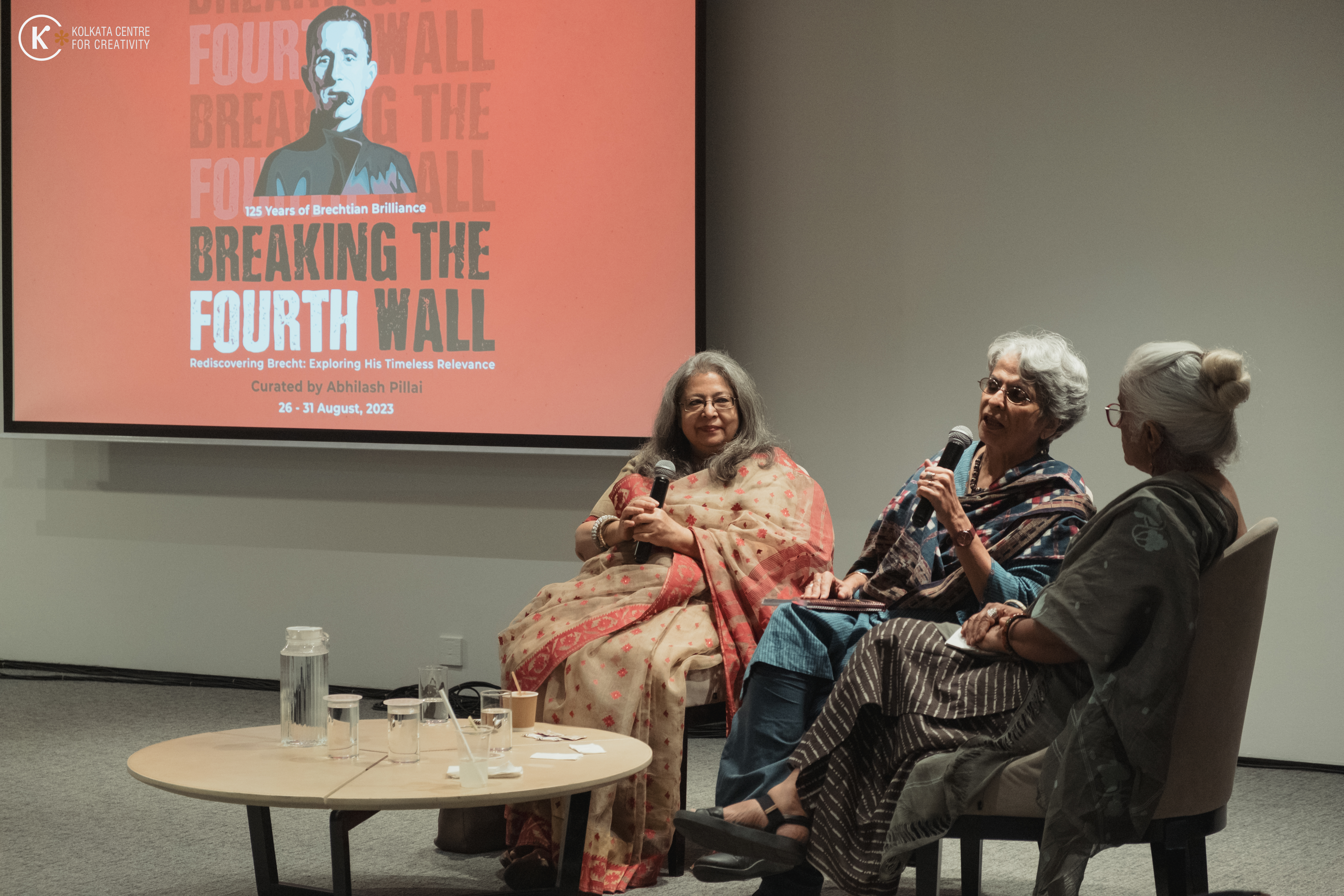
Kolkata Centre for Creativity, is a multi-disciplinary interactive arts centre based in Kolkata. KCC is a unit of Anamika Kala Sangam Trust, a not-for-profit public trust that promotes research and experimentation and champions inclusivity and accessibility in the interface between the arts and society. They are trans-local in spirit and encourage the cross-pollination of ideas and creativity across borders.
Festival Highlights and Impact on Indian Media
In the realm of Indian theatre, Brecht’s influence has forged a unique dialogue between Western and Indian traditions. This festival delves into this intersection, exploring how his work provided the ideological and aesthetic foundations for modern theatre to shape a national identity. The dialogue between Brechtian aesthetics in India and Europe and the history of cultural resistance adds to the richness of this discourse. The Festival explored the opportunity to celebrate Brecht’s enduring legacy and the diverse voices his work has inspired.
In the 1960s to 1990s, Indian artists exchanged visits, translations, and conversations with those from the socialist bloc. This led to lasting effects on Indian art practices. The Bandung Conference in 1955 brought together newly independent nations from Asia and Africa, advocating for world peace, self-determination, and opposition to imperialism. It also initiated a radical postcolonial formation meant to unify former colonised peoples. The Lotus magazine, co-funded by the Soviet Union, Egypt, GDR, and the PLO, provided a platform for anti-colonial politics. Translation played a crucial role in this interculturism. The topic of “interculturism” brings to mind the significant impact that Fritz Bennewitz, a theatre director from the GDR, had on the evolution of modernism in contemporary Indian theatre. In the 1970s, Indian theatre conventions were redefined, with folk and classical categories becoming high vs. low art issues and authenticity vs. imitation.
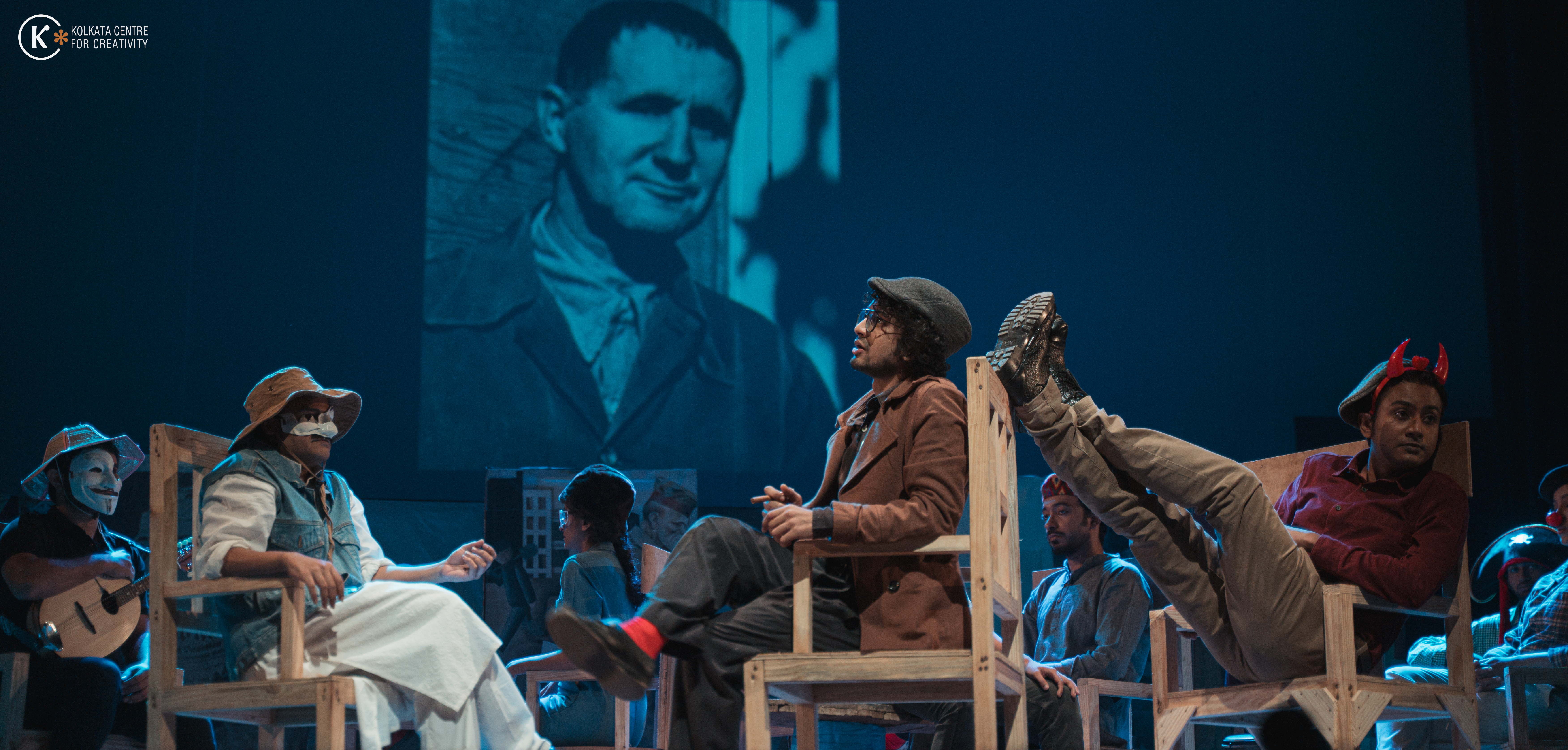
This approach blurred the lines between folk and classical theatre, transforming both into estrangement (previously referred to as alienation) techniques. The exploration of how gestures and actions could evoke affective responses in audiences led to enhanced critical analysis. The pedagogical approach employed emphasised ethical and critical training, moving beyond rote learning. Students were prompted to contextualise actions within historical settings, challenging established affiliations. This environment facilitated the convergence of traditional and modern forms, uncovering contradictions between likeness and diversity. The aftermath of the fall of the Berlin Wall had a profound impact, leading to a re-evaluation of certain ideals. The approach, bridging cultures and ideologies, prompted reflections on the connection between tradition, heritage, and contemporary contexts. This legacy inspires a continued disruption of conventional narratives in the realms of art and culture.
The evolution of interculturalism from solidarity to multiculturalism and trans-culturalism was examined during the festival. This influential work was aligned with an earlier vision of third-world internationalism, seeking global solidarity. The impact extended to reshaping artistic practices and fostering critical thinking in India, demonstrating the potential of blurring boundaries between cultural forms and ideologies.
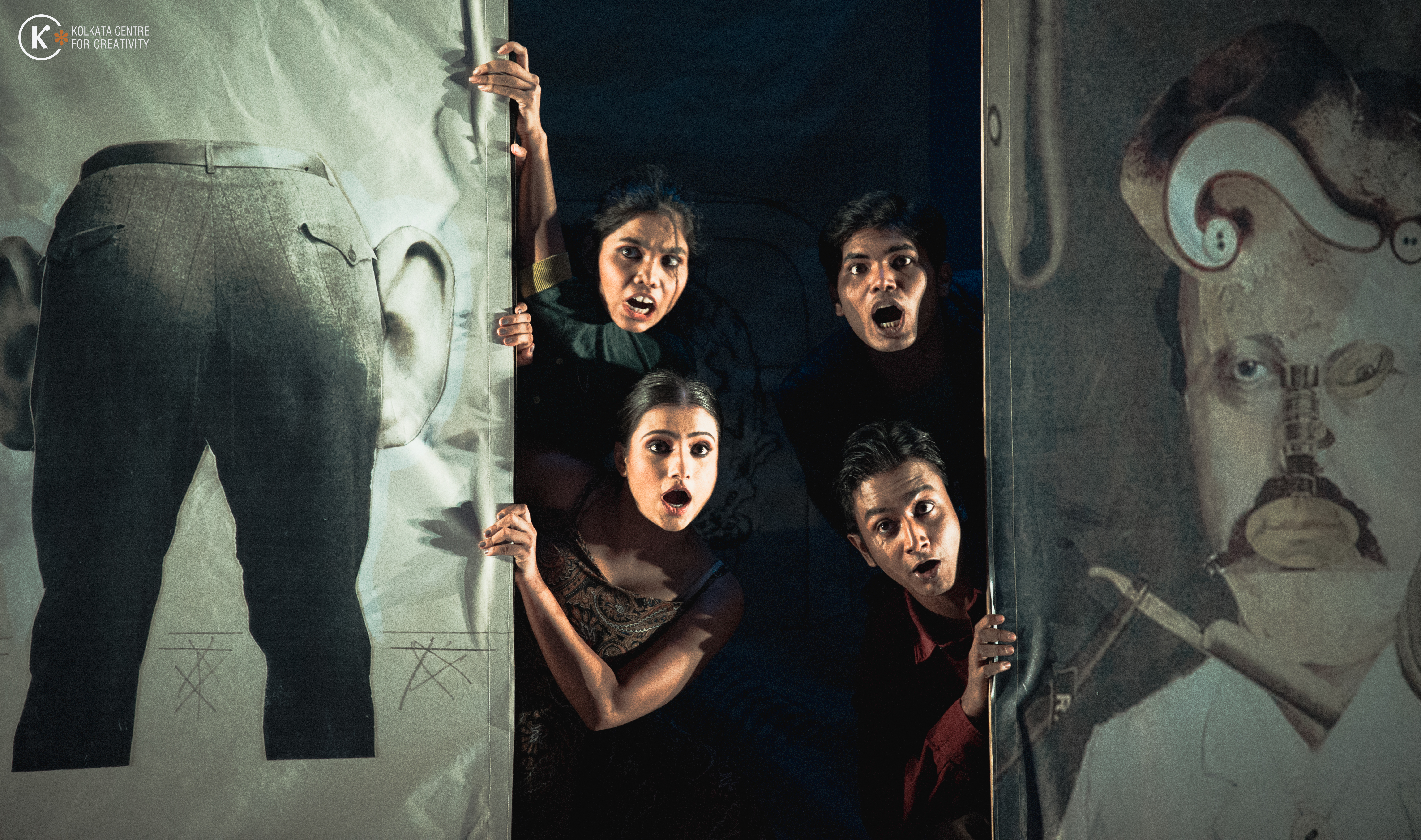
Brecht’s legacy extends to cinema, philosophy, and beyond. Filmmakers drew from Brechtian aesthetics to craft thought-provoking films that resonated with his socio-political concerns. His impact is also evident in the realm of music, with his compositions influencing artists from Ella Fitzgerald to modern singer-songwriters like Bob Dylan, Tom Waits, and David Bowie. Similarly, Indian Cinema and media were greatly impacted by his influence. Despite fluctuations in his popularity, Brecht’s ideas persist in our collective consciousness. His engagement with issues like class struggle, societal inequality, and the deconstruction of theatrical illusion remains relevant, offering a critical lens through which to examine and transform the world. The discourse around Brecht’s legacy underscores his enduring significance. As various artistic movements and societal shifts unfold, his work provides a rich tapestry for exploration, adaptation, and reinterpretation. His legacy is not static; it evolves with the times, constantly rekindling conversations about the intersections of art, politics, and the human experience.
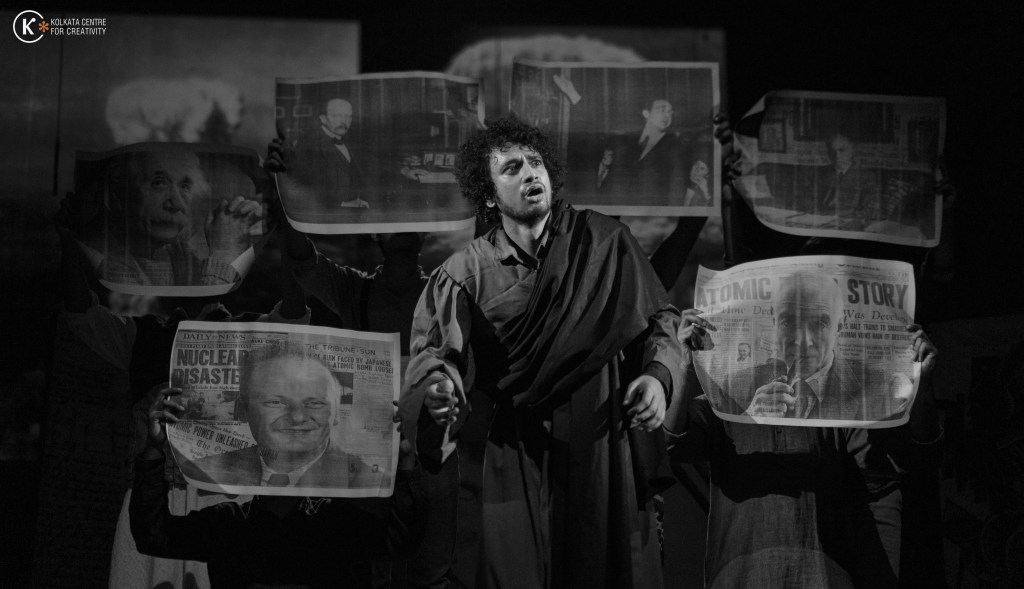

The festival tried to provide an extensive platform for discussions and artistic exploration. The “Performing Brecht” section examined the convergence of past and present in Brechtian theatre, while “Directing & Designing Brecht” delved into the complexities of staging his works. “Remembering Brecht” explored his collaborations and perspectives, and “Philosophising Brecht” probed his unique theatrical philosophy. “A Future Brecht” examined the global ramifications of his socio-political messages. The festival’s workshops, led by experts, nurtured creativity and critical thinking, and the “In Conversations” sessions unearthed adaptations of Brecht’s works. Following the panel discussions, we have gained access to new approaches and methodologies that we can implement. As a result of this thought-provoking event, we anticipate that we will be able to generate fresh insights and ideas that will help us achieve greater clarity in our future endeavours.


I was impressed by the level of enthusiasm and dedication displayed by the young participants in the workshops. It’s motivating to see them investing their time and energy wholeheartedly, attending every session with unwavering focus. The workshops and sessions must have provided great value and meaning to them. I encourage them to continue exploring and building on this experience. The feedback we received from participants is a testament to the thought-provoking nature of this event.

The festival’s workshops, helmed by experts, nurtured creativity and critical thinking. “In Conversations” unearthed adaptations of Brecht’s works, and the “Brecht in India” photo exhibition offered a visual journey through his Indian impact. Central to the festival was the immersive art project “Unveiling Disquiet,” engaging the audience in a transformative experience. Another intriguing artwork, “Death Mask,” explored Eastern India’s mourning tradition of imprinting feet with Altha dye. This art form bridges the gap between life and death by symbolising an intimate connection to the Earth. It defies isolation, embraces multilateral perspectives, and represents emotions like anger, love, and ambition. By unveiling the natural person behind the mask, it celebrates diverse selves and unveils the profound grammar of consciousness, echoing Brecht’s call for human connection.

Brecht’s commitment to social commentary and his unique blend of irony, poetry, and intellectual rigour continue to resonate today as politically engaged art is more important than ever. His legacy beckons us to bridge the gap between art and audience, question conventions, and challenge societal norms. Our festival may testify to his enduring relevance and may ignite dialogue, introspection, and creativity. We scrutinise the world’s injustices and disparities through Brecht’s lens, seeking to transform our reality. We expect this festival will be a catalyst for change, a beacon of artistic transformation, and a source of hope for a more compassionate world. The festival was introduced by the esteemed Bengali personalities Pabitra Sarkar and Ramkurmar Mukhopadhyay. Their opening address took us on a journey to explore the dynamic facets of Brecht’s legacy while inspiring us to renew our commitment to the transformative power of art. Their message: Let’s join hands to break the fourth wall together. The impact of the festival reached far beyond the event itself. It generated substantial media attention and discussion, emphasizing the significance of Brech’s legacy in the Indian theatre scene. Brecht’s ideas about class struggle, societal inequality, and the deconstruction of theatrical illusion were discussed in the context of contemporary issues, further underlining the relevance of his work.
Future Festivals and Publication of Proceedings
The festival in Kolkata was not merely a one-time event but part of an ongoing commitment to explore and celebrate Brecht’s legacy. The organizers expressed their intention to continue hosting future festivals, which could address various aspects of Brechtian theatre, including regional interpretations such as Bengal Brecht, Marathi Brecht, or Kannada Brecht. Dialogues are ongoing with the International Theatre Festival of Kerala (ITFOK 2024) to collaborate with KCC and host the next “Breaking the Fourth Wall” festival in Thrissur, Kerala. Furthermore, the organisers intend to compile the festival’s proceedings into a book or journal. This collection would serve as a valuable resource for both participants and future generations, shedding light on the multifaceted legacy of Bertolt Brecht and the impact of his work on the Indian theatre landscape.
Conclusion
We went through the quintessential Brecht for six days during this festival of thoughts and ideas, as all the distinguished scholars and theatre practitioners have agreed that Brecht’s theatre was a departure from the traditional and a revolt against the mainstream modern theatre. He openly declared that theatre should be political. While breaking the fourth wall, the plays would remind us that we are not watching a reality but a representation of it. Commemorating Brechtian brilliance @125 years in Kolkata becomes far more relevant because it was here that India had a Brechtian society formed way back in 1970.
The discussions covered various topics, such as his perspective on stage design, lighting, music, props and costumes, and simplicity. Brecht’s life and work were extensively referenced during the festival, and his influences, collaborators, translations, and political and economic views were also touched upon in great length and depth. We cannot but mention here three energetic performances, namely the Ishtehar Songs from Brecht, Bechara BB, and Ravan reloaded, which were appropriate to the text and context of Brechtian brilliance. We also could walk through the exhibitions during the festival’s six days: “Death Mask” by Hiran Mitra and “Unveiling Disquiet” by Pallavi Majumdar and Sanjeev Barui were powerful installations of ideas. The core idea of the festival emphasised dismantling the fourth wall. It is well-known that in traditional Indian theatre, the concept of a fourth wall is not present as the stage and audience are not separated. Today, this wall represents more than just a physical, emotional, and intellectual boundary between the stage and the audience. It symbolises the divisions among societies, religions, classes, migrants, non-migrants, and other divisive political ideologies. Unfortunately, such divisions are prevalent in our country and globally, despite our claims as a civilisation that has reached the Digital Age.

The “Breaking the Fourth Wall” festival in Kolkata was a celebration on the 125th anniversary of Bertolt Brecht’s birth and an exploration of his enduring relevance in contemporary theatre. The event highlighted the commitment of the Kolkata Centre for Creativity and the dedication of the organizers and participants in promoting Brecht’s legacy. It generated meaningful discussions and artistic exploration, emphasizing the ongoing relevance of his ideas in the context of modern Indian theatre. This festival was a testament to the power of art, political engagement, and the transformative potential of theatre, and it is poised to leave a lasting impact on the Indian theatre landscape. As Brecht once said, “In the dark times, will there also be singing? Yes, there will also be singing. About the dark times.” This festival, indeed, demonstrated that even in challenging times, art has the power to illuminate and inspire, and it serves as a beacon of hope for a more compassionate world.
[About the author: An alumnus of the School of Drama, Calicut University, National School of Drama, New Delhi, Royal Academy of Dramatic Art, London, and Ph.D. from Jawaharlal Nehru University, New Delhi, Abhilash Pillai is a play director, pedagogue, and scholar of contemporary Indian theatre who has directed plays in various Indian and international languages. He was Professor of Acting and Directing and Head of the Cultural Exchange Program at the National School of Drama for nearly 20 years. Recently he was also the Executive Director of the Asia Theatre Education Centre (ATEC) at the Central Academy of Drama in Beijing. Currently he is the Director of the School of Drama and Fine Arts at the University of Calicut in Thrissur. Along with other awards, Abhilash has been honoured with the Sanskriti Award (2002/03), National School of Drama’s Manohar Singh Smriti Purskar (2009), and Kerala Sangeet Natak Award (2012) for his achievements in the field of theatre.]
[Back to TABLE OF CONTENTS]
Documentation: Brecht’s Hofmeister on Tour
Introduction: Berlin Theater Director Jürgen Kuttner on a Midwest Tour
by Marc Silberman
In Fall 2019, Jürgen Kuttner had the idea of using Ruth Berlau’s stop-motion documentation of Brecht’s 1951 Der Hofmeister, an adaption of J.M.R. Lenz’s eighteenth-century tragicomedy, for an experimental presentation at Berlin’s Kino Babylon (Rosa-Luxemburg-Platz). Because the film footage had no sound, he convinced some actor colleagues to stand on stage in front of the large projection screen where the silent film was projected, while they read the dialogues projected on a screen behind the audience, accompanied by improvised music and spoken commentaries from Brecht’s notes by Kuttner himself. The evening event was so successful that the “production” was moved to the Kammerspiele in the Deutsches Theater where it ran for two seasons through 2022.
I contacted several colleagues in the Midwest about the possibility of bringing Kuttner to our campuses to work with the Hofmeister film footage. Because they knew him from a previous tour in 2018 for a performance of “I wanna be Americano,” a comic presentation of video excerpts from television ads and films (Videoschnipseln) held together by his commentary, there was an enthusiastic response. Meanwhile the Covid pandemic hit, and it wasn’t until December 2021 when I was able to see the performance of Der Hofmeister at the Kammerspiele and discuss details with Kuttner about the feasibility of such a campus tour. Already at the GSA conference in early October 2021 in Indianapolis, Teresa Kovacs, Jack Davis, André Fischer, and I had developed a tentative plan, that I was to present to Kuttner in December. The format we imagined was for each campus to host the director for about a week in spring 2023 in an advanced undergraduate course. In preparation, the faculty member would introduce Brecht’s Hofmeister adaptation for about a week (context, background, some scenes), and the next week Kuttner would be present to rehearse with the students for a public “performance” using Berlau’s stop-motion film as at Kino Babylon in Berlin. Then in March 2022, Kuttner informed us that it would be impossible for him to arrange the trip in spring 2023 because of a new production he would be rehearsing in Berlin, so we pushed the tour to fall 2023 instead.
In June 2022, several of us were in Berlin and met with Kuttner (in the Kantine of the Volksbühne after one of his regular “Videoschnipselabende”) to strategize the timing of the visit from mid-October through mid-November 2023. By October 2022, we had nailed down the precise timing as follows:
1) Oct. 15-21, Indiana University-Bloomington, hosted by Teresa Kovacs
2) Oct. 22-28, Truman State University in Kirksville, MO, hosted by Jack Davis
3) Oct. 29-Nov. 4, Washington University, St. Louis, hosted by André Fischer
4) Nov. 5-11, University of Wisconsin-Madison, hosted by Melissa Sheedy
At this point each host began seeking funding at each campus, arranging the undergraduate seminar course announcement, planning for travel, lodging, etc. The only major change was that instead of a performance at Washington University, Fischer arranged for other kinds of presentations and seminar visits for Kuttner. As fall semester approached and teaching got underway, each campus developed its own scenario for hosting Kuttner. What follows are documentations produced by each campus for their experience in producing Der Hofmeister: University of Wisconsin-Madison, Indiana University, and Truman State University.
[Back to TABLE OF CONTENTS]
*******************************

Kuttner in Madison
by Melissa Sheedy
No costumes. No props (does a stuffed squirrel count?). Three rehearsals total. And yet, as 11 nervous students took the stage at the Memorial Union Play Circle, their transformation from a group of undergraduates into a retinue of flawed and funny figures, led by the hapless tutor Läuffer, was a marvel to behold. This chilly evening performance of Brecht’s Der Hofmeister was a resounding success, delighting the nearly full house of spectators, myself as their instructor, our special guest director Jürgen Kuttner, and—most especially—the students themselves.
This performance was the highlight of a semester devoted to hands-on, interactive engagement with theater through a German cultural and linguistic lens. German 372, “Theater auf Deutsch,” is an advanced (4th-year) culture course that I inherited from esteemed colleague Professor emerita Sabine Gross. Through the addition of literary (and literal) cats, Monty Python sketches, and new frameworks such as queer theory, feminism, and drag, I’ve made the course my own, but am deeply indebted the innovative, workshop-like style of Professor Gross’s classes, her informal, yet rigorous, teaching style, and her creative use of texts and scenes. To prepare for taking on this course myself, I spent most of last fall in Professor Gross’s classroom, trying to soak up any and all theater knowledge (my own research area is concentrated on literary characters who stay put inside their books; translating these figures onto the stage was a bewildering prospect). The next several months were a crash course in German theater, including a visit to Berlin this past summer to absorb as much theater as possible and meet and strategize with local director Jürgen Kuttner, whose innovative and hilarious Videoschnipsel I still remembered from his 2018 visit to Madison. Generously funded by the German+ unit of the Department of German, Nordic, and Slavic+ and the Center for German and European Studies (CGES), the trip prepared me to help students engage more authentically with German language theater. (But did it turn a devoted introvert into an exuberant theater kid? Only time will tell …)


In class, students spent weeks working up to Lenz’s Der Hofmeister (and Brecht’s reworking of the drama). In addition to enjoying generous guest lectures by Marc Silberman and Sabine Gross, students learned about (and from) Brecht, put their own Brechtian twists on various texts, and became acquainted with the play’s plot, themes, and characters. When Kuttner hit the scene in the week of the performance (once again thanks to the generous support of the German+ unit and CGES), his mere presence seemed to inspire students to achieve new heights. While we only had three rehearsals in preparation for the performance, each one was, to me, an astonishing achievement, both on the part of our guest director and of course the students themselves. I was fortunate enough to be in the front row at the finale performance of Der Hofmeister this summer in Berlin. The incredibly talented actors, led by the inimitable Jürgen Kuttner, brought Brecht’s vision and Lenz’s characters to life, and caused me to question everything I thought I knew about theater. Nearly six months later, this fresh take on the drama by a group of German students—many of whom wholly without prior theater experience, all of whom at the mercy of Lampenfieber—is a performance I will never forget.
Follow this link to watch the performance in Madison.
[Back to TABLE OF CONTENTS]
*******************************
Ein Interview mit Jürgen Kuttner (10. November 2023)
von Zoe Jaeger (ZJ), Annika Kline (AK), Collin Queen (CQ), Melissa Sheedy (MS)
Transkript: Melanie Bernstein, Melissa Sheedy

ZJ: Wie hat der Mauerfall Ihre Kunst und Ihre Arbeit beeinflusst? Und wie hat sich Ihre Arbeit verändert seit dem Fall der Mauer?
Kuttner: Ach, der Fall der Mauer war schon ein grundsätzliches biographisches Erlebnis. Ich war ungefähr 30 Jahre alt, was eigentlich ganz gut war. Ich hatte meine Ausbildung abgeschlossen. Ich hatte Lebenserfahrung, ich hatte schon zwei Kinder und war noch jung genug, um alles mögliche andere zu machen und nicht so jung, dass ich so orientierungslos war wie Leute, die zehn Jahre jünger waren, z.B. Für die war das, glaube ich, viel schwieriger. Es war auch insofern gut, als dass ich in Berlin lebte. Wir haben ja jetzt viel Unzufriedenheit in Deutschland, insbesondere in Ostdeutschland, und die Vorstellung, dass ich zum Mauerfall 50 Jahre alt gewesen wäre, in irgendeiner Firma in der Provinz gearbeitet und im Osten gelebt hätte, dann macht die Firma zu und man ist arbeitslos, das ist schon irgendwie eine schreckliche Vorstellung. Es gibt ja in Bezug auf den Mauerfall den Begriff der “Kriegsgewinnler”. Ich bin einer der Kriegsgewinnler: im richtigen Alter, mit einer guten Ausbildung, in Berlin beheimatet, Das war schon gut. Was die Arbeit betrifft, hat das grundsätzlich ganz viel verändert.
Ich bin in Ost-Berlin groß geworden, habe an der Humboldt Universität Kulturwissenschaften studiert, habe da promoviert und dachte nach sieben Jahren Universität, ich muss jetzt raus, ich will sehen, wie das wirkliche Leben aussieht und habe noch zu DDR-Zeiten im Künstlerverband gearbeitet, mit Kunstwissenschaftlern. Wir hatten eine kleine Gruppe und wir haben versucht zu dokumentieren, was es an Underground-Kunst in der DDR gab – Performances, Installationen, diese Sachen, die nicht zum offiziellen Kunst-Diskurs in der DDR gehörten. Dann fiel die Mauer. Mir war klar, dass dieser Künstlerverband auch ein Ende haben wird, dass das keine Perspektive ist.
Dann fragte ein Freund, ob wir nicht eine Zeitung machen wollen. Er hatte ein Angebot aus West-Berlin, die TAZ, (eine linksalternative Tageszeitung, bis heute), und die wollten eine DDR-Ausgabe machen. So fragte er mich, ob ich nicht Lust hätte, da mitzumachen. Dann haben wir die DDR-Ausgabe von dieser Zeitung gemacht, und das war nach zwei Jahren für mich auch zu Ende. Danach gab es die Frage, ob ich nicht beim Radio arbeiten wollte, weil sich das alles auch neu organisierte im Osten Deutschlands. Ich habe gesagt: Ja, ja, Radio ist doch super. Ich höre gern Radio. Jetzt Radio zu machen ist doch auch eine schöne Gelegenheit, wie grundsätzlich alle Jobs, die ich gemacht habe, quasi auf mich zugekommen sind. Ich bin da nie hingegangen, sondern sie sind immer gekommen, und haben gefragt: haben Sie nicht Lust Zeitung zu machen? Haben Sie Lust, Radio zu machen? Haben Sie Lust, Fernsehen zu machen? Haben Sie Lust, Theater zu machen? Das hat sich alles immer so ergeben. Im Grunde auch mit dem Effekt, dass ich alles, was ich mache, nicht eigentlich kann!
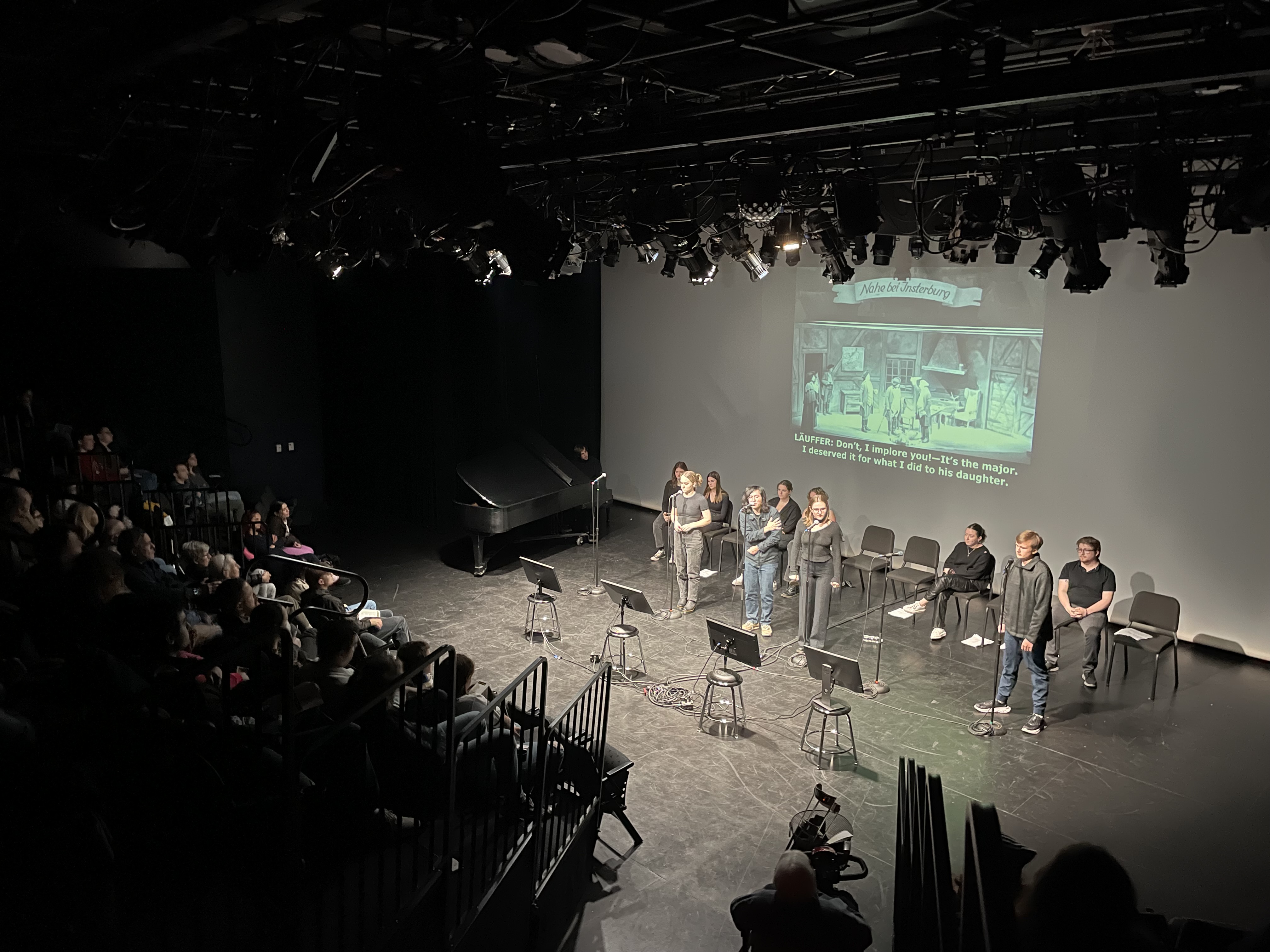
Das war ganz komisch. Ich wäre in der DDR nie ins Radio gekommen. Das waren wirklich politisch geprägte Propaganda-Medien, wo eine ironische Sicht, wie ich sie habe, oder eine auch manchmal “roughe”, plebejische Sicht – “with the strength of a plebeian” –, das wäre in den offiziellen Medien in der DDR und mein Berliner Dialekt wäre im Radio in der DDR überhaupt nicht vorstellbar gewesen. Insofern hat sich das alles ergeben, und die Jobs haben sich, auch alle die ich jetzt mache, wirklich erst mit dem Mauerfall ergeben. Das wäre in der DDR so definitiv nicht möglich gewesen.
ZJ: In Ihrem Interview mit Slavoj Zizek haben Sie über “GDR-nostalgics” (Ostalgie) gesprochen. Haben Sie Ostalgie empfunden? Können Sie Ostalgie erklären?
Kuttner: Die Begegnung mit Zizek war ja kein wirkliches Gespräch. Ich habe eben bloß eine Einführung gemacht. Und er hat seine Performance gemacht. Aber es war schon irgendwie toll, ihm zu begegnen. Das Ostalgie-Problem ist ein bisschen schwierig. Es ist zum einen eine Denunziations-Vokabel, wo man sagt: “Das ist ja von früher”, “hört mal auf damit. Wir haben jetzt andere Zeiten. Ihr seid noch nicht in der neuen Zeit angekommen. Ihr seid noch nicht in der Demokratie angekommen”! Damit lässt sich alles abwehren. Fragen wie: Was war die DDR eigentlich? Wie haben Leute da gelebt? Was fangen sie mit ihren Lebenserfahrungen, die sie in der DDR gesammelt haben, an? Was können die da mit ins neue Deutschland, ins andere Deutschland rüber nehmen? Ich bin kein Ostalgiker. Und ich finde, der Begriff des Ostens ist sehr unpräzise. Zu Ostlern gehören Leute, mit denen ich nichts zu tun haben will. Also wirkliche Armleuchter: Die sind Ostler, ich bin auch Ostler – aber das hat nichts zu sagen. Ich finde, dass die Grenze nicht zwischen Ost und West verläuft – natürlich gibt es da jede Menge Unterschiede – aber die eigentliche Grenze ist die zwischen Armleuchtern und okayen Leuten! Es gibt im Osten jede Menge Armleuchter und es gibt im Westen jede Menge Armleuchter. Und es gibt im Osten Leute, die ok sind, und genauso im Westen. Das ist also für mich das eigentliche Unterrscheidungskriterium!
CQ: Wie hat Ihre Arbeit beim Radio Ihre Theaterstücke beeinflusst?
Kuttner: Das Radio bestand ja nicht nur aus dem Reden, sondern ich habe ja auch immer andere Musik gespielt. Weil die Radiosender, die ihr ja auch kennt, total formatiert sind. Da gibt es Firmen, die entwerfen Programm-Formate für Radiosender: deutsche Volksmusik, Blues, Schlager, die größten Hits der 60er, 70er Jahre, die größten Hits der 90er und Nullerjahre und alles Mögliche. Da dachte ich immer, dass jeder Mensch ein musikalisches Museum im Kopf hat. Das fängt an mit Kinderliedern oder Weihnachtsliedern. Dann kommen die Songs, wo man zum ersten Mal dachte “ich bin total cool.” Danach kommen die Songs, wo man zum ersten Mal eng getanzt oder geküsst hat, oder wo man seine Freundin kennengelernt hat, ganz unterschiedliche Sachen. Die sind eben nicht nach einem Stil oder nach einem Genre sortiert, sondern diese Lieder gehen quer durch. Genau das habe ich versucht im Radio auch zu machen, unterschiedliche Musikrichtungen zu spielen und versucht dieses “innere musikalische Museum” abzubilden. Und ich freue mich immer sehr, wenn Leute auch heute noch sagen: Du hast meinen Musikgeschmack geprägt. Ich habe auch sehr gern “seltsame” Musik, “strange music” gespielt, Musik, die keiner kennt, z.B. irgendwelche japanischen Singer-Songwriter oder afrikanische Trommler, auch tolle Schlager oder eben Funny van Dannen, Maria Callas oder Billie Holiday. Sagen wir mal, ich hatte kein Interesse daran, Sachen zu spielen, die Mainstream sind.
Das Theater ist im Grunde auch ein bisschen formatiert. Wir (Tom Kühnel und ich) haben uns immer an interessanten, eher ungewöhnlichen Projekten orientiert und eher antizyklisch gedacht. Wir haben z.B. einen großen Abend über Hanns Eisler gemacht. Oder wir haben einen Abend, als dieser “Hashtag-Feminismus” aufkam, gemacht. Das klingt immer ein bisschen abfällig, aber das war einfach eine Bubble jüngerer, gutaussehender, akademischer Frauen, die über Feminismus redeten und kein Interesse an und keine Solidarität mit Frauen haben, die an einer Laden-Kasse sitzen, eine Zweizimmerwohnung haben, schlecht bezahlt werden und mit Kind zu Hause sind. Deren Interesse spielt überhaupt keine Rolle. Wir haben also das “SCUM Manifesto” von Valerie Solanas genommen, einen Text, den keiner mehr kannte, der vergessen war, der aber in den 60er-70er Jahren in der feministischen Bewegung eine große Rolle spielte. Das Tolle an diesem Text ist die Radikalität dieses Feminismus. Solanas stellt die Eigentumsfrage, spricht über das Geldsystem und den Kapitalismus, was halt auch wirklich zusammengehört. Oder wir haben uns mit Ayn Rand beschäftigt, die ja eine Ikone des radikalen, rechten, neoliberalen Gesellschaftsdenkens ist. Das war, als diese Neoliberalisierung ein stärkeres Thema in Deutschland wurde.
Sich mit Sachen zu beschäftigen, die keiner mehr kennt, aber interessant sind, das hat die Theaterarbeit schon beeinflusst. Ich habe das Gefühl, wir leben in einer permanenten Gegenwart. Es gibt nur noch Gegenwart und kein Wissen um Vergangenheit. Deswegen gibt es auch keine Zukunftsvorstellungen. Man kann sich Zukunft heute nur noch so vorstellen, welche neue iPhone Generation kommt, oder dass die Krankenkassenbeiträge steigen. So stellt man sich die Zukunft heute vor. Da komme ich ganz naiv, quasi aus den 60ern. Ich weiß nicht, ob das eine Generationsfrage ist, aber ich stellte mir die Zukunft ganz toll vor. Z.B. werden wir mit Hubschraubern in die Schule fliegen, und man muss nicht mehr laufen. Oder die Gehwege sind Rollbänder, man stellt sich drauf und wird durch die Stadt gerollt. Also ganz naiv, aber insgesamt eine Zukunft, die ganz anders und ganz toll ist. Das gibt es ja heute gar nicht mehr, dass man sagt, die Zukunft könnte besser werden, dass man sagt, die Zukunft soll besser werden. Das hängt damit zusammen, dass es in gewisser Weise keine Erinnerung mehr an die Vergangenheit gibt. Deswegen finde ich die Vergangenheit wieder total interessant. Alexander Kluge nennt das den “Angriff der Gegenwart auf die übrige Zeit”
AK: Können Sie bitte Ihre erste Begegnung mit Brechts Theater diskutieren? Was war besonders bemerkenswert?
Kuttner: Brecht habe ich natürlich in der Schule kennengelernt, und da konnte man ganz unterschiedliche Erfahrungen machen. Als wir unsere Fatzer-Produktion gemacht haben mit befreundeten Musikern der Band “Ornament und Verbrechen”, hatten die ganz schreckliche Schul-Erinnerungen an Brecht (die sich übrigens in der Arbeit total verändert haben). Bei mir war das ein bisschen anders. Brecht hatte für mich einen subversiven Moment. Er galt ja in der DDR quasi als Klassiker. Er war Schullektüre, und wenn man Literatur in die Schule holt, ist das eine Form von Beerdigung. Dann ist die Literatur verbrannt für die Zukunft, keiner will das mehr lesen, weil man es in der Schule lesen musste. Aber er hatte und hat eben auch was Subversives: z.B. in Bezug auf den Arbeiter-Aufstand 1953. Dazu hat Brecht sich ja geäußert und hatte für die Funktionäre in der DDR, die diesen Streik verurteilten einen tollen Satz: “Wenn die Funktionäre mit dem Volk nicht zufrieden sind, dann sollen sie sich doch ein neues Volk wählen.” Also die Umkehrung, wenn die vom Volk gewählten Repräsentanten mit dem Volk nicht können, sollen sich doch die Repräsentanten ein neues Volk wählen. Das ist natürlich ein subversiver Moment, und das fand ich bei Brecht interessant. Das war, was mich beschäftigt hat. Später kam die Beschäftigung mit Brecht im Theater. Auch bei der ersten gemeinsamen Produktion mit Tom Kühnel, die sich am Lehrstückgedanken Brechts orientierte. Brechts Lehrstücke aus den 20er Jahren waren eine Entwicklung, die versucht hat, ein anderes Theater zu entwickeln, nicht das klassische, bürgerliche Theater mit Schauspielern und der vierten Wand, wo das Publikum unten sitzt und zuhört. Brecht wollte ein Theater, wo normale Leute selber spielen, vielleicht auch ohne Zuschauer und im Spielen etwas lernen. Es ist etwas komplexer, als ich das jetzt beschreibe. Diese Entwicklung wurde abgebrochen durch die Nazis. Es ging nicht weiter. Brecht ging ins Exil, und schrieb ohne Theater, ohne praktische Überprüfung seiner Arbeit diese großen Stücke, die heute quasi seinen Dramen-Kanon bilden. Aber er hatte eben dieses interessante Konzept entwickelt, das immer wieder überlegenswert ist, gerade wenn es starke politische Bewegungen gab. Das war in den 20er Jahren so, und wurde in den 60er Jahren mit der Studenten- und Bürgerbewegungen quasi wiederentdeckt. Jetzt warte ich darauf, dass mal wieder eine politische Bewegung kommt, die diese Lehrstücke wiederentdecken wird. Aber in der Zwischenzeit denken wir schon immer ein bisschen dran und versuchen das in unsere Stücke mit hineinzunehmen, in unsere Produktionen. Übrigens finde ich den englischen Begriff für “Lehrstücke”, “learning plays” viel präziser als den deutschen, der ja immer eine gewisse Didaktik impliziert…

AK: Haben Sie sich bewusst dazu entschieden, Ihre Karriere auf Brecht zu fixieren?
Kuttner: Brecht ist ein wichtiger Punkt, aber das war keine Entscheidung, sondern es war einfach die Erfahrung, dass Brecht interessant ist. Die erste gemeinsame Produktion mit Tom Kühnel war nämlich ein Lehrstück von Brecht – Der Jasager und der Neinsager, das auch eine interessante Entwicklung hatte. Brecht hatte erst Jasager geschrieben, welches auf ein japanisches Noh-Stück zurückgeht. Das wurde aus dem Japanischen ins Englische übersetzt, und Elisabeth Hauptmann hat das aus dem Englischen ins Deutsche übersetzt, und Brecht hat das bearbeitet und politisiert. Das hieß Der Jasager und es ging darum, dass in einer komplizierten Situation, Der Jasager eben “Ja” sagt zu der Entscheidung, dass er jetzt getötet werden muss, um alle anderen zu retten. Das wurde zuerst aufgeführt oder geprobt und gespielt von Berliner Schülern. Die machten hinterher eine Diskussion und kritisierten dieses “Ja”-Sagen, kritisierten Brechts “Moral” des Stückes, den Satz “wichtig ist zu lernen vor allem ist Einverständnis”. Diese Kritik hat Brecht aufgenommen und als zweiten Teil den Neinsager geschrieben. Es war dasselbe Stück, gewissermaßen, nur das erste endet mit dem Einverständnis dessen, der geopfert wird, und das andere endet mit der Verweigerung. Somit stehen die beiden Stücke nebeneinander. Und das haben Tom und ich in einer anderen Version zusammen gemacht. Insofern war Brecht quasi der Anfang unserer gemeinsamen Arbeit, und wir haben immer wieder den Begriff des Lehrstückes auch teilweise in die Titel unserer Produktionen mit reingenommen. Z.B. in der Theatralisierung des Dokumentarfilms von Harun Farocki “Die Schöpfer der Einkaufswelten”, dass dann im Untertitel “ein quasi-maoistisches Lehrstück” hieß.
AK: Wie haben andere Regisseure Ihren Geist beeinflusst?
Kuttner: Es gab einen total starken Einfluss und das war die Volksbühne in den 90er und 2000er Jahren. Frank Castorf als Intendant und Regisseur “erfand” ein ganz anderes Theater. Er öffnete das Theater auf radikale Art und Weise. Man könnte sagen, es war wie eine Form von Rock’n’Roll-Theater. Die Schwelle war niedrig. Die Theaterkarten waren anfangs billiger als Kinokarten. Es fanden Konzerte statt, es wurde auf der Bühne getanzt und so was. Frank Castorf gilt als Dekonstruktivist, weil er die Stücke auch immer zerschlägt, neu montiert, neu interpretiert, andere Texte reinnimmt oder mit ganz anderen Zusammenhängen konfrontiert, die nicht nur eine Illustration einer Idee waren, sondern das Ganze verfremdeten, und man sich fragt: “Was hat denn jetzt der Faust mit dem Befreiungskampf der Algerier in den 60er Jahren zu tun?” Er hat eine Theatersprache entwickelt, nach dem Motto: Mach hier bloß keine Kunst!
Castorf hat immer gegen eine Schauspielerhaltung gearbeitet, die sich ihres Handwerks zu sicher war. Er wollte immer an die Leute ran – an deren persönliche Charakteristik, an deren Erfahrungen. Das Ganze war oft sehr körperlich, sehr zirkushaft: große Bilder mit teilweise total billigen Witzen und gleichzeitig totaler intellektueller Überforderung. Das war eine sehr komplexe Angelegenheit und hat mich tief beeinflusst.
Gleichzeitig waren an der Volksbühne auch andere Stimmen vertreten, mit anderen, ebenfalls radikalen Ästhetiken. Leute wie Christoph Schlingensief oder Christoph Marthaler, Hans Kresnik, René Pollesch. Für 25 Jahre war die Volksbühne für mich der Traum, das Ideal von einem Theater. So etwas gibt es jetzt in Deutschland nicht mehr und das ist sehr traurig. Und genau deswegen kann ich heutzutage auch kaum noch ins Theater gehen, weil Theater heute oft eine Rückversicherungsveranstaltung ist, in der man in seiner Weltsicht bestätigt werden will und soll. Man geht da hin, um sich Sachen erzählen zu lassen, die man weiß, bzw. um Ansichten oder Ideen vorgeführt und angeboten zu bekommen, die man selbst teilt. Dadurch fühlt man sich wohl und denkt: Ja, genauso ist es, so denke ich auch. Klar, der Umgang mit Migranten ist schrecklich, ja, Rassismus ist ganz fürchterlich, ja natürlich, Frauen sind ja auch Menschen… Dieses schreckliche Wellness-Theater.
Castorf hat eben auch immer die Provokation gesucht, die Provokation der Zuschauer, die Provokation, dass Zuschauer selber denken sollen. Er hat sich ja in den neunziger Jahren viel mit der DDR-Thematik beschäftigt, z.B. einen großen Abend gemacht – Clockwork Orange –, wo er das Aufkommen der Rechtsradikalen Anfang der 90er Jahre thematisiert hatte und er hat später den Raum nach Osten ausgeweitet und Dostoevsky genommen, mit seinem irren Gottsuchertum, wo man ratlos da saß und den weiteren Osten mit einem anderen Blick präsentiert bekam. Das fehlt mir heute. Oft sind das heute die Illustrationen von Sachen, wo man sich denkt, das ist richtig, ja klar, wir müssen toleranter sein, Ja, Frauen sind überall unterrepräsentiert, und die Rechten sind scheiße – aber dafür muss ich nicht ins Theater gehen!
ZJ: Es gibt immer noch ein klares öffentliches Interesse an Brecht und Live-Theater. Warum haben Sie den Hofmeister für diese Aufführung ausgewählt?
Kuttner: Der Hofmeister – das war gar nicht unsere Idee. Das kam vom Leiter des Brecht Archivs, Dr. Erdmut Wizisla, weil er wusste, dass Tom Kühnel und ich immer wieder an seltsamen Projekten interessiert sind. Er hat uns also diesen Film gegeben und gefragt, ob wir nicht Lust hätten, etwas damit zu machen. Wir haben uns den Film angeschaut und gedacht: Das ist ja toll. Das ist interessant. Vor allem aber haben wir es als ein Experiment gesehen. Kann man so etwas im Theater machen?
Weil wir ja oft in unseren Stücken kleinere Szenen haben, wo die Schauspieler “mouthing” machen, wo meinetwegen Diskussionen aus dem Fernsehen eingespielt werden und die Schauspieler stehen auf der Bühne und machen Pantomime, weil der Sound vom Band kommt. Da dachten wir, das wäre ja interessant, und wir wollten einfach sehen, ob man das überhaupt im Theater machen kann. Man muss im Theater auch bereit sein, Risiken einzugehen! Es hätte auch eine totale Katastrophe werden können, und dann hätten wir es 1-2 Mal gespielt und es wäre vorbei gewesen. Also fünf Schauspieler hinstellen und sie den Text sprechen lassen zu den Bildern, die da zu sehen sind. Das funktionierte aber gut. Die Leute fanden das interessant. So kam das zustande, in gewisser Weise eher zufällig.
CQ: Können Sie eine Zeit beschreiben, wo etwas bei einer Ihrer Aufführungen einfach nicht geklappt hat?
Kuttner: Ja, ein Stück von Heiner Müller, den ich ja sehr verehre. Wir haben Die Umsiedlerin gemacht. Wir hatten vorher Der Auftrag von Müller gemacht, und das war ein großer Erfolg. Müller hatte mal das ganze Stück auf Band gelesen, und wir haben als Sound nur diese Lesung von Müller genommen, und die Schauspieler haben den Mund bewegt und Action gemacht. Das war ein toller Abend. Dann haben wir uns an Die Umsiedlerin getraut. Das ist eine realistische Komödie über die Kollektivierung der Landwirtschaft in der DDR. Dieses Stück wurde 1961 nach zwei Tagen verboten. Müller war dann zehn Jahre lang ein No-Name. Er hat kein Geld verdient. Er konnte nicht arbeiten. Seine Stücke wurden nicht aufgeführt, aber er ist trotzdem in der DDR geblieben. Tom und ich haben dieses Stück 2019 inszeniert und sind (für mein Gefühl) daran gescheitert. Das war kein guter Abend, denn das war langweilig, aber es gehört irgendwie auch dazu. Wir haben das Stück nicht in den Griff gekriegt.
AK: Welche Gemeinsamkeiten sehen Sie zwischen MINT-Fächern und Theateraufführungen? Haben Ihre vorherigen MINT-Erlebnisse neue Perspektiven zu Ihrer Arbeit im Theater gebracht?
Kuttner: Ich glaube, der Einfluss war nicht so groß, aber ich war auf einer Mathe-Spezialschule, wo man viel Matheunterricht hatte. Ich hatte mich für einen Studienplatz in Physik beworben, den ich auch bekommen habe. Ich hatte aber gleichzeitig Interesse an Literatur, Kunst und Musik und solchen Sachen. Dann hatte ein Verwandter von mir, der in einer Fabrik arbeitete, wo Besteck hergestellt wurde, mir gesagt, dass sie alle 5 Jahre einen Physiker bei sich in die Firma bekommen. Begründung war: Weil Metall Physik ist. Er meinte, dass der letzte Physiker jetzt Lohnabrechnung macht. Ich schaute mich im Spiegel an und dachte: Einstein, bist du nicht! Ich glaube, Physik ist nur cool, wenn man quasi glaubt, Einstein zu sein. Daraufhin dachte ich: Lass es sein! Aber ich konnte mich nicht zwischen Literatur, Musik und Theater entscheiden. Deshalb habe ich mich für Kulturwissenschaft entschieden. Da haben alle Sachen miteinander zu tun. Was meine Mathe-Erfahrungen betrifft? Ich bedauere sehr, dass es heute unter Intellektuellen quasi als cool gilt zu sagen: Ach Mathe, da habe ich ja gar keine Ahnung! Ach nein, Zahlen, das kann ich nicht! Also stolz sein, etwas nicht zu wissen oder nicht zu können. Das finde ich schon wirklich irre. Solche Aussagen begegnen einem im Kunstbereich relativ häufig. Ich finde, dass das manchmal ein Mangel ist, weil das Reden über Kunst oft nur Emotionen und Gefühle betrifft. Aber ich denke, dass man über Kunst auch wissenschaftlich, akademisch, kritisch oder auch ernsthaft reden kann, also auch mit einem Rationalismus oder einer Grund-Logik, wo man sagt: Wenn A, und wenn B, dann C. Das ist jetzt gewissermaßen ganz mathematisch gesagt, aber ich finde, so kann man und muss man auch in der Kunst argumentieren können. Man braucht natürlich Fantasie und Grenzüberschreitung – das ist ganz klar. Aber dieses gefühlige, schwurbelnde Reden über Kunst finde ich ganz schrecklich. Eine bestimmte Form von rationalem Denken, von Argumentieren, was Naturwissenschaftler natürlich beherrschen müssen, finde ich schon eine ganz gute Voraussetzung, um über Kunst nachzudenken oder zu reden.
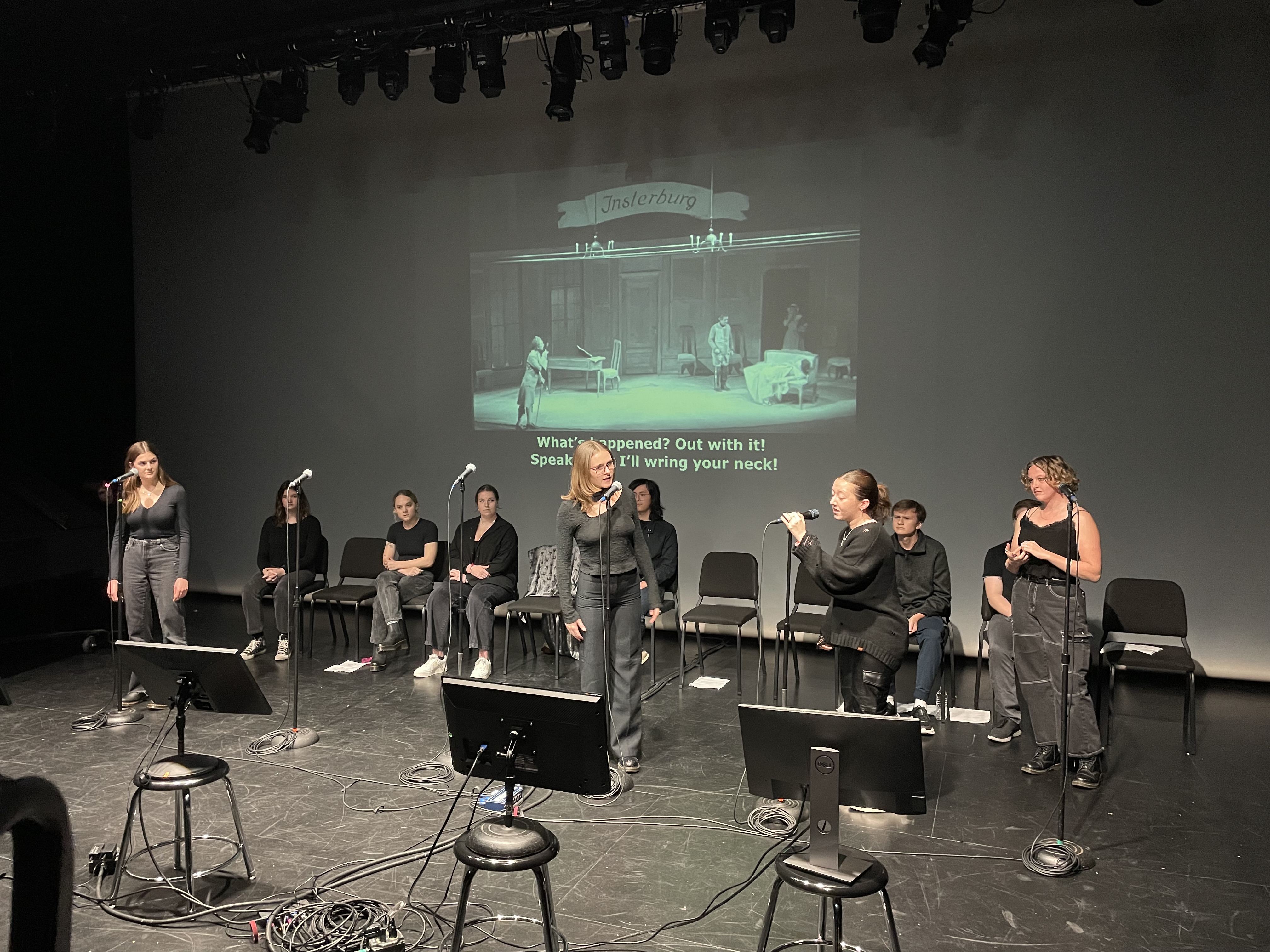
ZJ: Angesichts moderner Technologie hat sich der Medienkonsum verändert: Content ist meistens kurz und digital. Was meinen Sie als Künstler dazu? Welche Veränderungen haben Sie als Künstler in der Kunst, Unterhaltung und Technologie gesehen?
Kuttner: Wenn man jetzt diese ganzen Tik-Tok-Phänomene nimmt, damit kenne ich mich nicht aus und das berührt mich auch nicht. Vielleicht entstehen da eigene Kunstformen. Vielleicht gibt es da ein paar künstlerische Aspekte, die ich nicht kenne. Was aber die Technologie betrifft, die finde ich schon auch interessant.
Als Tom Kühnel und ich das Brecht Festival für drei Jahre in Augsburg organisiert haben, sind wir in diese Covid-Zeit gefallen, wo man eben nicht live performen konnte. Da haben wir im Internet eine tolle Chance gesehen, und alle Künstler, die Performances vorbereitet hatten, sollten Filme daraus machen. Damit meinten wir nicht, dass sie das Theater abfilmen und einsenden sollten, sondern sie sollten einen richtigen Film daraus machen. Da sind wirklich tolle Filme entstanden. Und wir hatten ein Brecht-Filmfestival, das international war, da es alle quasi überall im Internet sehen konnten.
Das hätte ich gerne weitergemacht. Beim ersten Mal funktioniert das alles natürlich nicht sofort, aber es sind so tolle Sachen entstanden, dass ich wirklich begeistert war. Aber eigentlich ist das Interessante im Theater, körperlich anwesend zu sein. So fing Theater an in Athen. Alle Athener Bürger haben sich im Theater versammelt und Stücke gesehen, in denen ihre Angelegenheiten verhandelt wurden. Der erste Dramatiker Phrynichos schrieb das Stück Der Fall von Milet, das davon handelte, dass die Athener ihre kleinasiatische Kolonie Milet (heute in der Türkei) im Stich gelassen haben. Die Perser haben Milet erobert und die Mileter abgeschlachtet. Das führte dazu, dass die Athener bei der Aufführung so ergriffen waren, dass sie weinen mussten, aber im Anschluss wurde Phrynichos zu einer hohen Geldstrafe verurteilt und das Stück verboten, so dass es auch nicht überliefert wurde. So fängt die europäische Theatergeschichte an: mit dem Verbot eines Theaterstücks!
Im Grunde ist das der Traum vom Theater – so politisch, so präzise zu sein, dass man von der Regierung verboten wird. Ich finde es schon bemerkenswert, dass die Geschichte des Theaters mit einem Verbot anfängt und mit einem Thema, das wirklich relevant ist und eben nicht in den Zeitungen steht. Ich habe das auch bei meinen Videoschnipsel-Abenden gemerkt. Immer bei besonders relevanten Themen kamen mehr Leute, gerade weil Theater eine Art Gegenöffentlichkeit sein sollte. Theater sollte Diskurse führen, die in den Medien, im Meinungskonsens, in den Zeitungen nicht stattfinden. Das ist doch das Schöne am Theater, dass die Leute wirklich dasitzen, wirklich körperlich anwesend sind. Eine Antwort auf diese Mini-Formate der digitalen Welt hat wieder Castorf gegeben: Er macht Inszenierungen, die 6-7 Stunden dauern, und wenn man sich darauf einlässt, ist das ein tolles Erlebnis!
Ich finde einen Satz wie “Kunst muss wehtun” gut. Nicht dass es immer Schmerz sein muss, aber ein bisschen an die Grenze gehen. Das ist eine ganz eigene Erfahrung, die man mit 300 oder 500 Leuten teilt, und man kommt in einen ‘Trance’-Zustand. Das ist wirklich eine große Chance von Theater, diese kollektive Erlebnisqualität. Das ist mit Netflix oder TikTok nicht zu erreichen.
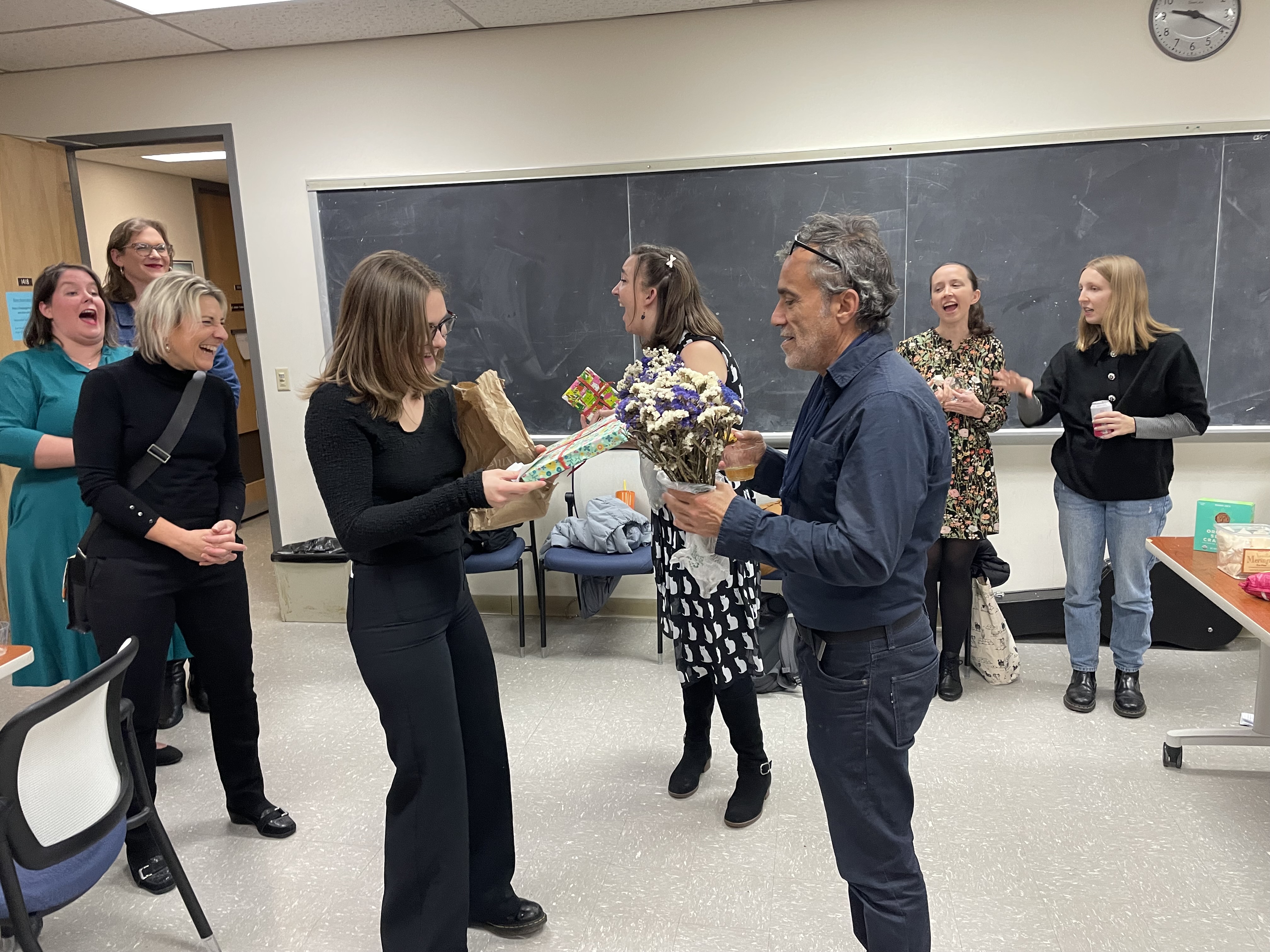
CQ: Dies ist vielleicht eine stereotypische Frage, aber wenn Sie alles noch einmal machen könnten, was würden Sie anders machen und warum?
Kuttner: Da habe ich Glück. Grundsätzlich würde ich nichts anders machen. Ich habe Chancen gehabt, die habe ich ergriffen. Klar, ich habe auch Fehler gemacht, aber nein, grundsätzlich denke ich, dass alles gut war, wie ich es gemacht habe. Ich lebe schon sehr in der Gegenwart und denke: jetzt ist der Zeitpunkt. Hier ist es sehr gut. Ich lebe heute, vielleicht bin ich morgen tot. Es ist doch blöde zu sagen: Ach, ich spare jetzt mal ganz viel Geld, um irgendwann etwas zu machen. Scheiß doch drauf! Wer weiß, ob ich noch da bin. Das ist doch Blödsinn. Ich könnte jetzt tot umfallen und würde nichts bereuen.
MS: Mich interessiert, wie die Erfahrung diesen Herbst gewesen ist, mit Studierenden in den USA zu arbeiten.
Kuttner: Grundsätzlich erstmal wirklich gut. Es ist natürlich schon eine andere Kultur, andere Geschichte, anderer Background, ein anderes Wissen. Diese Theaterarbeit hat wirklich viel Spaß gemacht. Das Interessante ist, dass Studenten – eben weil sie keine Schauspieler sind und nicht über ein Handwerk verfügen – viel naiver, viel fröhlicher, viel offener an Sachen rangehen. Deshalb fand ich diese Proben erstaunlich. Sowohl in Kirksville und in Bloomington aber auch hier in Madison. Was von Euch kam, war wirklich sehr bemerkenswert. Wirklich ganz toll. Ihr könnt mit Euch zufrieden sein. Ihr habt das sehr, sehr gut gemacht!
[Back to TABLE OF CONTENTS]

Hands On! Bertolt Brecht Bloomington Karaoke Theater’s Der Hofmeister
by Cynthia Shin
What would a contemporary German theater director’s adaptation of Brecht’s adaptation of Lenz’s Der Hofmeister look like in Indiana, USA in 2023? Kuttner’s adaptation of Brecht’s adaptation of Lenz’s play transcended time, space, and language to resonate with a new brand of educators in higher education at Indiana University Bloomington that still face similar challenges as Lenz did in 1772: the constant devaluation of their labor, how their responsibilities continue to grow, and the need to sever their “private” parts from themselves in order to be an educator that the state demands.
Jürgen Kuttner and Helga Angarano visited Indiana University Bloomington for a week, from October 15th to 21st, as the first stop to his visit to American universities in the Midwest. They were very generous with their time, working with students during an intense 5-day long rehearsal. The inaugural (and the final) performance of Bertolt Brecht Bloomington Karaoke Theater (BBBKT), aptly christened by Jürgen, took place on October 20th. Why karaoke? Because Kuttner’s performance worked like a “Brecht karaoke” – the actors were on the stage reading the script from a monitor in front of them, just as one would read lyrics as they sing at a karaoke, while the photos from the Berliner Ensembleare displayd in the background.
When I heard that Teresa Kovacs would be bringing Jürgen Kuttner to Indiana University, I was very excited. Everything I know about German-language theater, I’ve learned from Teresa. Before I met her, I always considered studying theater and performance as something unattainable for someone like me: a graduate student with no ties to the German-speaking world, studying in the flyover state. How could I have the chance to observe live performances when Europe is so far away, it’s prohibitively expensive to travel, and Indiana is not a destination of most theater troupes? Teresa makes theater accessible to us at IU, not only through her huge archive of materials but also by bringing playwrights and directors directly to us. Perhaps it is not surprising that so many of our graduate students have theater and performance as part of their interest. We have the intellectual community here that helps further cultivate these interests.
Furthermore, the question that Der Hofmeister raises – what is education worth? – feels particularly relevant for the graduate students at Indiana University who have been fighting for union for years. Thanks to student organizers like the Indiana Graduate Worker’s Coalition (IGWC-UE), there were victories and gains – graduate workers no longer need to pay fees and have had a raise for the first time in years. But we are aware that without union recognition, there cannot be any actual protection of graduate student labor. We are aware that our work is still undervalued on campus, even though it is our work as TA, lab assistant, and Gen-Ed instructors is essential in maintaining the university.
This essay is a report on Der Hofmeister by BBBKT, both the performance and how it came together, but also a report on how art can foster a community in a university by inviting different groups of people – undergraduates, graduate students, faculty, and community members – into a shared space of dialogue.
The performance of Der Hofmeister took place on October 20th at 3 PM in the Studio Theater, located in the Lee Norvelle Theater of Indiana University Bloomington. [ed. note: See link to full performance and other related video materials below.] The theater was packed – so many people came that some of the latecomers had to sit on the floor or stand in the back.
The performance was a collaboration across the university as undergraduates, graduate students, faculty, and Bloomington community members were all part of the performance. The student actors were from Teresa’s undergraduate and her graduate course. Together with Teresa, Johannes Türk, the chair of Germanic Studies at IUB, also participated as an actor. Thomas Schaller, a community member from Austria, played the piano which added beautiful emotional depth to the performance. Some participants came from outside of the German department. The dramaturg, Sheridan Schreyer, was a graduate student in the Theater department. She put together a beautiful infographic titled “The ABCs of German Misery” that provided important historical information that provided cultural context to the audience. The recording of the performance and a short documentary were created by Ahmed Tahsin Shams, also a graduate student in the Media School. I organized and moderated the roundtable that followed the performance. Faculty and graduate students equally participated in the roundtable discussion, as well as the undergraduates and audience members.
The performance was abridged to focus on the story of Läuffer, making it about an hour long. Students wanted to perform in German, but it was switched to English during the rehearsal. German lines from Brecht’s adaptation were translated into English with DeepL and polished by students. During my conversation with him, Jürgen mentioned that changing the language to English really brought the voices of the actors out. I understood what he meant as I was watching the performance. Lanre Okuseinde, who played the Major, had the charisma of a military man all the while revealing the ridiculous hypocrisy of the character. Lousie Bassini, the Majoress, embodied both the overbearing mother and the eager defender of her class. Even though it was a small role, Sophia Iskowich’s Lise will be forever memorable because of the American Southern accent that she so seamlessly integrated into the character.


Watching the performance, I was reminded yet again that theater is an embodied, collective experience. It was not the students’ acting skills or the expensive set that made the performance a meaningful experience but the simple fact that students acted the play out and we, the audience, were there to chuckle and groan alongside. After Läuffer’s castration, Wenzeslaus celebrates his act, calling him “the beacon of the school system.” Everyone laughed so hard. Ethan Walsh had an amazing presence on the stage. His Läuffer was at times funny, at times pathetic, at times insufferable, but then completely relatable. Raymond Wolf was a fantastic Wenzeslaus as well – it was clear already from classroom that he would make an excellent schoolmaster. But we in the audience laughed not just because of how wonderfully Ethan and Raymond embodied their respective roles, but also because we were in an environment that allowed a collective experience of the scene. Jürgen said that “students learn more by doing this play than by reading.” They really did. At the end of the performance, Ethan and Raymond read an additional epilogue, in German and English respectively. Similar to how Brecht had added the prologue and epilogue to his adaptation of Lenz’s play, students wrote their own epilogues and prologues, mimicking Brecht’s style. The final version, which Raymond put together, read as a call for action:
A Message from Mr. Läuffer
Distinguished guests,
Having now borne witness to my struggle
I hope I brought you a little chuckle.
But keep it well in your mind
The story differs from your world only in time.
My successors now work in the public sphere
And have done so for many years.
Tuition has risen uncomfortably high
But their payment can’t be the reason why.
An end to these cycles would be grand
But it only could come through our hand.
Eine Nachricht von Herrn Läuffer
Geehrtes Publikum,
Jetzt dass ihr meine Not betrachtet habt,
Hoffe ich, es euch zum Lachen bracht
Aber auch im Sinn behalten
Diese Geschichte ist euch nur durch Zeit gespalten
Meine Ahnen sind jetzt im öffentlichen Dienst,
doch ändert das nichts an ihr Verdienst
Öffentlich ist schon lange nicht mehr frei
ihr bezahlt ganz viel — für wessen Völlerei?
Und doch, vielleicht verändern sich die Zeiten
Aber nie, wenn wir stillsitzen, sondern nur, wenn wir streiten
(Reproduced with permission of Raymond Wolf)
Listening to the epilogue took me back to observing Teresa’s undergraduate course. Prior to Jürgen’s visit, students spent four weeks reading Lenz’s Der Hofmeister out loud. Each student volunteered to read a role. Teresa explained some archaic German phrases. They stumbled through Latin and French that creeped into the “learned” scholars’ dialogues. In addition to the play itself, we also discussed what education means to them and the explosion of tuition costs in the US. It was while I was observing this class that I realized how funny Der Hofmeister still can be. Especially memorable was Act 1. Scene 5., when Fritz and Gustchen are pretending as if they were Romeo and Juliet. This scene that read simply sentimental and pretentious was so full of humor when students read it out loud, giggling and having fun with the texts. This scene was beautifully reproduced on stage by Jeremy Hersh as Fritz and Julia Irmscher as Gustchen.

I’d like to think that the roundtable also helped with the understanding of the performance by letting the audience members also participate in the dialogue of the play. Rather than teaching the audience members what to make of the performance, we made sense of the performance together. We talked about Läuffer and his castration, which was perhaps less about sexual desires and more about any private parts of his life that interfered with his work as an educator. We share this with Läuffer since we cannot function as a researcher and instructor if we were to fully empathize with students crying in our office hours, struggling with financial situations, dealing with stress and death, or responding to overbearing crises of this world. We too sever these private, emotional moments of our lives to do our job.
I believe the performance was a testament to the role that art can play in creating a community and beginning a conversation on college campus. I believe the deep personal dimensions that this performance nurtured makes a project like this worthwhile. Teresa told me that the relationship between her and her students completely changed – that there is a new sense of trust, especially after seeing their instructor outside of the classroom, as a collaborator. People were already thinking about our next projects as soon as the performance ended. At the afterparty, students mentioned how they should re-do the performance at Germanic Studies end-of-the-year party. Cole Nelson, a roundtable participant, suggested that this performance would make a great teach-in for the graduate student union. Most students probably won’t become actors, nor will they be theater critics. But they found something valuable out of this project beyond career prospects: learning by doing.
Läuffer struggles throughout the play to get paid his promised wage without having to take on more work. This project was largely a passion project for all the participants. Everyone agreed to generously share their time, labor, and professional skills without financial compensation for their work. So, the question remains: how do we continue to nurture such a community while appropriately compensating our educators?


Video materials from the Bloomington production (Archived by Ahmed Tahsin Shams)
Follow this link to the watch the full performance of Der Hofmeister / The Tutor.
“Off-Script: Behind Stage and Screen“: Follow the link to a short promotional video with organizers from Bloomington and Jürgen Kuttner.
Roundtable discussion from the Bloomington production.
[Back to TABLE OF CONTENTS]
*********************************

Kuttner in Kirksville
by Jack Davis
Jürgen Kuttner and Helga Angarano visited the campus of Truman State University, in Kirksville, Missouri, from October 22–28, 2023. They worked with students in an advanced language and culture course (GERM 430: Deutsches Theater) to put on a production of Brecht’s adaptation of J.M.R. Lenz’s play Der Hofmeister. In preparation, the students read Lenz’s original text, as well as parts of the Brecht adaptation, both in the original German.

Rehearsals took place every day during the week of the visit, usually lasting between one and two hours. Kuttner’s chosen format for the adaptation proved to be highly flexible and easy to learn – a must for such a tight schedule, during which students’ other commitments did not always allow them to be present for the entire rehearsal time. Kuttner referred to his concept for the performance as “karaoke theater”: live actors read lines from monitors, ventriloquizing actors in a film stitched together out of stills from Brecht’s original production at the Deutsches Theater. This procedure allowed for a simple and quite effective means of Verfremdung. The live actors quite literally stood “beside” or “in front of” the characters they were playing, thus creating a distancing effect twice over: from Brecht’s actors as they appeared on the screen, and from the characters in the play.

Early on, the decision was made to perform the piece in English translation, both to reach a wider audience at the university, and to facilitate the rehearsals in such a short time. The Theatre Department graciously allowed us the use of their Black Box Theater for several rehearsals and the final performance, and the student actors from the German class were joined by a student percussionist and saxophone player, who created an appropriately ironic and at times unsettling sonic atmosphere. Professor Brad Carlson in the theater department donated his time to managing the technical aspects of the performance. He was assisted by German and Theater student Rowan Burba (who also performed in the play).
The performance took place in the Black Box Theater on October 27, and was well-attended, by students of theater and German, as well as faculty and students from across campus. Professor Jack Davis introduced Jürgen Kuttner, who then gave a brief introduction, explaining the history of Brecht’s version and the version that he and Tom Kühnel developed for the Deutsches Theater. Professors Davis and Ernst Hintz joined their students in performance. All in all, Kuttner and Angarano’s visit was a success!
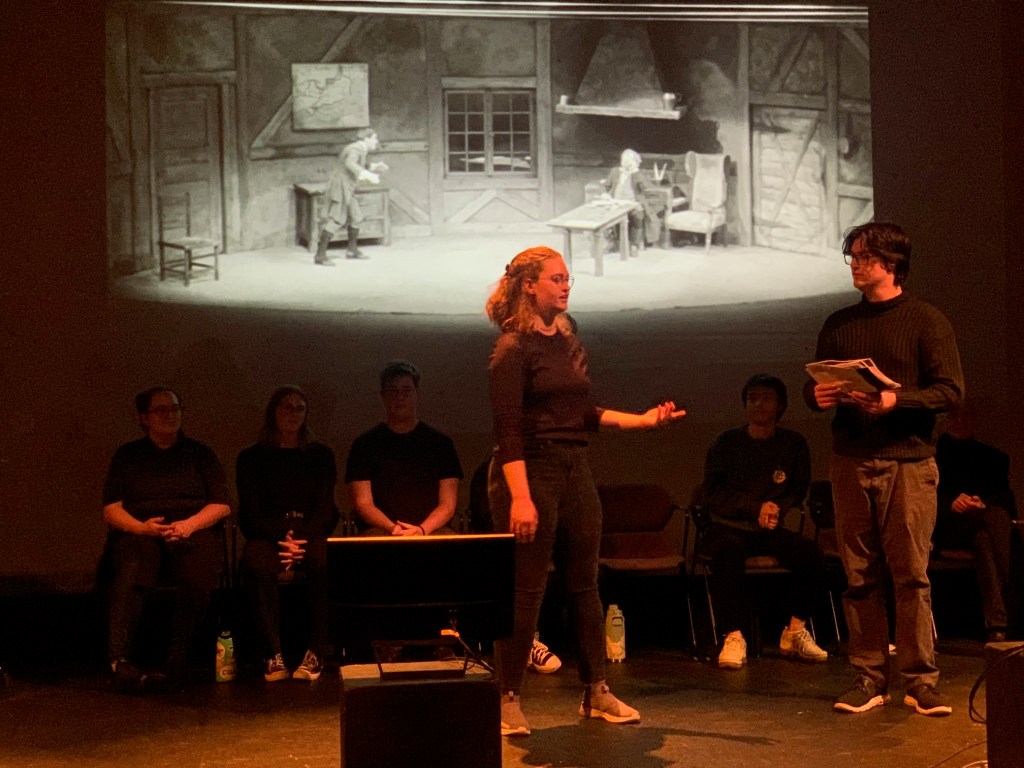


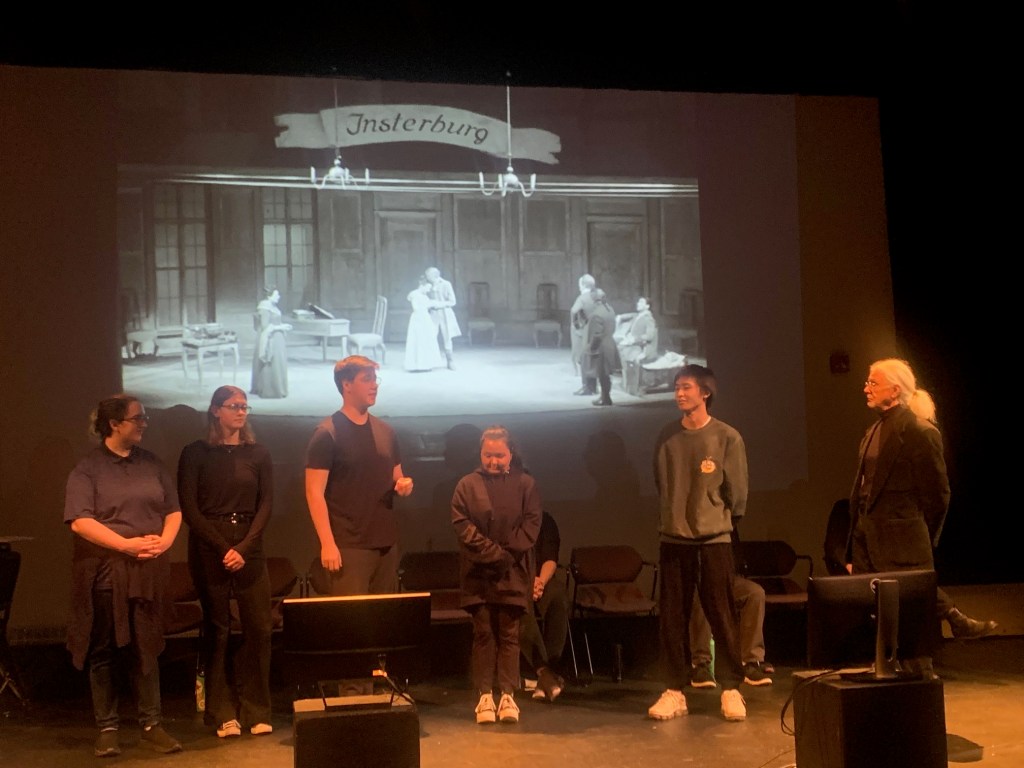
Kuttner and Angarano’s visit was organized by Jack Davis, with the cooperation of Ernst Hintz and the students of GERM 430. The visit was funded by the Department of Classical and Modern Languages, with support of the Theatre Department and the Music Department. Professor Davis also wishes to acknowledge the assistance of Dawn Coy, Will Murphy and CML department chair Dan Doman. Davis also thanks his colleagues at Indiana University, Washington University St. Louis, and the University of Wisconsin-Madison.

[Back to TABLE OF CONTENTS]
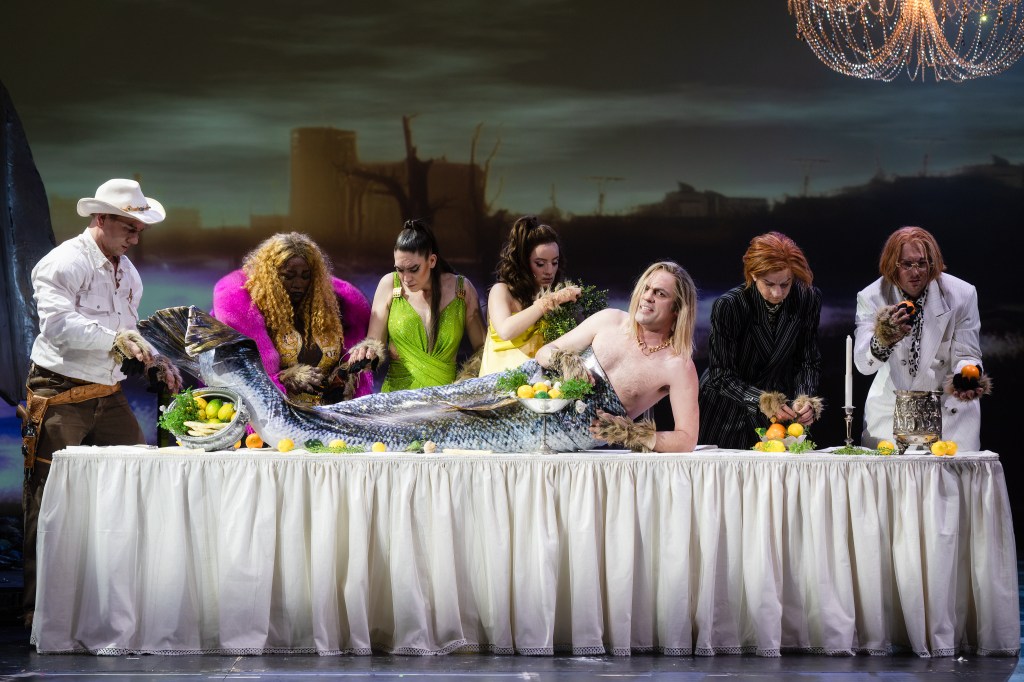

 E-CIBS