
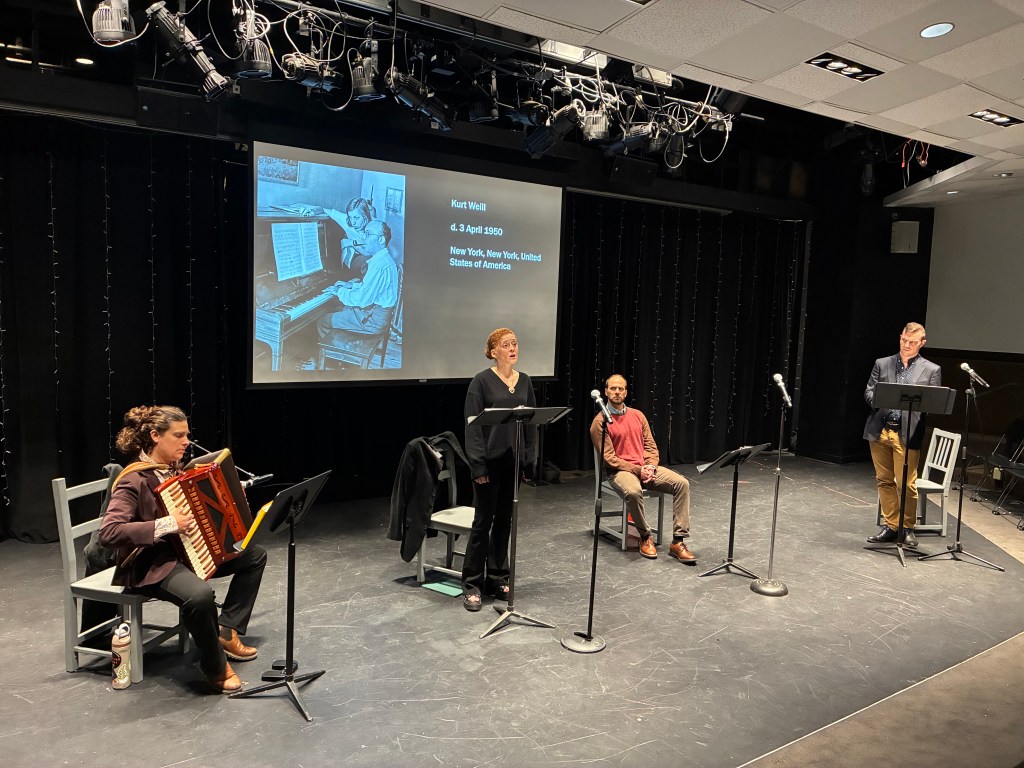
“Artists in Exile” was a theatrical performance held in the Arellano Theater at Johns Hopkins University on April 22, 2026, co-sponsored by the German Embassy. The evening consisted of vignettes made up of excerpts from letters, essays, interviews, songs, and novels by figures from German art, philosophy, and literature ranging from WWI until the aftermath of the fall of the Berlin wall and the end of East Germany. These were collected and arranged by Drew Lichtenberg, artistic producer at the Washington D.C. Shakespeare Theater Company and lecturer in the Theater Arts & Studies program at Johns Hopkins.
The vignettes were structures into five acts: act 1 portrayed figures during WWI, mainly Hugo Ball and the dada movement; acts 2 and 3 dealt with WWII, showing some figures (Brecht, Benjamin, Arendt, Seghers) on the flight from Germany, and others (Schoenberg, Weill, Eisler) commenting on their experience in exile in the USA; act 4 focused solely on Heiner Müller and his relationship to the three German states that existed between 1933 and 1989; act 5 concluded the performance with Jenny Erpenbeck’s responses to the end of East Germany.
Of the roughly two-hour duration of the play, acts 1 and 5 were the shortestand the focus on WWII in acts 2 and 3 formed the most substantial part of the piece. The script was written so that the actors (Johnathan Feuer and Melissa Wimbish) portrayed individual figures, such as Richard Strauss, Bertolt Brecht, or Arnold Schoenberg. For example, in an early scene, one actor read from Hugo Ball’s letters describing how he performed his poem “Karawane” at Café Voltaire; in another scene the actress took up the role of Leni Riefenstahl who defended herself against the claims of being complicit in the actions of the Nazi party. These early scenes established the main themes of the play: artistic reactions to political events and artistic responsibility to respond to the same events.
Each scene was accompanied by a PowerPoint slide with the name and picture of the speaker. Scenes were occasionally interrupted with songs by Friedrich Holländer, Hanns Eisler, Kurt Weill, and Paul Dessau (accompanied by Simone Baron on accordion). The didactic presence of the PowerPoint slides and the interruptions by music were overt Brechtian references, reminding the audience of the playwright’s attempts to keep the viewer levelheaded during the performance, as well as of the possibility of feeling sympathy for some of Brecht’s characters despite these efforts.The method of performing excerpts of letters and diaries alongside poetic works was effective at bringing life to these figures, allowing for emotional moments. Hannah Arendt’s description of Benjamin’s final days, and her return to the Spanish city where he died to look for his grave was especially powerful, as well as Stefan Zweig’s letters written to Joseph Roth about how despite his gratefulness to the Brazilian’s for their hospitality in welcoming him and his wife to their country, he was incapable as a European at sixty years old to redefine himself as something other than a member of the culture he saw collapsing.
Another highlight of the piece was the extended fourth-act focus on Heiner Müller. The east-German director’s inclusion in the performance offered an important counterweight to the familiar material from WWII. Throughout the fourth act, the two actors played together with one taking the role of interviewer and the other taking the role of Müller responding to questions. Müller told of how his father, a staunch anti-Stalinist, found himself the enemy of Nazi Germany and shortly thereafter also the enemy of communist East Germany; when his father decided to flee East Germany, he ended up with a position in the Federal Republic writing the checks to the wives of retired (or executed) Nazi officials. Müller offered an unwavering critique of West German politics and culture, which he saw as relegated completely to market interests, thus one is permitted to say anything in West Germany, only because the words of poets carry no weight there—they get lost in the heaps of literature for sale. In contrast, he tells of how he wrote a line about the erection of the wall, and although this line could be potentially threatening to the party, it would depend on the audience’s reaction to the line in performance. If they cheered or laughed, he would have been punished, but the audience understood the importance of the moment and the poetic statement and therefore kept silent.
Act 5 consisted of an excerpt from the novel Kairos by East-German novelist Jenny Erpenbeck. Dramaturgically, this was an effective conclusion because the novel’s two lovers were played by the two actors, allowing a more naturalistic style to emerge in this section.. The act ended with a song from Brecht’s Mutter Courage sung by one of the characters in Erpenbeck’s novel. Here, the figure of Brecht took on multiple contexts: the play itself calls forth the period at the start of World War II before Brecht fled Germany; the context within the performance reminds the viewer of Brecht’s exile with Walter Benjamin and later in the United States; and the diegetic context of Erpenbeck’s novel presents Brecht primarily as an important cultural figure for the recently dissolved GDR. Following the Brecht song, the performance concluded with a quotation from Hannah Arendt’s Origins of Totalitarianism. The Brecht song and the quotation of Arendt left the performance on an ambiguous note. Are there no newer models for what exile means for art after the fall of the wall, or are we now trapped by the force of WWII to return again and again to Brecht and Arendt as the quintessence of exile experience?
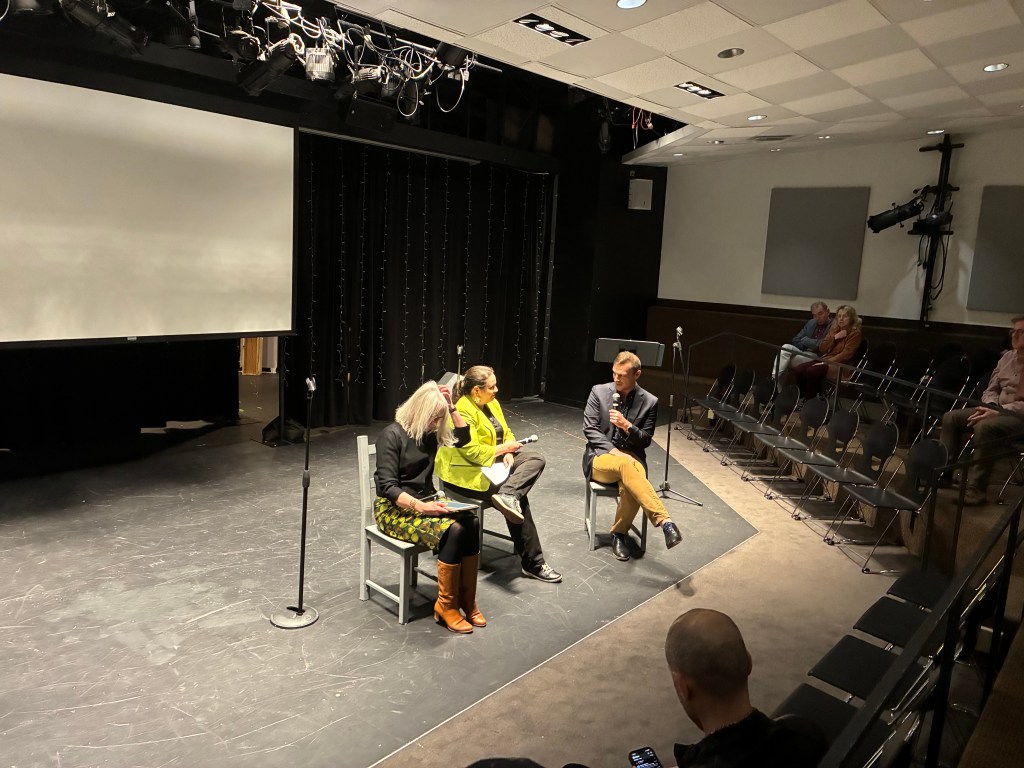
At the conclusion of the performance, there was a Q&A with the director, Drew Lichtenberg, a representative from the German Embassy, Melodie Franzen, and a professor of German at Johns Hopkins, Dr. Katrin Pahl. Prof. Pahl comments on her research of the Maxim Gorki theater in Berlin—which currently invites playwrights and dramaturgs to stage pieces, often not in the German language—were a welcome addition to the mainly twentieth-century figures in the play. The evening was aptly summarized by a member of the audience, who praised Lichtenberg for illuminating the voices of an intellectual tradition that sought to identify and combat political oppression.

Glen Gray is a Ph.D. candidate in German at Johns Hopkins University. His research concerns opera, drama, and political theory in the eighteenth and nineteenth centuries. He received a Fulbright grant in 2024 and a DAAD short-term grant in 2019. He has published on operatic adaptations of Kleist’s Das Käthchen von Heilbronn and has forthcoming articles on German Gothic opera and Kant’s theory of monarchy.

 E-CIBS