William MacGregor and Dennis Raphael, School of Health Policy and Management, York University, Toronto, Canada
Abstract
Achieving health equity – reducing health inequalities between population groups – is becoming increasingly elusive under contemporary neoliberal inspired capitalism. Traditional approaches of carrying out research and advocacy to rectify these inequities have failed as the economic imperative of capital accumulation under capitalism does not allow governing authorities to implement policies that would first manage and then transform the capitalist structures and processes that are the root causes of inequities and which lead to what contemporary epidemiologists call premature morbidity (illness) and mortality (death) and what Friedrich Engels called “social murder.” The poems and songs of Bertolt Brecht appear to be an excellent means of raising these issues as Brecht had key insights into the socially produced nature of health and illness, the societal structures and processes that threaten health, and the means of moving to a more just society. Indeed, he intended for his work to help: “Change this world: It needs it!” (Brecht “The Measures Taken” 310). In this article, we explore our own work detailing how his poems and songs can be applied in the service of promoting health justice.
Keywords: Bertolt Brecht, Health Humanities, Capitalism, Critical Pedagogy
And I Always Thought . . .
And I always thought the very simplest words
Would be enough. If I say what is
Every heart will surely be lacerated.
That you will go under if you don’t fight back
Surely you must see that? (Brecht)1
Purpose
The purpose of this commentary is to communicate how we have been using Bertolt Brecht’s poems to promote the achievement of health equity, defined to mean “that ideally everyone should have a fair opportunity to attain their full health potential and, more pragmatically, that no one should be disadvantaged from achieving this potential, if it can be avoided” (Whitehead 217). Simply put, health inequities are differences in health outcomes between groups that are caused by broader social, political, and material inequities and not differences in biology or health behaviours; in this way, health inequities are “un-natural” and unjust. The profound lack of health equity is apparent both between and within contemporary societies across the globe with one key indicator of this being that working class individuals are at much greater risk of suffering from a wide variety of afflictions and diseases when compared with their wealthier counterparts (a trend that exists universally within all nations). In addition to working class people, racial and ethnic minorities, Queer people, and other socially marginalized groups are also more likely to die prematurely from these un-naturally occurring inequalities that are brought on by problematic and unjust living and working conditions.
For over 50 years, public health advocates around the globe have been calling for action to address these health inequalities with rather little to show for it; indeed, 2026 is the 40th Anniversary of the Ottawa Charter for Health Promotion, one of the landmark documents calling for action to address health inequities, but its goals seem further away than ever (World Health Organization). While the study of health equity has become much more widespread in recent decades, what is especially noteworthy is that Bertolt Brecht clearly saw the links between social and material conditions and health close to 100 years ago, yet it has only been recently that attention has been drawn to his insights.
Personal Backgrounds
William MacGregor is a PhD student in Health Policy and Equity at York University. He came to know Brecht through his focus on political theatre during his BFA in Theatre and Political Science and subsequent MA in Theatre Studies and through his own theatrical practice; a highlight of this was the 2011 Toronto Fringe show The Cage, deeply inspired by Brecht, exploring police abuses during the 2010 G20 Summit in Toronto (Kowalski and Parasram). Upon taking an MA level course with Raphael on The Political Economy of Health Inequities and then enrolling in the PhD program in Health Policy and Equity at York University, MacGregor and Raphael embarked on an ongoing collaboration which examines the potential value of Brecht poems in the promotion of health equity. As they discovered, while there was a body of scholarship on how literature can promote health equity, it was narrowly focused and paid little attention to the potential use of poetry, let alone Brecht’s work specifically.
Dennis Raphael is a professor in the School of Health Policy and Management at York University. While Raphael had a background in liberal arts with a PhD in Educational Psychology obtained in 1975, it was only upon his auditing a course at the University of Toronto on Modern Drama taught by Colin Visser that same year that he was exposed to Brecht’s work. As early as 2002 he began using Brecht’s “A Worker’s Speech to a Doctor” in his teaching of Health Studies at York University.
Health Humanities
The belief that the arts and humanities can contribute to health workers’ education is well-established, especially in the USA and increasingly in Canada; indeed, MacGregor presented the findings from our first paper at the 2023 Canadian Association of Health Humanities conference in Quebec City (Canadian Association for Health Humanities 6). Not only are numerous academic departments of health humanities devoted to such activities and scholarship, but the academic literature on the use of the arts and humanities in training health care workers is now vast with most activities taking place in medical and nursing schools (Jones 415).
Donohoe makes the case for the inclusion of health humanities in health education programs: “Curricula covering public health, social justice, and global bioethics might be more interesting and provocative if they incorporated works of literature” (600), with the idea of utilizing narratives to prompt new analysis and understandings in students. Specifically, he suggests having students read George Orwell’s How the Poor Die, Anton Chekhov’s Ward Six, and Upton Sinclair’s The Jungle. For Donohoe, these activities can:
Introduce basic principles of social medicine and community health; facilitate discussion between students regarding the social determinants of illness, the health of populations, and the public health responsibilities of physicians; increase empathy, understanding, and appreciation of alternative viewpoints; and encourage students to undertake further studies and/or research in public health and publicly work towards solutions to sociomedical problems (600).
Promoting Health Equity through Brecht’s Poetry
An excellent example of the humanities and arts promoting appreciation of how living and working conditions cause illness is provided by Brecht’s 1938 poem “A Worker’s Speech to a Doctor” (Brecht 700). In it the titular Worker, under medical examination, rebukes his Doctor’s suggestion that the cure-all for his severe and chronic health issues is simply to “put on weight.” The Worker points to the rags he is wearing, naming the true root cause of both his tattered clothes and his poor health: explicitly, the living and working conditions associated with living in poverty and, implicitly, the economic system of capitalism. Raphael began using the poem in 2002 as part of his health studies courses and more recently used excerpts from this and other poems as epigraphs in a number of journal articles and book chapters.
The Brecht Poems
MacGregor and Raphael embarked on their exploration by first considering how “A Worker’s Speech to a Doctor” can provoke reflection upon the living and working conditions that shape population health. The publication of Kuhn and Constantine’s Collected Poems of Bertolt Brecht also included three poems, the Call to Arms Trilogy, which were not previously available and seemed especially relevant, expressing a more militant, critical, and activist tone than “A Worker’s Speech to a Doctor” (Brecht 701).
The trilogy begins with the “Call to a Sick Communist”, followed by “The Sick Communist’s Answer to the Comrades”, a dialogic exchange where a communist taken ill with tuberculosis exchanges letters with his comrades offering support; both poems explicitly name the capitalist economic system as the true root cause of illness, through producing and maintaining an exploitive economic structure that sickens and then kills workers. In the third poem of the trilogy, “Call to the Doctors and Nurses”, Brecht cleverly pairs his structural critique with a recruitment effort, exhorting health care workers to join the struggle for social justice by appealing to both their ethical responsibility as health care providers and to their own exploitation inside the economic order; rhetorically, this contrasts with “Worker’s Speech to a Doctor” where he critiqued physicians as part of that same system, but in this final poem he includes them in his call to action. Our analysis of these four poems resulted in our article “Beyond Empathy to System Change: Four Poems on Health by Bertolt Brecht”, which outlined our recommendations on how to utilize these poems to provoke reflection and discussion about the structural determinants of health and was published in the Journal of Medical Humanities (MacGregor, Horn, and Raphael 53).
This work was followed by an extensive analysis of the instances in which “A Worker’s Speech to a Doctor” had been used as a pedagogical tool to promote a deeper understanding of health equity (Karodia, MacGregor, and Raphael 386). This subsequent article, “Evoking Brecht’s ‘A Worker’s Speech to a Doctor’: Developing Clinical Skills, Deepening Understanding and Promoting Action on Living and Working Conditions, or Mobilisation for System Reform or Transformation?”, was published in Medical Humanities and revealed that while most of the 56 usages of the poem found in books, book chapters, journal articles, presentations, and blogs did draw attention to how living and working conditions shape health (and in many cases their public policy antecedents that determine these conditions), most excerpts did not include what we would argue is the most important part: Brecht’s implicit critique of the economic system and physicians’ complicity within it. In practice, this blunts the criticism of the medical system itself and how it reifies and reproduces many of the social inequities that produce ill health to begin with. Accordingly, in this paper as well as our previous one, we suggested that “A Worker’s Speech to a Doctor” and other Brecht poems could serve as a rich source for reflection, discussion, and action to promote health by health and social services workers, researchers, community activists, and the public.
At the same time, Raphael was co-editing the volume The Politics of Food Insecurity in Canada and the United Kingdom, where six Brecht poems were identified as being specifically relevant to understanding the upstream social and political forces creating food insecurity and hunger, as well as the limitations of the present charitable-based food provision system (primarily food banks) as a means of meaningfully rectifying this insecurity (Mendly-Zambo and Raphael). Each chapter begins with a Brecht poem or song, and these six works with an additional four were then placed in the article “Beyond Food Charity to Systems Change: Pedagogical Application of Bertolt Brecht’s Songs and Poems to the Problems of Food Insecurity and Hunger” together with recommendations of how they could be used to promote reflection on the true root causes of food insecurity and hunger in capitalist society, as well as means of dealing with these problems at their source (MacGregor, Mendly-Zambo and Raphael). A small research grant has now been received to carry out such an exploration with Health Studies students at York University through focus group work for an upcoming article.
Future Directions
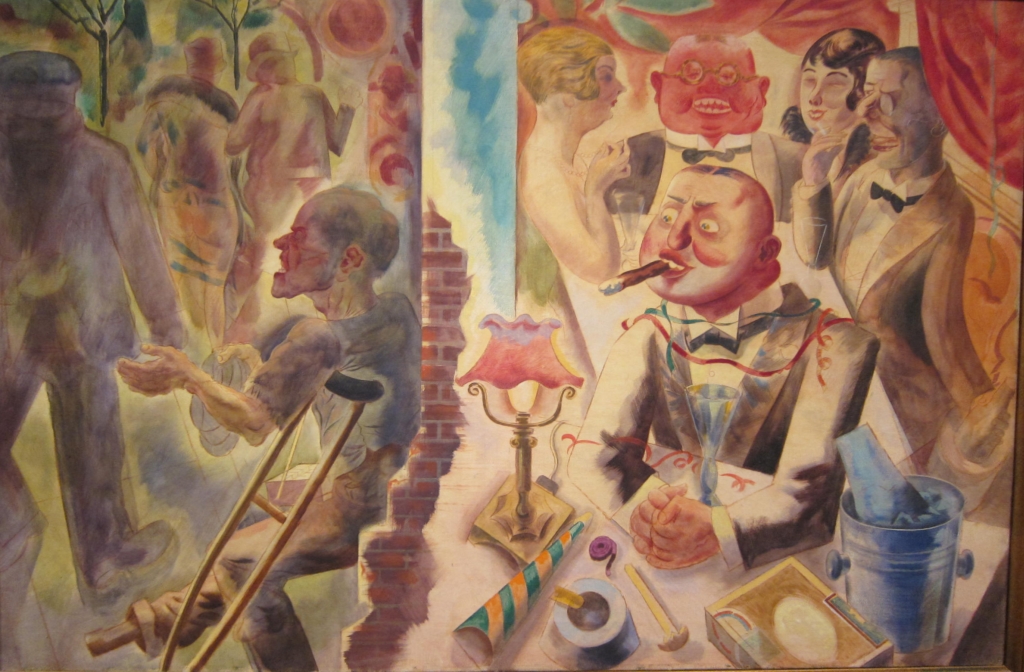
In addition to the small research study, we intend to integrate these poems into two undergraduate courses for which they seem especially relevant: Social Determinants of Health and Poverty and Health. The poems will be part of class discussions as well as course assignments. A similar effort was carried out with drawings by German visual artist George Grosz, whose illustrations during the short-lived Weimar Republic explored issues of exploitation and social inequity. Raphael’s previous experience teaching with these drawings has demonstrated the process to be highly engaging for students and an excellent means of raising issues of social and health inequalities and how they are driven by problematic living and working conditions under contemporary neoliberal capitalism (Akadinma and Raphael 166; Ghanbari and Raphael).
A paper entitled “Bertolt Brecht on Health, Power, and Justice: Societal Systems and Structures as Root Causes of Illness” that employs another selection of poems is in preparation. In closing we wish to emphasize that The Collected Poems of Bertolt Brecht (Kuhn and Constantine) is an embarrassment of riches in this regard, overflowing with poems that explore a wide range of social justice issues and provide multiple avenues for promoting understanding of the exploitative nature of modern capitalism and the urgent need for transformation of the economic system, perhaps now more relevant than any point since the 1930s.
Works Cited
- Akadinma, Eberechukwu, and Dennis Raphael. “Relevance of Georg Grosz’s Weimar-era drawings to promoting social justice and health equity in contemporary society.” Medical Humanities, vol. 52, no. 2, 2026, pp. 166-181.
- Brecht, Bertolt. “The Measures Taken.” In The Collected Poems of Bertolt Brecht, edited and translated by Thomas Kuhn and David Constantine. Original poem published in 1930. New York: Liveright Publishing Corporation, 2019, p. 310.
- Brecht, Bertolt. “Call to Arms.” In The Collected Poems of Bertolt Brecht, edited and translated by Thomas Kuhn and David Constantine. Original poem published in 1937. New York: Liveright Publishing Corporation, 2019, pp. 701-703.
- Brecht, Bertolt. “A Worker’s Speech to a Doctor.” In The Collected Poems of Bertolt Brecht, edited and translated by Thomas Kuhn and David Constantine. Original poem published in 1938. New York: Liveright Publishing Corporation, 2019, pp. 700-701.
- Donohoe, Martin T. “Stories and society: using literature to teach medical students about public health and social justice.” International Journal of the Creative Arts in Interdisciplinary Practice, vol. 8, 2009, pp. 1-21.
- Ghanbari, Nastaran, and Dennis Raphael. “Health studies students consider the relevance of Georg Grosz’s depictions of social inequalities in Weimar Germany to the contemporary Canadian scene.” Medical Humanities, published online first on 16 January 2026, DOI: 10.1136/medhum-2025-013609.
- Jones, Anne Hudson. “Why teach literature and medicine? Answers from three decades.” Journal of Medical Humanities, vol. 34, no. 4, 2013, pp. 415-428.
- Karodia, Humairaa, William MacGregor, and Dennis Raphael. “Evoking Brecht’s ‘A Worker’s Speech to a Doctor’: developing clinical skills, deepening understanding and promoting action on living and working conditions, or mobilisation for system reform or transformation?” Medical Humanities, vol. 51, no. 3, 2025, pp. 386-396.
- Kowalski, Janina and Parasram, Jivesh, directors. The Cage by Valerie Zawilski. George Ignatieff Theatre, Toronto Fringe, July 7-17, 2011.
- Kuhn, Thomas and David Constantine, translators and editors. The Collected Poems of Bertolt Brecht. Liveright Publishing, 2019.
- MacGregor, William. “Beyond empathy to system change: four poems on health by Bertolt Brecht.” Canadian Association for Health Humanities, Creating Space 13 Conference, Quebec City, April 13-14, 2023.
- MacGregor, William, Martin Horn, and Dennis Raphael. “Beyond empathy to system change: four poems on health by Bertolt Brecht.” Journal of Medical Humanities, vol. 45, no. 1, 2024, pp. 53-77.
- MacGregor, William, Mendly-Zambo, Zsofia, Bryant, Toba, and Dennis Raphael. “Beyond food charity to systems change: pedagogical application of Bertolt Brecht’s songs and poems to the problems of food insecurity and hunger.” Community Health Equity Research and Policy, in press.
- Mendly-Zambo, Zsofia, and Dennis Raphael, eds. The Politics of Food Insecurity in Canada and the United Kingdom. Bristol: Policy Press, 2025.
- Whitehead, Margaret. “The concepts and principles of equity and health.” Health Promotion International, vol. 6, no. 3, 1991, pp. 217-228.
- World Health Organization. “The Ottawa charter for health promotion: first international conference on health promotion.” Ottawa, 21 November 1986. WHO, https://www.who.int/teams/health-promotion/enhanced-wellbeing/first-global-conference.
- Excerpted from The Collected Poems of Bertolt Brecht, p. 1070. Translation copyright © 2019, 2015 by Tom Kuhn and David Constantine. Underlying copyright © Bertolt-Brecht-Erben / Suhrkamp Verlag. Used with permission of the publisher, Liveright Publishing Corporation, a division of W. W. Norton & Company, Inc. All rights reserved. ↩︎
Correspondence to: Dennis Raphael, PhD, York University, Toronto, Canada, draphael@yorku.ca
Credit for header image: Photograph of George Grosz’s painting “Drinnen und Draussen” (1926) in the Yale University Art Gallery, by Bosc d’Anjou, Creative Commons licence, https://creativecommons.org/licenses/by-nc-sa/2.0/.