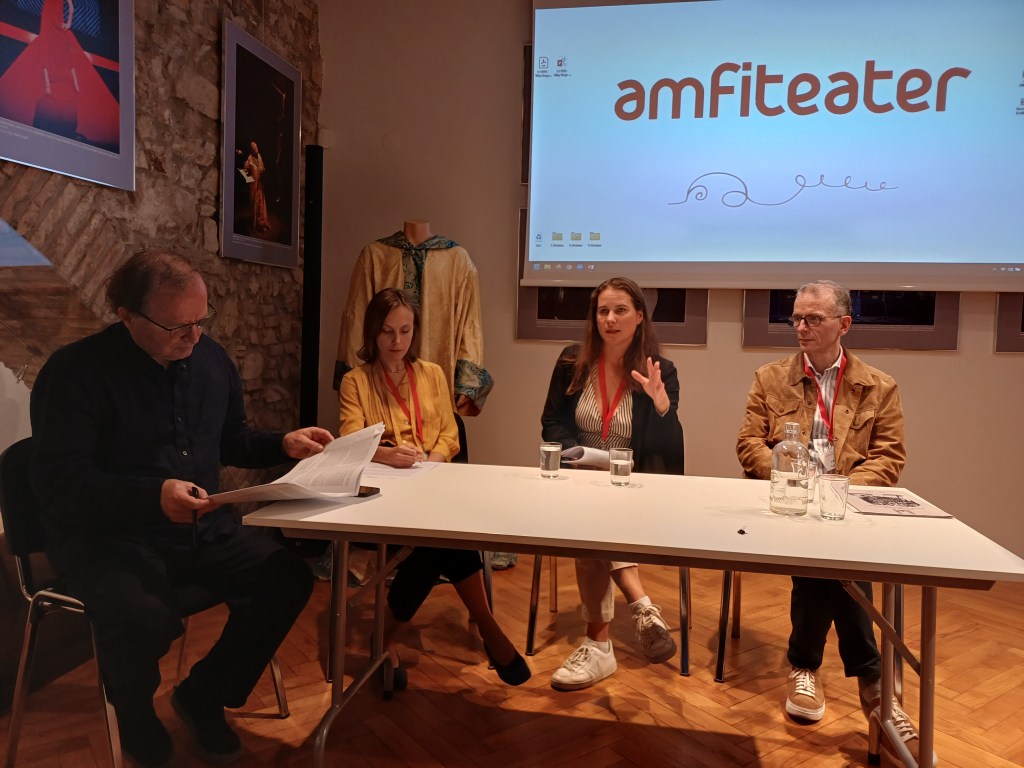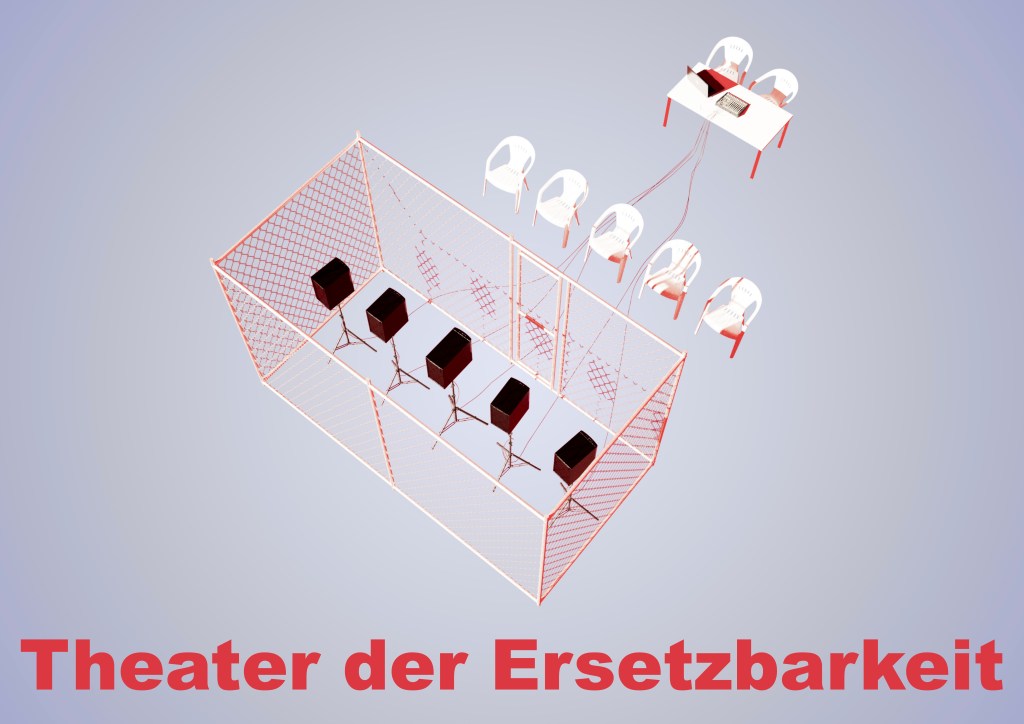
On the evening of 9 October 2026, a group of participants from the international symposium “Speech on the (Dark) Times: Brecht’s Thought Then and Now” traveled together by shuttle from Ljubljana to Novo Mesto to attend a special performance of The Life and Times of Bertolt Brecht (Življenje in časi Bertolta Brechta). Organized by Aldo Milohnić and Jakob Ribič, in association with the University of Ljubljana and the Slovenian Theatre Institute, the symposium brought together international scholars to explore the continuing relevance of Brecht’s artistic and political thought in our current moment. The excursion provided an especially fitting conclusion to four days of intellectual exchange. Located approximately one hour from Ljubljana, Novo Mesto is a picturesque Slovenian town of roughly 24,000 inhabitants, hardly a place one might immediately associate with an ambitious production about one of the twentieth century’s most influential playwrights. Yet the evening proved to be one of the highlights of the symposium. Many of us were deeply impressed not only by the quality and sophistication of the performance but also by the fact that such a demanding theatrical production had enjoyed an extended run in a relatively small town.
Directed by Matjaž Berger and produced by the Anton Podbevšek Theatre, The Life and Times of Bertolt Brecht offered an intellectually engaging and visually inventive exploration of Brecht’s life, work, and historical moment. With a text developed by Eva Mahkovic, Ula Talija Pollak, Jakob Ribič, and Berger, the approximately two-hour production resisted the conventions of straightforward biography. Instead, it approached Brecht through the political, personal, and artistic contradictions that shaped his thinking. Drawing on documentary material, philosophical reflections, historical imagery, music, and physical performance, Berger constructed a theatrical montage that is distinctly Brechtian in both form and intention. The result was a compelling investigation of the relationship between artistic production and political history, one that asks not simply what Brecht accomplished but what his ideas might mean for contemporary audiences.
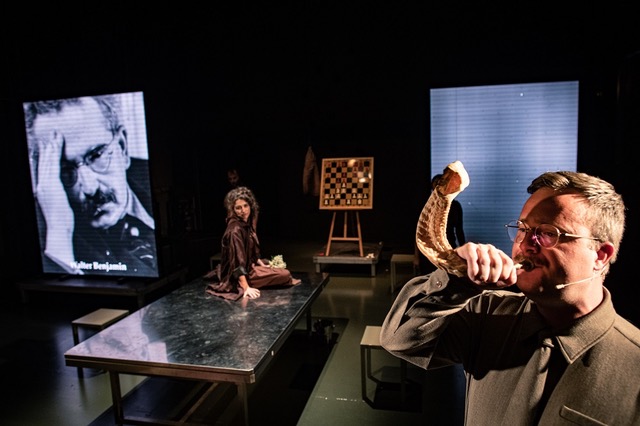
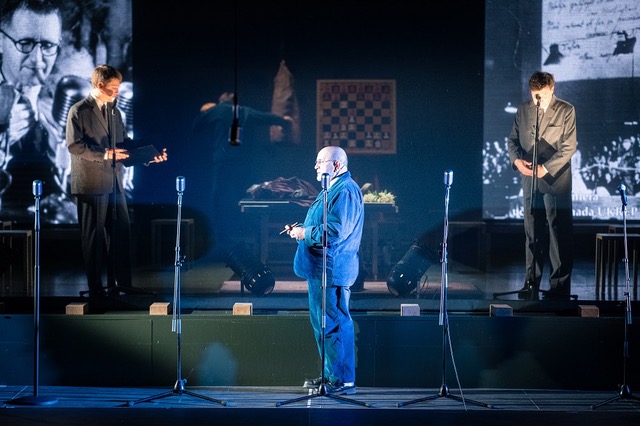
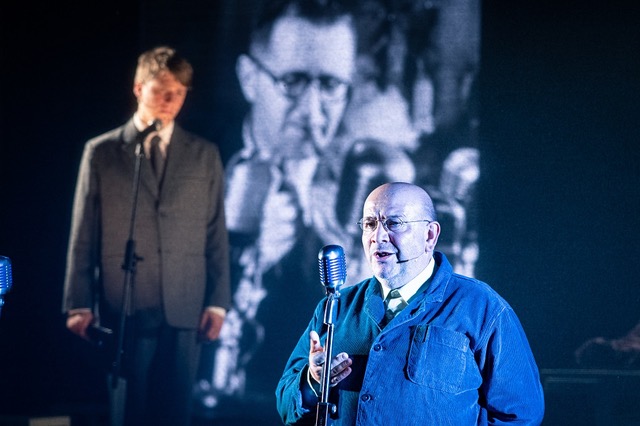
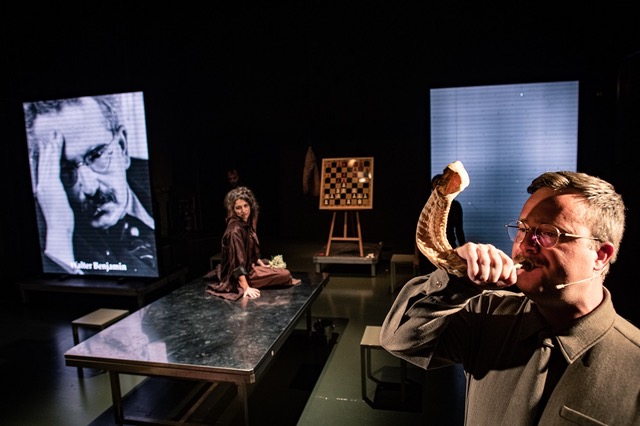
The stage design was notably minimalist, but effective. Two large projection screens dominated the background, displaying archival photographs, historical figures, and other images relevant to the unfolding dialogue: Brecht appearing before the House Un-American Activities Committee, portraits of Joseph Stalin, and even images of contemporary philosopher Slavoj Žižek provided visual reference points that extended the production beyond the immediate circumstances of Brecht’s life. Downstage, a U-shaped arrangement of chairs served as a gathering place for the performers, some of whom remained seated while waiting for their turn to speak or participate. This simple configuration created the impression of a conversation unfolding across time, with Brecht, his collaborators, friends, and lovers becoming overlapping participants in an ongoing examination of his intellectual and artistic legacy. The relative spareness of the set, designed by Simon Žižek and Berger, allowed the performers and historical materials to take center stage. Microphones, movable wooden blocks, a chessboard, and a few other objects provided the principal theatrical elements. Rather than attempting to reconstruct specific historical locations through realistic scenery, the production created a flexible space that resembles an experimental workshop. The visible microphones and exposed theatrical arrangements continually reminded spectators of the constructed nature of performance. Especially effective was the interaction between the live performers and the two background screens. Historical images were not merely decorative illustrations but frequently functioned as visual counterpoints to the spoken material. The appearance of Stalin, for example, situates Brecht’s political commitments within the complicated and often contradictory history of twentieth-century communism. The inclusion of Žižek introduces a further interpretive layer, suggesting that Brecht’s concerns with ideology, capitalism, and political power remain quite present in contemporary philosophical debates. These visual juxtapositions connected past and present without collapsing the historical differences between them.
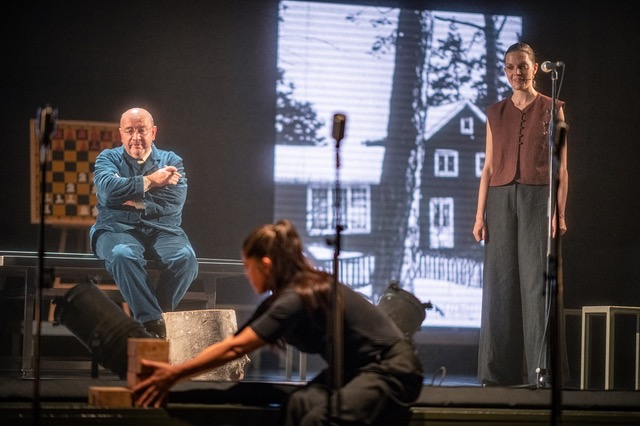
The ensemble cast deserves particular praise. The production brought together younger and older representations of Brecht alongside the women and men who shaped his personal and professional life. The performers worked exceptionally well both individually and collectively, moving between moments of direct address, dialogue, physical action, and more reflective passages. Their interactions conveyed the sense that Brecht’s work emerged from an ongoing network of intellectual exchanges and personal relationships rather than from the isolated talent of a single individual. The interplay between the different versions of Brecht was striking in suggesting a figure continually changing in response to historical circumstances. Among the strongest performances were those portraying Margarete Steffin, Elisabeth Hauptmann, and Ruth Berlau, three of Brecht’s most important collaborators and intimate partners. Their performances helped challenge the persistent tendency to treat the women in Brecht’s life primarily as companions or muses rather than as the significant creative collaborators they were. In doing so, their performances raise important questions about authorship, gender, and the often unequal recognition of their artistic partnerships. At times, however, these relationships and their inherent tensions could have been explored even more fully.
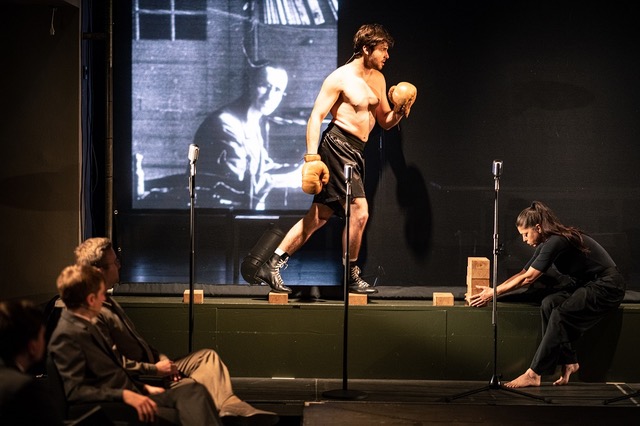
The production also made memorable use of physical performance. A striking sequence involving a bare-chested boxer wearing gloves recalls Brecht’s fascination with boxing as a model for theatrical spectatorship. For Brecht, the boxing match offered an example of audiences observing technique, judging strategies, and responding critically to action rather than becoming absorbed in theatrical illusion. Berger transforms this association into a compelling visual image, juxtaposing physical confrontation with the intellectual and political debates unfolding elsewhere onstage.
The recurring chessboard offered another suggestive metaphor recalling Brecht’s intellectual exchanges with Walter Benjamin during their years in exile.
The production’s historical emphasis fell primarily on Brecht’s exile years following the Nazi rise to power in Germany in 1933. His movement across Europe and eventual arrival in the United States, together with the subsequent experience of political interrogation before the House Un-American Activities Committee, illuminated the precarious position of artists confronting authoritarianism and ideological persecution. These episodes acquire particular urgency when considered against contemporary developments, including the resurgence of nationalist movements, threats to democratic institutions, and growing hostility toward political dissent. Berger wisely avoided reducing these parallels to simplistic comparisons. Instead, the performance encouraged spectators to consider how historical circumstances might make us rethink the contradictions of our own present.
What ultimately made the evening so memorable was the combination of artistic ambition, theatrical professionalism, and the remarkable circumstances of the production itself. That a theatre in a town the size of Novo Mesto could sustain such a sophisticated engagement with Brecht over many months was genuinely impressive! It offered a welcome reminder that intellectually demanding, politically engaged theatre need not be confined to major metropolitan cultural institutions (i.e., if you make it, they will come). Indeed, the Anton Podbevšek Theatre demonstrated how a smaller regional theatre can become a vital space for artistic experimentation and critical public discourse. Following the performance, our group gathered for a farewell reception, raising a toast to the symposium organizers and continuing the conversations that had animated the preceding days of wonderfully rich intellectual discussions.
Ultimately, The Life and Times of Bertolt Brecht provided a nuanced portrait of its subject, but rightly resisted presenting an all-encompassing picture of Brecht’s life and work. Rather, Brecht emerges as a contradictory, collaborative, politically engaged, and historically situated figure whose ideas remain open to reinterpretation. 70 years after his death, the questions that animated his work about the relationship between art and society, the responsibilities of artists, and the possibility of transforming existing conditions are as urgent as ever. Berger’s production does not simply commemorate Brecht the person but seeks to continue the critical inquiry that made his theatre so useful and revolutionary.

Kristopher Imbrigotta is Associate Professor of German Studies and is an affiliate faculty member in the Department of Environmental Sciences and Studies at the University of Puget Sound (Tacoma, WA). He serves as editor for the well-established monograph series German Life and Civilization (Peter Lang). From 2016-2023 he served as co-editor of E-CIBS. He is the author/editor of the critical student edition of Bertolt Brecht’s Caucasian Chalk Circle (Bloomsbury, 2021). He was also a member of the international translation team for the newest edition of Brecht on Theater (Bloomsbury, 2014).