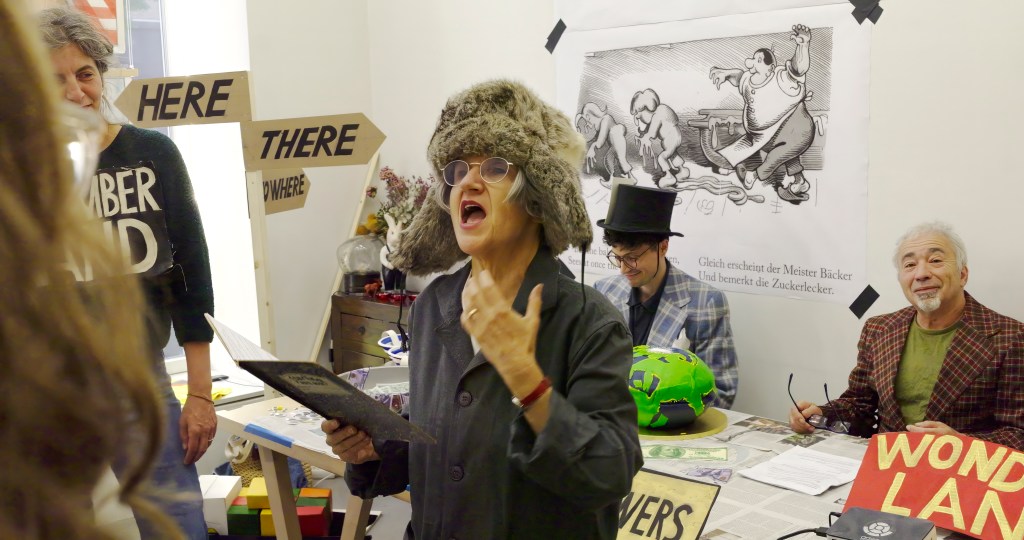
A Recipe for Disaster is a participatory performance and installation that explores the geopolitics of our world through culinary metaphor. One might describe it as a Brechtian response, both humorous and terrifying, to the catastrophe of our time. The piece itself incorporates Brecht’s writing in new ways. It was created by Zoe Beloff at the invitation of Chto Delat, a Russian art collective in exile. It took place at their Emergency Project Space in Berlin in September 2026.
A Potato Steps onto the Stage:
I am an artist and filmmaker. I aim to make art that entertains and provokes discussion. My projects often involve films, drawings and archival objects. They go out into the world; I stay out of the limelight. So, it was quite a strange experience to find myself this summer taking on an entirely new role, master of ceremonies, conceiving, creating and leading A Recipe for Disaster, a participatory performance that explores geopolitics through culinary metaphor, a Brechtian response, both humorous and terrifying, to our world today. Here there is a part for everyone, the Great Powers who carve up the territories, the Red Herring that spreads misinformation, a giant potato and a series of islands, Wasteland, No Man’s Land, Land without Bread, Land of a Thousand Checkpoints, each with a lone inhabitant that evoke borders, boundaries and terrible inequalities. The project was born from my awareness that we are indeed living in times of catastrophe, whether it is the destruction of cities and civilian life or the havoc wrought by climate change; to turn away from this would be a dereliction of artistic integrity. To tell people what to do or think would be to mirror authority. Rather, I’m looking to open a space where we can reflect together.
How did this project come about? In 2025, I decided to visit my comrades, the Russian art collective in exile, Chto Delat in Hamburg[1]. They invited me to create a window installation and performance for their Emergency Project Space in Berlin, a small storefront gallery and workspace. It would be one of a series of invited events that went under the title A Mad Tea Party. I was intrigued, intimidated and I said yes.
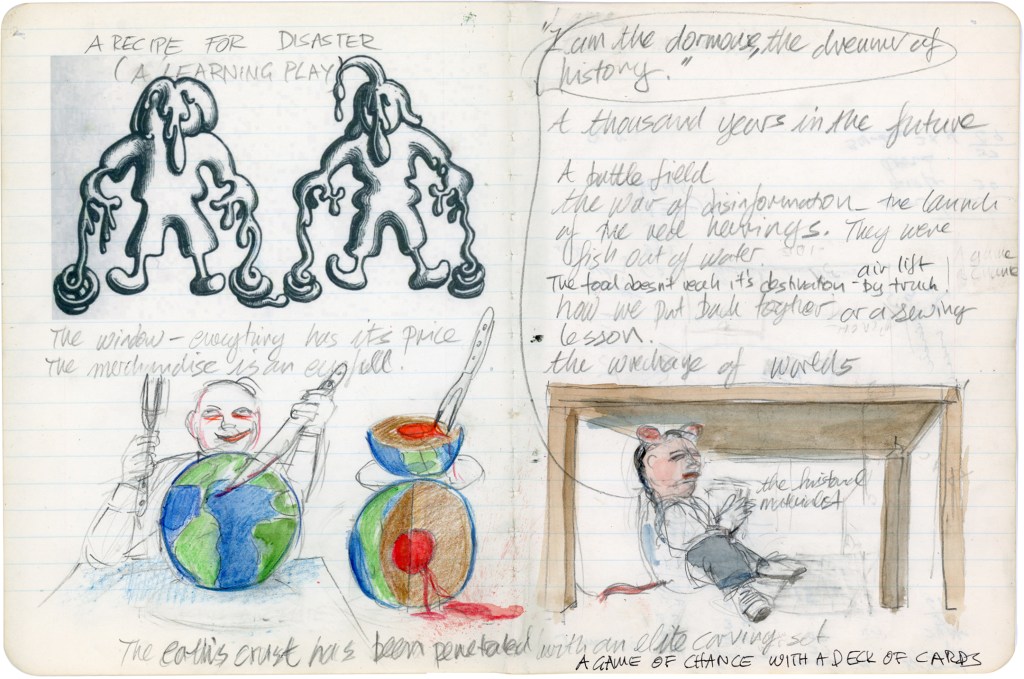
I returned to New York and started drawing the bare bones of an idea. I feared my title, A Recipe for Disaster, given my lack of experience, might indeed end up being all too accurate. I sketched an island named Wonderland where the Hatter and the Hare hack up the earth in the form of a giant spherical cake with a molten core. Islands wait for shipments that will never arrive. I collaged illustrations from the nineteenth century German picture book Max and Moritz, two bad boys falling into the vat of dough and being summarily baked in an oven – figures that terrified me as a child.[2] That was as far as I got, images, but not yet drama. Brecht was there in spirit but had not yet stepped onto the stage.
A core member of Chto Delat, Dmitry Vilensky joked with me recently that we are the last Brechtian artists. Since certainly 2012 my work has been in dialog with Brecht’s thinking and writing. That year I staged The Days of the Commune as street performance in solidarity with Occupy Wall Street. In 2015, I created a large-scale installation at the James Gallery CUNY, A World Redrawn: Eisenstein and Brecht in Hollywood. Chto Delat saw the show. I had already seen their performance videos in the exhibition Specters of Communism: Contemporary Russian Art at the same space. We responded to each other’s work. We met again in St. Petersburg. They invited me to take part in their exhibition, Anti-festival of Mutations in 2020. Two years later Russia invaded Ukraine. Like many artists and writers, Chto Delat had to leave St. Petersburg immediately, the FSB on their heels. Fortunately, they were able to relocate in Germany, thanks in part to the Rosa Luxemburg Foundation.
Almost a hundred years after Brecht’s flight from Germany, we are once more living in dark times. Everywhere borders are closing. Now the United States is under the sway of America Firsters; it is no longer welcoming to artists. Despite lack of funding, despite our governments, or perhaps because of these obstacles, I believe it is more important than ever to keep cross border collaboration with comrades alive. I am one of the lucky ones who can travel, and I determined to accept the invitation from Chto Delat. These obstacles are reflected not just in the subject matter of A Recipe for Disaster but in its form, its sense of humor and in the way this project was made and will, I hope, be remade in the future. I had to make art that could roll up into a cardboard tube and a theater that could collapse into two suitcases. Whatever I couldn’t take on the plane, I would make in a week when I got to Berlin with materials from a chain of big box hardware stores, rather poetically called Bauhaus, a charity thrift shop, and a cake decorating emporium.
Chto Delat’s Emergency Project room is small, suitable for about fifteen people. In a participatory performance the audience are the performers. Since there could be no rehearsal, I figured some people would be too shy to speak, others might not speak English. I needed to create a structure that was flexible, where I would act as a guide and spokesperson and there would be a part and a costume for everyone. Some performers had lines, others had activities. I imagined everyone could dance. But what if no one showed up, or too many? I wouldn’t know what would happen till the moment of the performance itself. I would run sound effects, music and movies all from my iPhone connected to a mini projector and Bluetooth speaker.
When I sat down to write the script, I knew Brecht would have things to say about food and with food. The song What Keeps Mankind Alive puts it bluntly, “Food is the first thing. Morals follow on”.[3] But the character that stepped off the page and onto the stage was a potato. I discovered her in Brecht’s poem, The Great Bellyache. “An unworthy, insignificant person, not much respected, rarely mentioned in the history books”. [4] Yes, I would interview her, and she would lead the way. One might call me a story scavenger. I piece text and image together, I quote. I am interested in taking ideas, embodying them and making them come alive. For this reason, I have always loved animated cartoons. I think of them as thought in action, and indeed Daffy Duck would soon make an appearance on my stage. Picture a long table, oversize teacups spin around generating a “storm in a teacup”. A spherical cake in the shape of the world, a red telephone receiver to connect to the Great Powers. A revolving signpost points HERE, THERE and NOWHERE. On the floor, the little islands each have a large shoe, built into their terrain. In this world every creature has become an island unto itself, so each islander performs with one foot in the island’s shoe. There they are trapped.
As the Dormouse, dreamer of history, I set the world in motion with these words, “Today we present a dream that goes by the title of a recipe for disaster, a culinary nightmare of epic proportion. A rehearsal for the future. Here the state of emergency is not the exception but the rule!” The Dormouse goes on to explain “All day long the islands make money. They stitch together the scraps and remains of US dollar bills. But their labor never creates capital for every night the currency mysteriously disappears.” Enter Border Patrol armed with dustpan and brush, to sweep up their currency. As music begins to play, the islands sway. The Dormouse announces, “from beyond the grave, Bert Brecht sings The Song of Human Futility, it is the only tune the islands know.”[5]
Reified objects come to life. The Container Ship is sent out to feed the starving Islands with mere crumbs. It becomes stuck in the Strait of Hormuz and is then recalled. The Great Powers munch on large banknotes made of sugar, thus consuming vast amounts of wealth
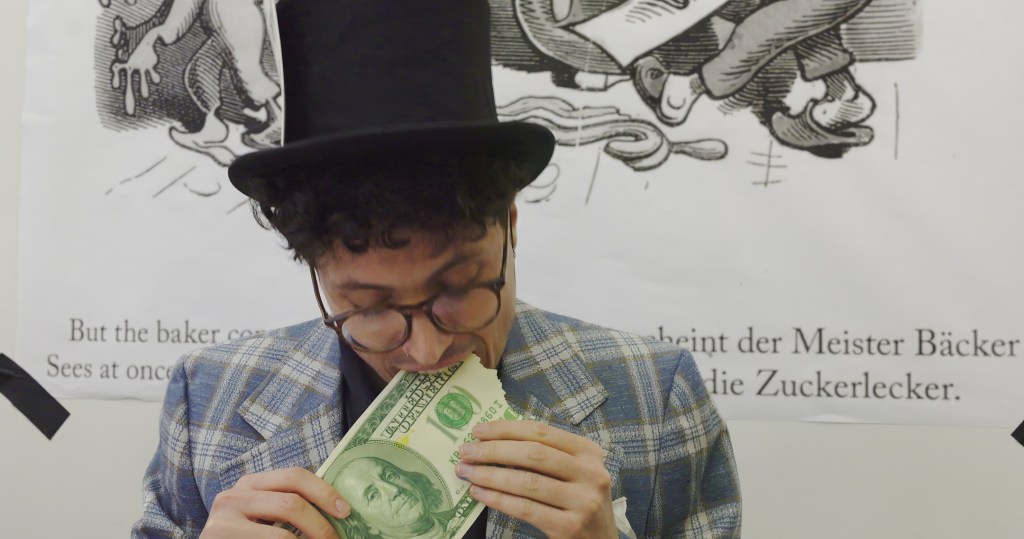
The Hatter waxes nostalgic, “Oh, for the days I used to consume Deutschmarks for dessert. And I did like a tasty little French Franc now and again.” The Hare responds, “He’s got the stomach for it.” But most of all they enjoy consuming the world itself.
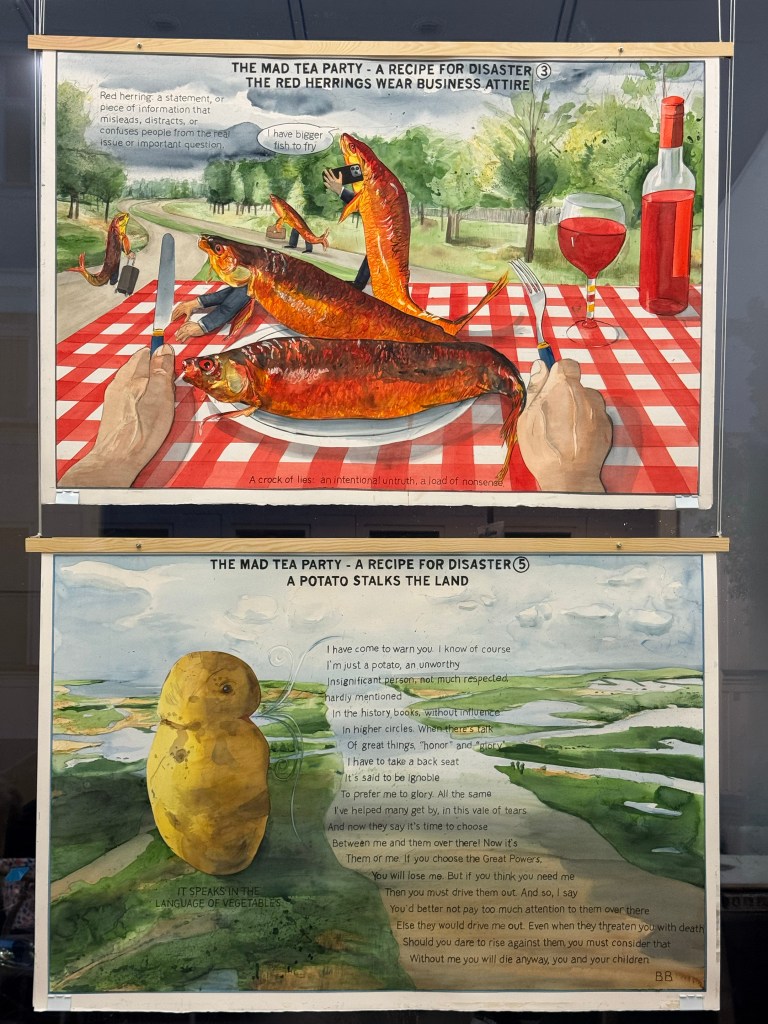
Dressed in business attire, the Red Herring goes from island to island spreading misinformation like a contagious disease.
The action is interrupted by sounds, Morse code, a game show buzzer. Visions from the east and from the west appear on the horizon; fragments of two cartoons, one a Soviet animation The Banquet (1987) where the diners are invisible and food takes on a riotous life of its own, in the other, Daffy’s Southern Exposure (1942) where the duck is almost eaten alive. Only then does The Potato step forward. The Dormouse – “What is this? A potato, bigger than a small mountain is stalking the land. A specter is haunting Europe, it speaks in the language of vegetables, low whistles and moans and groans stemming from a life underground. Let me translate…” In the words of Brecht’s poem, the Potato explains that people must drive out the Great Powers else they will destroy her and without the potato to sustain them, the people will die. But as the Great Powers continue to consume the earth, the Potato grows ever more sickly, shrinking down onto the floor.
With the simplest means, the islands struggle to create signals of support. They scrawl and scribble with sticks and leaves and charcoal. The Potato rises up. She leads them in a dance.
Finally, the islands fall into a deep sleep. The Dormouse concludes with lines inspired by the writing of Walter Benjamin, “Now it is the dream that waits secretly for the awakening. The sleeper waits for the second until he wrests himself from capture with cunning. In our dialectical fairytale, cunning is the dream’s capacity to outwit history, to awaken the dreaming collective.”[6]
The performance was a wild one-off event. Afterwards my Russian friends served up potatoes and herring and we talked. My installation remains up for several weeks in the window of the space. For this part of the project, I created a set of large watercolors inspired by educational charts for school children. Schematic representations of the characters and the ideas in the performance.
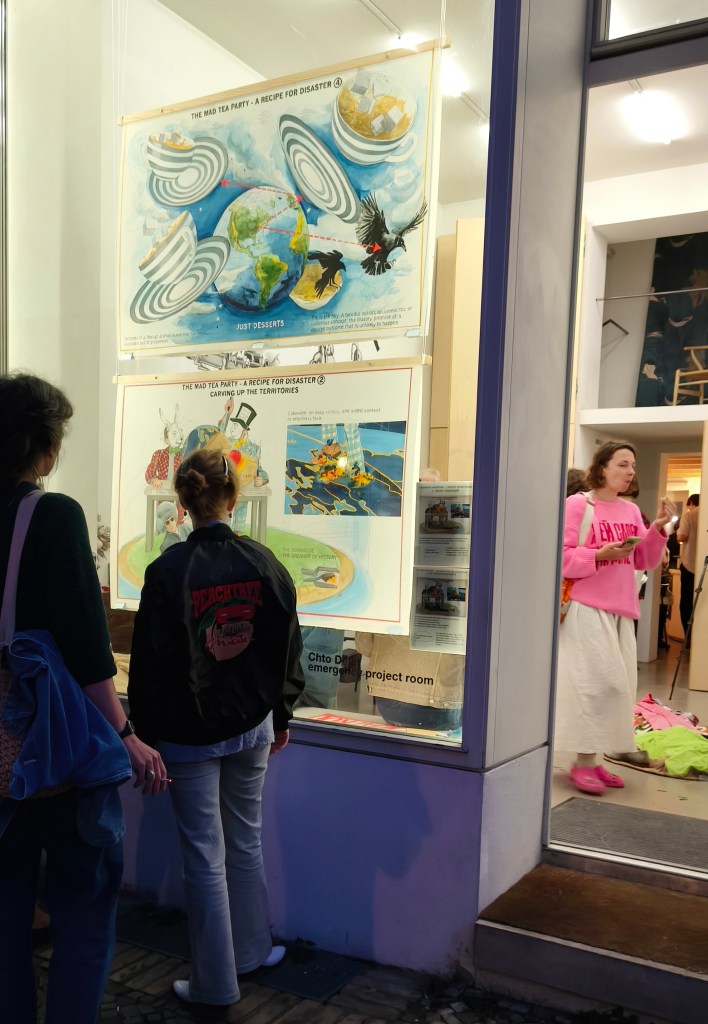
I came away, dazed, but also clear that this was a first very rough sketch for something I plan to develop. I see the watercolor charts as just the first part of a larger installation that will involve performance that is filmed and projected. I envision life-size non-naturalistic figures that represent the characters. This installation will be presented at The Clemente Soto Vélez Cultural Center, a multidisciplinary arts organization in my neighborhood next year. At the same time, I want to use this project to create a flexible protocol, that can travel anywhere, can include diverse performers and invite dialog. A Recipe for Disaster, unfixed, ready for updates in these hard times where money for art has all already been consumed. I am open to suggestions and invitations…
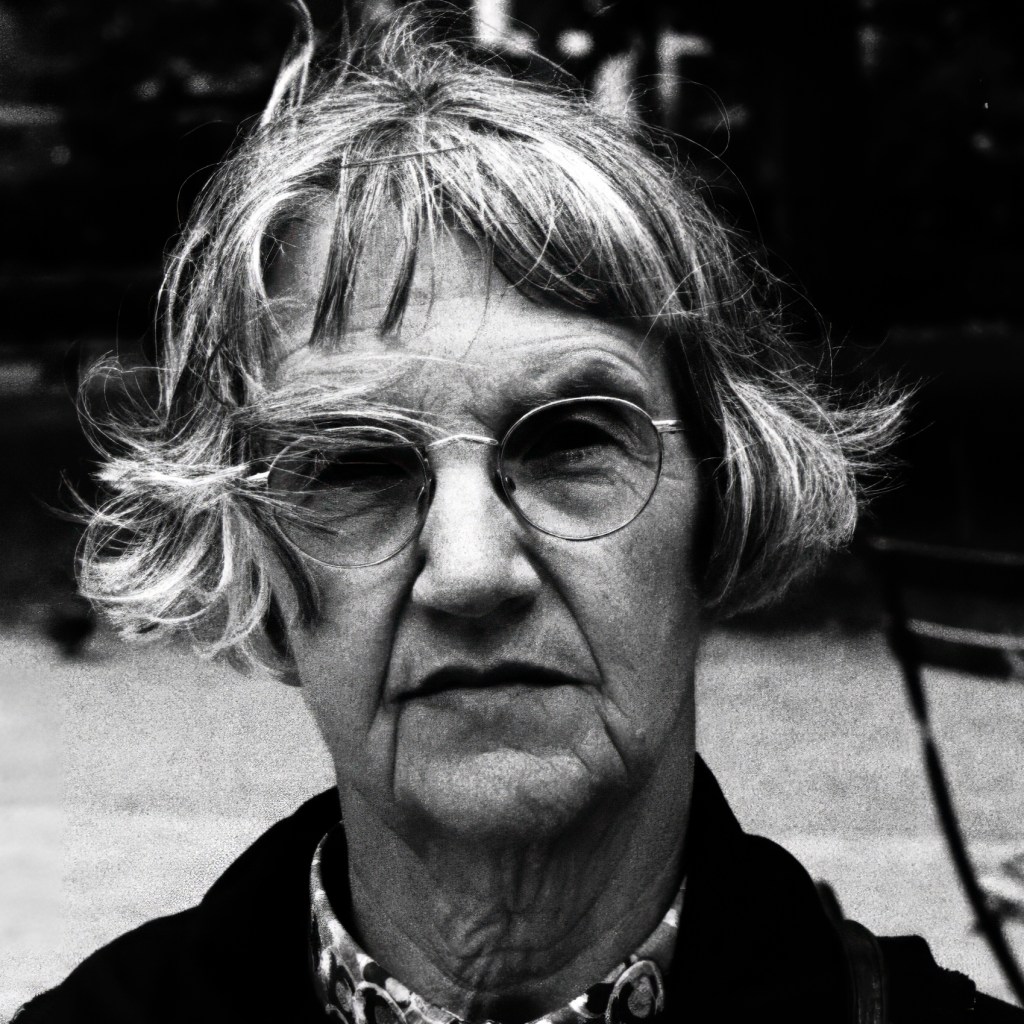
Zoe Beloff is an artist, filmmaker, writer based in New York. With a focus on social justice, she draws timelines between past and present to imagine a more egalitarian future. She has shown at museums, galleries and film festival but particularly enjoys working in community venues that are free and open for conversations. zoebeloff.com
[1] Chto Delat promotes the integration of art, activism, and political theory and invite collaboration. More information about their work can be found here.
[2] Wilhelm Busch, trans. Ann E. Wild Max and Moritz: A Story of Two Bad Boys in Seven Tricks, Edition Tintenfass, Germany 2011- 2021.
[3] The Threepenny Opera. Brecht Collected Plays:Two (trans. and ed John Willett and Ralph Manheim) Methuen Drama, 1998, p 145.
[4] The Collected Poems of Bertolt Brecht (trans. and ed, Tom Kuhn and David Constantine), W.W. Norton and Company, 2019 p 709.
[5] The Threepenny Opera. Brecht Collected Plays:Two (trans. And ed John Willett and Ralph Manheim) Methuen Drama, 1998, p 152.
[6] For a detailed discussion of Benjamin’s ideas about the dreaming collective, see Chapter 8 of Susan Buck-Morss, The Dialectics of Seeing: Walter Benjamin and the Arcades Project MIT Press, 1995.
All still video frames and video clips by Eric Muzzy. 03 installation-exterior by Dmitry Vilensky.