Bertolt Brecht – 70 Years On is an interdisciplinary project marking the 70th anniversary of Brecht’s death. Created by Aldo Milohnić and Jakob Ribič, both lecturers and researchers at the Academy of Theatre, Radio, Film and Television of the University of Ljubljana (UL AGRFT), it encompasses an international symposium, new Slovenian translations of Brecht’s writings published in book form, and exhibitions. One of these, also conceptualized by Milohnić and Ribič, is Brecht’s Attempts and Experiments (Versuche): Slovenian Translations, First German Editions and Documents from the Bertolt Brecht Archive at the Academy of Arts, Berlin (BBA). The exhibition opened on October 7, 2026, at the National and University Library in Ljubljana (NUK), Slovenia.
The original and reproduced Brecht manuscripts and typescripts come from the BBA, with Iliane Thiemann and Noah Willumsen serving as consultants on the archival material. The book editions come primarily from Aldo Milohnić’s collection, with others provided by UL AGRFT and NUK. Several original manuscripts and typescripts of Slovenian translations of Brecht’s works, selected by Barbara Jesenovec, are also on display from the NUK Manuscript Collection. Maj Blatnik (NUK) designed the exhibition, giving it a visually coherent form. It was created in collaboration with UL AGRFT and with the support of the Goethe-Institut Ljubljana.
The opening in NUK’s Main Reading Room included speeches by Jana Kolar (Director of NUK), Sylvia Groneick (German Ambassador to Slovenia), Iliane Thiemann, Noah Willumsen, Aldo Milohnić, and Jakob Ribič, as well as an artistic program. Singer Sofia Zavratnik Kain performed two Brecht-Weill songs, while actress Nataša Barbara Gračner interpreted two monologues from Life of Galileo. The latter performance recalled an important moment in the history of Brecht staging in Slovenia: exactly 30 years earlier, in the same reading room, Gračner had played the title role in Matjaž Berger’s production of Life of Galileo. The event symbolically renewed NUK’s connection to Brecht and brought to life the exhibition’s account of that production.
Dialectics as a starting point
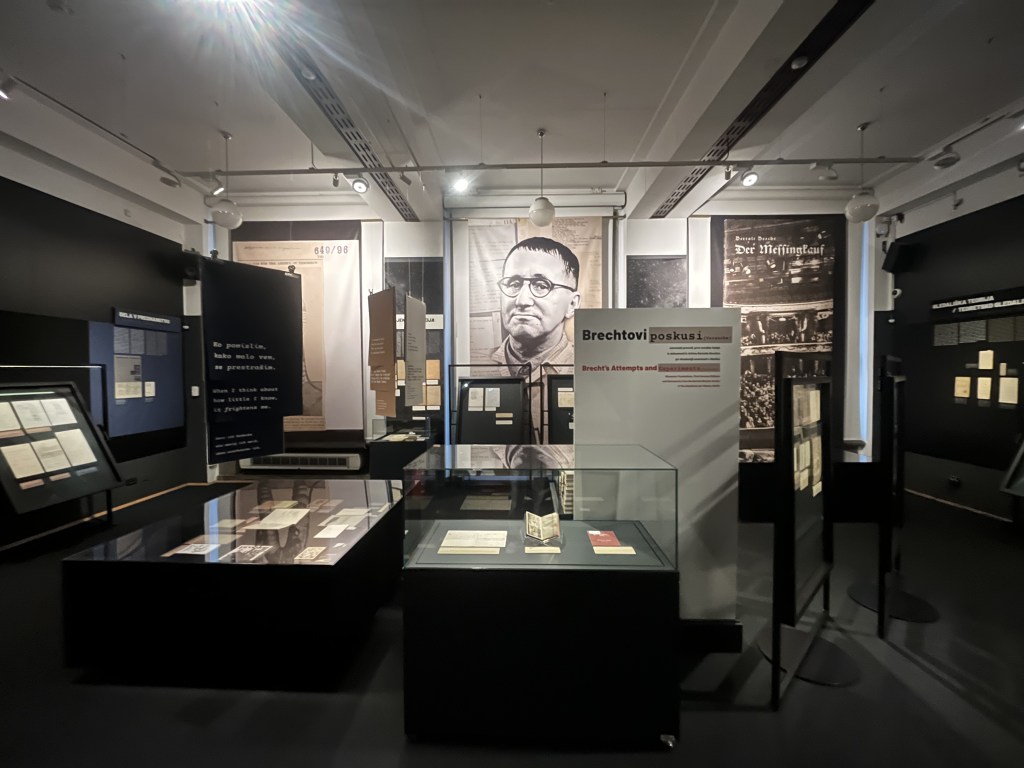
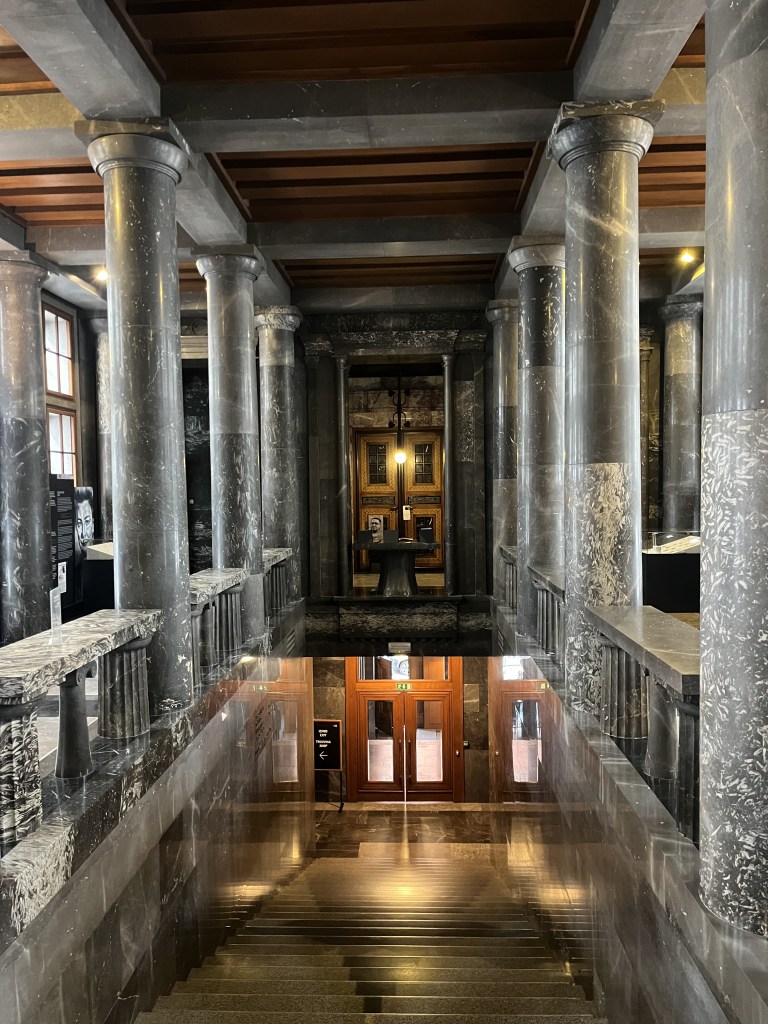
To reach the Exhibition Hall, visitors first ascend the broad stairs of a silent, reverberating foyer with a cathedral-like atmosphere, then pass between monumental pillars and along a corridor with a high ceiling. Heavy wooden doors mark the threshold to the exhibition. This approach seems to prepare visitors for the first exhibit: as the doors open, a display case comes into view near the center of the single exhibition chamber, holding a small, open Bible.
This is Brecht’s famous personal copy of the Bible, displayed so that visitors can see an image of a Buddha statue that he pasted into the volume. He also pasted an image of a race car inside the back cover. The juxtaposition of these images with the Bible, and their association with an author known for his materialism and Marxism, creates a series of contradictions that suggests Brecht’s dialectical way of thinking. By placing the Bible among the first objects visitors encounter, near the center of the room, the exhibition introduces dialectics as both a starting point for the exhibition and a fundamental aspect of Brecht’s creative method. The same display case contains a sheet from the original manuscript of his early play Drums in the Night and a reprint of the school magazine Die Ernte, in which Brecht published his first dramatic work, The Bible, in 1914.
Brecht’s workshop
Looking up from the Bible, visitors see the other display cases. Some form an island in the center of the room; others line its perimeter. On the walls above the latter, section headings organize the exhibition text, accompanied by English translations, around Brecht’s creative and biographical periods, genres such as theory and poetry, and several of his major works. Together with the archival and documentary material on the walls, the text guides visitors along a circular route around the book editions, facsimiles—mainly of collage-like typescripts from The Resistible Rise of Arturo Ui—and other exhibits at the center.
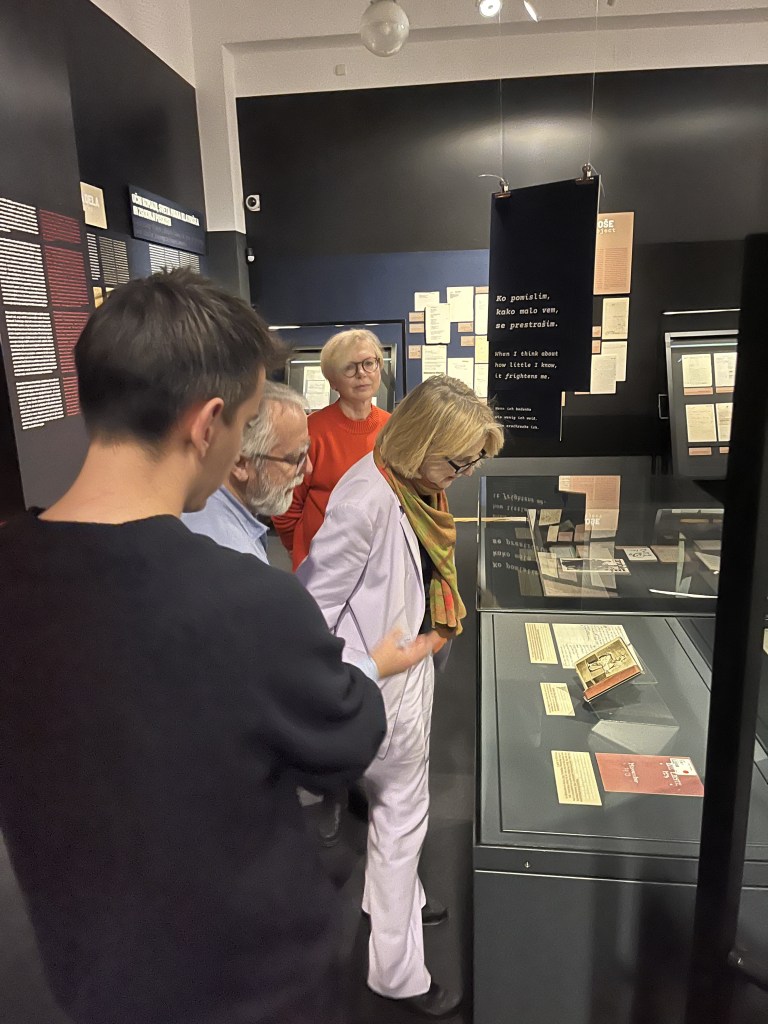
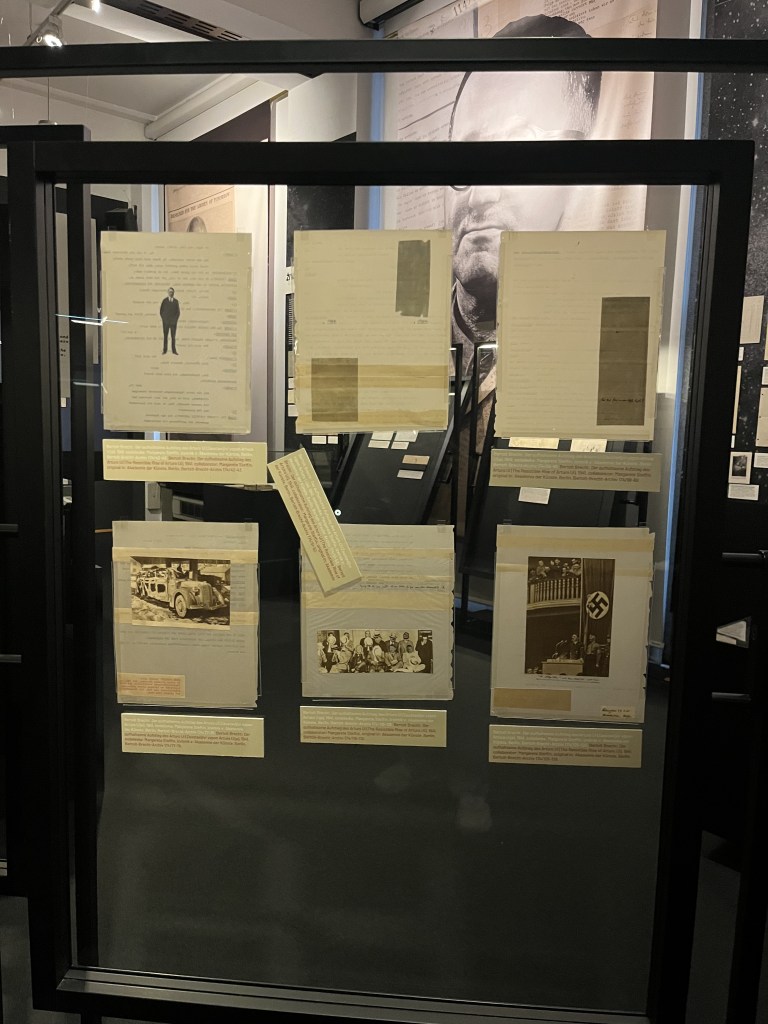
Throughout the room, the display cases contain Slovenian translations of Brecht’s works, first German editions, original manuscripts, typescripts, and collages. Corrections and strikethroughs in the manuscripts and typescripts reveal a working method rooted in constant revision. The collages, composed of newspaper clippings, photographs, magazine covers, and Brecht’s comments, vividly illustrate how he played with “whatever came to hand.” One of the central display cases is devoted to editions of his selected and collected works, including Versuche, which inspired the exhibition’s title. Among the objects in the perimeter cases, Brecht’s final manuscript draws particular attention. It contains a poem he wrote shortly before his death, while ill in a hospital bed, and brings the exhibition to a close.
Design and layout
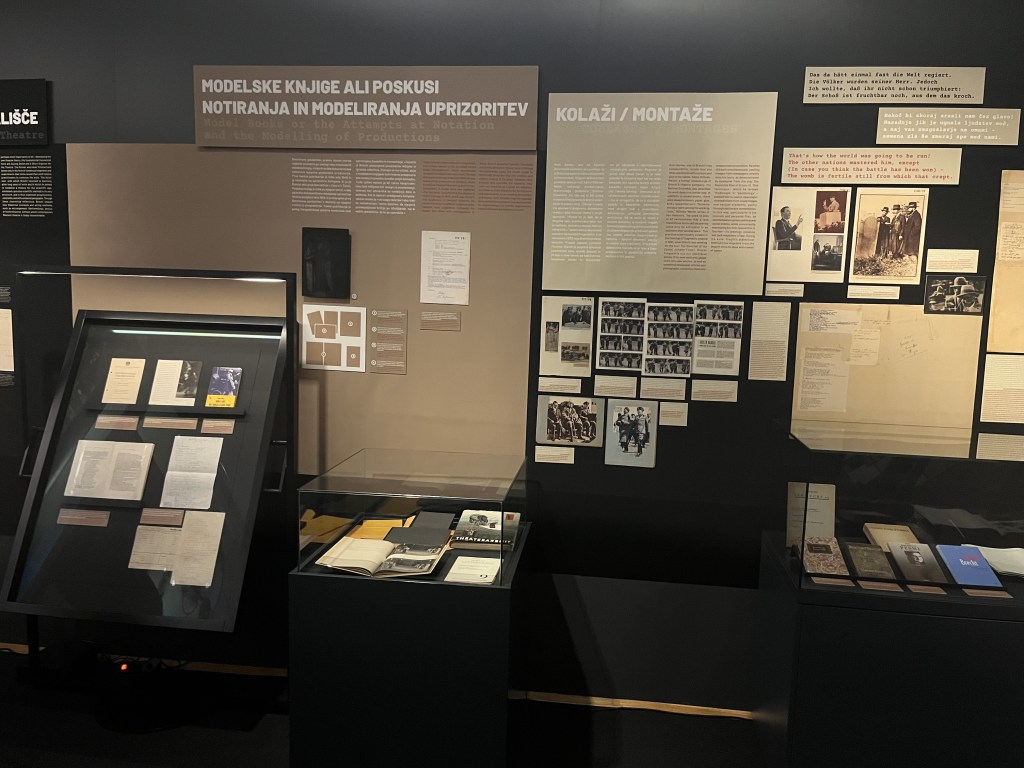
Maj Blatnik’s circular arrangement of the space, with focal points at its center, establishes a clear relationship between the exhibition’s core content and its context. It leads visitors along a narrative route from start to finish, only to return them to the beginning—a gesture that suggests Brecht’s enduring presence. Three hanging panels bearing significant quotations from Brecht and three large-format posters add movement to the well-used space. The visual design relies predominantly on a black background, with occasional pastel shades distinguishing the sections. It creates a comfortable viewing atmosphere and draws attention to the exhibits.
The exhibition’s recurring image, which also appears on the main poster, was partially generated with artificial intelligence. Its use may invite criticism in an exhibition devoted to Brecht, an advocate of material labor and workers’ rights. The exhibition itself, however, does not use contemporary audiovisual media. Instead, its silence and even lighting give visitors space for a degree of focus and contemplation to which they may no longer be accustomed.
Brecht, our contemporary
The exhibition’s title, Attempts and Experiments (Versuche), refers both to the series of Brecht’s works bearing that name and to the nature of his work and his understanding of artistic production. As Milohnić and Ribič explain in the exhibition text, Brecht saw his work as a dialectical experiment intended to encourage critical thought. Just as the exhibition shows Brecht’s relationship with the people for whom he worked, it seeks to engage its own audience.
Through historical material, the exhibition raises contemporary questions and prompts reflection. It captures the breadth of Brecht’s life and work while emphasizing his constant trial and experimentation. It presents him as an author whose work remains open to further reflection and development. The exhibition will remain open until February 10, 2027, Brecht’s 129th birthday.

Lucas Carboni Kopše is a theatre practitioner and a fourth-year student at the Academy of Theatre, Radio, Film and Television (UL AGRFT) in Ljubljana. Through his directing practice, grounded in the interpretation of dramatic texts and the craft of acting, he explores various theatrical theories and methodologies stemming from Brecht, Artaud, Grotowski, and Stanislavski.
Photos by Lucas Carboni Kopše.