Adapted and directed by Patrick Walsh under the artistic direction of production manager Michael Streeter, The Life of Galileo raises the same relevant questions today as it did when Bertolt Brecht finished the play in Danish exile in 1939. In what ways is it possible to resist meaningfully in a time of authoritarian regime? Does the current political situation call for a full-scale rebellion or something else? With great finesse and standing ovations, the Mt. Hood Repertory Theatre produced and staged the play about the renowned astronomer in the fully operational Kendall Planetarium at the Oregon Museum of Science and Industry in Portland, Oregon. In addition to posing Brecht’s questions about the shutdown of scientific research, it also seems that the Mt. Hood Repertory Theatre pulled off a world premiere.
Previous documented productions simulated planetarium environments in traditional theaters, like the Young Vic (London, 2017) and the Théâtre de la Porte Saint-Martin (Paris, 2018). The Meseu da Vida (Museum of Life) staged a short adaptation in its performance tent, the Tenda da Ciência Virginia Schall (Rio de Janeiro, 2016-18). The Planetario do Rio presented a staged reading at the Teatro Maria Clara Machado, a theater within the planetarium building complex (Rio de Janeiro, 2016) and later staged the entire play at the same location (2017). Another show celebrated Galileo in a digital show in the planetarium of the Cité des Sciences et de l’Industrie (Paris, 2026).
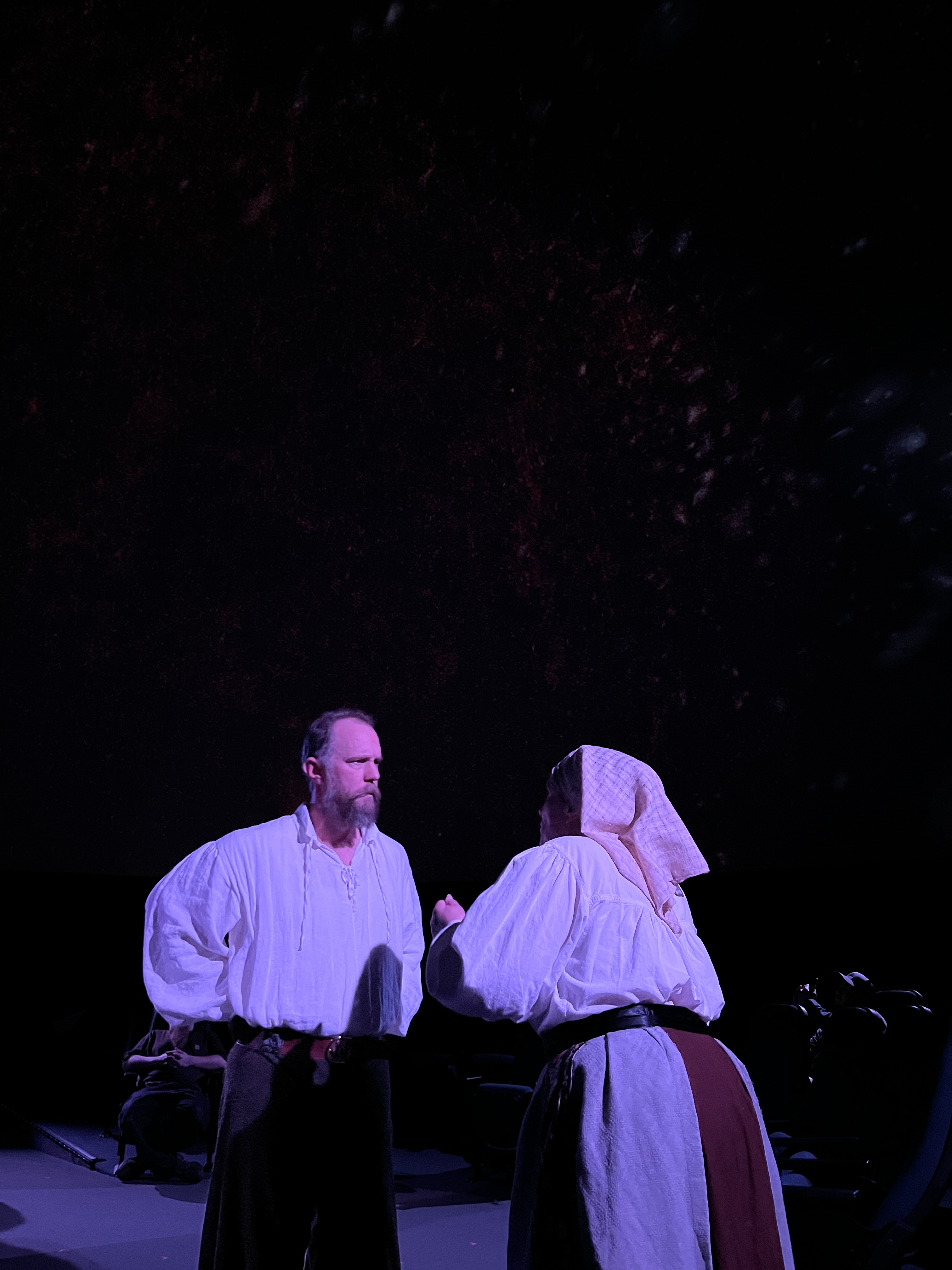
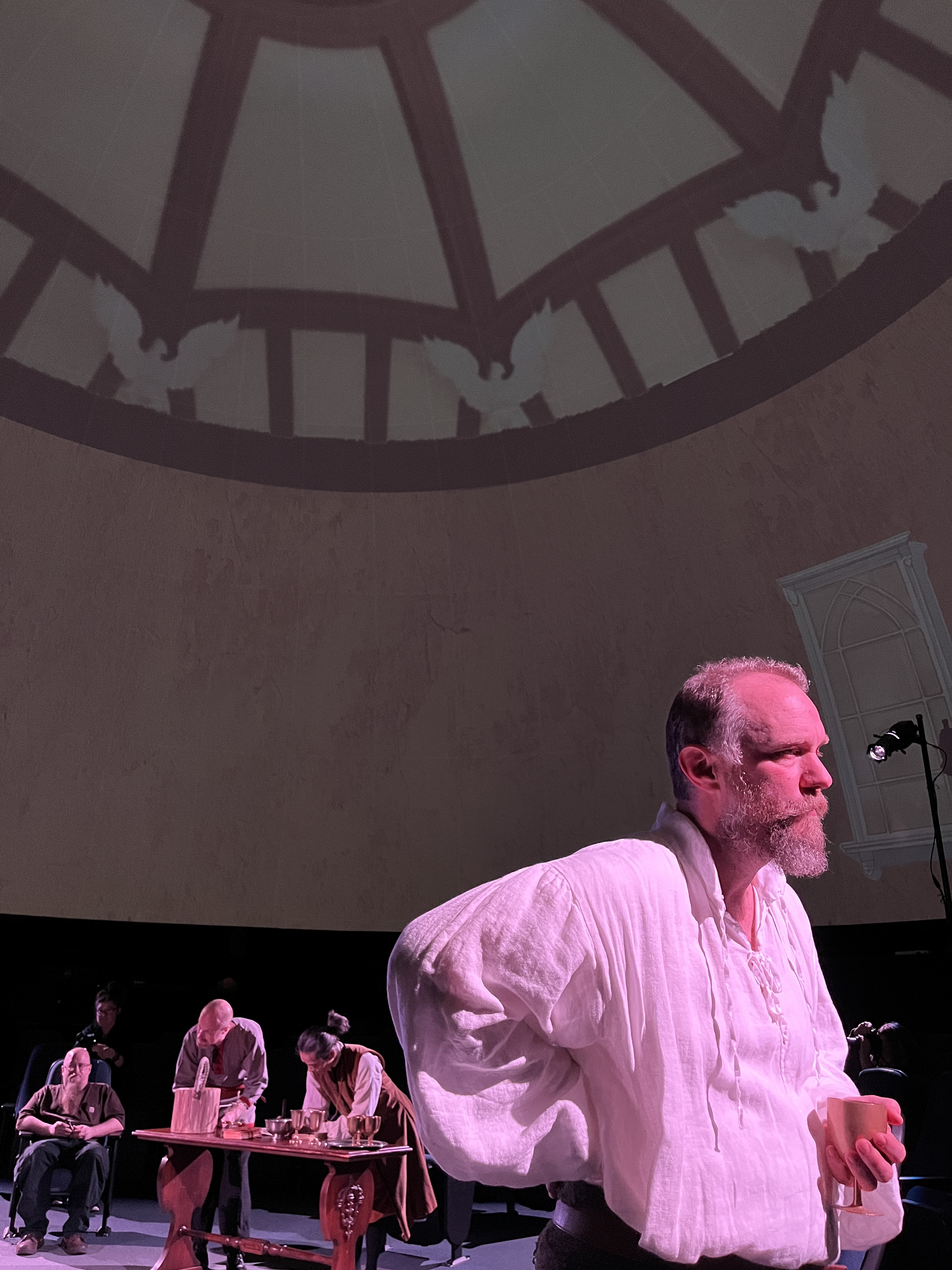
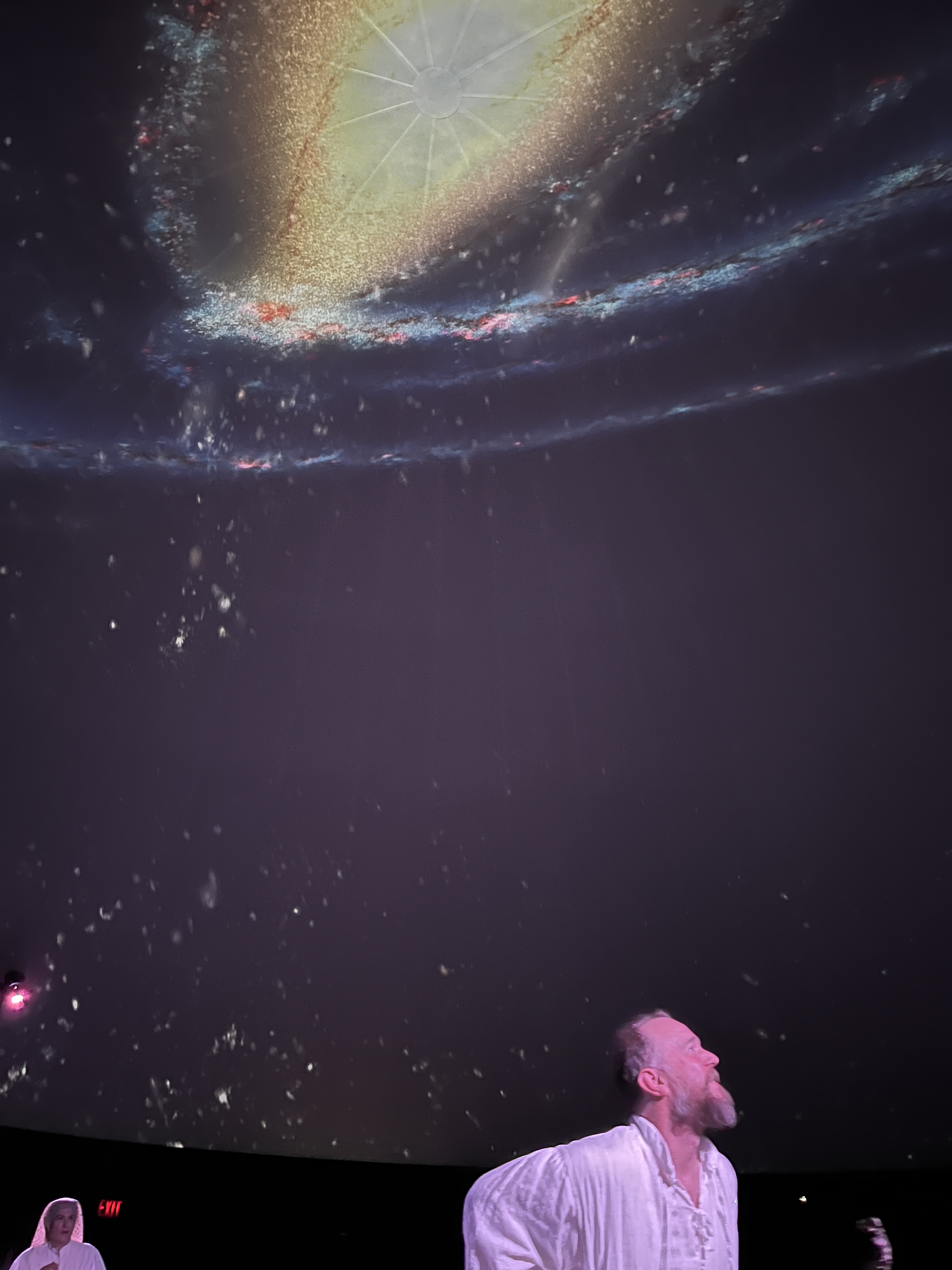
Walsh’s adaptation at the Kendall Planetarium, however, delights with the full play, actors in opulent costumes (Lisa Bonderenko), a dignified aristocratic puppet (Michael & Laura Streeter), frightening masks (Wildland Roots), essential props (Emily Trimble), dramatic lighting (Thyra Hartshorn), masterful sound design (Marcus Storey), and live music throughout the play (Adrian Harris Crowne). Difficulties with stage lighting and acoustics inside a planetarium might have been reasons for past theatrical stagings to resort to theater settings, but the technical aspects did not challenge this theater group, in particular Jim Todd (Planetarium Director & Visual Designer), a full member of the production team. He combines actual planetarium renderings, for example Jupiter and its moons, with his own visual designs. His meticulous displays even show details like the stars as Galileo would have seen them in 1610. And of course, a planetarium is the ideal setting for a play about the legendary astronomer, bringing storytelling and science together.
The space in the packed planetarium, reportedly the largest in the Pacific Northwest with a total seating capacity of 200 under a 52-foot-wide dome, lends itself brilliantly to performance, and it was sold out both nights I attended. Its four aisles serve as extensions of the stage and as ramps for actors to enter and exit. The central area under the dome has room for a few simple, easily moved props, initially a desk, chair, stool, a model of the infamous Aristotelian crystal spheres, a floor-standing globe, and later Galileo’s telescope with a few other simple items.
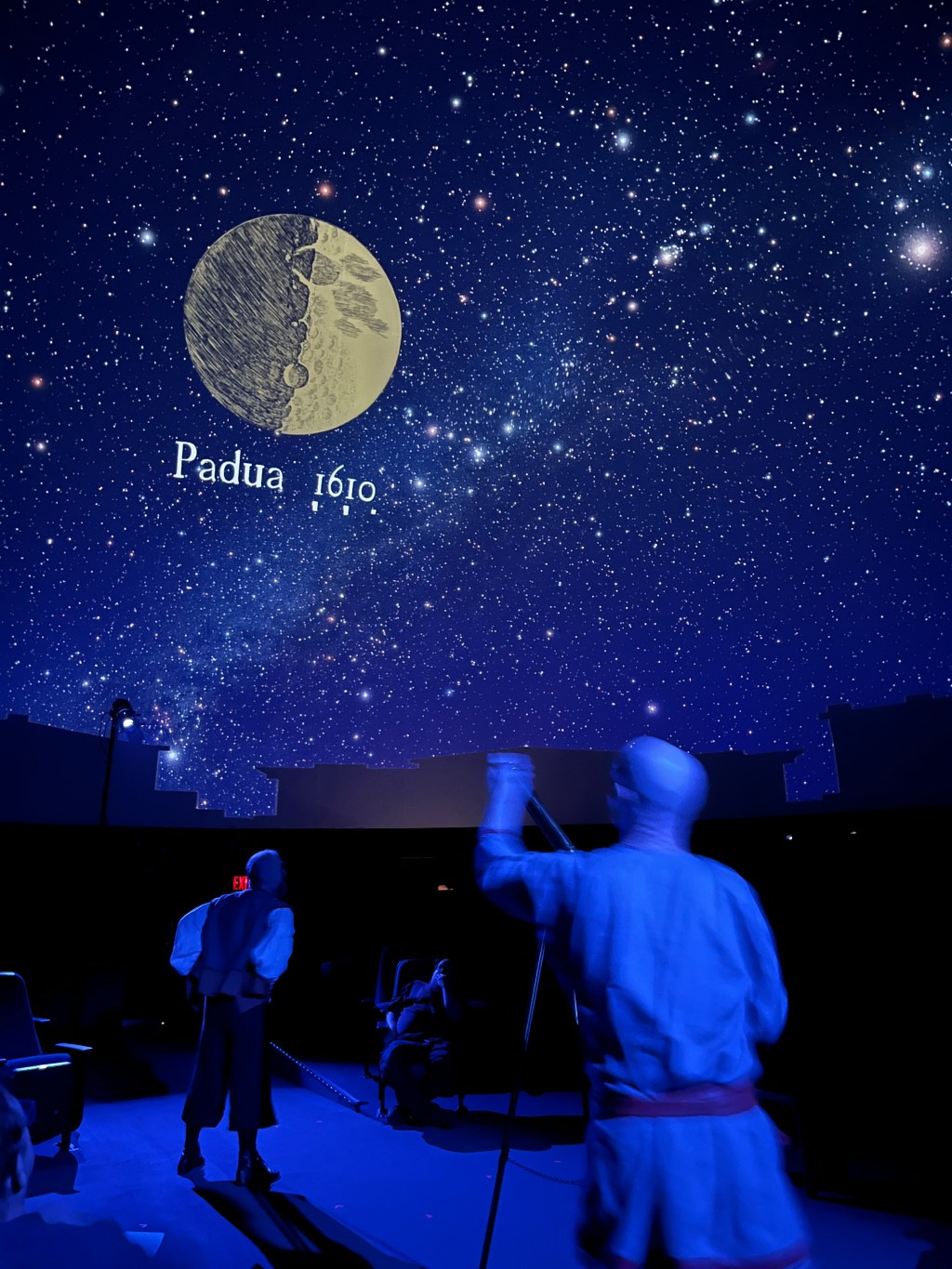
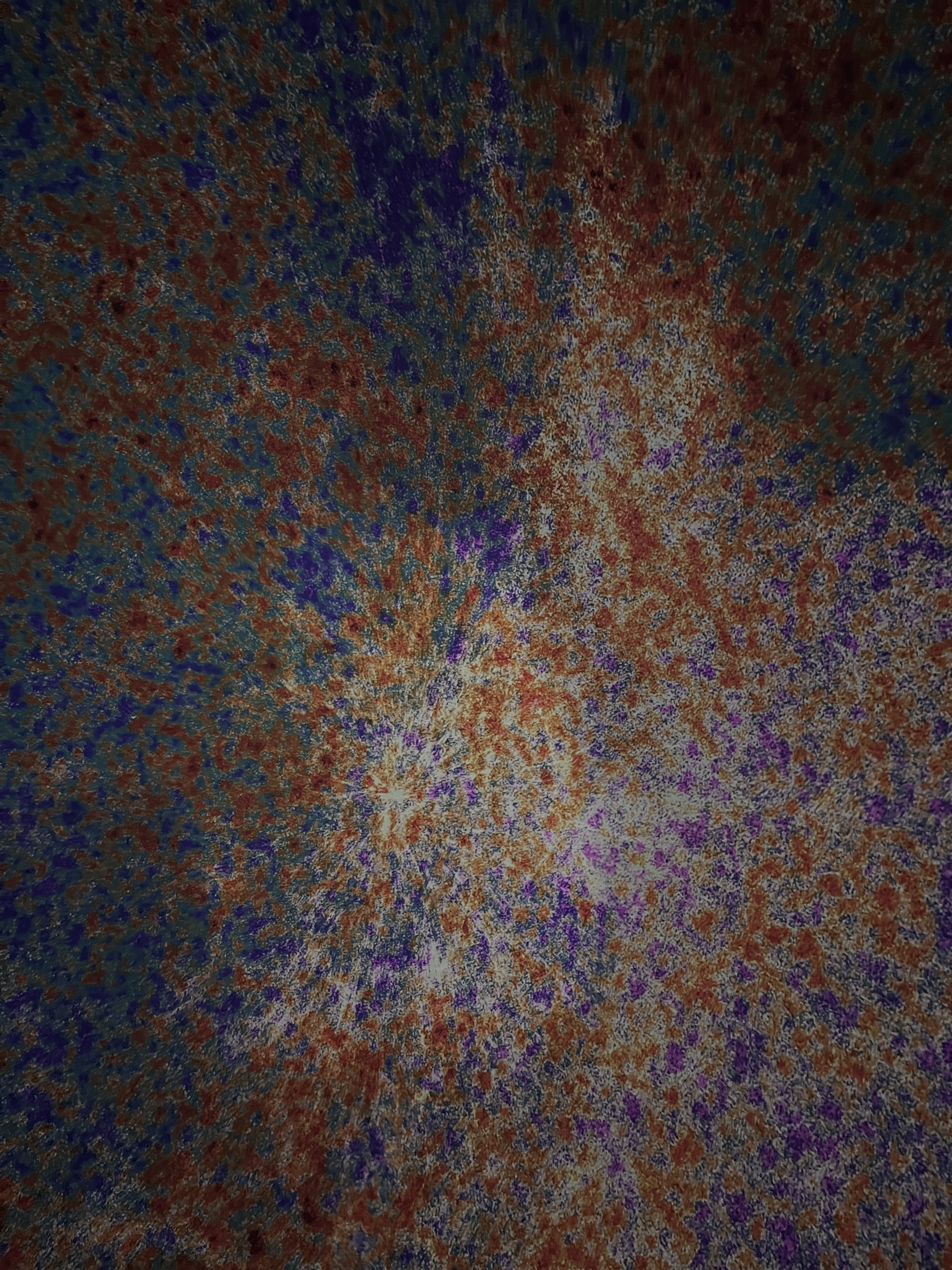
But what about the stage design, you might ask. How can a planetarium have room for scenery? This production doesn’t need a traditional set — it uses the enormous hemispherical screen. The first projection on the dome is an excerpt from John Donne’s 1611 poem “An Anatomy of the World: The First Anniversary.” We have time to read the first lines: “Loth to go up the hill, or labour thus / To go to heaven, we make heaven come to us.” Galileo makes the sky come to him with his telescope, defying Donne’s scorn of science. Other projections on the dome screen announce locations, for example, “Padua 1610,” and it appears in a flood of majestic blue light. City names and years orient the audience, and recognizable buildings — Venice, Florence, Rome — parade around the horizon, or sumptuous projections fill the entire dome to suggest grand interiors, a vast library or an Italian palazzo. The age of exploration has begun; everything is in motion. The old age is over, the new age begins, and everything and everyone on earth is moving. In this celestial playground, for example, the audience gasps as the silhouette of an enormous sailing ship makes its way around the circumference of the dome. Amid the quickly changing scenes, Adrian Harris Crowne (Singer and Music Director) offers the continuity of a narrator and commentator. As our north star, his songs guide us through the action and effortlessly carry us along through the events.
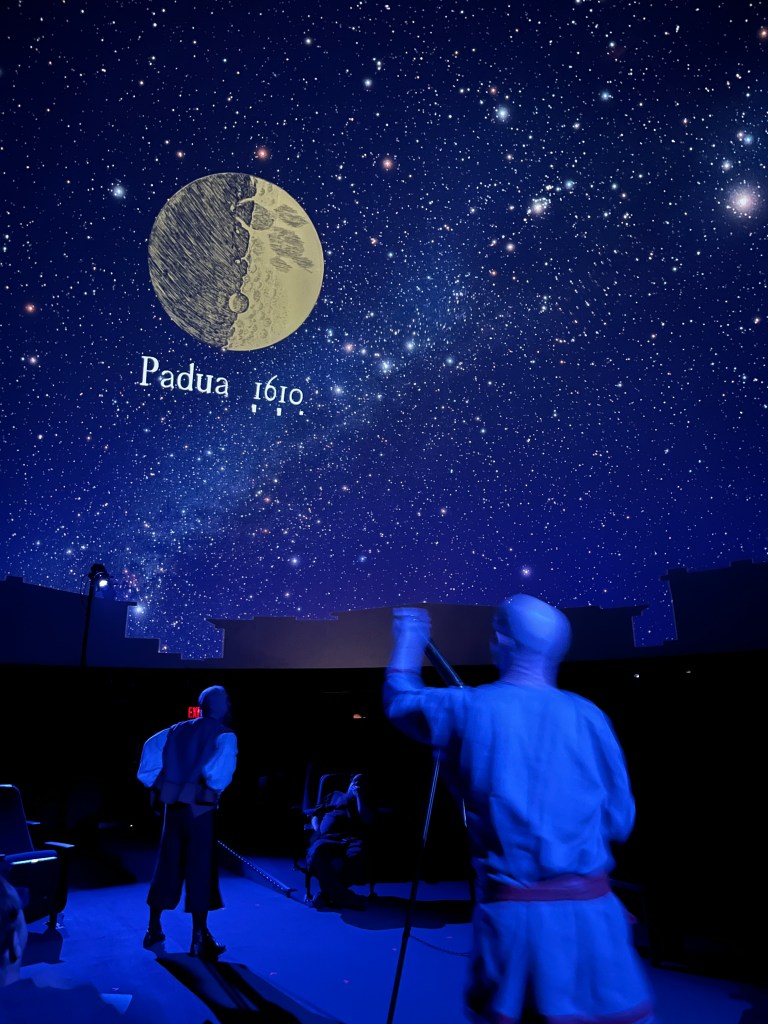
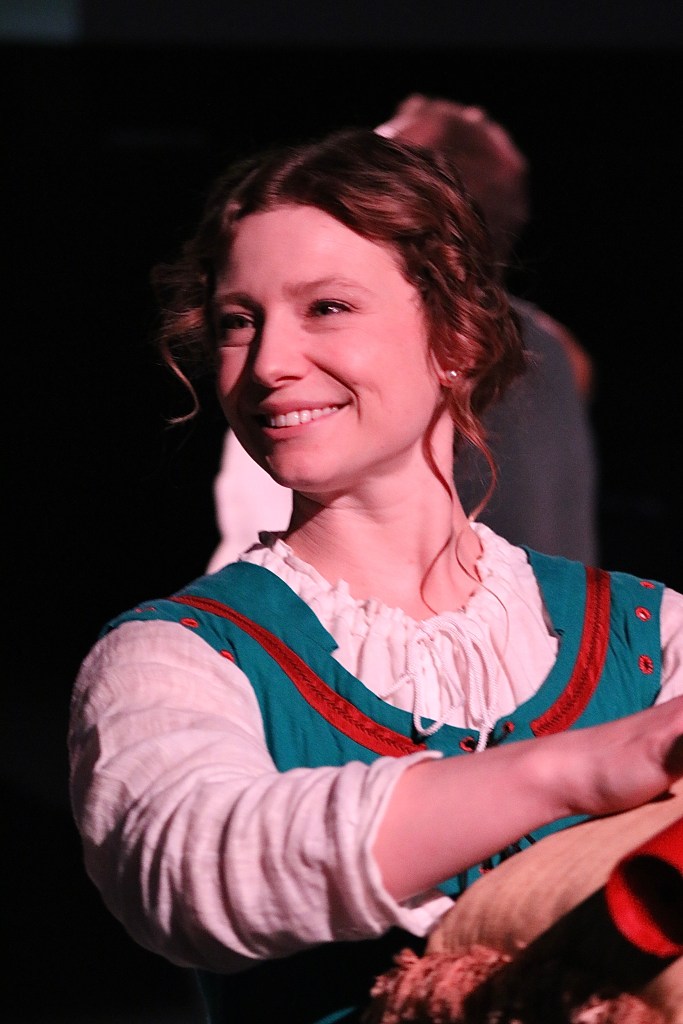
The show therefore incorporates music, text, and visuals — the familiar elements of epic theater. Moreover, the actors interact with the audience. Cradling her father’s new telescope on an ornate pillow, Galileo’s charming daughter Virginia (Shay Wisniewski), presents it to various audience members for inspection. An early form of journalist called a gazetteer (Oliver Turner-Emerson) passes fliers out to some audience members. Scenes are short, locations change quickly, and we skip over many years at once. We learn that Galileo has been a prisoner of the Inquisition from 1633-42 (about the length of two presidential terms).
While recognizing these well-known structural markers of Brechtian anti-Aristotelian theater, we also listen to Galileo’s persistent critique of Aristotle’s geocentric model, the crystal spheres — a series of concentric spheres that turn, with a motionless earth at the center. As we follow Galileo’s reasonable arguments, we are entertained at the same time, filled with the overwhelming spectacle overhead. Sometimes we forget to think. Simply gazing up at the notorious model of crystal spheres unleashes an overpowering feeling of awe, contrary to the horrified response we should have when viewing the antiquated and despised object of Galileo’s critique. A theatrical set rarely creates this kind of conflicted feeling. Through these breathtaking visuals, the production is more than epic theater. We share a sense of wonder for the sky with Galileo. After all, isn’t the sky the original theater — the Ur-theater — and still the greatest theater of all? Who doesn’t jump into action to see the Aurora Borealis? With the infamous model of the crystal spheres in mind, we need to grasp the gravity of what Galileo’s views propose. He will topple the world’s explanations of the heavens for the past two thousand years.
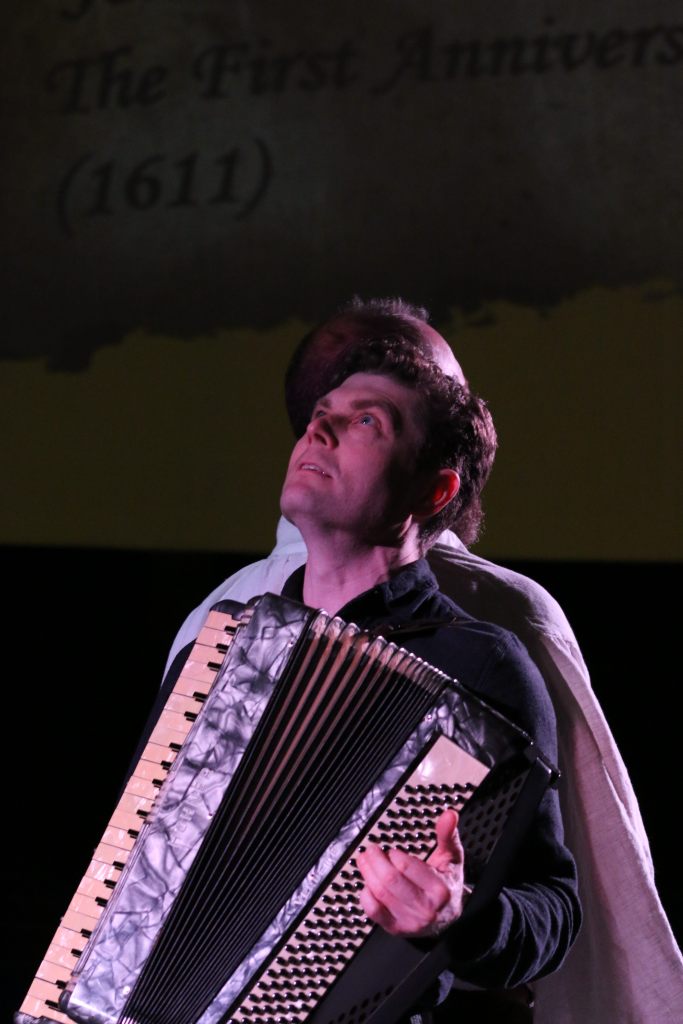
The production begins with Crowne and his accordion. He sings Bella Ciao (Farewell, Beautiful), a song that has come to signify resistance. Some researchers believe that a large group of resistance fighters sang the song in Italy in defiant opposition to fascism during WWII. Others believe that its mighty origin is a constructed myth as a song of freedom and resistance to oppression. In the song, a resistance fighter bids farewell to his love as he leaves for war, troubled by a premonition of his death. The song is not part of Brecht’s play. Walsh added it, and every time we hear this music during the evening, it brings the production another step closer to the spirit of resistance. In the first moments of the evening, Crowne sings alone. The actors enter gradually until the whole cast sings along.
As established by the initial song however, the production’s underlying theme of resistance is not the kind of noisy and confrontational protest of plays like Brecht’s The Mother (1931), but is instead quiet and secretive, almost stealthy. To refresh our memory, a quick review of the events. Sparing himself torture and possible burning at the stake, Galileo (brilliantly rendered by Brian Trybom) ultimately recants before the Catholic Church, renouncing his theory of heliocentrism. His recantation severely disappoints his supporters Andrea (Sean Ryan Lamb), the Little Monk (Heath Hyun Houghlan), and Galileo’s assistant and lens grinder Federzoni (Sam Holloway). The authorities allow him to continue his writing at home, but they secure and lock up every new piece of writing. Although Galileo argues that his recantation had no strategy other than avoiding pain, secretly and at great cost to his weakening eyes, he manages to copy his fresh pages by moonlight and hide them in his globe. Finally, he gives his completed work, the Discorsi, to astronomer Andrea who is on his way to Amsterdam. Andrea smuggles the work out of Italy. Holland will welcome Galileo’s new research, and his resistance will change the world understanding of motion and mechanics.
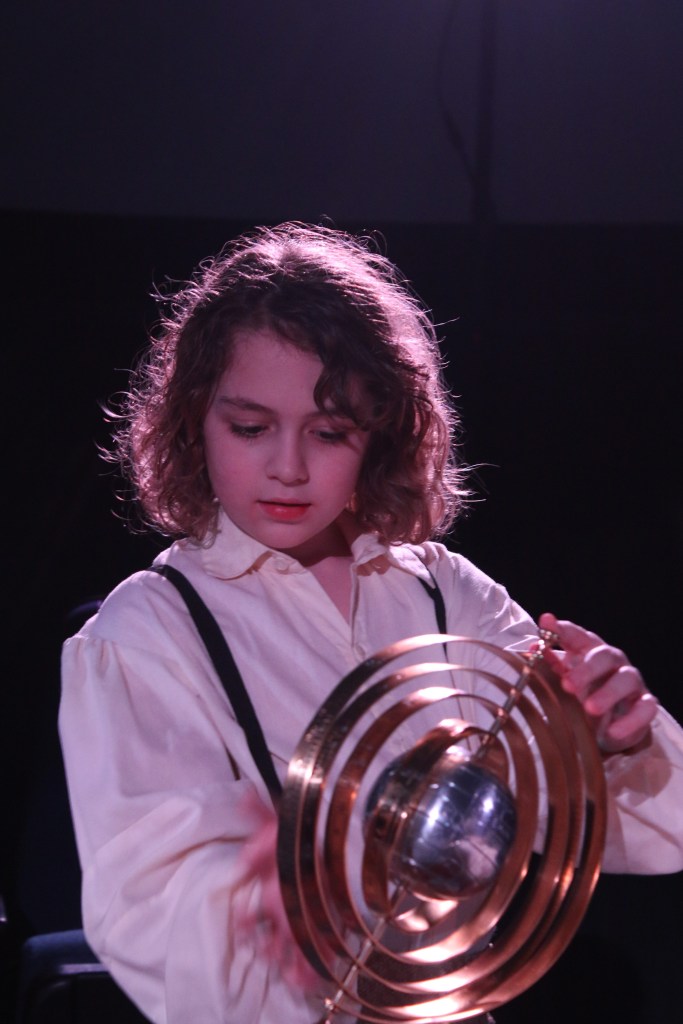
Now, let’s take a closer look at Walsh’s adaptation. After the projection of John Donne’s poem overhead, this streamlined version begins in Galileo’s study, “Padua 1609.” Here, Galileo expresses his doubts about the old science to his confidant and student Andrea, the eleven-year-old son of his housekeeper Mrs. Sarti (Diane Kondrat). Galileo uncovers the Aristotelian model of crystal spheres that supposedly shows how the universe works. As Andrea examines it, Galileo rejects Aristotle’s hypothesis that the earth is fixed. “Now the moment is here. Everything is in motion again.” Copernicus was right, or as Andrea calls him, “Cooper Nickus.” The sailing ship traverses the horizon. Young Andrea displays natural reason and a good sense of humor to go along with an experiment. Galileo lifts his chair and moves him from one side to the other side of the “sun” to demonstrate why it is sometimes on his left and other times on his right. Wealthy landowner Ludovico (Paul Susi) arrives from Amsterdam, asks for lessons, and casually announces that a new invention with two lenses is being sold there. Galileo immediately sends Andrea to get suitable lenses. The rector of the University arrives, refuses Galileo’s request for a raise, but instead encourages him to invent something useful. Perfect timing; Galileo shows him his sketch of the telescope. Andrea brings the new lenses, and the crystal spheres begin to crack. We hear of Bruno, an astronomer burned at the stake for critiquing the theory of the crystal spheres.
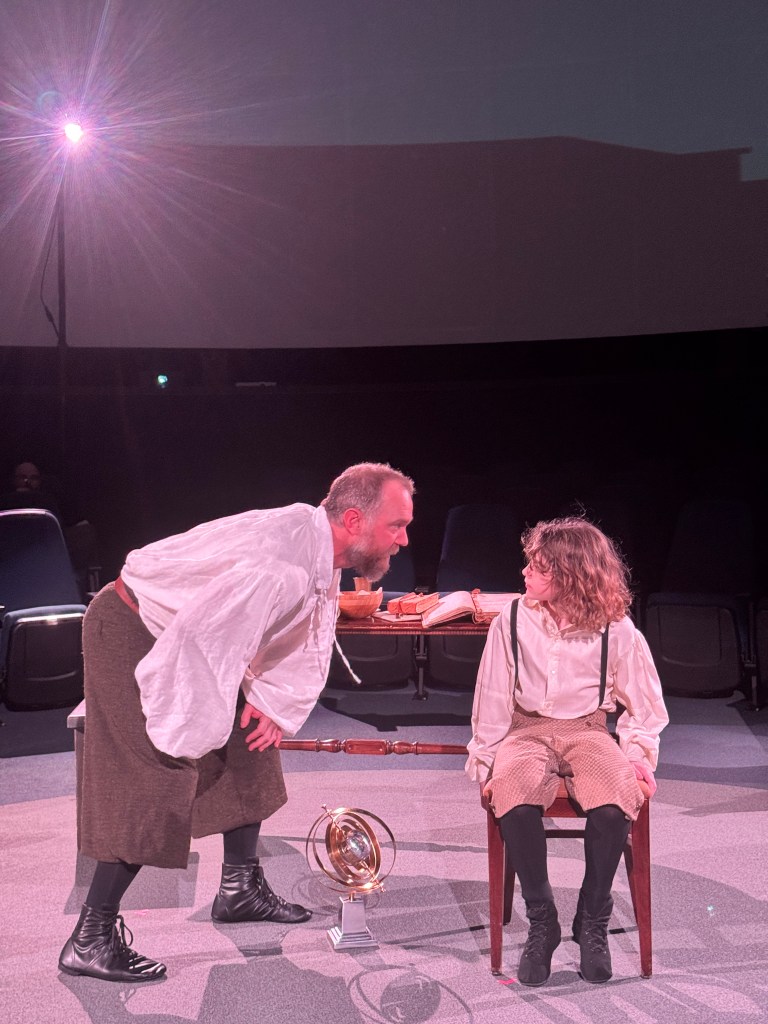
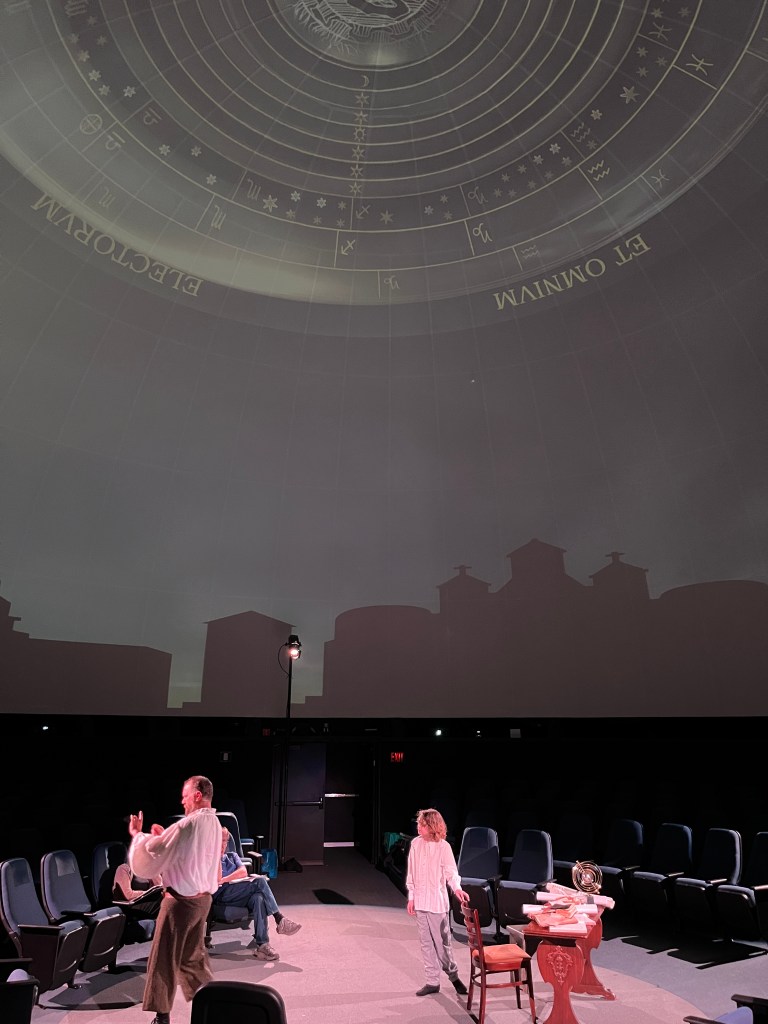
In the next scene, “Venice 1609,” Galileo presents his new telescope to the Venetian Arsenal. It is not Galileo’s invention. He adapted the idea from a new invention with concave and convex lenses that he learned was being sold in Amsterdam. And since he improved it for his research, we forgive him and laugh at his exaggerated claim upon presenting it to the Venetian Republic that it took him seventeen years of patient research.
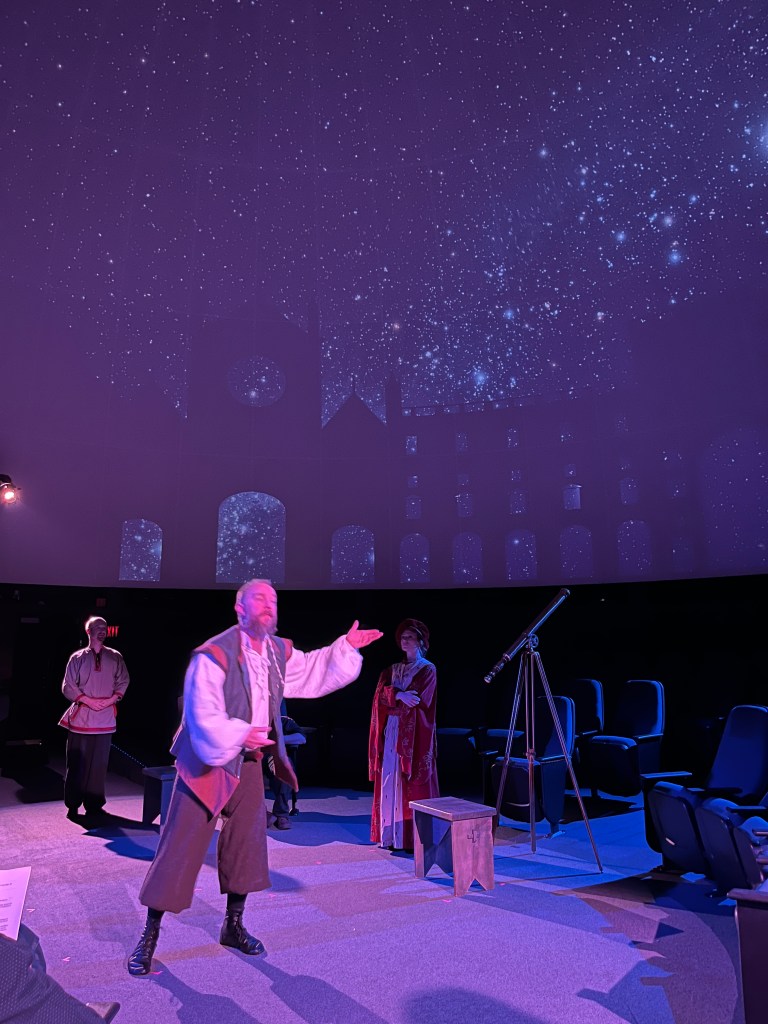
At home again, “Jan. 1, Padua 1610,” Galileo looks through his telescope and discovers mountains on the moon. His assistant Federzoni listens as Galileo hypothesizes that the light on the moon’s dark side comes from the earth and that the earth is merely a star. Galileo concludes: “There is no difference between heaven and earth. Heaven is abolished.” The rector visits briefly, complaining that the telescopes arriving from Holland are for sale everywhere, but he still pays the promised 500 scudi for the invention. Galileo, who insists his instrument is better, keeps observing the sky. He notes four moons around Jupiter one night, and only three the next. We view his sketch of the moons of Jupiter on the dome screen, then see the stars exactly as Galileo saw them then. (MSE: Today, Jupiter’s four moons are called the Galilean moons in Galileo’s honor, the first objects found to orbit a planet other than the earth’s moon.) With this evidence, he is certain that Copernicus’s heliocentric model was correct. The planets are not fixed; the moons of Jupiter move. His new observations confirm his previous suspicions of movement. Stunned, Federzoni asks: “Where is God?” Galileo: “Not there…In us or nowhere.” And although Federzoni brings up Bruno’s conviction that the planets move, Galileo retorts that he taught the Ptolemaic system for so long only because he could not prove it wrong.
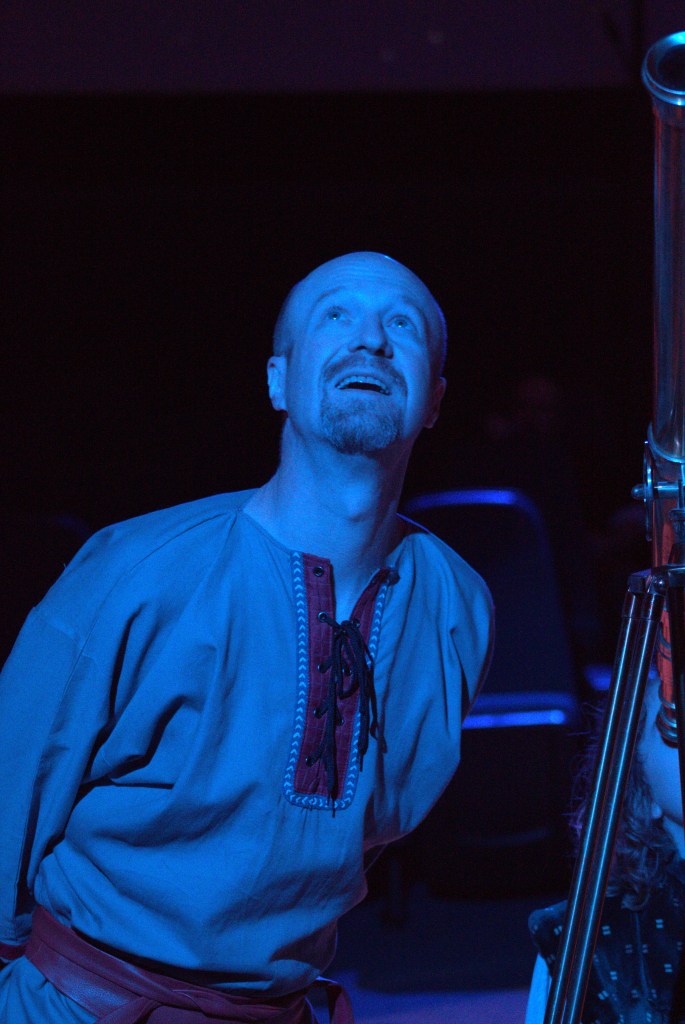
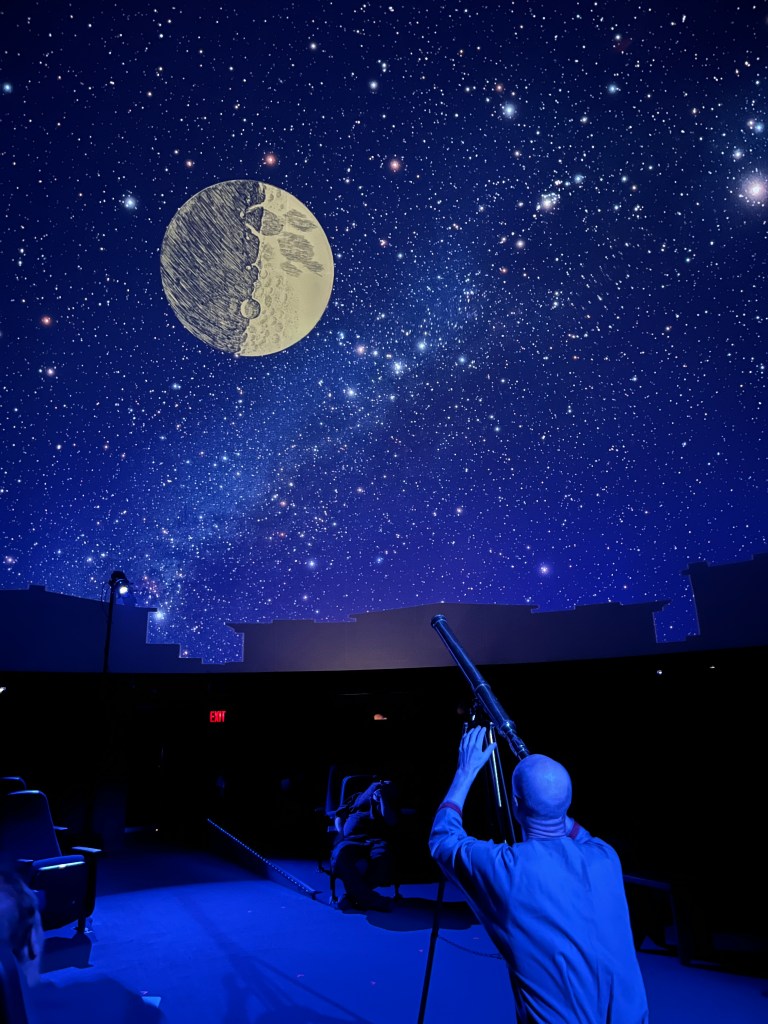
In Florence, Galileo presents his discovery of Jupiter’s moons, “the Medicis,” to the Medici family. Here, Walsh ingeniously imagines the young Grand Duke of Florence, nine-year old Cosimo I de’ Medici, as a richly attired puppet of few opinions, mostly capable of nodding. Galileo explains that Jupiter has four moons, and the child asks, “Is something wrong with my stars?” Galileo invites the sumptuously clad authorities to look through the telescope, but although Galileo proclaims that “proof is the child of the time,” they decline. They would rather believe than look for evidence themselves, and say that the Papal College in Rome will review Galileo’s discovery.
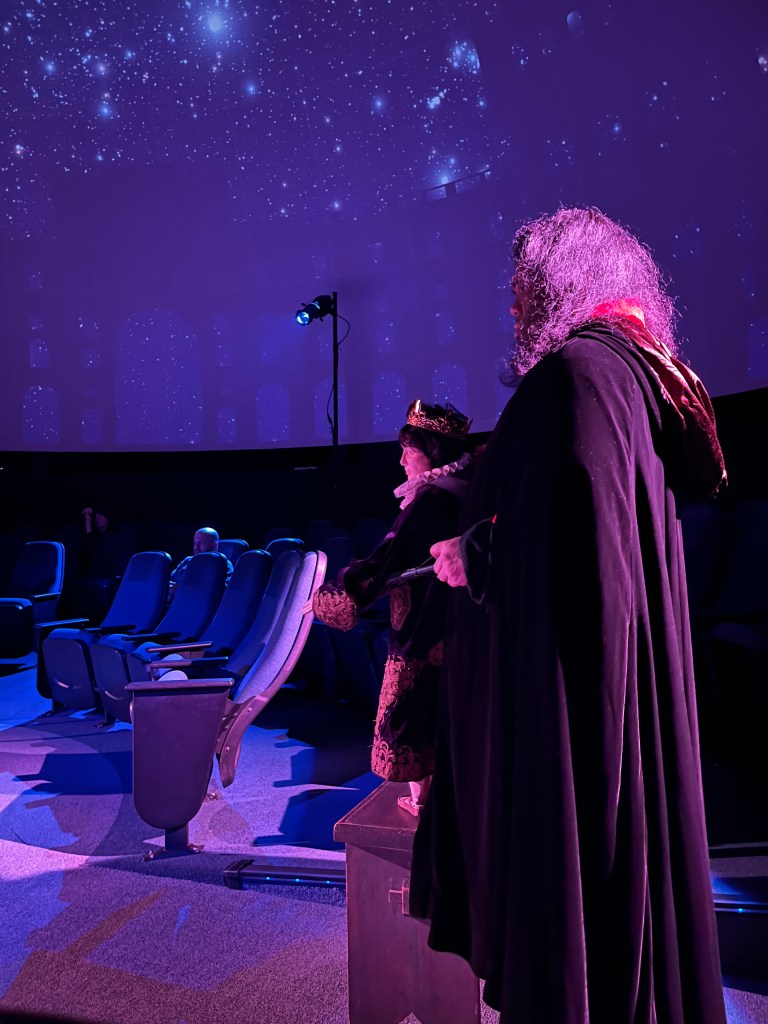
At the Vatican, “Rome 1616,” while waiting for the chief astronomer of the Church to evaluate Galileo’s views, the authorities complain that Galileo is degrading mankind, the “world’s most important creation.” They want to believe that the earth is motionless at the center of the solar system, and located at its absolute center, the Catholic Church and its Pope. We understand the consequences of Galileo’s discoveries more clearly now. His work questions the fundamental structure of the Church. The Church astronomer Clavius announces that Galileo is right, and Galileo comments: “Reason has won, not me.” But he is not free.
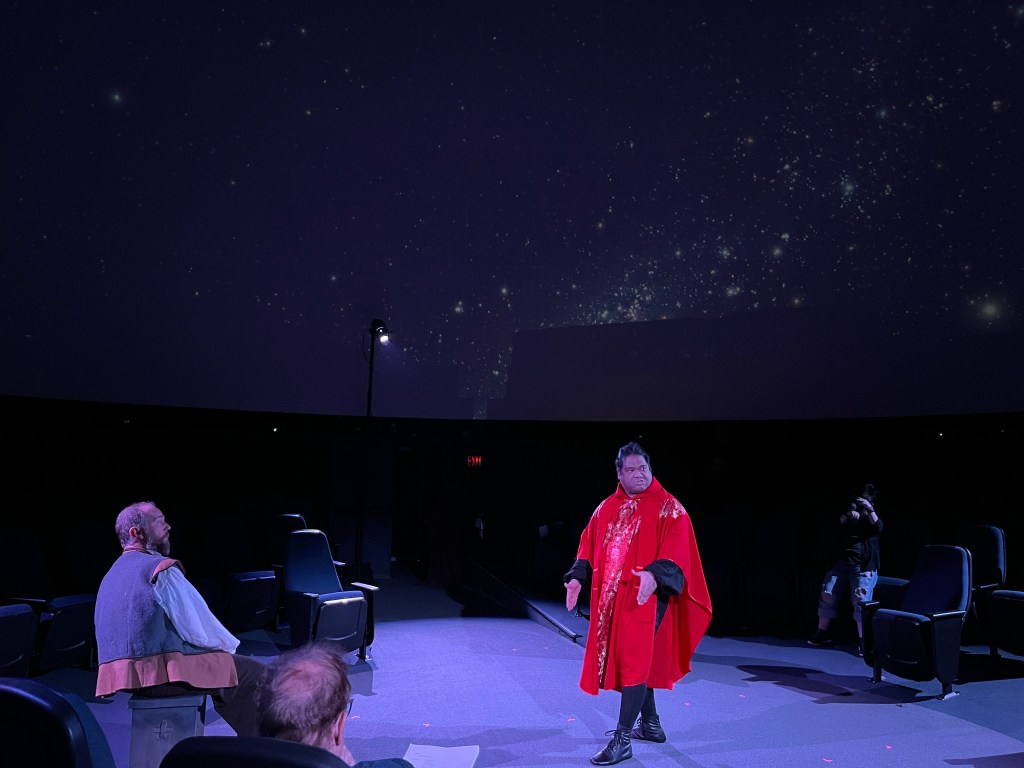
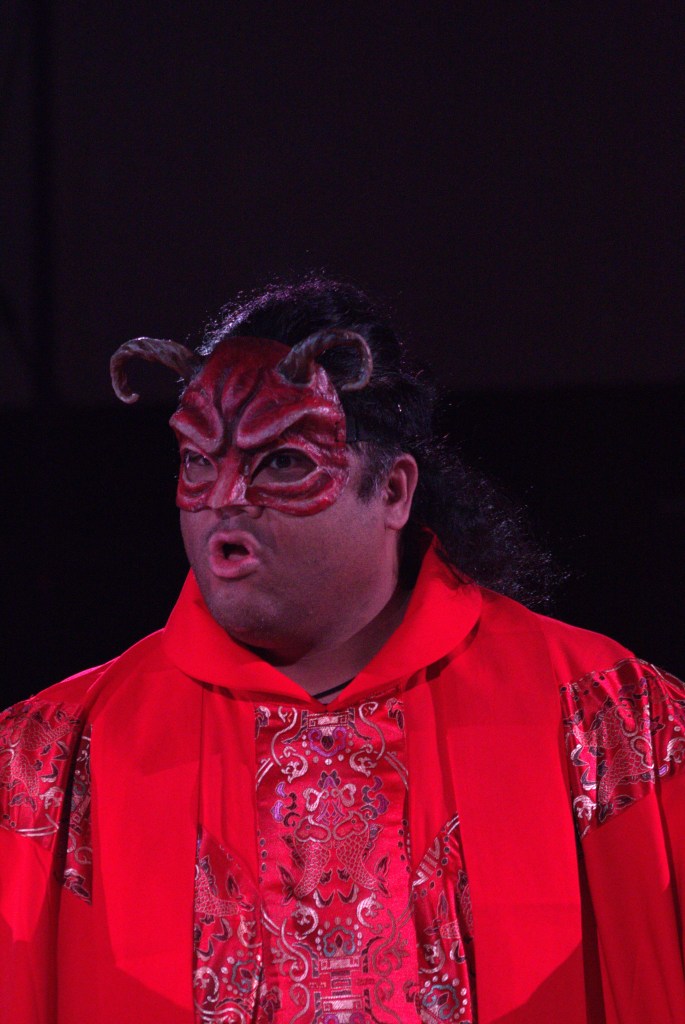
Soon thereafter, to the sound of breaking glass as the theory of the crystal spheres shatters, the projection dome changes the scene to a masked ball in an immense ballroom at the home of Cardinal Bellarmine (Paul Susi) in Rome. Galileo and Virginia dance happily in the presence of Cosimo de Medici, now the adult Grand Duke of Florence (Heath Hyun Houghlan). Bellarmine and Barberini (Sean Ryan Lamb) arrive in rich red robes, sporting frightening carnival domino masks with ram’s horns. (Do the horns stand for stubbornness, deception, or power and authority?) Barberini and Galileo engage in a fast-paced duel of Bible verses while the Inquisitor’s spies listen. Suddenly, the stars dart upward. Barberini asks, “What if God decided to have the stars move like that?” Bellarmine argues that the peasants need the Church to lend dignity to their suffering. Galileo states, “I believe in reason.” (scientific truth); Barberini counters, “I believe reason to be inadequate” (i.e., the Church holds society together). Finally, Bellarmine announces that Galileo is free to expound his ideas as mathematical hypotheses, not as truth. No one believes he wants to challenge the authority of the Church. Barberini knows that the concept of God is necessary to maintain the social structure: “If God didn’t exist, we would have to invent him.” God is necessary, both to keep the peasants in their place and give them hope.
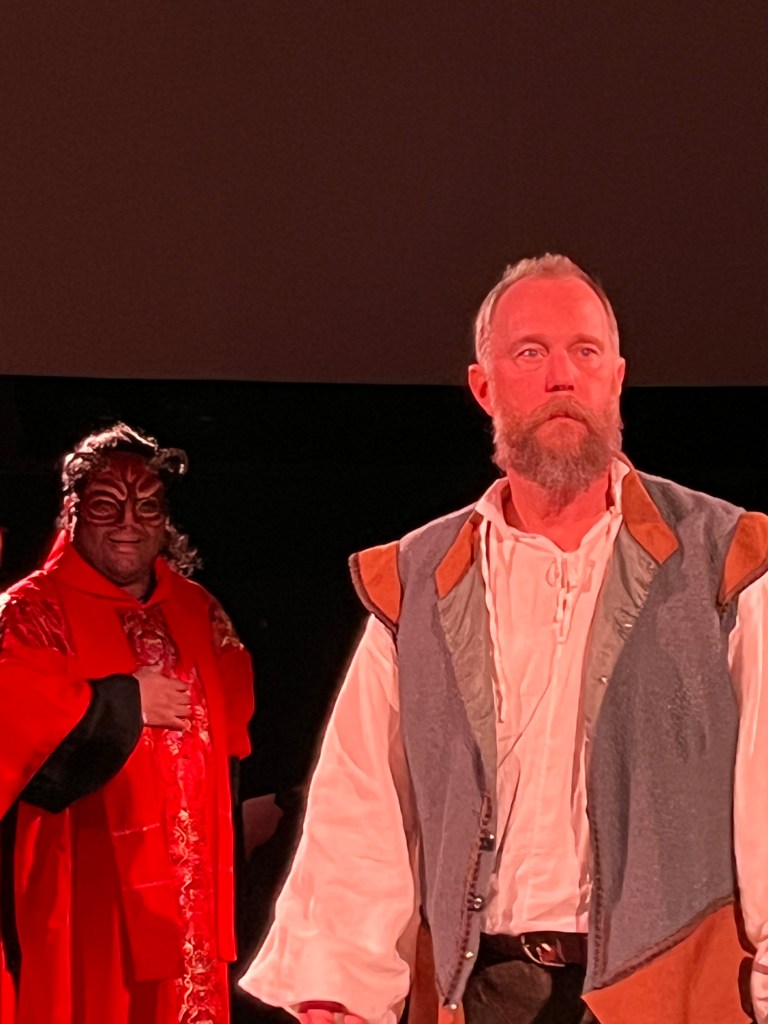
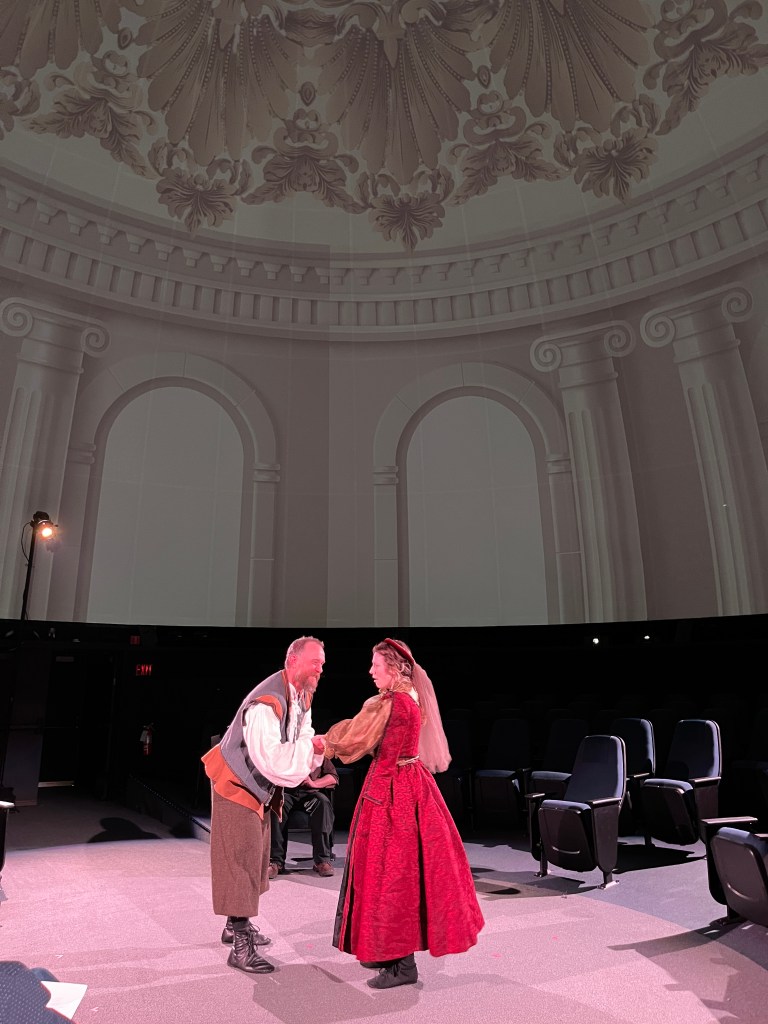
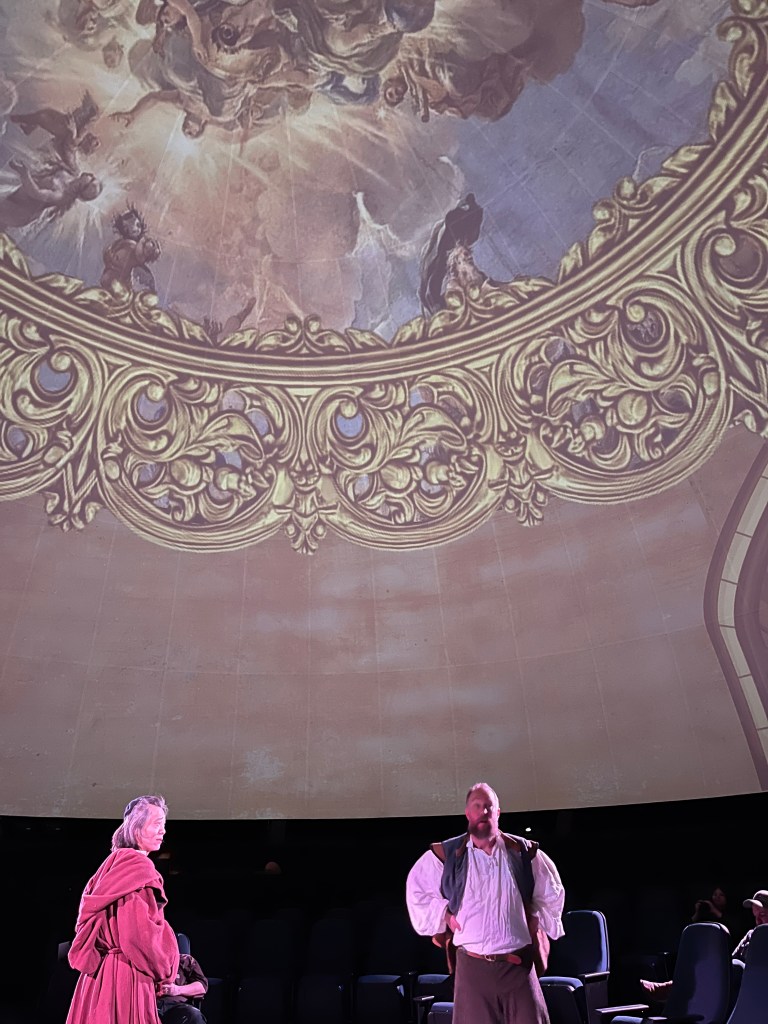
The projection screen now invites us into a grand room at the “Palazzo Firenze” in Rome under a magnificent painting (MSE: It is an excerpt of Luca Giordano’s ceiling fresco “Apotheosis of the Medici,” 1682-85, at the Gallery of Mirrors in the Palazzo Medici Riccardi in Florence. The artwork depicts four Medicis, each with a moon of Jupiter, a “Medicean star,” sparkling over his head. In this magnificent setting, the conflicted Little Monk explains to Galileo why he has decided to give up astronomy. Trained as a scientist and astronomer, he stems from a peasant background and believes that his family and other peasants who draw strength from the Bible are in now in danger. Without their faith, they will feel that no one looks after them. Galileo stands firm: “He who knows the truth and denies it is a criminal.” Only truth will conquer. We hear Brecht here loud and clear, a thought that might resonate with protesters today, despite the current murky status of “truth.” Galileo insists that the peasants must change: “Where is their anger?” As soon as the Little Monk asks Galileo to explain a passage in a book he gives him, we know Galileo has won. This good omen ends the first part of the production. Renaissance music fills the planetarium and eases us into the intermission as it did before the play began.
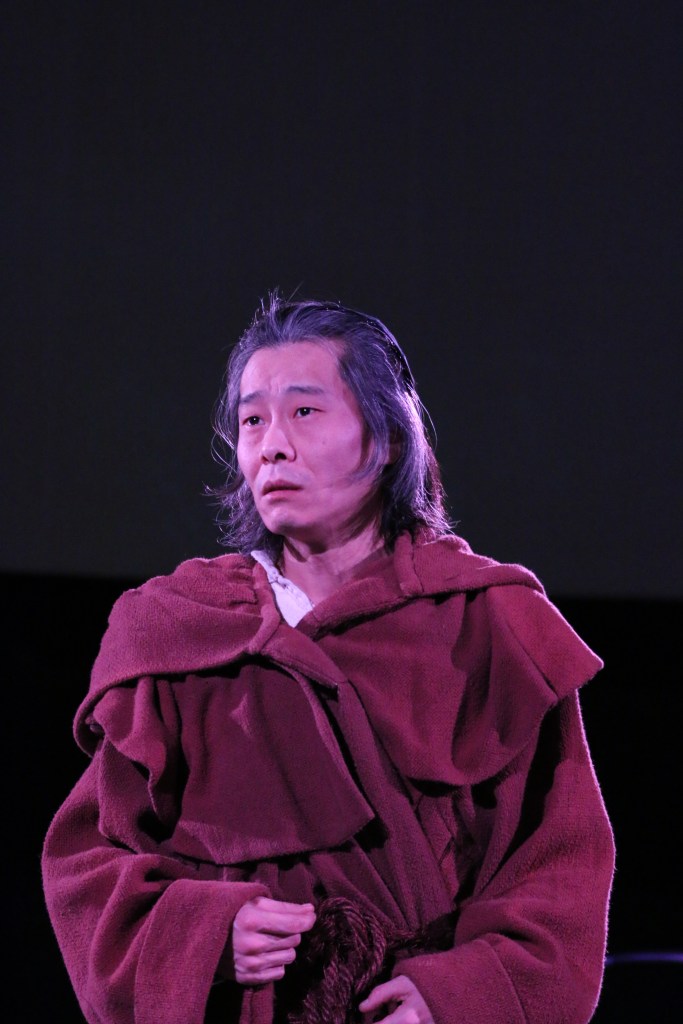

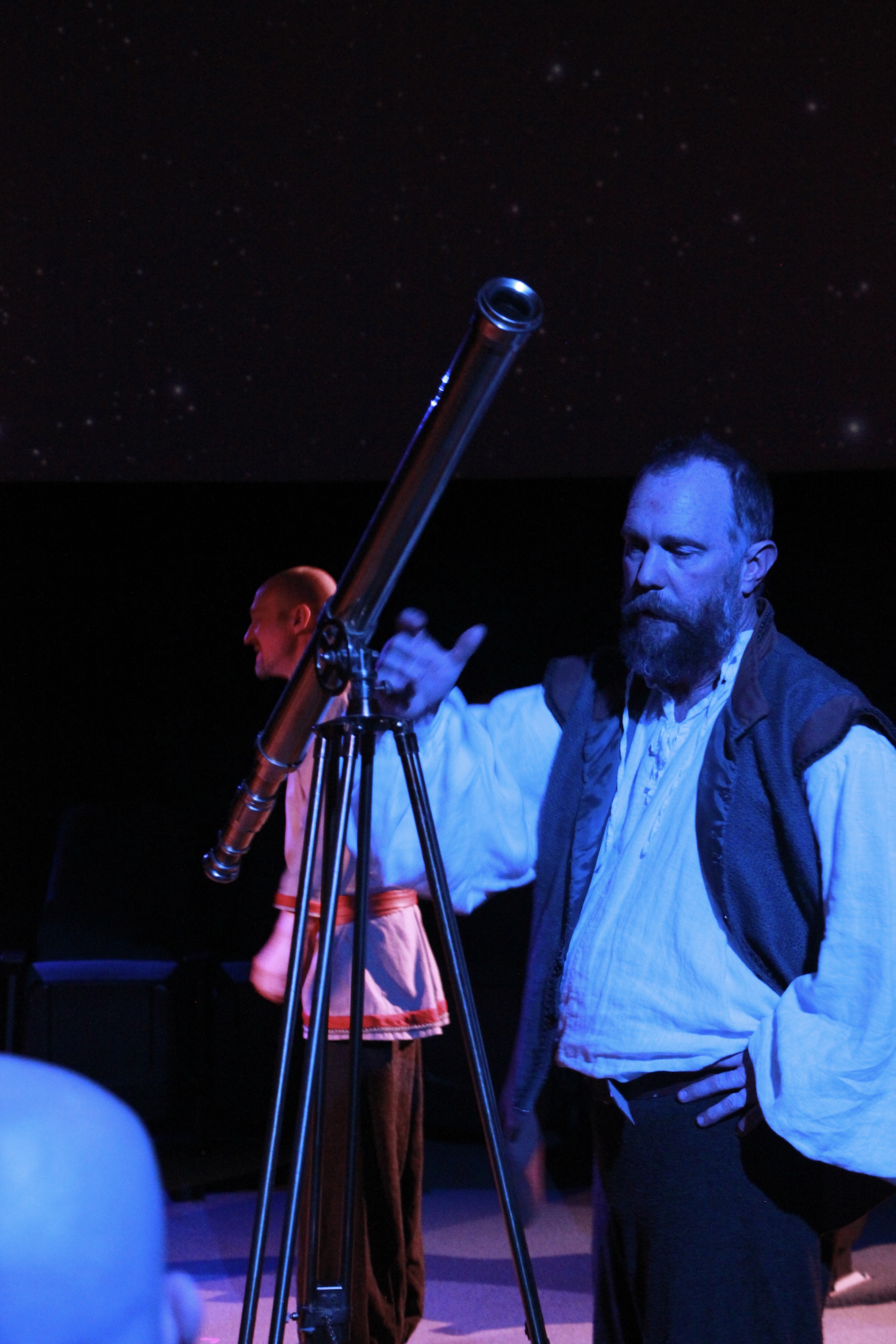
During the intermission, years have gone by. We are in a house near Florence, where Galileo has been living under house arrest for eight years. His voice is no longer heard in the public arena. Although he is permitted to continue his writing, the Church supervises him closely, and he is careful about what he says. His daughter Virginia has waited to marry the rich landowner Ludovico (Paul Susi). She will lose him, has no other prospects, and Mrs. Sarti accuses Galileo of “trampling” on his daughter’s future. As a foil to Galileo, Virginia has remained true to her Catholic faith and the horoscope, readily explaining to Mrs. Sarti that her father knows he was wrong. However, his eyesight is failing and she is essential as his scribe. While the Dutch have been studying sunspots as proof of the sun’s rotation and changes in the solar system, Galileo is silent. Andrea, the Little Monk, and Federzoni briefly discuss sunspots (swarms of stars? vapors?), but Galileo insists he has no opinion. He shifts quickly to seemingly harmless experiments with floating bodies (pieces of ice and a needle). One of the main reasons for failure, he says, is that “we set a limit for our own stupidity.” (MSE: It’s easier to understand than Brecht’s “to put a limit to infinite error.”) Ludovico arrives, soon to dissolve his engagement. Over wine, the conversation turns to the illness of the reactionary Pope and his anticipated successor, Cardinal Barberini. This prospect suddenly excites Galileo, since Barberini is a mathematician intrigued by scientific advancement. Galileo announces his renewed interest in sunspots, although Ludovico reiterates Clavius’s comment that the “sunspot nonsense will lead to the earth-around-the sun again.” Energized now, Galileo assures his colleagues that they will “question everything” and “distrust” until they reach a conclusion. Resplendent projections slowly traverse the dome: red and yellow, with hints of the Milky Way. Ludovico shows his ugly side, calling the peasants stupid and animals, while an exuberant Galileo calls for his telescope to be uncovered and turned to the sun. He considers writing in the language of the people, not in Latin.
A new projection announces “Italy 1632. Galileo proclaims in the language of the marketplace.” A gazetteer passes out fliers about Galileo’s ideas spreading among the common people. Brilliant shooting stars like firework displays illuminate a carnival fairground, and singer Crowne mocks Galileo’s teachings in chaotic visions of the future: “Who doesn’t want to be his own master?” and “Galileo threw down the Bible.” Brecht’s play describes a crowded scene of pure mayhem — songs, laughter, and jubilation — everyone can do anything. The established class structure bursts apart, and the fixed social order is overturned. In Walsh’s drastically streamlined carnival atmosphere of inspired commoners, only three people dance around, brandishing magnificent masks on poles in a rowdy celebration. Are they stand-ins for the crowd, or spies from the Church? It does not bode well for Galileo and we soon hear the word “investigation.”
The dome screen announces the new scene, “Rome 1633,” where Galileo is being investigated. In the grand library of the Medici Palace, iron founder and industrialist Vanni (Diane Kondrat), tells Galileo how Europe is changing. Industry and science are making progress in other countries like Germany and England, and people have newspapers. He picks up a leaflet, explaining that fliers attacking the Bible are everywhere. In Italy, progress is being stifled, people are not given the freedom to make money, and the Church is against iron foundries because “too many people in one place encourages immorality.” He warns Galileo that he does not recognize what danger he is in, and offers an escape route. But Galileo declines without telling him about the new book he has written on the mechanics of the universe. He is waiting to offer his book to the Church dignitaries. When they arrive, no one wants to hear that the Church is not at the center of the universe. Finally, the Grand Duke of Florence takes his book, only to hand it off quickly to Virginia. The coach for the Holy Inquisition awaits Galileo.
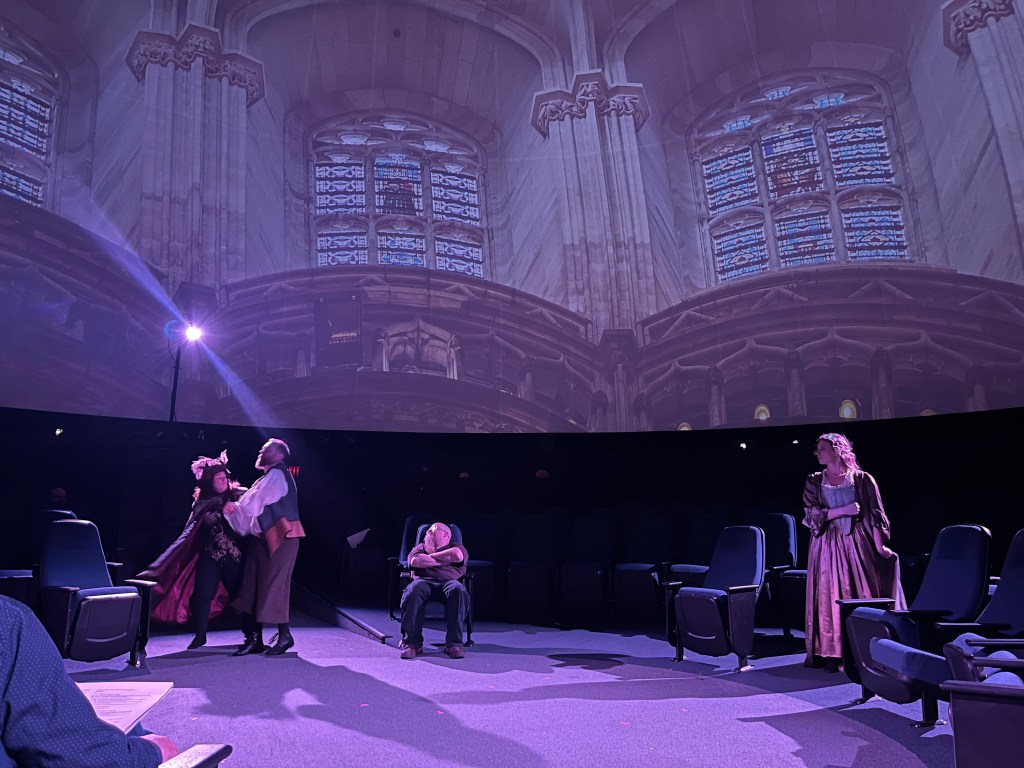
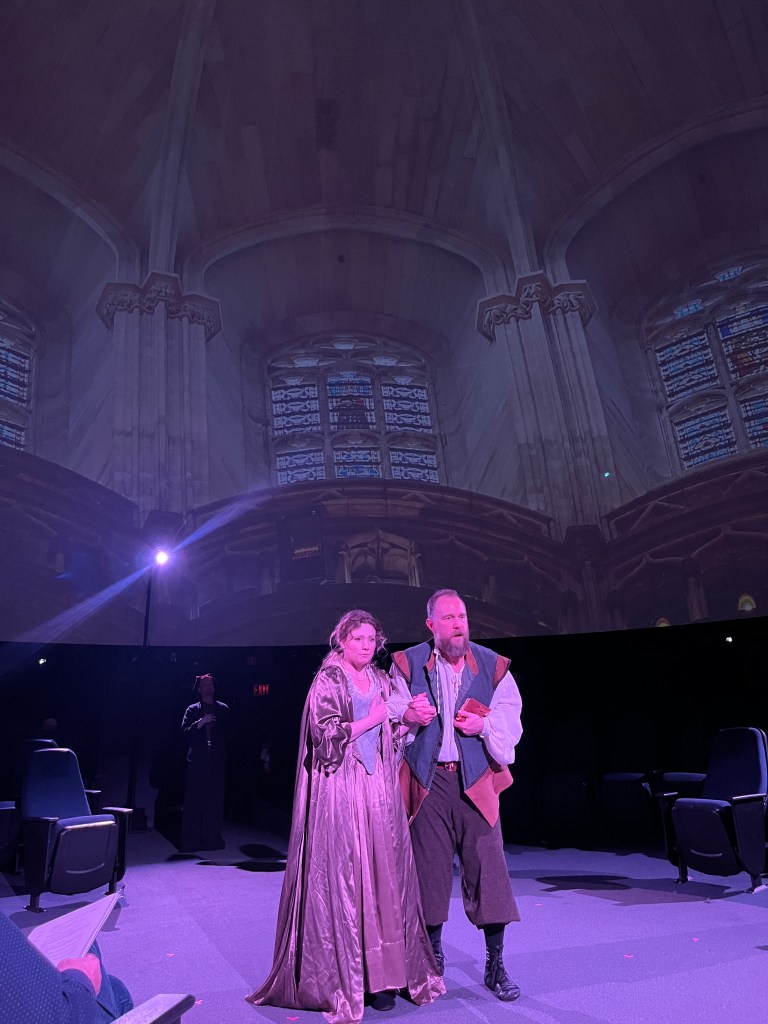
“The Vatican 1633.” Cardinal Barberini, lavishly robed in white, has become the new Pope Urban VIII. In a sumptuous scarlet robe, Bellarmine is the Cardinal Inquisitor who ordered Galileo to abandon Copernicus’s heliocentric theory in 1616. Bellarmine pressures the Pope, asking if he wants the Church to say the scriptures are wrong and that everything needs to be overturned. Navigators, he complains, now trust Galileo’s compass, not the scriptures, and everyone wants his star charts. “Leave him alone,” the Pope retorts, “Galileo is the greatest physicist of the age.” Bellarmine explains that when Galileo writes in the language of the people, he wants to incite them. The more liberal thinking Pope recalls Galileo’s weaknesses: he can resist neither an old wine, nor a new idea. But when Bellarmine informs the Pope that Galileo uses the Socratic method in his writing for the common people, in which a clever man (Galileo) argues with a stupid man (Aristotle), the Pope suggests they show Galileo the instruments of torture to scare him. Bellarmine agrees that Galileo is, after all, an expert on instruments.
The projection screen presents the grand Medici Palazzo Firenzi in Rome: “June 22, 1633.” The Little Monk, Federzoni, and Andrea wait with Virginia and Mrs. Sarti to hear whether Galileo will recant his ideas on the motion of the earth. After twenty-three days, the great examination has finally taken place. As Virginia recites the Hail Mary, the men pass the time playing chess (with new rules for movement). They reiterate Galileo’s ideas, confident that Galileo will not yield. The Little Monk complains that they never should have left Venice where Galileo presented the new telescope, but remembers that he could not write the book in Venice and they could not publish it in Florence. Loyal to Galileo, he insists that you cannot make something unseen once it has been seen. Mrs. Sarti suddenly brings bad news: Galileo is expected to recant at 5:00 pm; the recantation will be read publicly. Utter dismay. When the bell has not rung by 5:03 pm, the scientists celebrate. Federzoni: “The age of science has begun.” Suddenly, the bell tolls. An announcer reads offstage: “I recant. The earth is not the center. I renounce all that does not uphold the teachings of the church.” Supported by Virginia, Galileo enters, now a broken old man grasping a large walking stick. Andrea is devastated: “Piss artist!” and “Unhappy the land that has no heroes!” Galileo famously replies, “No. Unhappy the land that needs heroes.” Italy still needs heroes. In an ideal country, a person should not need to act alone to uphold the truth. In his opinion, the political environment should be changed to embrace the truth. It is good thought, and the crux of Brecht’s writing, but unfortunately this vision of having the freedom to speak the truth is hardly realistic today.
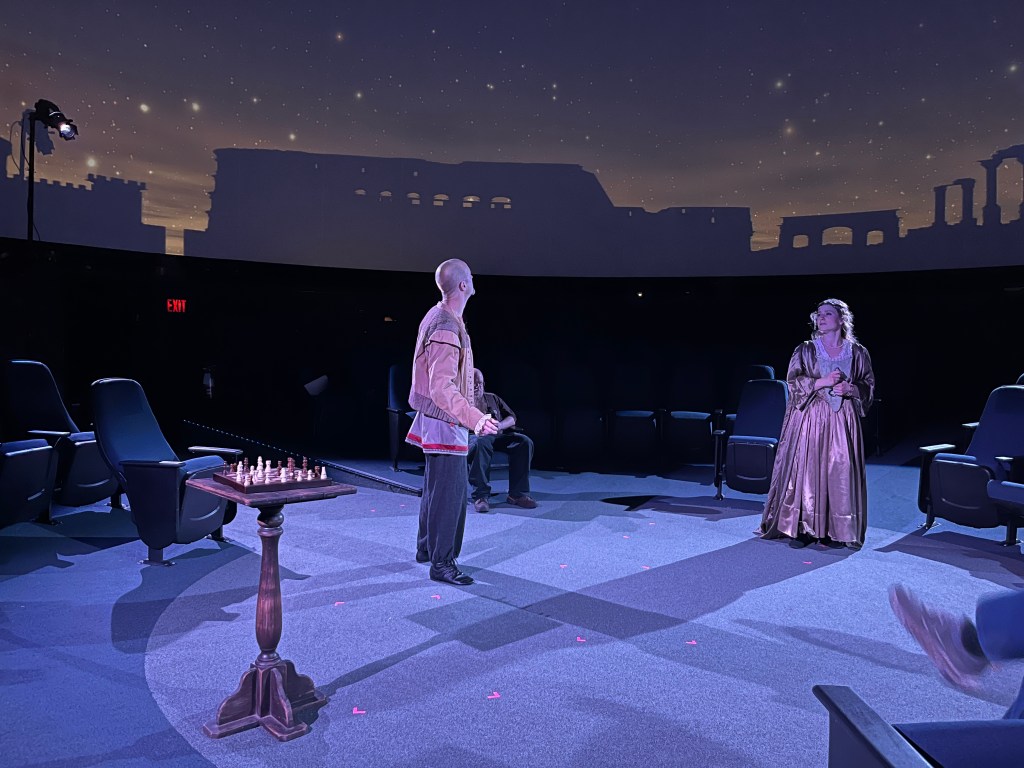
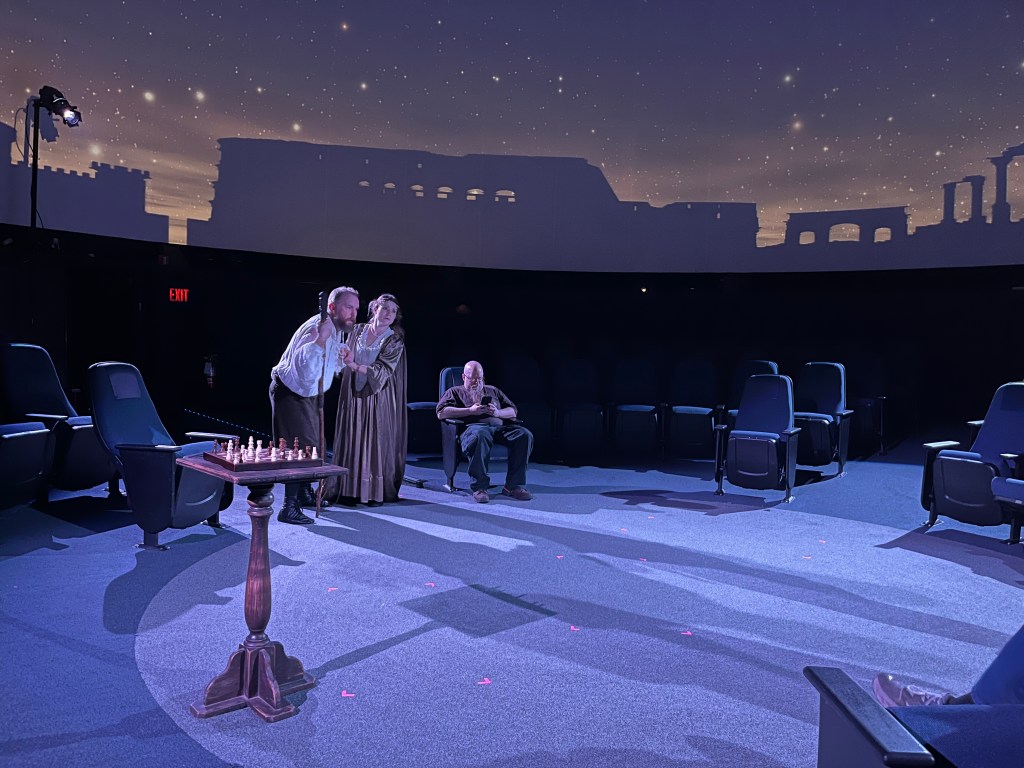
The scene “1633-1642” changes to an interior room in Florence in 1642, where Galileo lives, still a prisoner of the church. Virginia shows him a bag with geese. “Someone” brought them. She explains to the Church’s guard (Sam Holloway) that her father’s contrition is genuine, and that she takes his dictation because his eyes are weak. He begins formulating the weekly letter to the archbishop: “I am still being reproached because I wrote a book in the language of the marketplace, in a familiar dialect.” Then he wants her to delete most of it. Andrea suddenly stops by on his way to Holland. Fabricius, a Dutch astronomer who has been using the telescope for research on sunspots, requested that he ask about Galileo’s health. Under the guidance of the Church, Galileo explains, he can still do some writing. Andrea reports that after the recantation, scientific research abroad ceased, and there were no new ideas. Scientists lacked input from Galileo: Descartes stuffed his treatise of light into a drawer, Federzoni returned to grinding lenses in Milan, and the Little Monk abandoned his scientific research and returned to the Church. Seconds after Virginia and the Church guard exit, Galileo confides to Andrea that he has been writing. Andrea inquires if it is the mechanics of falling bodies. Galileo confesses that he has indeed finished the Discorsi. (MSE: His last work was entitled Discourses and Mathematical Demonstrations Relating to Two New Sciences, i.e., mechanics and motion.) The officials take every new manuscript page away and lock it up. (MSE: Perhaps the new Pope wants to read it?) Andrea bemoans this loss; people in Amsterdam are desperate for it. Galileo reveals that he has been copying the new pages by moonlight for the last six months and hidden his transcription in the globe (hence his weak eyes, we realize). “If you took it to Amsterdam…” Andrea insists that this will be the foundation of a new physics: “We thought you were a traitor. You concealed the truth from the enemy. We said you would die, not recant. Galileo retorts: “Better stained than empty. Sounds realistic. Sounds like me.” Andrea realizes that he should have suspected this, after learning as a boy that Galileo took the invention of the telescope as his own. Galileo insists he is not a hero, but simply feared pain and torture. Andrea can’t believe that his mentor denies having had a strategy.
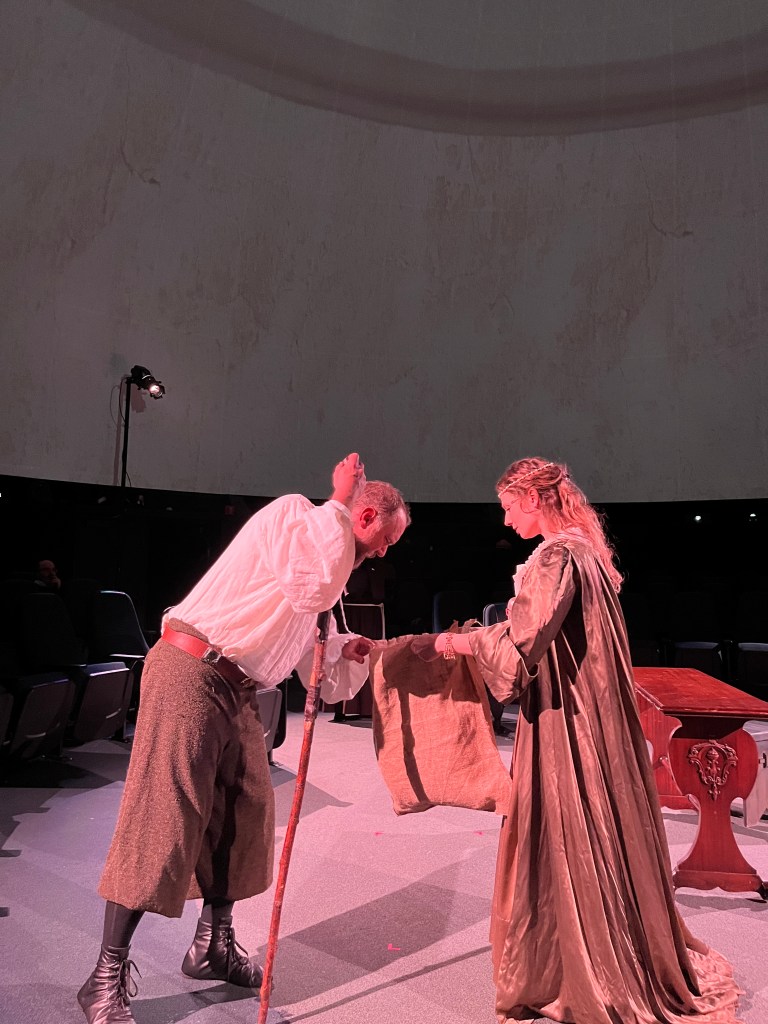
In his short conversation with Andrea, self-guilt consumes Galileo. His failure to incite the common people to bring about change weighs heavily on him. Instead of taking a firm stand against the Church when the spark of social unrest started to ignite, he gave in to Church demands and recanted. The people could have had a say. But had he resisted and started a rebellion, wouldn’t he have been killed like Bruno? He warns Andrea that his own science will move him away from ordinary people. Is science for everyone or only for scientists? He claims that he betrayed his profession by failing to ensure that scientific advances would be used only to improve humanity: “The sole purpose of science is to relieve the hardship of life.” (MSE: But has this ever been the only goal in the history of scientific advancement? Take AI, for example.) In an ideal world, we hope this might be true. Do we condemn Galileo for recanting and failing to incite a successful uprising against the church by writing for the common people? Or should we praise Galileo for recanting and continuing his research in Latin? Brecht wants us to debate these conflicting images of Galileo — coward or champion. Walsh’s production faces the moral dilemma head-on. But hasn’t it gently nudged us in one direction since the opening song Bella Ciao? In line with his interpretation, Walsh’s adaptation simplifies Galileo’s long speech about “self-interested rulers” limiting science. Instead, he says science will be crippled if intimidated by power. Can one person completely control the direction of scientific research? Did Galileo have a strategy after all? We learned in the first minutes of the play that he is sly.
In the final scene, the projection screen moves to a magnificent snowy mountainscape on the horizon of the entire planetarium. Walsh pared this scene down to its bare essentials. We are on the border of Italy. The border guard (Sam Holloway) examines Andrea’s pack. He retrieves a small book, opens it, and looks at Andrea inquiringly. He replies simply: “It’s in Latin.” The guard closes the book. “Let him through.” Scientific research can resume.
If we need any more prodding to understand the direction of Walsh’s adaptation, a dizzying number of projections now counterbalances the final short scene on the border. In the first, we see the text “Galileo Mission 2023” on the projection screen, along with an image of a spacecraft and a closeup of Jupiter. (MSE: The NASA spacecraft called Galileo was the first mission to orbit an outer planet. It orbited Jupiter from 1995 until it was intentionally crashed into Jupiter in 2003 to protect the moon Europa from contamination because it might someday support life. Responsible science.) The large planet Jupiter slowly recedes. We look into the dome as dazzling visuals announce names and images of the four moons of Jupiter discovered and named by Galileo in 1610. Ganymede, Gallisto (now Callisto), Europa, and Io dance across the dome. Jupiter recedes. The audience and the actors gaze upward. These moments are even more significant for anyone who knows, with a grateful nod to Galileo, that NASA’s Artemis II will take four astronauts around earth’s moon for the first time in more than fifty years. The anticipated launch is scheduled for April 2026.
To help us reach this stage of scientific advancement today, Galileo publicly recanted his teachings and became silent. The Italian cities and the Catholic Church in the play obliquely suggest locations and power structures in fascist Germany, as we know from Brecht’s estrangement effect (alienation effect). 1637 as 1937, when Brecht began to write his play in Danish exile. And today, we can imagine these locations as places like Cambridge’s Harvard University and New York’s Columbia University up against the power structures of the current administration in Washington DC. Similar to the suppression of scientific research by the Church in Galileo’s Italy, drastic cuts to programs and grants in the United States have resulted in some scientists and researchers leaving the country to continue their work. Recently, the Goddard Space Flight Library closed, the Goddard Institute for Space Studies was evicted from its location, the US withdrew from the World Health Organization, and research grants from the National Institutes of Health were canceled, along with countless others on climate change and public health.
The Kendall Planetarium at the Oregon Museum of Science and Industry is not far away from the Oregon Health and Science University, where many national grants have also been defunded, resulting in lawsuits and work with lobbyists. In what ways can research continue under the present conditions? With the current cutbacks, we must ask what scientists and researchers across the United States can learn from Galileo. Recall the last events of the play. Did a vulnerable and fallible Galileo avoid pain and torture and still find a way to complete and copy his Discorsi? Did he succeed in having it smuggled out of the country, a work that fundamentally changed our understanding of the universe? Walsh’s adaptation reflects on the consequences of speaking truth to power today and on finding morally acceptable alternative methods. What forms does courage take when scientific research is being stifled? He asks us to consider what counts as a heroic act, now that the concept of heroism has become destabilized and ambivalent. Navigating through the contemporary minefield, we should consider alternative routes, new ways around them. Under. Over. Or up and over and into the vast space of the Kendall Planetarium. Patrick Walsh brought many hundreds of people into the unusual setting of a planetarium to consider kinds of resistance in The Life of Galileo. He takes a strong position simply by staging this play about the suppression of scientific research in a planetarium, and he is keenly aware of the urgency. As he puts it so eloquently in the director’s notes, “The question is not whether we would have done better, but whether we are doing enough now.”
Margaret Setje-Eilers, emerita, was assistant professor, teaching assistant supervisor, and director of Vanderbilt in Berlin at Vanderbilt University. She has published on Bertolt Brecht’s plays and is author of Hinter den Kulissen. Theaterfrauen des BE erzählen. Her contributions to e-cibs include reviews of The Caucasian Chalk Circle and Arturo Ui.