
A Review of Fear and Misery in the Fourth Reich by The Brecht Project (Produced by Susan E. Evans and Scott Munson)
Any attempt to adapt Bertolt Brecht’s Furcht und Elend des dritten Reichs to the tumultuous world of Donald Trump’s reign steps smack bang into the middle a slew of debates—not only about parallels between Nazi Germany and Trumpian America but about the character of our current historical conjuncture more broadly. The Brecht Project’s The Private Life of the (Not So) Master Race (2020) was their first go at adapting Brecht’s portrait of daily life under the NSDAP to the current US context. Now the second installment, Fear and Misery in the Fourth Reich (FMFR), has dropped—into a rather different political economic landscape. Is it timely or passé? What sort of now has it parachuted into? While there isn’t space here to properly dig into our current moment, the crudest of snapshots is nevertheless in order.
As of this writing, a barrel of Brent crude hovers around $109, up 50% since January, with the average price of gas in the US at $4.50 a gallon. American consumer confidence is at an all-time low, but Wall Street is soaring, seemingly unencumbered by what the International Energy Agency has called “the biggest energy crisis in history.” Stagflation waits in the wings. The Iran War, nearing its sixty-day mark (at which time its furtherance will require congressional approval) has been declared over by Pete Hegseth. But both talks with Iran and shipping through the Strait of Hormuz are at a standstill. Perhaps emboldened after nabbing Nicolás Maduro, Donald Trump now jokes that, on the way back from Iran, the US Navy will take Cuba. Russia continues to pound Ukraine, while Israel is set to demolish border villages in Lebanon. ICE has reported its eighteenth detainee death of the year, a rate that would put it on track to surpass detainee deaths under G.W. Bush in 2004. Deportations sit somewhere around 470,000—not yet Obama numbers but getting there. “We are no longer in the land of the free, the home of the brave,” Bruce Springsteen has taken to saying on tour. Trump’s approval has hit its lowest point yet, especially with Independents, $166 billion of his tariffs must be refunded, DOGE is long dead, and Tucker Carlson has turned his back on this more “globalist” version of the Donald. In short, fear and misery abound within and without the US. But does Trump 2.0 a Fourth Reich make?
Susan Watkins has recently made the case that Trump embodies a continuance in the logic and practice of the US presidency from Ronald Reagan through Barack Obama (the “deporter in chief,” whose plan to bomb Fordow Trump merely dusted off and extended) to Joe Biden. Tim Barker notes that Trump epitomizes, if more boldly, American-style presidency since at least Richard Nixon. After all, the slogan “Make America Great Again” is lifted from Reagan, “an American hero who mocked the poor for being hungry, compared African diplomats to monkeys and (on the advice of Pat Buchanan) proclaimed the Waffen SS to be ‘victims, just as surely as the victims in the concentration camps.’”[1] If there is a Fourth Reich it would seem then to be post-Cold War America itself.
Further, any Left worthy of the designation ought not forget that Trump 2.0 did not ride a red wave into office. Rather, it was an unexpected ebb in Democrat turnout that allowed him to secure wins in key swing states. What got Trump into office was working-class dealignment from the Democratic party. On the rise since the1960s, with brief reversals during the Clinton and early Obama years, working-class defection from the Democratic party was decisive in 2024, as voters without a college degree failed to turn out for Kamala Harris. Though this drift away from the Democratic Party is mostly that of white voters, there has been a substantial decline in African American votes, as well, and working-class Latino votes have fallen off significantly since 2016. Harris may have won households earning more than $100,000, but in 2024, the working class, across race, either did not show up or drifted rightwards. As Bernie Sanders, in the wake of the election, put it: “It should come as no surprise that a Democratic Party which has abandoned working people would find that the working class has abandoned them.”[2]
How then to consider Bertolt Brecht’s Fear and Misery in the Third Reich now, and to do so through the lens of The Brecht Project’s retrofitting of it into Trump 2.0’s America?
Like the first round, The Private Life of the (Not So) Master Race, round two was performed as a livestream in a Zoom-style format that occasionally served, diegetically, as setting. The Zoom-like format distances, which hinders and constrains affect, and some effort is required of the viewer to, as Zoe A. Welch noted in her review of round one, generate the required suspension of disbelief. The pieces that used the streaming format as part of their content were, to my mind, more successful. In any case, I rather liked not suspending disbelief, reminding myself I was watching a streaming performance, and accepting the sketch- or rehearsal-like quality of the production as part of its aesthetic—intended or not. This seemed more properly Brechtian (I told myself), and it allowed me to consider the stories monadically, as attempts to imagine how the broader landscape of Trump’s “liberal fascism,” to borrow Slavoj Žižek’s term, might play out in the atomized spheres of professional and domestic life. While this is perfectly consonant with Brecht’s Fear and Misery, a series of twenty-four, more or less disconnected playlets, I also found myself thinking about Edgar Reitz’s Heimat (1984–2004), a nearly sixty-hour TV series depicting some hundred and sixty years of German history, including that of the Third Reich, through the lens of a single small town. The contrast between Heimat and FMFR—the former unified narratively by place, the latter spatially and temporally disjointed—suggested the formal problem of depicting a social whole riven by the socioeconomics and politics of division and fracture. Part of what FMFR might accomplish is to sensitize us to everyday instances of such fracture and how, banally, insidiously, they serve the ruling order.
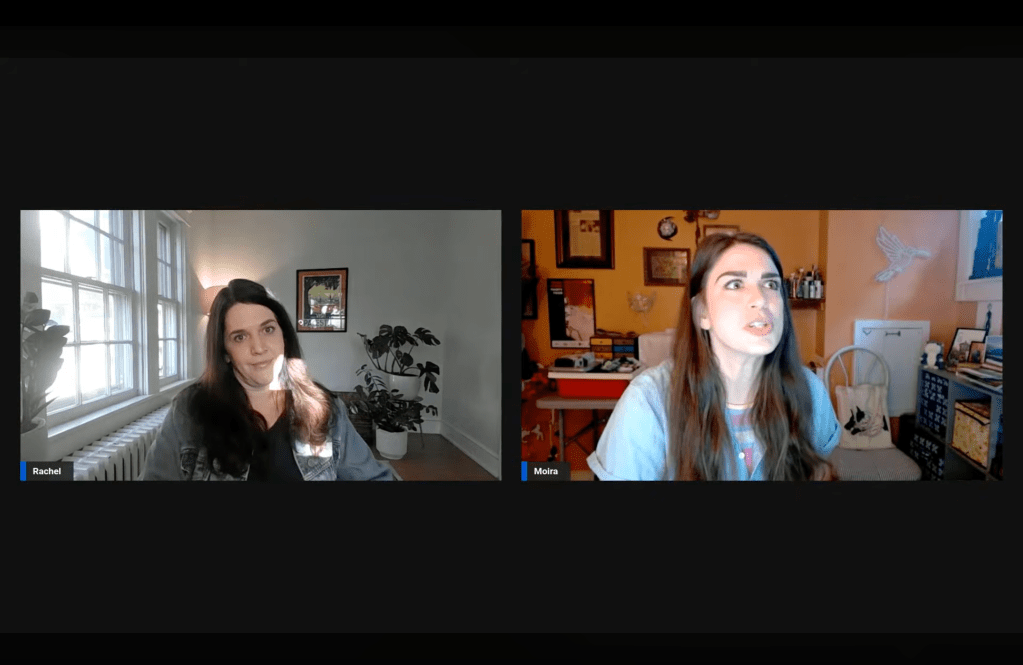
Such insidiousness is perhaps most palpable in the final piece in the series, “The Revolutionaries,” which suggests a metacommentary on the whole FMFR project, as it depicts two female actors and self-described “Brecht girls,” on a Zoom call discussing their participation in a play based on a Brecht Stück. The piece in question has been authored by an erstwhile professor at UC Berkeley (he’s taught a class on the theater of the absurd), who lost his job after a “run-in” with “reactionary students.” Because of this, and because his piece depicts the kidnapping of a senator, one of the Brecht girls expresses concern that her participation will make her “internet bait” and ruin her career. “The whole Trump, Brechtian Third Reich thing,” she says, her fear cloaked in complaint, “it’s pretty obvious, don’t you think?” “But isn’t that the whole point?” her friend replies. “It’s staring us all in the face and what are we doing about it? … Don’t we have an obligation to do something …?” Sure, the friend agrees, but only if it was a better play, not “a ten-minute-based-on-Brecht play by some has-been playwright.” Yes, we are meant to think, yes, yes, and yes. What makes “Revolutionaries” compelling, though, isn’t its rather trite metacommentary. Rather, it is how fear, and its more cerebral cousin, paranoia, seeps into it. One friend’s fear infects the other, and by the end of the Zoom call, both have decided to back out. We knew from the start these Brecht girls were poseurs, but now we are witness to their inner curdling, their collapse into the silent misery of self-preservation. This is how the Reich takes hold: not with the butt of a 9mm duty handgun (i.e. a Glock), but with the isolated whimper of individual survival.
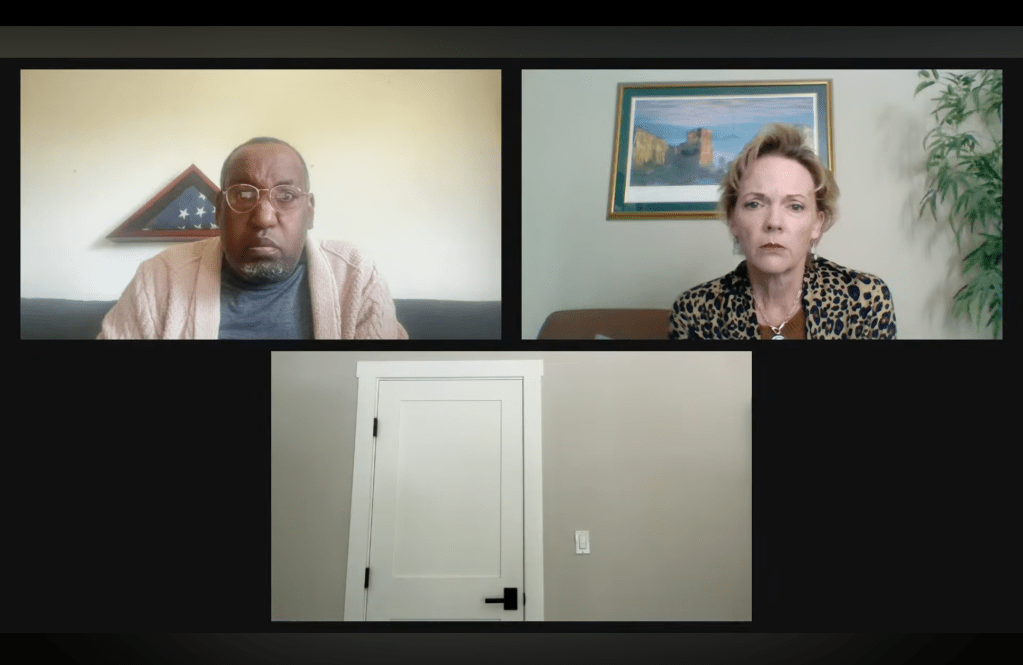
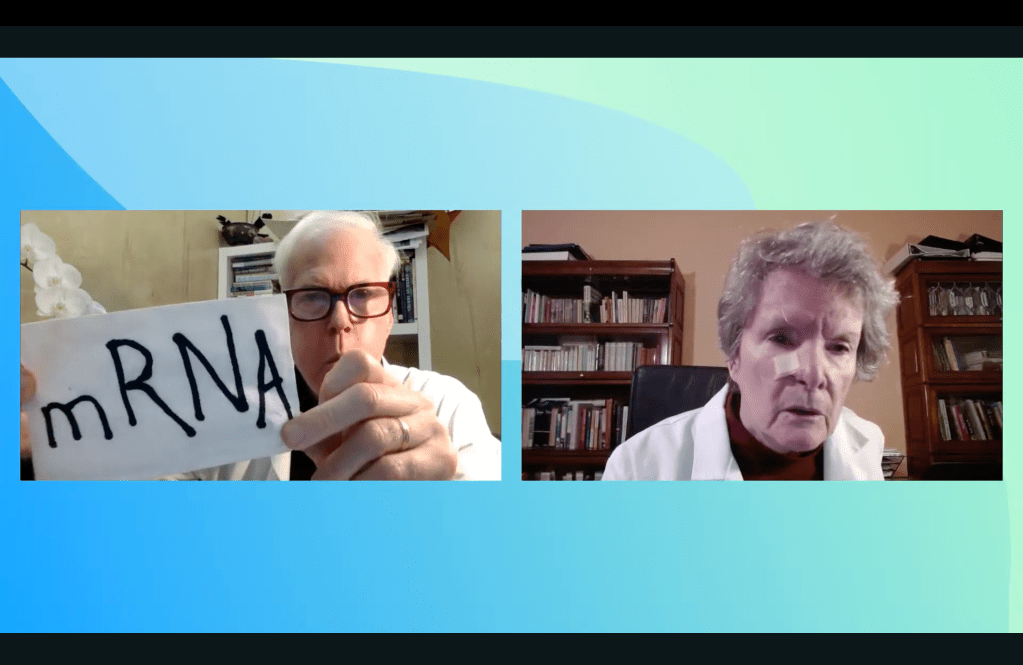
True to Brecht’s title, then, it is fear and misery, cohabitating at the intersection of necessity and freedom, that bind the splintered diversity of FMFR’s eleven pieces. Fear and misery suffocate the married couple in “The Informer” who suspect their son will turn them in. In “The Naturalized Husband,” fear and misery fuel the bitterness of a tenured Hispanic professor held in detention who, like a latter-day gumshoe of bureaucratic crimes, slings hard-boiled comments such as, “I gave them footnotes, they gave me a file,” or “Lies are easier in English. They sound like policy.” The bad boy Trump supporter in “When We Fight, We Win!” represses his own misery and fear, but they are nevertheless palpable in his defensive, racist quips and his defiant claim that he “just wants his country back.” In “Virologists,” two scientists, terrified of projecting the “wrong” sort of science, camouflage their Zoom-call discussion of viral mRNA by exclaiming “Bleach!” and “Fauci should be roasted on a spit on livestream!”—absurd exclamations skittering across depths of despair. In one of the strongest pieces, the engaging “Workers’ Playtime,” an influencer, via a Zoom call, interviews workers at the Donald J. Trump Data Center, owned by Microsoft and powered by Three Mile Island. Fear and misery lurk behind the influencer’s focus-grouped smile, as the workers unintentionally reveal that everything that glitters in Trump’s America isn’t gold. It might, in fact, be Uranium—irradiated glow instead of glitter—as a siren sounds in the background, and the influencer slips into a white hazmat suit. Like “Virologists,” this piece employs off-screen ICE agents, who remove, or “take care of,” a worker who isn’t hitting his mark. Gestapo tactics indeed.
It must be said that FMFR is often tedious, largely, I think, because this Trump Brechtian Third Reich stuff is rather on-the-nose. Perhaps this is a symptom of our current media culture—we are too knowing, too saturated with memes and algos. Our historical conjuncture, too, surely matters here; setting aside debates about Trump Inc.’s fascism, any mapping of Nazi Germany onto our present, while not without utility, is bound to fall short. It could also be because FMFR too directly cites “hot button” issues as Welch put it in her review of round one. Or, as Brecht’s work itself can be dull, departing more from the original might have given FMFR better purchase on how Trump 2.0 feels. Further, important components of US political life are absent. There is nary a whiff, for example, of the UN’s judgment of Israel’s war on Palestinians as genocide or Israel’s hold on both Democrats and Republicans, and thereby its infusion into the daily life of Americans. Shouldn’t we at least find here a professor fired for teaching a course on Palestine or a Gen Z Evangelical troubled by his parents’ conviction for the rapture and therefore unconditional support for Jews returning to their homeland? Ultimately, FMFR’s resolution is too low, its portrayal too pixelated, to capture the complexities of the current US political landscape.
Still, what FMFR does do is point to the need for a more granular depiction of the banality of US evil, which is to say, the day-to-day in which duty, self-preservation, algorithmized media worlds, and siloed individuality hinder the formation of solidarity across class, race, and gender. It is not, then, just an opportune moment to watch FMFR and then read, or reread, Brecht’s Fear and Misery in the Third Reich ;it is a crucial, even an urgent one.
Josh Todarello, PhD, is currently a lecturer for the Chloe Center for the Critical Study of Racism, Immigration, and Colonialism at Johns Hopkins University. He is the author, most recently, of The Novel and Class Consciousness from Mann to Brecht.
[1] Tim Barker, “Dealignment,” New Left Review—Sidecar, 11 November 2024.
[2] In this and the preceding paragraph, I draw heavily from Tim Barker, “Dealignment,” New Left Review—Sidecar, 11 November 2024; Mathew Karp, “Trump Redux,” New Left Review, 150, November/December, 2024; Susan Watkins, “Baselines,” New Left Review 151, January/February, 2025 and “Trump Abroad,” New Left Review, 157, January/February, 2026; Jared Abbott, “Understanding Class Dealignment,” Catalyst, vol. 7, no. 4, Winter 2024. I hope to not have distorted their deeply considered analyses in my gloss.
Cover photo: Workers Playtime: Katie Rogers as Youtube Influencer; Michael Swanberg as Mr. Brown; Carolyn Doyle as Miss Snyder; John Rabasa as Mr. Weaver (Not pictured); Reg Clay as ICE Officer; David Minton as Derek, C Suite Man. Photos courtesy of The Brecht Project.