
Introduction
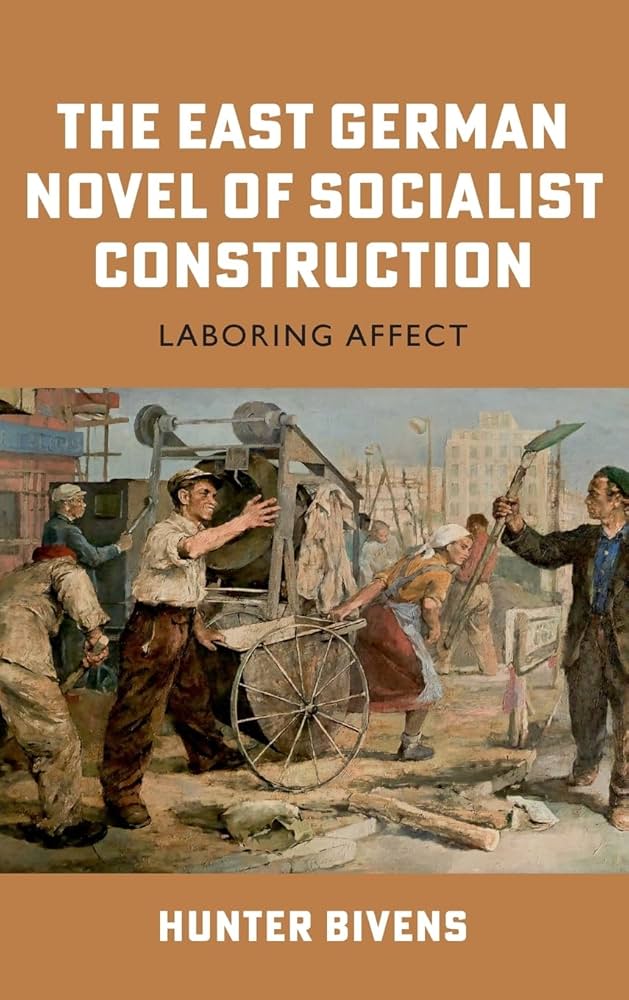
The East German Novel of Socialist Construction: Laboring Affect by Hunter Bivens, published by Camden House (Boydell & Brewer), argues contrary to popular opinion that early GDR construction novels are not merely propaganda or failed aesthetic works, but a crucial literary archive of socialist transformation. The book demonstrates that these texts aim to create new socialist subjectivities by shaping the affective experience of labor, rather than merely representing it. Focusing on “collective worker,” Bivens demonstrates how these novels grapple with the contradictions between utopian aspirations for collective, meaningful labor and the material constraints of postwar East Germany. Their often schematic form reflects this tension, revealing both the ambition and the ultimate failure of the socialist project they sought to imagine.
E-CIBS co-editor Anthony Squiers conducted the following written interview with the author.
Opening
AS: Thank you for agreeing to talk with us. Your book asks us to take the Aufbauroman seriously as more than failed propaganda. What do we miss, politically and aesthetically, when we dismiss these works too quickly?
HB: On the one hand, these books are propaganda, but to say that also presupposes precisely the bourgeois/capitalist literary field that the early GDR was attempting to break with. I take seriously East German literary historians like Ingeborg Münz-Koenen who argue that the ‘50s were a moment where GDR authors, critics, and cultural workers were to some degree in earnest in their attempts to integrate literature into the social process and remake the public sphere around the working class. I think one of the most significant aspects of what gets overlooked is the way that these books are, in some ways, earnestly about what they’re about. What they share with propaganda is an ostensible lack of subtext. At the same time, I’d argue that rather than simply propaganda literature, Aufbauliteratur, or construction literature, as it has become known, was an attempt to change the social role of literature. The strain of doing this is visible in the hybrid nature of the novels themselves—stranded between realism, reportage, and genre literature—as well as the critical and public reaction to them, which was mixed at best.
There is a utopian core to these novels, and that has to do with the attempt to re-envision the ways that people work and live. One of the more surprising aspects of these novels is how concerned they are with what we often refer to in contemporary discussions as care work, or the work of social reproduction. We often think about socialist realism and Communist iconography in terms of figures of the male working body, and not without reason, but these books are centrally concerned not only with women entering the working world, but also with the necessity of what might be called “women’s work,” i.e., the various labors of care, materially and emotionally, for socialist labor. At the same time, the Aufbauroman is much less about work, or the politics of work, than it is about the feeling of work, yet this “new feeling” of socialist labor that these books frantically evoke seems not only fake, but strange. This strangeness points, I think, to their utopian aspect, which is that they ask us to re-arrange our affective attachments, and in this sense, they have something in common with science fiction, asking us to inhabit a new world with new impulses. As Fredric Jameson liked to point out, however, the work of utopia begins with a certain zero degree, a radical reduction of our attachments to this world, which these novels deliver, behind their open backs as it were, through their frenetic eventlessness and affect-laden boringness.
AS: You frame these novels as an archive of “laboring affect.” How does this shift our understanding of socialist realism beyond ideology and toward lived experience?
HB: If you look at the debates in the ‘50s in the GDR about “Gegenwartsliteratur,” or literature of the present—by which critics often meant the construction novel—they are often framed in terms of an opposition between the demands of realism, defended in different ways by figures like Anna Seghers, Stefan Heym, and Brecht, versus ideological rigor, insisted on by figures like Alexander Abusch, Alfred Kurella, or the poet Kuba. What seems to go unnoticed is that the rhetoric of the SED [Sozialistische Einheitspartei Deutschlands, or Socialist Unity Party of Germany] on cultural matters was, in fact, largely an affective one, demanding a literature that reflected and produced enthusiasm for the collective work of socialist construction. This is something that I think is really important, since socialist realism is often discussed in terms of political ideology, as though it were trying to convey a particular line or platform. This is often part of what a socialist realist work is up to, to be sure, but the more interesting takes on socialist realism—Boris Groys, perhaps, or Evgeny Dobrenko—focus on its broader ambitions to transform what Jacques Rancière calls the regime of the sensible. For Groys, this means the collective project of reconstructing the world; for Dobrenko, likewise, socialist realism is the production of Soviet reality itself. What I try to argue in my book is that socialist realism is in fact in some ways a very biopolitical aesthetic, in that it conjures a form of life grounded in labor, and it does so not by cultivating political consent, but by summoning enthusiasm. This fits in turn with a regime of labor extraction that viewed enthusiasm as a means of production, as witnessed by the various rituals of socialist emulation, from socialist competitions to the shock worker movement. The vision of the Aufbauroman links labor and everyday life through this affective economy of enthusiasm. In order to theorize this affective economy, I trace how attributes and characteristics of work, what Oskar Negt and Alexander Kluge call labor capacities (which include affects), are translated into a language of feelings and affects in the Aufbauroman. The recourse to Negt and Kluge in turn allows the affects and feelings surrounding work in these novels, both affirmative and negative, to be grasped as historical and material.
How all of this landed with actual East German workers has to remain somewhat conjectural. We have more or less enthusiastic testimonies and strong condemnations, but how we should take sources like published discussions among workers in GDR newspapers, or something like the famous Nachterstedter Letter, written by a group of workers at a brown coal works praising these works and asking for more, is still a matter of debate among scholars.
Brecht Angle
AS: I was initially surprised by how frequently Bertolt Brecht appears in the book, given that he published only one novel and was famously critical of socialist realism, as we see in his debates with Georg Lukács. But as I read on, it made sense. He functions as a kind of theoretical bridge between Marxism, aesthetics, and socialization.
HB: Brecht was in many ways my point of orientation while I was working on the book, and he appears throughout as a kind of ringside commentator. Of all of the positions staked out in the literary and cultural debates of the East German ‘50s, Brecht’s strike me as the most cogent, particularly around the disastrous formalism campaigns, which really set the stage for the Aufbauroman by installing an excessively narrow and Zhadonovite form of socialist realism and barring recourse to the socialist avant-garde positions of the ‘20s and ‘30s, now denounced as “proletcult.” Brecht’s criticisms of GDR cultural life in the ‘50s are informed by this foreclosed legacy, but also by a subtle historical understanding of how things had arrived at this pass. His notion of an aspirational socialist public sphere as “a great conversation” (a term he used to describe what the June 17th events could have led to, but didn’t) marks the unrealized horizon of GDR socialism, which I link, unoriginally perhaps, to Negt and Kluge’s notion of the proletarian public sphere. At the same time, I didn’t want this book to center on Brecht, for fear of his position overshadowing my own attempt to come to terms with the Aufbauroman.
AS: This led me to wonder whether there might be more to this connection. If we consider Brecht’s own trajectory, from a revolutionary Marxist aesthetic aimed at mobilizing the masses in the Weimar period, to exile-era antifascist work, and then in the GDR, especially at the Berliner Ensemble, toward a project that looks much closer to what you describe, namely that of an agent of socialization shaping socialist subjectivity: in the writers you examine, do you see a comparable trajectory, or is something different happening in how they take up, or perhaps institutionalize, that socializing function?
HB: Yes, I absolutely agree. I wrote a piece trying to think about this in relation to Brecht’s use of comedy in his staging of Lenz’s play The Tutor for the Brecht Yearbook when I was in the early stages of writing the book.[1] I think you see this in Brecht’s turn to a language of affects and attitudes like grace, perseverance, and optimism in poems and songs in the early 1950s like “Children’s Anthem,” “The FDJ’s Song of Rebuilding,” “Song about Happiness,” but also in his invocation of the pleasure of production and changing the world in pieces like the “Short Organum” or the notes to his production of Strittmatter’s Katzgraben, not to mention the critical reflection on affect that happens across the Bukow Elegies. Here, Brecht seems concerned with the question of the role of the arts in developing and supporting a socialist Haltung, or mode of comportment. Of course, Brecht was extremely active in the institutional life of GDR culture through the Berliner Ensemble and the Academy of the Arts in trying to build structures that would give a material grounding to this socializing function of art.
Failure, Contradiction, and Possibility
AS: You argue that the “failure” of these novels is revealing. What, in your view, is still politically productive in that failure?
HB: Looking back at this moment now, I think what remains interesting, for me anyway, is the way that these insist on re-imaging capitalist modernity’s regime of labor, with its division between often male connoted wage labor and femininized domestic labor that is often unwaged and unrecognized. These novels do this in a very awkward and partial way, but they do point to the central, world-making aspect of reproductive labor, as Marxist feminists call it, and attempt to foreground that moment in the socialist labor process, figuring that process itself as a bringing forth not of commodities, but of socialist subjects. Making this inherent sociality of labor explicit and conscious is one contribution of these novels, even as they do so under the constraint of their “Stalinist” integument. In doing so, these novels anticipate in a curious way contemporary regimes of immaterial labor, where the production of affective situations becomes primary (even as much immaterial labor often remains intensely material). If in contemporary capital, such affective situations remain shackled to the capitalist value form, the Aufbauroman at least evokes a different regime of collective affect that’s explicitly social.
This also points to another perhaps productive aspect of their failure. These novels are part of the archive of what Anson Rabinbach describes as utopias of labor. They attempt to depict the liberation of labor and the anchoring of a new, socialist public sphere in the world of work. At the same time, they are everywhere marked by the contradictions of this liberation of labor; i.e., that it is still labor, guided by the compulsions and imperatives of what might be called socialist abstract labor (to quote Alberto Toscano and Jeff Kinkle).
On the one hand, this has to do with the historical moment, where material rebuilding was paramount, but on the other, it points, indirectly, to another horizon, that of the liberation from labor and the uncoupling of human activity from the labor regime itself. Weirdly, one could read these novels against the grain as part of the literary history of a postwork culture to come.
AS: Do these novels point to unrealized possibilities within socialism itself?
HB: In a sense, they do, in the ways I tried to describe above, but they also point to the tragedy of twentieth-century socialism, which was never really able to sufficiently organize the very creativity that it did, I would argue, call forth. One sees this in the economy, where the very lack of capital forced the construction of socialism through the sweat of the working class itself. By the ‘70s, even this elan had worn away. You see it in the arts, too, and the strong impulses in literature, theater, film, and the arts that the GDR brought forth through democratizing access to culture, excellent educational and training infrastructures, and strong investment in cultural infrastructures from factory Cultural Houses to theaters and publishing houses, but continually undermined and cut off through misguided cultural policy—the Bitterfeld program is a great example of this, but this dynamic of creativity and the sloppy, uncoordinated efforts for the GDR’s cultural apparatus to control it throughout the eighties.
The construction novels are a prime example of this contradiction, embodying in some ways the most avant-garde aspirations of socialist culture, connecting literature and the arts directly to the world of work in the midst of a project of emancipatory social transformation. Yet, at the same time, they betray on a formal level the worst qualities of East German socialism, with all of its arbitrariness, half-measures, forced compromises, and its unresolved contradiction between discipline and autonomy. Thus, you have novels that are formally stranded between the realist novel and the reportage, that seek to portray collectives but are constantly forced into unconvincing character portrayals, that attempt to portray action and romance in the mode of trivial literature, but then undermine those narratives with their excessive didacticism. This is a result, as I mentioned, of the SED’s ‘50s Kulturpolitik, but also, as Brecht and others since have pointed out, of a reading public whose habits, expectations, and tastes had been shaped by twelve years of national socialist cultural levelling. Writers, critics, and readers found themselves in a learning process in the 1950s, groping toward a new organization of the literary public sphere.
As Anna Seghers insisted in her correspondence with Lukács, a society in upheaval often brings forth new literary forms that look more like shards than mirrors. I think the Aufbauroman, and the literary public sphere of which it was a part, marks a disavowal of this insight into the necessary messiness of the new in its insistence on hewing to the novel form. The only one of these books that works on this level is Eduard Claudius’s Menschen an unserer Seite, and the reason for this success lies both in Claudius’s unique emotional intensity as a writer, but also, paradoxically, in his clever patterning of the book after Fyodor Gladkov’s socialist realist classic, Cement.
To answer the question, though, these novels in many ways represent the missed opportunity for an experimental, yet popular literature that grappled with the present as a historical moment in its messiness and openness, and that did so from a socialist perspective.
AS: If we read these texts dialectically, are they better understood as premature, rather than simply misguided?
HB: I think that would be a fair assessment, and maybe you could say the same about East German socialism, but that takes us far afield. These books lay the groundwork for later East German literature and particularly its emphasis on framing social life in terms of social labor. One thinks of novels like Brigitte Reimann’s Franziska Linkerhand or Werner Bräunig’s Rummelplatz, novels that could never have been written outside of a socialist context, but which were both unwritable in the actually existing socialism of the GDR and remained fragments. Both of these novels aspire to an almost Balzacian social totality, but do so from the perspective of the world of work. Perhaps the most ambitious project in the vein was Franz Fühmann’s Bergwerk project, which would have used the mines of central Germany as the setting for a wide-ranging meditation on the role of the artist in socialist society, a psychoanalytic exploration of memory and German history, and the relationship between manual labor and literary production from the German Romantic tradition through socialist realism. All three of these authors were influenced by the Bitterfeld movement, which placed writers and artists in factories even as it encouraged workers to make culture in writing circles and other venues. This was cut off in 1965, with disastrous consequences, but Reimann, Bräunig, and Fühmann, among others, remained committed to the connection between labor and literature and pursued their work in the face of strong resistance from GDR officials.
This impetus to portray social life from the perspective of work and the working class, broadly construed (i.e., as not just wage workers, but also precarious laborers, surplus populations, etc.—in the way Michael Denning or Tithi Bhattacharya conceive of the working class as those who participate in the production and reproduction of society, whether paid or unpaid) remains vital today—in the German context in the work of authors like Heike Geissler, Deniz Ohde, and Ilija Trojanow, for example, as well as former GDR writers like Volker Braun, but one also thinks of works like Phil Neel’s recent work Hellworld. In this sense, I don’t think East German construction novels were misguided as much as they are trying to carry out a project that is vital to any socialist culture, but under extremely constraining historical circumstances. Precisely this dynamic of breakthrough and constraint is what I find interesting about these novels.
Contemporary Relevance
AS: In an era of precarious labor and platform capitalism, do the construction novels help us reimagine collective forms of work and life?
HB: I think, to wax a little bathetic, that they are part of the literary archive of attempts to break out of the double-binds of capitalism, politically and culturally. They give us a portrayal of work as a collective, world-building project that cultivates and develops the very potentials and capacities within people that capitalism wastes, throws away, and destroys every minute that the law of value continues to shape our lives. At the same time, these novels are, from the perspective of the present, ridiculous. The experience of reading them is one of shuttling back and forth between boredom and laughter. Following a comment by Jameson to the effect that boredom is a hermeneutic tool pointing to where something is repressed, one could maybe suggest that if the vision of collective labor that these novels articulate may seem alien and irrelevant, the very discomfort and ridicule that they provoke point to our collective inability to do this work of reimagining and thus call upon us to embark upon such a project. The perspective of labor in other words, seems to me to be a necessary lever in the project of imaging the very possibilities of the liberation from work, a long and complicated process of self-abolition.
AS: Your coda connects the GDR to contemporary labor regimes. Are we, in some sense, still grappling with the same problem of how to organize meaningful collective labor?
HB: I think we absolutely are, but there is a difference. I think now we’re in a situation where capital has saturated our emotional and psychic worlds completely, rendering those dimensions as tools of living labor to be exploited, at the same time as the regime of wage labor contracting and being re-organized in more precarious ways—for example global circuits of migrant labor, but also the whole-scale abandonment of populations by the formal economy—because an increasingly technologically advanced capitalism simply requires less labor. In this context, labor becomes again what it was for Arendt, the realm of animal laborans, of captivation, toil, and survival. In this situation, the utopian aspects of Marxism’s anthropomorphic view of labor perhaps migrate to an antiwork politics of tying human activity to forms of community-making and world-building, a project that I think is implicit beneath the productivist veneer of the construction novel. I find Kathi Weeks’s take on this in The Problem with Work really compelling, where she seeks to disentangle the dimension of cooperation as a socially constitutive force, from the inherently capitalist forms of discipline that shape labor as the glue that holds capitalist society together. Making labor explicit as a social mediation is a contribution to its abolition as labor.
AS: What might a twenty-first century “construction novel” look like under current conditions?
HB: On the one hand, to revisit such a project, we’d need ourselves to be involved a project of post-capitalist transformation, whatever that might look like.
This question, though, has an aesthetic, or representational, dimension as well that we are also still grappling with today. As Peter Hitchcock reminds us, any portrayal of a labor process or of a person or group of people, working, has two dimensions—first, of a phenomenological experience, of someone doing something and experiencing that, and secondly, of an objective, abstract social relation, which is to say the dimension of social labor. The Aufbau-novel was forced by the normative aesthetic regime of socialist realism to conflate these levels, because of the persistent demand to show what was called real, flesh and blood characters in the context of organically unified plots. Neither labor nor social reproduction work this way, though, and other forms would have been demanded to portray socialist construction—a basically Brechtian insight. At any rate, I see work that seeks to articulate the complicated chains of mediations between what Amy De’Ath, borrowing from Marx, calls “the hidden abode” of any given labor, paid or unpaid, and the “inner bond” of the capitalist value form as the cultural precondition for something like a socialist project of collective world-building.
Closing
AS: Looking back on the project, what do you think is most misunderstood about the construction novel, and what would you most want readers to take away from it today?
HB: I guess basically it would be this aspect of real political and social commitment that is didactic, but not simple propaganda. The other vital aspect too I hope I’ve contributed to bringing out, is that socialist realism is actually a much more complicated aesthetic than usually acknowledged, working on multiple affective, representational, and historical registers. Finally, these novels need to be read in terms of a deep project of social transformation that registers in ways much more complex than simply an aspect of some project of political power plays or cynical manipulation.
AS: As a professor of literature, do you see a place for any of these novels in the classroom?
HB: There’s obviously the historical interest, but this question brings up a number of issues. I don’t personally have the ability to teach much in German—UC Santa Cruz having eliminated German language instruction in 2025—so I’m largely dependent on translated materials in the classroom, and there is not much from this period. In this vein, when I teach GDR materials, I often use film, since there is such a wealth of resources there (largely due to the work of the DEFA Film Institute at UMass). Students are often surprised by the dilemmas posed by GDR culture, which seldom correspond to what they expected from their received wisdom about socialist countries or even from studying Marxism, and this can be productive not only for thinking about the complicated history of Germany, the Cold War, or socialist cultural formations, but acts as a means of Brechtian Verfremdung to allow them to pose all sorts of political, ethical, and personal questions in a new register. For example, watching Slatan Dudow’s Destinies of Women, we had a long conversation about whether happiness can be considered as a social problem in the sense that the film suggests, and what that would mean both politically and ethically. We read Heiner Müller’s play The Scab (which, as Loren Kruger always points out, should be translated as The Wage-Buster), which is a dramatization of Hans Garbe’s legendary blast-furnace repair in the winter of 1949-50, which saved the people’s economy and the Two-Year Plan, but, given the piece-rate norms, tended to undermine the wages of his fellow workers. I have students discuss whether or not they would help Balke repair the furnace. What are the stakes here? If Balke carries out the repair, he contributes to the long-range prosperity of the country, but he also contributes to the heightened exploitation of the labor of his fellow workers. How do you think about this contradiction? How do you think about personal responsibility, solidarity, and the public good under these conditions? We negotiate these kinds of issues every day, largely without thinking about it, but posing them in this context presents precisely the kind of productive cognitive estrangement that Darko Suvin sees at work in science fiction.
AS: Hunter, congratulations again on the book. We have covered a great deal of ground, but is there anything we have not touched on that you would like to share before we wrap up?
HB: Well, thank you again for taking the time to formulate these thought-provoking questions. I hope that at the very least, the book has a similar effect, perhaps on a more modest scale, to be sure, as works like Julia Hell’s Postfascist Fantasies or Benjamin Robinson’s The Skin of the System, books that took GDR-literature out of the familiar Cold War binaries of affirmation versus dissent, propaganda versus autonomous art, etc, etc, and showed that it can be framed in more interesting and theoretical ways as complex responses to the crises and catastrophes of the twentieth century and the vicissitudes of building an alternative to capitalist modernity in its tragedy and mundane everydayness. I think the Aufbauroman itself has a lot to say about core issues of regimes of labor, feeling, and experience, the relationship between manual and intellectual labor, work and life, and the organization of gender, as well as simply being a fascinating archive of the 1950s as an unexpectedly volatile decade.
Hunter Bivens is Associate Professor of Literature at the University of California, Santa Cruz and the author of two books, The East German Novel of Socialist Construction: Laboring Affect and Epic and Exile: Novels of the German Popular Front, as well as the co-editor of The Routledge Handbook of Red World Literature and A Companion to the Works of Anna Seghers, both in progress.
[1] Hunter Bivens, “Brecht’s Cruel Optimism or, What are Socialist Affects? / Der unbarmherzige Optimismus Bertolt Brechts oder, Was ist ein sozialistischer Affekt?” The Brecht Yearbook 43 (2018), 118-136.